Showing posts with label July 20. Show all posts

Saturday, 20 July 2019

16th Sunday of Year C – Mary and Martha

It is easy for us in the twenty-first century to forget just how difficult it was to travel in the past. And how important hospitality was. In a world without service stations, hotels, and only few inns, you would depend on the kindness of strangers offering you a place to refresh and recuperate before returning to the road. 

In our first reading this morning, from Genesis, we see visitors arrive outside Abraham’s tent by the oaks of Mamre. It’s the scene pictured in the famous icon of the holy Trinity by Nicholai Rublev.  And these are not just any visitors, but God in embodied form, which is quite surprising, and very uncommon in the Old Testament. Abraham called the three persons Lord, the One God. He offers them water to cleanse themselves, and bread to nourish them. Sarah, Abraham’s wife,  takes three measures of flour. These we understand as representing faith, hope, and love, the virtues of the Christian life, which we receive in our baptism. Abraham takes a calf, which prefigures the sacrifice of Christ, the truly gentle one, who does not refuse the Cross. After the visitors have eaten, they promise that Sarah will have a son. In response to their hospitality, generosity and faithfulness, the patriarch and his wife are rewarded. Their kindness is repaid. 

In this morning’s epistle, we see that for Paul our actions as Christians are firmly rooted in our relationship with God and our understanding of His will. As Abraham’s vision of angels in Genesis gives us the merest glimpse of what God is like, in the Letter to the Colossians we see that the person of Jesus Christ is the image of the Living God, in Him we can see both what God is really like, who God is and what God does.

This morning’s Gospel follows on directly from last week’s Parable of the Good Samaritan. It is another story about making a journey, but a more positive side of travelling is shown by Martha’s welcoming of Jesus and his disciples into her home, continuing the theme of the earlier passage, although this time the travellers have arrived safely and haven’t been attacked by bandits. Martha is a model of hospitality, and looks after her guests: they’re hungry and thirsty after their travels. Martha puts her faith into practice. But she goes too far, and gets distracted by all the serving. She takes her eyes off Jesus. She forgets whom she is serving and why. However, she is not rebuked. Her service is valued. 

Her sister Mary has chosen to sit at Jesus’ feet and listen to Him. Mary has chosen a good part, and is being nourished in her faith. However, the point is not simply to prefer the contemplative to the practical, or the spiritual to the physical. That would be Gnosticism. Instead we need to balance our physical needs with our spiritual ones. It is Mary who will anoint Jesus in Bethany just before His Passion. Thus faith and action need to be lived out together.

We are called to be generous as a church, both in our hospitality and our attentiveness to God. In our proclamation of the Good News, in our making the Word of God known, and inannouncing Christ, the hope of glory, through His Death and Resurrection.

As is so often the case in the Gospels it isn’t a case of ‘either…or’ but rather ‘both…and’. We need to be both active and contemplative, and always keep our eyes on Jesus, the centre of our faith, the great example of how to live a fully human life. Christians need to hospitable and welcoming, as well as prayerful. It’s something which lies at the heart of Rule of St Benedict. This begins by telling us to listen with the ear of the heart, and to welcome guests as we would welcome Christ, so that in all things God might be glorified. Prayer and service, love and contemplation, balancing physical and spiritual needs, is how God wants us to live. It is how we flourish. We are nourished at the Eucharist, so that we can live out our faith in our lives, in a balanced way. Ora et labora, pray and work, the monastic motto 

Jesus’ teaching is that the way to show real hospitality is to pay attention to one’s guest, rather than just fussing to show hospitality. Instead of busyness, God tells us this morning that, like the Good Samaritan, we should be attentive to God and his message for us in the Gospel. In doing this we, like Mary will choose a good part. This choice has a moral dimension: in truly listening attentively to what God says to us, our actions and our character will be formed, helping our growth in holiness. Nourished by Word and Sacrament we progress in living out the virtues of faith, hope, and love0, which we received in our baptism, and prepare for our inheritance with the Saints in glory. We do not achieve this through prayer and contemplation alone, but by making our prayer and our work, all that we do and all that we are, a response to God and our neighbour. We are truly living in love, a love which is the nature of God and which binds together the persons of the Trinity, a love which transforms both us and our world. A love which we share so that all the world may sing the praises of to God the Father, God the Son, and God the Holy Spirit, to whom be ascribed as is most right and just all might, majesty, glory, dominion, and power, now and forever. 

Mary-Martha-Lazarus-icon.jpg

16th Sunday of Year C – Mary and Martha

It is easy for us in the twenty-first century to forget just how difficult it was to travel in the past. And how important hospitality was. In a world without service stations, hotels, and only few inns, you would depend on the kindness of strangers offering you a place to refresh and recuperate before returning to the road. 

In our first reading this morning, from Genesis, we see visitors arrive outside Abraham’s tent by the oaks of Mamre. It’s the scene pictured in the famous icon of the holy Trinity by Nicholai Rublev.  And these are not just any visitors, but God in embodied form, which is quite surprising, and very uncommon in the Old Testament. Abraham called the three persons Lord, the One God. He offers them water to cleanse themselves, and bread to nourish them. Sarah, Abraham’s wife,  takes three measures of flour. These we understand as representing faith, hope, and love, the virtues of the Christian life, which we receive in our baptism. Abraham takes a calf, which prefigures the sacrifice of Christ, the truly gentle one, who does not refuse the Cross. After the visitors have eaten, they promise that Sarah will have a son. In response to their hospitality, generosity and faithfulness, the patriarch and his wife are rewarded. Their kindness is repaid. 

In this morning’s epistle, we see that for Paul our actions as Christians are firmly rooted in our relationship with God and our understanding of His will. As Abraham’s vision of angels in Genesis gives us the merest glimpse of what God is like, in the Letter to the Colossians we see that the person of Jesus Christ is the image of the Living God, in Him we can see both what God is really like, who God is and what God does.

This morning’s Gospel follows on directly from last week’s Parable of the Good Samaritan. It is another story about making a journey, but a more positive side of travelling is shown by Martha’s welcoming of Jesus and his disciples into her home, continuing the theme of the earlier passage, although this time the travellers have arrived safely and haven’t been attacked by bandits. Martha is a model of hospitality, and looks after her guests: they’re hungry and thirsty after their travels. Martha puts her faith into practice. But she goes too far, and gets distracted by all the serving. She takes her eyes off Jesus. She forgets whom she is serving and why. However, she is not rebuked. Her service is valued. 

Her sister Mary has chosen to sit at Jesus’ feet and listen to Him. Mary has chosen a good part, and is being nourished in her faith. However, the point is not simply to prefer the contemplative to the practical, or the spiritual to the physical. That would be Gnosticism. Instead we need to balance our physical needs with our spiritual ones. It is Mary who will anoint Jesus in Bethany just before His Passion. Thus faith and action need to be lived out together.

We are called to be generous as a church, both in our hospitality and our attentiveness to God. In our proclamation of the Good News, in our making the Word of God known, and inannouncing Christ, the hope of glory, through His Death and Resurrection.

As is so often the case in the Gospels it isn’t a case of ‘either…or’ but rather ‘both…and’. We need to be both active and contemplative, and always keep our eyes on Jesus, the centre of our faith, the great example of how to live a fully human life. Christians need to hospitable and welcoming, as well as prayerful. It’s something which lies at the heart of Rule of St Benedict. This begins by telling us to listen with the ear of the heart, and to welcome guests as we would welcome Christ, so that in all things God might be glorified. Prayer and service, love and contemplation, balancing physical and spiritual needs, is how God wants us to live. It is how we flourish. We are nourished at the Eucharist, so that we can live out our faith in our lives, in a balanced way. Ora et labora, pray and work, the monastic motto 

Jesus’ teaching is that the way to show real hospitality is to pay attention to one’s guest, rather than just fussing to show hospitality. Instead of busyness, God tells us this morning that, like the Good Samaritan, we should be attentive to God and his message for us in the Gospel. In doing this we, like Mary will choose a good part. This choice has a moral dimension: in truly listening attentively to what God says to us, our actions and our character will be formed, helping our growth in holiness. Nourished by Word and Sacrament we progress in living out the virtues of faith, hope, and love0, which we received in our baptism, and prepare for our inheritance with the Saints in glory. We do not achieve this through prayer and contemplation alone, but by making our prayer and our work, all that we do and all that we are, a response to God and our neighbour. We are truly living in love, a love which is the nature of God and which binds together the persons of the Trinity, a love which transforms both us and our world. A love which we share so that all the world may sing the praises of to God the Father, God the Son, and God the Holy Spirit, to whom be ascribed as is most right and just all might, majesty, glory, dominion, and power, now and forever. 

Mary-Martha-Lazarus-icon.jpg

15th Sunday of Year C – The Good Samaritan

We all love having someone to blame: foreigners, immigrants, economic migrants, politicians, especially politicians, they’re particularly good! There is something about the human condition which makes us love having someone to blame other than ourselves. Someone to point the finger at, as long as it is not US! The Ancient Jews were no different. And generally speaking they blamed the Samaritans. They hadn’t gone into exile to Babylon, they’d stayed and intermarried. They weren’t pure, and they worshipped in the wrong place: on Mt Gerazim, rather than Mt Zion, Jerusalem.

So in this morning’s Gospel a lawyer stands up and tries to test Jesus. The lawyer understands the law of Moses, and quotes from Deuteronomy and Leviticus to get to the heart of the matter, loving God, and loving your neighbour. Quite simple and straightforward.

But that’s not enough for our legal friend. He’s competitive. He wants to win this encounter with a Galilean rabbi. So, he asks Jesus to define his terms. And so Our Lord tells him a story. The road which snaked its way down from Jerusalem was steep and windy. It was very easy for a single traveller to fall prey to robbers or bandits. The priest and the Levite, not knowing if the man is alive or not just pass by. They don’t want to risk becoming impure by touching a dead body. So a Samaritan, an outcast, someone the Jews loved to hate, stops, has pity on him, and saves his life. But he’s beyond the pale! It’s just not right! He’s been saved by an outcast, someone who isn’t ‘one of us’. The Samaritan doesn’t care. He simply sees someone in need, and helps them. That’s all! He demonstrates love and care. And that’s what matters.

God is a God of Love and Grace, generous in ways which we can never fully understand. Ours is a God who gives His Only Son to die the death of a common criminal, for love of us, to bear our sins, to heal our wounds, and heal the world of its brokenness. That’s how much God loves us, and longs to see us healed. That’s why the Sacrifice of Calvary will be represented here, this morning, so that we can be fed with the Body and Blood of Christ, to heal us, and transform us, so that we might become what Christ is. On the Cross, Christ becomes the outcast to save us, to make us free form the power of sin and death. He binds up our wounds, not pouring on oil and wine, but His own Blood to heal us. He saves us from the brigands of sin and death, so that we might know God’s love and grace, and our lives might be transformed.

This happens in the Church: here is the place of transformation, the place of healing, where we experience the grace of God in the Sacraments. The Word is very near to us here, the Word made flesh who reconciles humanity to God, making peace by the blood of His Cross. We are transformed by Christ and into Christ, so that we too may ‘go and do likewise’ and be agents of God’s love and grace in the world, to transform our communities, and all the world. To fill it with God’s love and compassion. It’s a radical vision, and a work in progress: loving, forgiving, healing, reconciling. And it’s what the Kingdom of God looks like in reality — lived out in people’s lives. It’s what Jesus tells the lawyer to do: ‘Go and do likewise.’

Is it easy? By no means! Do we all have to do it? Yes! And we have to support each other as we do it. It’s a communal effort, for the entire baptised people of God, across space and time. In Christ, God’s grace has been poured out upon us, costly, self-giving love, which we accept when we repent and turn away from sin, and turn back to God, acknowledging our failures and weaknesses, and asking God to transform us. This leads us ti become more generous, loving, and forgiving of others (and ourselves), thankful people, who are generous, who ‘go and do likewise’ and that’s the HARD bit, actually doing it. It’s easy to talk about doing it. Doing it is difficult and costly, and that’s the point. It’s why we need a community, nourished by Word and Sacrament to support us as we try to do it together. Helping us to shoulder the burden, and picking us up when we fall. It’s supposed to be a communal thing, so that we help each other become saints. This is the Christian vision of the world. It looks radical. It isn’t selfish, or obsessed with power or wealth. The Church doesn’t look like this. But that’s ok, because we can transform both the Church and the World, so that they look the way God wants them to look: filled with loving and generous people who are, by God’s grace, making the Kingdom of God a reality here and now. Preparing us all for the joy of heaven, and inviting others to share in that joy so that all people may sing the praises of to God the Father, God the Son, and God the Holy Spirit, to whom be ascribed as is most right and just all might, majesty, glory, dominion, and power, now and forever. Amen
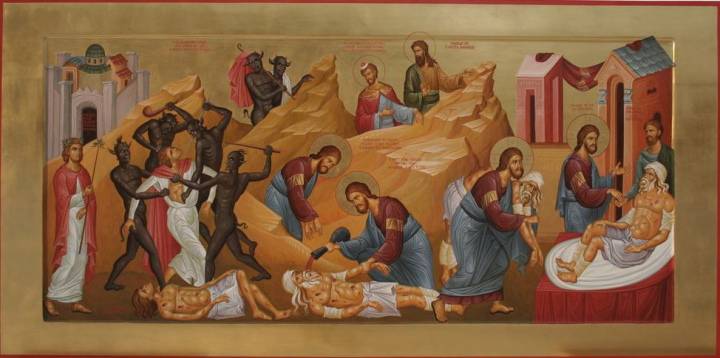
image.png

15th Sunday of Year C – The Good Samaritan

We all love having someone to blame: foreigners, immigrants, economic migrants, politicians, especially politicians, they’re particularly good! There is something about the human condition which makes us love having someone to blame other than ourselves. Someone to point the finger at, as long as it is not US! The Ancient Jews were no different. And generally speaking they blamed the Samaritans. They hadn’t gone into exile to Babylon, they’d stayed and intermarried. They weren’t pure, and they worshipped in the wrong place: on Mt Gerazim, rather than Mt Zion, Jerusalem.

So in this morning’s Gospel a lawyer stands up and tries to test Jesus. The lawyer understands the law of Moses, and quotes from Deuteronomy and Leviticus to get to the heart of the matter, loving God, and loving your neighbour. Quite simple and straightforward.

But that’s not enough for our legal friend. He’s competitive. He wants to win this encounter with a Galilean rabbi. So, he asks Jesus to define his terms. And so Our Lord tells him a story. The road which snaked its way down from Jerusalem was steep and windy. It was very easy for a single traveller to fall prey to robbers or bandits. The priest and the Levite, not knowing if the man is alive or not just pass by. They don’t want to risk becoming impure by touching a dead body. So a Samaritan, an outcast, someone the Jews loved to hate, stops, has pity on him, and saves his life. But he’s beyond the pale! It’s just not right! He’s been saved by an outcast, someone who isn’t ‘one of us’. The Samaritan doesn’t care. He simply sees someone in need, and helps them. That’s all! He demonstrates love and care. And that’s what matters.

God is a God of Love and Grace, generous in ways which we can never fully understand. Ours is a God who gives His Only Son to die the death of a common criminal, for love of us, to bear our sins, to heal our wounds, and heal the world of its brokenness. That’s how much God loves us, and longs to see us healed. That’s why the Sacrifice of Calvary will be represented here, this morning, so that we can be fed with the Body and Blood of Christ, to heal us, and transform us, so that we might become what Christ is. On the Cross, Christ becomes the outcast to save us, to make us free form the power of sin and death. He binds up our wounds, not pouring on oil and wine, but His own Blood to heal us. He saves us from the brigands of sin and death, so that we might know God’s love and grace, and our lives might be transformed.

This happens in the Church: here is the place of transformation, the place of healing, where we experience the grace of God in the Sacraments. The Word is very near to us here, the Word made flesh who reconciles humanity to God, making peace by the blood of His Cross. We are transformed by Christ and into Christ, so that we too may ‘go and do likewise’ and be agents of God’s love and grace in the world, to transform our communities, and all the world. To fill it with God’s love and compassion. It’s a radical vision, and a work in progress: loving, forgiving, healing, reconciling. And it’s what the Kingdom of God looks like in reality — lived out in people’s lives. It’s what Jesus tells the lawyer to do: ‘Go and do likewise.’

Is it easy? By no means! Do we all have to do it? Yes! And we have to support each other as we do it. It’s a communal effort, for the entire baptised people of God, across space and time. In Christ, God’s grace has been poured out upon us, costly, self-giving love, which we accept when we repent and turn away from sin, and turn back to God, acknowledging our failures and weaknesses, and asking God to transform us. This leads us ti become more generous, loving, and forgiving of others (and ourselves), thankful people, who are generous, who ‘go and do likewise’ and that’s the HARD bit, actually doing it. It’s easy to talk about doing it. Doing it is difficult and costly, and that’s the point. It’s why we need a community, nourished by Word and Sacrament to support us as we try to do it together. Helping us to shoulder the burden, and picking us up when we fall. It’s supposed to be a communal thing, so that we help each other become saints. This is the Christian vision of the world. It looks radical. It isn’t selfish, or obsessed with power or wealth. The Church doesn’t look like this. But that’s ok, because we can transform both the Church and the World, so that they look the way God wants them to look: filled with loving and generous people who are, by God’s grace, making the Kingdom of God a reality here and now. Preparing us all for the joy of heaven, and inviting others to share in that joy so that all people may sing the praises of to God the Father, God the Son, and God the Holy Spirit, to whom be ascribed as is most right and just all might, majesty, glory, dominion, and power, now and forever. Amen

image.png