Showing posts with label Transformation. Show all posts

Saturday, 25 September 2021

Trinity XVII

The Book of Numbers tells the story of the journey of the people of Israel through the desert of Sinai towards the Promised Land. In Chapter 11, the people are complaining about their lack of food which leads God to send first manna, and then quail, to feed the people. While this is happening, God promises Moses that He will share his Spirit with seventy others. This is so that Moses may have some helpers to aid with leadership, to deal with complaints, and to settle disputes.

Seventy men go to the Tent of Meeting, and two men stay behind in the camp: Eldad and Medad. They are both filled with the Holy Spirit and begin to prophesy. Moses is told about this, at which point something of a dispute arises:

‘And Joshua the son of Nun, the assistant of Moses from his youth, said, “My lord Moses, stop them.” But Moses said to him, “Are you jealous for my sake? Would that all the Lord’s people were prophets, that the Lord would put his Spirit on them!”’ (Numbers 11:28-29)

Moses is not as concerned as Joshua about observing proprieties, and he recognises that there is a freedom to the Spirit: it blows where it wills (cf. Jn 3:8). God is free to work through whomsoever He chooses. Moses wishes are granted on the Day of Pentecost, when the Apostles were filled with the Holy Spirit. We too, as Christians, are dwelling-places of the Holy Spirit, which works in us and through us. 

Just as Moses is able to see the bigger picture, likewise in today’s Gospel reading we see Jesus being rather generous. The disciples have noticed some exorcisms taking place, which have not been sanctioned. However, Jesus does not want His disciples put a stop to this, so He tells them:

“Do not stop him, for no one who does a mighty work in my name will be able soon afterwards to speak evil of me. For the one who is not against us is for us. For truly, I say to you, whoever gives you a cup of water to drink because you belong to Christ will by no means lose his reward” (Mk 9:39-41)

If the point of exorcism is to heal people, then as the Kingdom is a place of healing, the more the better. Evil spirits are cast out in Jesus’ Name, because it is powerful. The point is that faith is not just a matter of belief, but rather of belief put into practice, an act of loving generosity. Putting faith into practice helps to make the Kingdom a reality in our and other people’s lives. It is easy to be exclusive, and small-minded, but thankfully God is more generous than that, and we should try to be like Him.

Then Jesus’ teaching turns to matters of wrongdoing, moral failures, and how they are viewed. It is important to state in the strongest possible terms that Jesus is not encouraging Christians to drown people, or mutilate themselves, but rather teaching His disciples about the serious nature of sin.

Jesus begins by explaining that whoever puts a stumbling block in the path of another has hindered their discipleship. This is a serious charge.

“Whoever causes one of these little ones who believe in me to sin, it would be better for him if a great millstone were hung round his neck and he were thrown into the sea.” (Mk 9:42)

In this passage Jesus is engaging in hyperbole, exaggeration for rhetorical effect, to underline the point that our actions affect others. Using exaggeration, Jesus is pointing out that living a Christian life is a serious business: His followers are called to perfection. People who are new to the Christian faith, who are learning the Way, are particularly vulnerable. If they are led astray by the wrong kind of example, by the wrong sort of teaching, then it is a serious thing. Those of us who are Christians have a great responsibility to nurture others in their faith. The disciples, however, have been petty and small-minded. They have been concerned more with their own power and prestige rather than judging the actions of those helping otherscorrectly, and seeing the situation for what it really is. 

There follows a difficult passage, which, if we were to take it literally, would see all of us blind, lame, and without hands. Clearly this cannot be God’s plan of salvation for humanity. So if we are not supposed to take Jesus literally we have to interpret His words allegorically.This means uncovering the spiritual meaning of Christ’s words. Jesus may be referring to sins committed by hand, foot, or eye, i.e., what we do, where we go, and what we look at. The cutting off may be metaphorical, referring to excommunication. This means temporarily excluding people to give them an opportunity to repent and ask for God’s forgiveness. Our sins lead to estrangement from God, characterised by Hell and unquenchable fire. This is what rejecting God means. By doing so, we confine ourselves to darkness and misery. Jesus has come to save humanity from the Hell we create. He will die to give us life. 

Only Jesus can do this for us, and we have to let Him. We need to follow Him. Only then can we be salt, flavouring and preserving the world around us. Only then can we truly be at peace with one another, and understand things properly, and act accordingly. 

Living as a Christian community means owning up to our shortcomings, and being humble enough to let God transform us, bit by bit, day by day, more and more into His likeness. We learn by carrying our Cross, a burden much lighter than our sin, a burden which can and will transform us. Pride, that great human sin, makes us think that we are important. The disciples think they are important, and lose sight of the fact that what really matters is who Jesus Christ is. We must focus on what He has done for us, dying on the Cross, and rising to new life, so that we can live in Him. This is why we come together on the first day of the week, the day Jesus rose from the dead, so that we can share His risen life, and be nourished by Him.

Today’s other text, the Letter of James has some strong words for the wealthy, and in particular those who acquire their wealth by defrauding others. Christianity is a religion of generosity, given to us by a generous God, who expects us to be generous in turn. Just like the moral shortcomings outlined in the Gospel, here we see that we are called to live in a just and loving way. As Christians we are to stand for fairness and justice for all. The temptation is always there to seek to be important, to pursue power and prestige. What matters is that we glorify God, that we advance His kingdom. This is a kingdom of love, and forgiveness and healing, where people come to know who they truly are in Christ. If we listen to what Jesus tells us, and try to live like Him, then we can help to bring about the day when God will be all in all. Then everyone will sing the praise of God the Father, God the Son, and God the Holy Spirit. To whom be ascribed, as is most right and just, all might, majesty, glory, dominion and power, now and forever. Amen.

James Tissot – Jesus teaches his disciples

Saturday, 16 January 2021

The Second Sunday of Year B

There is a common misconception that when the Church talks about vocation, being called, it is referring to the call to ordained ministry, to be a deacon or a priest. Nothing could be further from the truth. While this call is an important one, there remains a fundamental call which comes to us all in our baptism: the call to follow Christ. Each and every one of us is called to be a disciple of Jesus, to listen to what He says, and to let this call affect our lives. It is both a daunting prospect, and the most normal and natural thing in the world. 

Our first reading this morning tells the story of the call of Samuel, a young boy serving at the sanctuary in Shiloh with the high priest Eli. After his mother, Hannah, had prayed to God for a child whom she would dedicate to God as a Nazirite, she became pregnant and Samuel was born. Nazirites were not allowed to cut their hair, drink wine, or touch a dead body. Eli’s predecessor, Samson, the last of the Judges in the Book of Judges, was also a  Nazirite. Samuel is called three times. Each time he goes to Eli, whom he assumes is calling him. Eventually Eli tells Samuel to reply, ‘Speak, Lord, for your servant hears.’ (1Sam 3:9). So Samuel responds to God’s invitation, and it totally changes his life. Are we willing to take that risk, and answer God’s call?

Ancient Corinth was something like a cross between London and Las Vegas. It was a rich trading centre with a reputation for sexual immorality. This morning’s second reading from St Paul’s First Letter to the Corinthians, is an attempt to argue that our embodied existence, that is how we live our lives , matters. Often, we become what we do. It is therefore important to do the right thing, and not the wrong. Paul’s argument leads to his conclusion:

You are not your own, for you were bought with a price. So glorify God in your body. (1Cor 6:19-20) 

We are not our own, we belong to God, who bought us with the price of His Son, Jesus Christ. The world likes to tell us that we are autonomous, that we can do whatever we want to, but at a fundamental level we are God’s people, and belong to the God who made us, and who redeemed us out of love for us. God sets us free to love Him and serve Him, so how we live our lives is our response to that love and an act of loving service. We can choose to glorify God, not that God needs our glory, but because it is how we should live our lives, in love and service. Our faith affects our lived existence.

In today’s Gospel we move beyond the Baptism of Christ to the events of the following day. John has testified that Jesus is the Lamb of God, who takes away the sins of the world, and that He is the Son of God. When John sees Jesus walking by he again exclaims ‘Behold the Lamb of God’ (Jn 1:36). The phrase looks back to the Suffering Servant in Isaiah 52-53 who is led like a lamb to the slaughter. The beginning of Jesus public ministry points to its end on the Cross. Jesus is the Messiah and He will die to take away our sins. Two of John’s disciples hear him saying these words and follow Jesus. When Jesus asks them what they are looking for, the disciples answer ‘Rabbi’. They acknowledge Jesus as a teacher, and ask Him where He is staying. Jesus replies, “Come and you will see.” (Jn 1:39). Jesus invites them to follow Him, to see where He is staying and to spend time with Him. These two disciples of John become followers of Jesus, literally and metaphorically. The Church continues to make the same invitation to the world, to come and see, to follow Jesus. These two disciples stay with Jesus, they listen to Him, they eat with Him, and begin to have a relationship with Him. We then discover that one of the men is Andrew, and that he has a brother, called Simon. Andrew is convinced that he has found the Messiah and brings his brother to Jesus. When Jesus meets Simon he says,

“So you are Simon the son of John? You shall be called Cephas” (which means Peter) (Jn 1:42)

Jesus gives Simon a new name. He calls him Cephas, which means ‘rock’ in Aramaic, Petros in Greek, from which our name Peter comes. Peter will be the rock upon which Christ will build His Church (Mt 16:18). The name Jesus gives points to Peter’s future role as the leader of the Apostles. Jesus takes the initiative and begins to sketch out a future for the disciples who are following Him. It is quick, and matter of fact, and yet momentous. Jesus is gathering people to help Him with this ministry.

The Church therefore begins with a few Galilean fishermen following a rabbi whom they recognise as the Messiah. Thanks to them, and their faith in Jesus, we are in the Church today. Faith, where we put our trust, is an important thing. It affects both who we are, and how we live our lives. Faith turned Peter from a fisherman into a leader of the early Christians, and it has continued to transform lives for the past two thousand years. 

In our baptism, God in Christ invites each and every one of us to follow Him, to ‘come and see’, as the first disciples did, and to invite others, as Andrew invited Simon Peter. To come and see who Jesus is, to get to know Him, and start a relationship with Him. This begins with our sharing in His Death and Resurrection, and ends in the glory of Heaven. Where we, and all the Church, give glory to God the Father, God the Son, and God the Holy Spirit, to whom be ascribed, as is most right and just, all might, majesty, glory, dominion, and power, now and forever. Amen. 

Saturday, 14 November 2020

The 33rd Sunday of Year A (Prov 31:10-13, 19-20, 30-31, 1 Thess 5:1-11, Mt 25:14-30)

In the ancient world, as in today’s world, the domestic life of women was difficult. Without modern labour-saving devices, household chores were even more laborious and time-consuming. A wife would be expected to run a household, and it was hard and difficult work. Such a demanding role means that paragons in the domestic sphere were to be praised and prized. And, in the Book of Proverbs, we see such an example of industry, of hard work. Throughout Ancient Wisdom Literature, wisdom and industry go hand in hand, they are beautiful and good, as they come from the source of all beauty and goodness, namely God. An excellent wife is more valuable than jewels, because while precious stones possess beauty and value, they are not capable of doing good. 

The heart of her husband trusts in her, and he will have no lack of gain. (Proverbs 31:11)

As a result of the relationship between a loving husband and wife, their mutual prosperity is assured. This then leads to generosity:

She opens her hand to the poor and reaches out her hands to the needy. (Proverbs 31:20)

The point of wealth is not for it to be acquired for its own sake, but so that it may be a blessing to others. God wants humanity to flourish by being loving and generous. This theme runs through all our readings this morning.

St Paul’s First Letter to the Thessalonians is written to a community that is afraid of two things: death and the return of Jesus in Judgement. These are understandable emotions. However, while death and judgement are inescapable, they do not need to be feared. They are compared with the labour pains of a pregnant woman, which are often sudden and sharp. But if we live lives characterised by love, and we have faith in Jesus Christ who died and rose again for us, we have the hope of salvation. This is good news, and leads St Paul to write:

For God has not destined us for wrath, but to obtain salvation through our Lord Jesus Christ (1Thess 5:9)

Paul’s letter is written to encourage his fellow Christians, to allay their fears and to build up their faith, hope, and love, as a community:

Therefore encourage one another and build one another up, just as you are doing (1Thess 5:11)

We all of us need encouragement, especially when times are difficult, and when we are as afraid or unsure, as we are at the moment. It is good to be reminded that, in trying to lift each others spirits, we are behaving as a Christian community should.

In today’s Gospel, Jesus continues to talk about the future using parables. Just as with the Parable of the Wise and Foolish Virgins, Jesus begins by showing that he is talking about a future reality: how things WILL BE, not how they are now. This future reality is Christ’s return. Christians believe that Jesus will come again to judge the world. The theme of today’s parable, the Parable of the Talents is judgement. These days, we are not comfortable with ideas of judgement. Many of us remember preachers using ideas of hell-fire and damnation to fill people with fear. But the heart of the Gospel is love not fear, and perfect love casts out fear. 

In the parable the master goes on a journey and entrusts his property to his servants. He puts his possessions into their care because he trusts them to look after it. The servants who are assigned five and two talents are both praised for being ‘good and faithful’. They have acted morally and demonstrated their faith, and they will be rewarded. The problem is with the servant who was given just one talent and hid it in the ground. He explains his actions, saying:

‘Master, I knew you to be a hard man, reaping where you did not sow, and gathering where you scattered no seed, so I was afraid, and I went and hid your talent in the ground. Here you have what is yours.’ (Mt 25:24-25)

This servant does not love his master, he fears him. He does not take care of what has been entrusted to him, because he simply sees it as a possession, a thing. The servant loves neither his master nor what was entrusted to him. By hiding the talent in the ground, he squanders the opportunity his master has given him, because he is jealous and resentful. As all gardeners know, seeds produce different results, just as in the Parable of the Sower, but they all need to be sown in the first place. What we learn here is that bitterness and resentment have no place in the Kingdom, they are not compatible with a Gospel of Love. The tragedy is that the fearful servant condemns himself to being outside the Kingdom, by failing to recognise both generosity, and the value of a relationship. 

The Parable of the Talents, just like the Parable of the Wise and Foolish Virgins, is a commentary on the life of the Kingdom. These are stories of servants who are prepared and continue to work, until their master returns. They are parables which teach us how to be a Church of loving generous service, not one of fear.

It may sound pedestrian, or even humdrum, but living the Christian life, living the life of the Kingdom, is, at a day to day level, boring, difficult and repetitive. It is about ‘keeping on keeping on’ — loving, forgiving, praying –- nourished by the Body and Blood of Christ, fed by Him, and with Him, freed from the fear which is the antithesis of the Kingdom, rejoicing in the gifts which God gives us, being thankful for them, and using them for God’s glory. None of us fully deserve the gift of God’s love and forgiveness in Jesus Christ: we have not earned it. It is not a reward, but rather the gift of a loving God. It is a gift which we are called to receive, and it transforms our lives. The God who will come to judge us, and all humanity, is a God of love and mercy, whose hands bear the mark of nails, wounded for love of us. Judgement and mercy go hand in hand, and if we love God and love our neighbour, we are living the life of the Kingdom, here and now, free from fear. 

So let us live out that life together, encouraging one another, so that we may all be built up in faith, hope, and love, and together share in the joy of the Kingdom, so that all may know and love God the Father, God the Son, and God the Holy Spirit, to whom be ascribed, as is most right and just, all might, majesty, glory, dominion, and power, now and forever. Amen. 
Rembrandt The Parable of the Talents

The 33rd Sunday of Year A (Prov 31:10-13, 19-20, 30-31, 1 Thess 5:1-11, Mt 25:14-30)

In the ancient world, as in today’s world, the domestic life of women was difficult. Without modern labour-saving devices, household chores were even more laborious and time-consuming. A wife would be expected to run a household, and it was hard and difficult work. Such a demanding role means that paragons in the domestic sphere were to be praised and prized. And, in the Book of Proverbs, we see such an example of industry, of hard work. Throughout Ancient Wisdom Literature, wisdom and industry go hand in hand, they are beautiful and good, as they come from the source of all beauty and goodness, namely God. An excellent wife is more valuable than jewels, because while precious stones possess beauty and value, they are not capable of doing good. 

The heart of her husband trusts in her, and he will have no lack of gain. (Proverbs 31:11)

As a result of the relationship between a loving husband and wife, their mutual prosperity is assured. This then leads to generosity:

She opens her hand to the poor and reaches out her hands to the needy. (Proverbs 31:20)

The point of wealth is not for it to be acquired for its own sake, but so that it may be a blessing to others. God wants humanity to flourish by being loving and generous. This theme runs through all our readings this morning.

St Paul’s First Letter to the Thessalonians is written to a community that is afraid of two things: death and the return of Jesus in Judgement. These are understandable emotions. However, while death and judgement are inescapable, they do not need to be feared. They are compared with the labour pains of a pregnant woman, which are often sudden and sharp. But if we live lives characterised by love, and we have faith in Jesus Christ who died and rose again for us, we have the hope of salvation. This is good news, and leads St Paul to write:

For God has not destined us for wrath, but to obtain salvation through our Lord Jesus Christ (1Thess 5:9)

Paul’s letter is written to encourage his fellow Christians, to allay their fears and to build up their faith, hope, and love, as a community:

Therefore encourage one another and build one another up, just as you are doing (1Thess 5:11)

We all of us need encouragement, especially when times are difficult, and when we are as afraid or unsure, as we are at the moment. It is good to be reminded that, in trying to lift each others spirits, we are behaving as a Christian community should.

In today’s Gospel, Jesus continues to talk about the future using parables. Just as with the Parable of the Wise and Foolish Virgins, Jesus begins by showing that he is talking about a future reality: how things WILL BE, not how they are now. This future reality is Christ’s return. Christians believe that Jesus will come again to judge the world. The theme of today’s parable, the Parable of the Talents is judgement. These days, we are not comfortable with ideas of judgement. Many of us remember preachers using ideas of hell-fire and damnation to fill people with fear. But the heart of the Gospel is love not fear, and perfect love casts out fear. 

In the parable the master goes on a journey and entrusts his property to his servants. He puts his possessions into their care because he trusts them to look after it. The servants who are assigned five and two talents are both praised for being ‘good and faithful’. They have acted morally and demonstrated their faith, and they will be rewarded. The problem is with the servant who was given just one talent and hid it in the ground. He explains his actions, saying:

‘Master, I knew you to be a hard man, reaping where you did not sow, and gathering where you scattered no seed, so I was afraid, and I went and hid your talent in the ground. Here you have what is yours.’ (Mt 25:24-25)

This servant does not love his master, he fears him. He does not take care of what has been entrusted to him, because he simply sees it as a possession, a thing. The servant loves neither his master nor what was entrusted to him. By hiding the talent in the ground, he squanders the opportunity his master has given him, because he is jealous and resentful. As all gardeners know, seeds produce different results, just as in the Parable of the Sower, but they all need to be sown in the first place. What we learn here is that bitterness and resentment have no place in the Kingdom, they are not compatible with a Gospel of Love. The tragedy is that the fearful servant condemns himself to being outside the Kingdom, by failing to recognise both generosity, and the value of a relationship. 

The Parable of the Talents, just like the Parable of the Wise and Foolish Virgins, is a commentary on the life of the Kingdom. These are stories of servants who are prepared and continue to work, until their master returns. They are parables which teach us how to be a Church of loving generous service, not one of fear.

It may sound pedestrian, or even humdrum, but living the Christian life, living the life of the Kingdom, is, at a day to day level, boring, difficult and repetitive. It is about ‘keeping on keeping on’ — loving, forgiving, praying –- nourished by the Body and Blood of Christ, fed by Him, and with Him, freed from the fear which is the antithesis of the Kingdom, rejoicing in the gifts which God gives us, being thankful for them, and using them for God’s glory. None of us fully deserve the gift of God’s love and forgiveness in Jesus Christ: we have not earned it. It is not a reward, but rather the gift of a loving God. It is a gift which we are called to receive, and it transforms our lives. The God who will come to judge us, and all humanity, is a God of love and mercy, whose hands bear the mark of nails, wounded for love of us. Judgement and mercy go hand in hand, and if we love God and love our neighbour, we are living the life of the Kingdom, here and now, free from fear. 

So let us live out that life together, encouraging one another, so that we may all be built up in faith, hope, and love, and together share in the joy of the Kingdom, so that all may know and love God the Father, God the Son, and God the Holy Spirit, to whom be ascribed, as is most right and just, all might, majesty, glory, dominion, and power, now and forever. Amen. 

Rembrandt The Parable of the Talents

Sunday, 12 April 2020

Easter 2020 [John 20:1-9]

Easter is for Christians a time of celebration, a feast which we continue to celebrate for fifty days until Pentecost. We do this because it is the most important day of the year for us, because Jesus Christ not only died for us on the Cross, but rose again from the dead. For Christians Death does not have the last word, it is not the end, quite the opposite, it is the start of New Life.

We are used to hearing the proclamation of the Easter message, to the point that we can run the risk of becoming immune to the strangeness of what we are celebrating. Easter is odd: bodies don’t usually rise from tombs. In today’s Gospel, Mary of Magdala simply cannot understand what is going on. St Peter goes into the tomb and sees the cloths lying there, but only the other disciple, St John, both sees and believes, because he looks with the eyes of faith. John has listened to what Jesus has said, and understands what has happened, and how it has been foretold in the Hebrew Scriptures. He sees and understands because he LOVES.

This Easter we are not able to worship together, as we usually do. Instead, for our own safety and the safety of others, we have to worship on our own. But this does not mean that our worship ceases, not at all. This is a hard and a painful time for all of us, because as Christians we are a family, we worship TOGETHER. But while we are not able to do this together physically, we can still be united spiritually. So what can we do? We can read scripture, and we can pray: for the church, for the world, for each other, for all dealing with the current pandemic, for the sick and suffering, and for the dead and dying. We do this because God hears our prayers, and because prayer changes us. It makes us more loving, more generous, more forgiving, and more keen to seek forgiveness. 

This is how we grow in faith, and we can do it whether we are together, or we are apart. It is difficult in this current isolation, but it is by no means impossible. We are an Easter people, and ‘Alleluia’ is our song. We are called to rejoice, regardless of what is happening, regardless of what we may face in this life, because the source of our joy is God, as the prophet Nehemiah says, ‘Go on your way. Eat the fat and drink sweet wine and send portions to anyone who has nothing ready, for this day is holy to our Lord. And do not be grieved, for the joy of the Lord is your strength.’ (Nehemiah 8:10 ESV) God does not disappoint us, and Christ’s resurrection is as true today as it ever was. Christ has conquered sin and death, and risen victorious from the grave, breaking down the bars of Hell and leading souls to Heaven, so we rejoice. As St Paul writes to the Church in Rome: ‘Who shall separate us from the love of Christ? Shall tribulation, or distress, or persecution, or famine, or nakedness, or danger, or sword? As it is written, “For your sake we are being killed all the day long; we are regarded as sheep to be slaughtered.” No, in all these things we are more than conquerors through him who loved us. For I am sure that neither death nor life, nor angels nor rulers, nor things present nor things to come, nor powers, nor height nor depth, nor anything else in all creation, will be able to separate us from the love of God in Christ Jesus our Lord.’ (Romans 8:35-39 ESV) So, my brothers and sisters in Christ, ‘Pasg hapus i chi gyd!’ ‘A Happy Easter to you all!’ May the joy and peace of the Risen Lord fill your hearts and lives, both now and always. Amen. 

If you wish to, you can make a Spiritual Communion: the means of grace by which someone, prevented from sharing in a celebration of the Eucharist, nonetheless shares in the communion of Jesus Christ. Please pray the prayer below:

My Jesus, I believe that You are present in the Most Holy Sacrament. I love You above all things, and I desire to receive You into my soul. Since I cannot at this moment receive You sacramentally, come at least spiritually into my heart. I embrace You as if You were already there and unite myself wholly to You. Never permit me to be separated from You. Amen.

7a55c-anastasischora

Easter 2020 [John 20:1-9]

Easter is for Christians a time of celebration, a feast which we continue to celebrate for fifty days until Pentecost. We do this because it is the most important day of the year for us, because Jesus Christ not only died for us on the Cross, but rose again from the dead. For Christians Death does not have the last word, it is not the end, quite the opposite, it is the start of New Life.

We are used to hearing the proclamation of the Easter message, to the point that we can run the risk of becoming immune to the strangeness of what we are celebrating. Easter is odd: bodies don’t usually rise from tombs. In today’s Gospel, Mary of Magdala simply cannot understand what is going on. St Peter goes into the tomb and sees the cloths lying there, but only the other disciple, St John, both sees and believes, because he looks with the eyes of faith. John has listened to what Jesus has said, and understands what has happened, and how it has been foretold in the Hebrew Scriptures. He sees and understands because he LOVES.

This Easter we are not able to worship together, as we usually do. Instead, for our own safety and the safety of others, we have to worship on our own. But this does not mean that our worship ceases, not at all. This is a hard and a painful time for all of us, because as Christians we are a family, we worship TOGETHER. But while we are not able to do this together physically, we can still be united spiritually. So what can we do? We can read scripture, and we can pray: for the church, for the world, for each other, for all dealing with the current pandemic, for the sick and suffering, and for the dead and dying. We do this because God hears our prayers, and because prayer changes us. It makes us more loving, more generous, more forgiving, and more keen to seek forgiveness. 

This is how we grow in faith, and we can do it whether we are together, or we are apart. It is difficult in this current isolation, but it is by no means impossible. We are an Easter people, and ‘Alleluia’ is our song. We are called to rejoice, regardless of what is happening, regardless of what we may face in this life, because the source of our joy is God, as the prophet Nehemiah says, ‘Go on your way. Eat the fat and drink sweet wine and send portions to anyone who has nothing ready, for this day is holy to our Lord. And do not be grieved, for the joy of the Lord is your strength.’ (Nehemiah 8:10 ESV) God does not disappoint us, and Christ’s resurrection is as true today as it ever was. Christ has conquered sin and death, and risen victorious from the grave, breaking down the bars of Hell and leading souls to Heaven, so we rejoice. As St Paul writes to the Church in Rome: ‘Who shall separate us from the love of Christ? Shall tribulation, or distress, or persecution, or famine, or nakedness, or danger, or sword? As it is written, “For your sake we are being killed all the day long; we are regarded as sheep to be slaughtered.” No, in all these things we are more than conquerors through him who loved us. For I am sure that neither death nor life, nor angels nor rulers, nor things present nor things to come, nor powers, nor height nor depth, nor anything else in all creation, will be able to separate us from the love of God in Christ Jesus our Lord.’ (Romans 8:35-39 ESV) So, my brothers and sisters in Christ, ‘Pasg hapus i chi gyd!’ ‘A Happy Easter to you all!’ May the joy and peace of the Risen Lord fill your hearts and lives, both now and always. Amen. 

If you wish to, you can make a Spiritual Communion: the means of grace by which someone, prevented from sharing in a celebration of the Eucharist, nonetheless shares in the communion of Jesus Christ. Please pray the prayer below:

My Jesus, I believe that You are present in the Most Holy Sacrament. I love You above all things, and I desire to receive You into my soul. Since I cannot at this moment receive You sacramentally, come at least spiritually into my heart. I embrace You as if You were already there and unite myself wholly to You. Never permit me to be separated from You. Amen.

7a55c-anastasischora

Saturday, 29 February 2020

The Church has entered the season of Lent, and she goes, with her Lord, into the desert for forty days, to pray, to turn away from sin, to turn back to God, to fast, to be generous in almsgiving. We do this to prepare to celebrate Jesus’ passion, Death and Resurrection in Holy Week and Easter. We get ready to celebrate the holiest week of the Church’s year by having something of a spiritual spring clean. This is a very good thing indeed. We need to do it, so that we can be reminded where we need to put some work in.

Our first reading this morning take us right back to the start of the problem of human sin: Adam & Eve in the Garden of Eden. They are tempted by the serpent to do what God has told them not to do. Thinking that you know better than God, and choosing to do what you want to do is where the sin of pride comes from. Adam and Eve prefer to trust the serpent, who promises that they will become like God. They are disobedient: they do not listen to what God says, and act in accordance with it. But rather than knowing good and evil, all they know is that they are naked, and cover their nakedness. The serpent makes empty promises, and they are taken in by them. Such is the power of lies. 

But while we have heard how sin and death came into the world, we also hear in our second reading from Paul’s Letter to the Romans how disobedience is countered by the obedience of Jesus Christ. It is obedience which will see Our Lord die on the Cross for us. Christ will bear the burden of our sin, to pay the debt which we cannot. This is what we are preparing to celebrate: one act of righteousness which ‘leads to justification and life for all men’ (Rom 5:18 ESV). To be justified is to be declared righteous in the sight of God. We are guilty, yet God declares us innocent. We deserve punishment, and yet are rewarded. It is remarkable. Such is God’s love for us that our slate is wiped clean. Each and every one of us deserves to be cast aside, for our sins, like those of Adam & Eve separate us from God and each other. Yet God did not leave us in slavery to sin, but sent His Son, so that we might have life in and through Him. This is the Good News of the Gospel. 

In the Gospel this morning we see Jesus at a crucial point, between His Baptism and the calling of the first disciples: Peter and Andrew, James and John. Christ goes into the desert for forty days, to be alone, to pray and to fast, and the church keen to imitate our Saviour likewise goes into the desert so that we may grow closer to God, that we may be purged and prepared to celebrate the mystery of the Lord’s Passion, Death, and Resurrection. 

Jesus is led by the Holy Spirit into the wilderness, a place traditionally associated with the prophets and with encounter with God. After fasting for forty days and forty nights He is hungry. This is no surprise at all. He has been fasting for forty days, Our Lord is starving – he is fully human not some superhero who is immune to human feelings and needs. So the devil tempts Him by saying, ‘If you are the Son of God, command these stones to become loaves of bread.’ (Mt 4:3 ESV). The temptation works on several levels. By doubting that Jesus is God and asking Him to prove it the devil is continuing to mock the God he refuses to serve. It is a temptation to be relevant: Jesus is hungry and needs to eat, but is being tempted to use the creative power of God simply to serve an appetite. The world tempts us to be relevant, and to conform ourselves to it, rather than let the world be conformed to the will of God. Jesus’ reply to the devil, that man does not live by bread alone but by every word which proceeds from the mouth of God, reminds us that as Christians we are fed by Word and Sacrament, nourished by God so that we may grow in faith, and hope, and love. 

Christ is taken to the pinnacle of the Temple in Jerusalem and told to throw Himself down. This is the temptation to be spectacular, to do something for show, again something which the contemporary church seems rather keen on. But nothing should be done for show; we are called to follow Christ simply and humbly, trusting in Him. The devil wants to put God to the test, it is an act of disobedience, contrary to the humble obedience which sees us live trusting in God, relying upon Him, formed by Him.

Christ is finally tempted to turn away from God the Father, to worship a false god. He is offered much in material terms –- all the world and its splendour -– wealth and power –- a huge temptation for humanity, and one into which many people give. The Church too has given in, and continues so to do. We have to be weak, powerless and vulnerable, utterly reliant upon God so that God can be at work in us, as we humbly worship and serve Him. It may look foolish in worldly terms, but that is the point –- we are not meant to be conformed to the world, but as we seek to grow in faith, in humility, and obedience, we allow God to be at work in us –- taking us and transforming us into His likeness.

The temptation to worship a false God: money, power, or success is always there, and many in the church give in to feelings of ambition, and if they are not ‘successful’ end up bitter, cynical, and miserable. But success is itself empty, popular favour can disappear like a puff of smoke. It is fleeting, it does not last. Whereas in Christ we are offered something that will last: eternal life with God in heaven. 

So as we undertake to follow Christ in our Lenten pilgrimage we do so in our weakness, so that we may rely upon God, and Him alone. We do so joyfully, knowing that Christ’s victory which we will celebrate at Easter is total and complete – it is justification and life for all.

Let us pray that we may receive grace to follow Christ so that we may prepare to celebrate His Death and Resurrection and sing the praises of God the Father, God the Son, and God the Holy Spirit, to whom be ascribed as is most right and just, all might, majesty, glory, dominion, and power, now and forever. Amen.

00.159.51

The Church has entered the season of Lent, and she goes, with her Lord, into the desert for forty days, to pray, to turn away from sin, to turn back to God, to fast, to be generous in almsgiving. We do this to prepare to celebrate Jesus’ passion, Death and Resurrection in Holy Week and Easter. We get ready to celebrate the holiest week of the Church’s year by having something of a spiritual spring clean. This is a very good thing indeed. We need to do it, so that we can be reminded where we need to put some work in.

Our first reading this morning take us right back to the start of the problem of human sin: Adam & Eve in the Garden of Eden. They are tempted by the serpent to do what God has told them not to do. Thinking that you know better than God, and choosing to do what you want to do is where the sin of pride comes from. Adam and Eve prefer to trust the serpent, who promises that they will become like God. They are disobedient: they do not listen to what God says, and act in accordance with it. But rather than knowing good and evil, all they know is that they are naked, and cover their nakedness. The serpent makes empty promises, and they are taken in by them. Such is the power of lies. 

But while we have heard how sin and death came into the world, we also hear in our second reading from Paul’s Letter to the Romans how disobedience is countered by the obedience of Jesus Christ. It is obedience which will see Our Lord die on the Cross for us. Christ will bear the burden of our sin, to pay the debt which we cannot. This is what we are preparing to celebrate: one act of righteousness which ‘leads to justification and life for all men’ (Rom 5:18 ESV). To be justified is to be declared righteous in the sight of God. We are guilty, yet God declares us innocent. We deserve punishment, and yet are rewarded. It is remarkable. Such is God’s love for us that our slate is wiped clean. Each and every one of us deserves to be cast aside, for our sins, like those of Adam & Eve separate us from God and each other. Yet God did not leave us in slavery to sin, but sent His Son, so that we might have life in and through Him. This is the Good News of the Gospel. 

In the Gospel this morning we see Jesus at a crucial point, between His Baptism and the calling of the first disciples: Peter and Andrew, James and John. Christ goes into the desert for forty days, to be alone, to pray and to fast, and the church keen to imitate our Saviour likewise goes into the desert so that we may grow closer to God, that we may be purged and prepared to celebrate the mystery of the Lord’s Passion, Death, and Resurrection. 

Jesus is led by the Holy Spirit into the wilderness, a place traditionally associated with the prophets and with encounter with God. After fasting for forty days and forty nights He is hungry. This is no surprise at all. He has been fasting for forty days, Our Lord is starving – he is fully human not some superhero who is immune to human feelings and needs. So the devil tempts Him by saying, ‘If you are the Son of God, command these stones to become loaves of bread.’ (Mt 4:3 ESV). The temptation works on several levels. By doubting that Jesus is God and asking Him to prove it the devil is continuing to mock the God he refuses to serve. It is a temptation to be relevant: Jesus is hungry and needs to eat, but is being tempted to use the creative power of God simply to serve an appetite. The world tempts us to be relevant, and to conform ourselves to it, rather than let the world be conformed to the will of God. Jesus’ reply to the devil, that man does not live by bread alone but by every word which proceeds from the mouth of God, reminds us that as Christians we are fed by Word and Sacrament, nourished by God so that we may grow in faith, and hope, and love. 

Christ is taken to the pinnacle of the Temple in Jerusalem and told to throw Himself down. This is the temptation to be spectacular, to do something for show, again something which the contemporary church seems rather keen on. But nothing should be done for show; we are called to follow Christ simply and humbly, trusting in Him. The devil wants to put God to the test, it is an act of disobedience, contrary to the humble obedience which sees us live trusting in God, relying upon Him, formed by Him.

Christ is finally tempted to turn away from God the Father, to worship a false god. He is offered much in material terms –- all the world and its splendour -– wealth and power –- a huge temptation for humanity, and one into which many people give. The Church too has given in, and continues so to do. We have to be weak, powerless and vulnerable, utterly reliant upon God so that God can be at work in us, as we humbly worship and serve Him. It may look foolish in worldly terms, but that is the point –- we are not meant to be conformed to the world, but as we seek to grow in faith, in humility, and obedience, we allow God to be at work in us –- taking us and transforming us into His likeness.

The temptation to worship a false God: money, power, or success is always there, and many in the church give in to feelings of ambition, and if they are not ‘successful’ end up bitter, cynical, and miserable. But success is itself empty, popular favour can disappear like a puff of smoke. It is fleeting, it does not last. Whereas in Christ we are offered something that will last: eternal life with God in heaven. 

So as we undertake to follow Christ in our Lenten pilgrimage we do so in our weakness, so that we may rely upon God, and Him alone. We do so joyfully, knowing that Christ’s victory which we will celebrate at Easter is total and complete – it is justification and life for all.

Let us pray that we may receive grace to follow Christ so that we may prepare to celebrate His Death and Resurrection and sing the praises of God the Father, God the Son, and God the Holy Spirit, to whom be ascribed as is most right and just, all might, majesty, glory, dominion, and power, now and forever. Amen.

00.159.51

Sunday, 26 January 2020

3rd Sunday of Year A

There are divisions in the Church. Sadly, there have been divisions since the earliest days of Christianity, as is made clear by the opening of St Paul’s First Letter to the Corinthians. But just because something has gone on for a long time doesn’t make it right. Quite the opposite! For the last seven days Christians around the world have been praying for unity, to heal the divisions which so mar the Body of Christ, the Church. And while it is good to focus our prayers on unity for a week, I would venture to suggest that the unity of Christians is something which we should all be praying for all the time. It is shocking that the tribalism which St Paul condemns in the first century, is still alive and well today. People are still defining themselves as one sort of Christian as opposed to another, or by the place where they worship. Our culpability in this is something for which we need to repent. We need to turn away from division, and to turn back to the God of love, who longs to heal our wounds and divisions; fostering unity is following the will of God. 

This morning’s Gospel begins with the news that John the Baptist has been arrested. His criticism of the immorality of the ruling family had upset the powers that be. Calling out Herod Antipas for divorcing his wife, and then breaking Jewish law by marrying his brother Philip’s wife, seems the right thing to do. We expect our rulers to set an example. It’s only right and proper. The church continues this prophetic vocation, calling out what is evil and wrong. This may, and will, indeed make people uncomfortable: That’s the point! No one likes having their wrongdoing pointed out, I know I don’t! But unless someone does, then we’re unlikely to change our ways. 

In the Gospel, Jesus has just been in the desert for forty days, praying, fasting, being tempted by the Devil. He begins his public ministry by leaving Nazareth, the town where He grew up, and walking to Capernaum by the shore of the Sea of Galilee. It is a day’s journey. This is an important place for Jesus to start His public ministry, because it fulfils a prophecy in Isaiah, which St Matthew quotes, ‘The land of Zebulun and the land of Naphtali, the way of the sea, beyond the Jordan, Galilee of the Gentiles— the people dwelling in darkness have seen a great light, and for those dwelling in the region and shadow of death, on them a light has dawned.’ (Mt 4:15-16 ESV) This part of Israel is where people were first taken off into captivity by the Assyrians, seven hundred years before. So Our Lord’s restoration of Israel starts in the place where the Northern Kingdom first began to fall apart. 

Strikingly, Jesus begins His proclamation of the Good news of the Kingdom by repeating the exact words of His Cousin, John the Baptist: ‘Repent, for the kingdom of heaven is at hand’. Their message is the same: turn away from your sins and turn back to God, turn back to the God who loves you, and who longs to heal you. These are words of hope for the future, for restoration. This is a message which we all long to hear. 

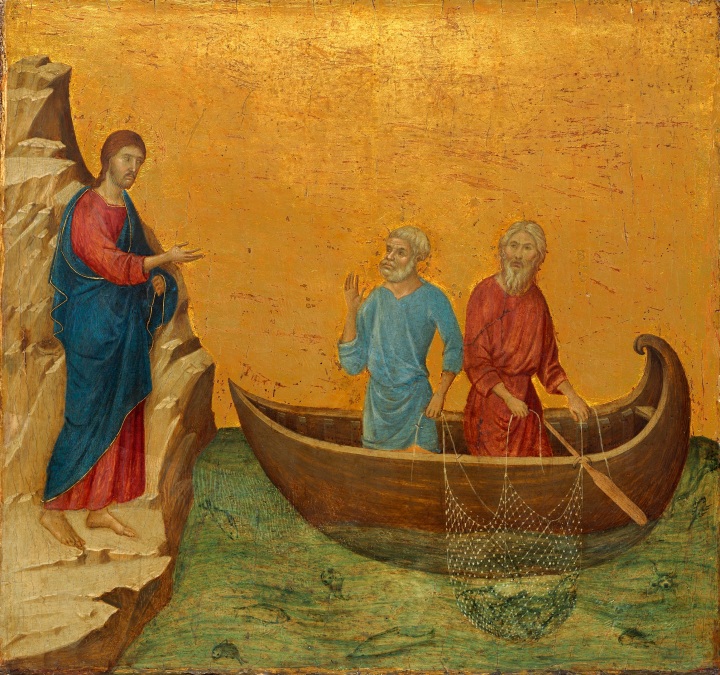
When Jesus sees two fishermen, Simon Peter and his brother, Andrew casting their nets,  and invites them to ‘Follow me, and I will make you fishers of men.’ It is quite a simple and straightforward invitation. On hearing Jesus’ words they drop everything and follow Him. Immediately! They don’t stop to put their affairs in order, or to say goodbye. A little later, James and John do the same, leaving Zebedee, their father, behind in the boat. Nothing is more important than following Jesus, but these early disciples show us that following God has a cost. It transforms our lives, totally, but not without cost. 

So what does Jesus do with this band of disciples? He takes them into synagogues, where He teaches and interprets the Jewish Scriptures, the Old Testament. Jesus proclaims the Good News of the Kingdom, that we are loved by God. He demonstrates this love in practice by healing the sick. God’s kingdom is a place where wounds are healed, where people are restored to wholeness, in mind, body and soul. There is a cost to following God, but here we see the reward of the Kingdom. Each and every one of us needs that healing and wholeness, which only God can provide. The Church continues to proclaim repentance from sin, belief in the Kingdom of God, and participates in the healing power of God. 

These things begin with us, here, today. We hear the Kingdom proclaimed, we confess our faith together, we pray for the Church and the World, and we join in the banquet of the Kingdom. The source and summit of the Christian life is the Eucharist, where Christ feeds and heals us with His Body and Blood. God’s love is a reality, with the power to transform us and our world, if we have the humility to let God be at work in our lives. He does not force Himself upon us like a tyrant, but rather gives us the free will to choose to turn to Him. 

God also wills that the Church be united, as Jesus prays in Gethsemane, ‘I do not pray for these only, but also for those who believe in me through their word, that they may all be one; even as thou, Father, art in me, and I in thee, that they also may be in us, so that the world may believe that thou hast sent me.’ (Jn 17:20-21 RSVCE) May we pray and work so that Our Lord’s will is a reality and that the world may believe and give glory to God the Father, God the Son, and God the Holy Spirit, to whom be ascribed as is most right and just, all might, majesty, glory, dominion, and power, now, and forever. Amen.

Duccio_di_Buoninsegna_036.jpg

3rd Sunday of Year A

There are divisions in the Church. Sadly, there have been divisions since the earliest days of Christianity, as is made clear by the opening of St Paul’s First Letter to the Corinthians. But just because something has gone on for a long time doesn’t make it right. Quite the opposite! For the last seven days Christians around the world have been praying for unity, to heal the divisions which so mar the Body of Christ, the Church. And while it is good to focus our prayers on unity for a week, I would venture to suggest that the unity of Christians is something which we should all be praying for all the time. It is shocking that the tribalism which St Paul condemns in the first century, is still alive and well today. People are still defining themselves as one sort of Christian as opposed to another, or by the place where they worship. Our culpability in this is something for which we need to repent. We need to turn away from division, and to turn back to the God of love, who longs to heal our wounds and divisions; fostering unity is following the will of God. 

This morning’s Gospel begins with the news that John the Baptist has been arrested. His criticism of the immorality of the ruling family had upset the powers that be. Calling out Herod Antipas for divorcing his wife, and then breaking Jewish law by marrying his brother Philip’s wife, seems the right thing to do. We expect our rulers to set an example. It’s only right and proper. The church continues this prophetic vocation, calling out what is evil and wrong. This may, and will, indeed make people uncomfortable: That’s the point! No one likes having their wrongdoing pointed out, I know I don’t! But unless someone does, then we’re unlikely to change our ways. 

In the Gospel, Jesus has just been in the desert for forty days, praying, fasting, being tempted by the Devil. He begins his public ministry by leaving Nazareth, the town where He grew up, and walking to Capernaum by the shore of the Sea of Galilee. It is a day’s journey. This is an important place for Jesus to start His public ministry, because it fulfils a prophecy in Isaiah, which St Matthew quotes, ‘The land of Zebulun and the land of Naphtali, the way of the sea, beyond the Jordan, Galilee of the Gentiles— the people dwelling in darkness have seen a great light, and for those dwelling in the region and shadow of death, on them a light has dawned.’ (Mt 4:15-16 ESV) This part of Israel is where people were first taken off into captivity by the Assyrians, seven hundred years before. So Our Lord’s restoration of Israel starts in the place where the Northern Kingdom first began to fall apart. 

Strikingly, Jesus begins His proclamation of the Good news of the Kingdom by repeating the exact words of His Cousin, John the Baptist: ‘Repent, for the kingdom of heaven is at hand’. Their message is the same: turn away from your sins and turn back to God, turn back to the God who loves you, and who longs to heal you. These are words of hope for the future, for restoration. This is a message which we all long to hear. 

When Jesus sees two fishermen, Simon Peter and his brother, Andrew casting their nets,  and invites them to ‘Follow me, and I will make you fishers of men.’ It is quite a simple and straightforward invitation. On hearing Jesus’ words they drop everything and follow Him. Immediately! They don’t stop to put their affairs in order, or to say goodbye. A little later, James and John do the same, leaving Zebedee, their father, behind in the boat. Nothing is more important than following Jesus, but these early disciples show us that following God has a cost. It transforms our lives, totally, but not without cost. 

So what does Jesus do with this band of disciples? He takes them into synagogues, where He teaches and interprets the Jewish Scriptures, the Old Testament. Jesus proclaims the Good News of the Kingdom, that we are loved by God. He demonstrates this love in practice by healing the sick. God’s kingdom is a place where wounds are healed, where people are restored to wholeness, in mind, body and soul. There is a cost to following God, but here we see the reward of the Kingdom. Each and every one of us needs that healing and wholeness, which only God can provide. The Church continues to proclaim repentance from sin, belief in the Kingdom of God, and participates in the healing power of God. 

These things begin with us, here, today. We hear the Kingdom proclaimed, we confess our faith together, we pray for the Church and the World, and we join in the banquet of the Kingdom. The source and summit of the Christian life is the Eucharist, where Christ feeds and heals us with His Body and Blood. God’s love is a reality, with the power to transform us and our world, if we have the humility to let God be at work in our lives. He does not force Himself upon us like a tyrant, but rather gives us the free will to choose to turn to Him. 

God also wills that the Church be united, as Jesus prays in Gethsemane, ‘I do not pray for these only, but also for those who believe in me through their word, that they may all be one; even as thou, Father, art in me, and I in thee, that they also may be in us, so that the world may believe that thou hast sent me.’ (Jn 17:20-21 RSVCE) May we pray and work so that Our Lord’s will is a reality and that the world may believe and give glory to God the Father, God the Son, and God the Holy Spirit, to whom be ascribed as is most right and just, all might, majesty, glory, dominion, and power, now, and forever. Amen.

Duccio_di_Buoninsegna_036.jpg

Wednesday, 25 December 2019

Christmas 2019

We have come here this morning because something wonderful happened two thousand years ago in Bethlehem. It is the single most important event in human history, summed up in St John’s memorable phrase, ‘And the Word became flesh and dwelt among us’ (Jn 1:14 ESV). The Word, through which God spoke all creation into being, the Son eternally begotten of the Father, who, through the power of the Holy Spirit, took flesh in the womb of His mother, the Blessed Virgin Mary, is born for us, and lives among us. The verb translated as ‘dwelt’ means to live in a tent, and thus to settle, which conveys something both temporary and permanent at the same time. This is the paradoxical quality of the Incarnation, which looks back to the Exodus when the people of Israel spent forty years in tents before they got to the Promised Land, and that God’s presence was with them, as then so now. God is with us, Emmanuel, He is with us now in the words of Holy Scripture and will be with us in the Eucharist.

Today is a day to be encouraged, and the message of Isaiah is one of joy. The birth of the Messiah, Jesus Christ, is good news, He comes to bring true peace to humanity. Our God reigns as a little baby, lying in a manger. Christ’s gift to us is peace and goodwill to all humanity. He can give us these gifts because He who is born for us today will die for us. The one wrapped in swaddling clothes will be wrapped in linen cloths in a tomb once He has died for us on the Cross. The beginning of His earthly life points to its end to remind us of the love of God for humanity. With joy the prophet can proclaim, ‘and all the ends of the earth shall see the salvation of our God.’ (Isa 52:10 ESV) Today salvation has indeed come to the whole world, for in His Birth and Death we are saved. 

The author of the Letter to the Hebrews understands that God speaks through his prophets, who look forward to the birth of the Son of God as the defining event, the turning point of human history. Prophets tell us both how things are and how they WILL BE, thus we have a vision of God’s future, we have the hope of glory in the one who is born today. We glimpse true glory in the vulnerability of the baby lying in the manger, dependant upon others for love, and food, and warmth. God’s glory confounds our expectations, and that’s the point. God’s ways are not our ways, nor his thoughts ours. In the same way that God saves us not because we ARE lovable, but so that we might become so. Humanity is saved in order to be transformed, and the Church exists to extend that transformation across space and time. 

Such is the mystery of God’s love, something so wonderful that we cannot fully understand it, but we can experience it, and through experiencing it, be transformed by it. As Austin Farrer wrote: 

God does not give us explanations; we do not comprehend the world, and we are not going to. It is and it remains for us a confused mystery of bright and dark. God does not give us explanations; he gives us a Son. Such is the spirit of the angel’s message to the shepherds: “Peace upon earth, good will to men … and this shall be the sign unto you: ye shall find a babe wrapped in swaddling clothes, and lying in a manger.” A Son is better than an explanation. The explanation of our death leaves us no less dead than we were; but a Son gives us a life, in which to live.’ [Austin Farrer Said or Sung pp. 27, 28]

As St John says, ‘ In him was life, and the life was the light of men.’ (Jn 1:4 ESV) Just as the star gives light to Bethlehem and guides the wise men on their way, so Christ gives light to a world filled with Darkness. Christ is the true light, and comes to give us true life in Him. ‘But to all who did receive him, who believed in his name, he gave the right to become children of God, who were born, not of blood nor of the will of the flesh nor of the will of man, but of God.’ (Jn 1:12-13 ESV) In the Church we are born again by water and the Holy Spirit, sharing in Christ’s Death and Resurrection, to have new life IN HIM. We are IN CHRIST, and are fed with HIS BODY AND BLOOD so that we may continue to be transformed by Him. Christ comes to give us life, new life, eternal life in Him, so that cleansed from our sins and transformed by the love of God we may live the life of the Kingdom, the life of heaven here and now. This is ‘glory as of the only Son from the Father, full of grace and truth.’ (Jn 1:14 ESV) given to humanity so that we may live as God intended us to. To us is offered through Christ the chance to return to Eden, to see Creation restored, and all things set right through Him. This is no pipe dream, but the reality of God’s love freely given to restore our fallen state. So let us live it and encourage others to so that all humanity may sing the praise of God the Father, God the Son, and God the Holy Spirit, to whom be ascribed as is most right and just all might, majesty, glory, dominion, and power, now and forever.

Christmas 2019

We have come here this morning because something wonderful happened two thousand years ago in Bethlehem. It is the single most important event in human history, summed up in St John’s memorable phrase, ‘And the Word became flesh and dwelt among us’ (Jn 1:14 ESV). The Word, through which God spoke all creation into being, the Son eternally begotten of the Father, who, through the power of the Holy Spirit, took flesh in the womb of His mother, the Blessed Virgin Mary, is born for us, and lives among us. The verb translated as ‘dwelt’ means to live in a tent, and thus to settle, which conveys something both temporary and permanent at the same time. This is the paradoxical quality of the Incarnation, which looks back to the Exodus when the people of Israel spent forty years in tents before they got to the Promised Land, and that God’s presence was with them, as then so now. God is with us, Emmanuel, He is with us now in the words of Holy Scripture and will be with us in the Eucharist.

Today is a day to be encouraged, and the message of Isaiah is one of joy. The birth of the Messiah, Jesus Christ, is good news, He comes to bring true peace to humanity. Our God reigns as a little baby, lying in a manger. Christ’s gift to us is peace and goodwill to all humanity. He can give us these gifts because He who is born for us today will die for us. The one wrapped in swaddling clothes will be wrapped in linen cloths in a tomb once He has died for us on the Cross. The beginning of His earthly life points to its end to remind us of the love of God for humanity. With joy the prophet can proclaim, ‘and all the ends of the earth shall see the salvation of our God.’ (Isa 52:10 ESV) Today salvation has indeed come to the whole world, for in His Birth and Death we are saved. 

The author of the Letter to the Hebrews understands that God speaks through his prophets, who look forward to the birth of the Son of God as the defining event, the turning point of human history. Prophets tell us both how things are and how they WILL BE, thus we have a vision of God’s future, we have the hope of glory in the one who is born today. We glimpse true glory in the vulnerability of the baby lying in the manger, dependant upon others for love, and food, and warmth. God’s glory confounds our expectations, and that’s the point. God’s ways are not our ways, nor his thoughts ours. In the same way that God saves us not because we ARE lovable, but so that we might become so. Humanity is saved in order to be transformed, and the Church exists to extend that transformation across space and time. 

Such is the mystery of God’s love, something so wonderful that we cannot fully understand it, but we can experience it, and through experiencing it, be transformed by it. As Austin Farrer wrote: 

God does not give us explanations; we do not comprehend the world, and we are not going to. It is and it remains for us a confused mystery of bright and dark. God does not give us explanations; he gives us a Son. Such is the spirit of the angel’s message to the shepherds: “Peace upon earth, good will to men … and this shall be the sign unto you: ye shall find a babe wrapped in swaddling clothes, and lying in a manger.” A Son is better than an explanation. The explanation of our death leaves us no less dead than we were; but a Son gives us a life, in which to live.’ [Austin Farrer Said or Sung pp. 27, 28]

As St John says, ‘ In him was life, and the life was the light of men.’ (Jn 1:4 ESV) Just as the star gives light to Bethlehem and guides the wise men on their way, so Christ gives light to a world filled with Darkness. Christ is the true light, and comes to give us true life in Him. ‘But to all who did receive him, who believed in his name, he gave the right to become children of God, who were born, not of blood nor of the will of the flesh nor of the will of man, but of God.’ (Jn 1:12-13 ESV) In the Church we are born again by water and the Holy Spirit, sharing in Christ’s Death and Resurrection, to have new life IN HIM. We are IN CHRIST, and are fed with HIS BODY AND BLOOD so that we may continue to be transformed by Him. Christ comes to give us life, new life, eternal life in Him, so that cleansed from our sins and transformed by the love of God we may live the life of the Kingdom, the life of heaven here and now. This is ‘glory as of the only Son from the Father, full of grace and truth.’ (Jn 1:14 ESV) given to humanity so that we may live as God intended us to. To us is offered through Christ the chance to return to Eden, to see Creation restored, and all things set right through Him. This is no pipe dream, but the reality of God’s love freely given to restore our fallen state. So let us live it and encourage others to so that all humanity may sing the praise of God the Father, God the Son, and God the Holy Spirit, to whom be ascribed as is most right and just all might, majesty, glory, dominion, and power, now and forever.

Saturday, 21 December 2019

Advent IV ‘He will save his people from their sins’

The story of salvation history, of humanity’s relationship with God can be characterised by one phrase: , ‘Paid ag ofni, Do not be afraid!’ Again and again God speaks to His people to tell them to be of good heart, to reassure and encourage them. This morning’s readings are a case in point. Joseph is afraid at the fact that his intended wife, Mary is with child. Rather than take her to court and divorce her publicly for infidelity, he intends to deal with the matter privately. Joseph is a just man, one who walks in the Law of the Lord. Joseph is someone close to God, so it is no surprise that God speaks to him in a dream. The angel is clear: the child that will be born is of the Holy Spirit, He will be the Son of God, and His name will be Jesus, because He will save His people from their sins. 

St Matthew clearly understands the Birth of Jesus as fulfilling the prophecy of Isaiah, which we heard as our first reading this morning. You ‘shall call his name Immanuel.’ (Isa 7:14 ESV) Jesus: God saves, Immanuel, God is with us. Names matter. What does is mean to say that God is with us? Is it an expression of solidarity? Or something more? In Jesus God is with us, and shares our human life, from birth to death. This is not some remote divine figure, but one intimately acquainted with all of human existence. This changes the dynamics of our relationship somewhat. God is not external, but someone who understands us, and loves us, whose entire existence is about communicating Divine Love and Reconciliation. This is all the Church has been about at its core for the past two thousand years, proclaiming the same message of hope and salvation.

He will save his people from their sins: the angel’s words to Joseph could not be clearer. Jesus is God’s rescue mission, to save humanity from their sins. It leads to the Cross, and so as we prepare to celebrate His Birth, we know that His life will end here, on Cross, where He who was without sin, became sin, experiencing all the alienation and estrangement which it produces. As we prepare the most joyous of feasts, we are mindful of the cost of God’s love. This is a love which will see the bonds of love which unite Father, Son, and Holy Spirit, ruptured, as the Son experiences death and desolation, so that we no longer have to. This is the Good News of the Kingdom of God, which the Church exists to proclaim and live out, to continue God’s work of love and reconciliation. 

Jesus will be born so that Scripture might be fulfilled, or as St Paul puts it in the beginning of his Letter to the Romans: ‘which he promised beforehand through his prophets in the holy Scriptures’ (Rom 1:2 ESV). The Church has always proclaimed this truth, because it is true. On the road to Emmaus, before He reveals Himself to them in the Eucharist,  Jesus explains the Hebrew Scriptures to them: ‘And beginning with Moses and all the Prophets, he interpreted to them in all the Scriptures the things concerning himself’ (Lk 24:27 ESV) The Church interprets Scripture as pointing to Jesus Christ because that is what Our Lord Himself does. We follow His example. It is how the Apostle Philip explains Scripture to the Ethiopian eunuch in Acts 8:35. Scripture, the Word of God, points to the Word made flesh who dwelt among us. He is its author, its focus, and the interpretative key, who unlocks its meaning. 

The final words Jesus says to His disciples before His Ascension are ‘And behold, I am with you always, to the end of the age.’ (Matt 28:20 ESV) The one who is God with us, as he departs this earth, promises to remain with us. And through His Holy Spirit, he does. He is with us in Scripture, and especially in the Eucharist, when we feast on His Body and Blood, given for us, so that we might have life in Him. God gives Himself for us, so that we might become what He is, so that we might share the Divine life of love forever. This is what salvation looks like, and tastes like. The act of love which we are preparing to celebrate in Our Lord’s Nativity should draw us to love God and our neighbour, to live out the love which becomes flesh in the womb of the Virgin Mary, which will become flesh and blood that we can touch and taste, here, this morning, to feed us, so that we might share His divine life. So let us imitate the mystery we celebrate, let us be filled with and transformed by the divine life of love, let us like Mary and Joseph wait on the Lord, and be transformed by him, to live out our faith in our lives so that the world might believe and sing the praise of God the Father, God the Son, and God the Holy Spirit, to whom be ascribed as is most right and just all might, majesty, glory, dominion, and power, now and forever. Amen.

T'oros_Roslin_-_Joseph's_Dream_-_Walters_W53917R_-_Detail_A.jpg

Advent IV ‘He will save his people from their sins’

The story of salvation history, of humanity’s relationship with God can be characterised by one phrase: , ‘Paid ag ofni, Do not be afraid!’ Again and again God speaks to His people to tell them to be of good heart, to reassure and encourage them. This morning’s readings are a case in point. Joseph is afraid at the fact that his intended wife, Mary is with child. Rather than take her to court and divorce her publicly for infidelity, he intends to deal with the matter privately. Joseph is a just man, one who walks in the Law of the Lord. Joseph is someone close to God, so it is no surprise that God speaks to him in a dream. The angel is clear: the child that will be born is of the Holy Spirit, He will be the Son of God, and His name will be Jesus, because He will save His people from their sins. 

St Matthew clearly understands the Birth of Jesus as fulfilling the prophecy of Isaiah, which we heard as our first reading this morning. You ‘shall call his name Immanuel.’ (Isa 7:14 ESV) Jesus: God saves, Immanuel, God is with us. Names matter. What does is mean to say that God is with us? Is it an expression of solidarity? Or something more? In Jesus God is with us, and shares our human life, from birth to death. This is not some remote divine figure, but one intimately acquainted with all of human existence. This changes the dynamics of our relationship somewhat. God is not external, but someone who understands us, and loves us, whose entire existence is about communicating Divine Love and Reconciliation. This is all the Church has been about at its core for the past two thousand years, proclaiming the same message of hope and salvation.

He will save his people from their sins: the angel’s words to Joseph could not be clearer. Jesus is God’s rescue mission, to save humanity from their sins. It leads to the Cross, and so as we prepare to celebrate His Birth, we know that His life will end here, on Cross, where He who was without sin, became sin, experiencing all the alienation and estrangement which it produces. As we prepare the most joyous of feasts, we are mindful of the cost of God’s love. This is a love which will see the bonds of love which unite Father, Son, and Holy Spirit, ruptured, as the Son experiences death and desolation, so that we no longer have to. This is the Good News of the Kingdom of God, which the Church exists to proclaim and live out, to continue God’s work of love and reconciliation. 

Jesus will be born so that Scripture might be fulfilled, or as St Paul puts it in the beginning of his Letter to the Romans: ‘which he promised beforehand through his prophets in the holy Scriptures’ (Rom 1:2 ESV). The Church has always proclaimed this truth, because it is true. On the road to Emmaus, before He reveals Himself to them in the Eucharist,  Jesus explains the Hebrew Scriptures to them: ‘And beginning with Moses and all the Prophets, he interpreted to them in all the Scriptures the things concerning himself’ (Lk 24:27 ESV) The Church interprets Scripture as pointing to Jesus Christ because that is what Our Lord Himself does. We follow His example. It is how the Apostle Philip explains Scripture to the Ethiopian eunuch in Acts 8:35. Scripture, the Word of God, points to the Word made flesh who dwelt among us. He is its author, its focus, and the interpretative key, who unlocks its meaning. 

The final words Jesus says to His disciples before His Ascension are ‘And behold, I am with you always, to the end of the age.’ (Matt 28:20 ESV) The one who is God with us, as he departs this earth, promises to remain with us. And through His Holy Spirit, he does. He is with us in Scripture, and especially in the Eucharist, when we feast on His Body and Blood, given for us, so that we might have life in Him. God gives Himself for us, so that we might become what He is, so that we might share the Divine life of love forever. This is what salvation looks like, and tastes like. The act of love which we are preparing to celebrate in Our Lord’s Nativity should draw us to love God and our neighbour, to live out the love which becomes flesh in the womb of the Virgin Mary, which will become flesh and blood that we can touch and taste, here, this morning, to feed us, so that we might share His divine life. So let us imitate the mystery we celebrate, let us be filled with and transformed by the divine life of love, let us like Mary and Joseph wait on the Lord, and be transformed by him, to live out our faith in our lives so that the world might believe and sing the praise of God the Father, God the Son, and God the Holy Spirit, to whom be ascribed as is most right and just all might, majesty, glory, dominion, and power, now and forever. Amen.

T'oros_Roslin_-_Joseph's_Dream_-_Walters_W53917R_-_Detail_A.jpg