Showing posts with label Service. Show all posts

Saturday, 14 November 2020

The 33rd Sunday of Year A (Prov 31:10-13, 19-20, 30-31, 1 Thess 5:1-11, Mt 25:14-30)

In the ancient world, as in today’s world, the domestic life of women was difficult. Without modern labour-saving devices, household chores were even more laborious and time-consuming. A wife would be expected to run a household, and it was hard and difficult work. Such a demanding role means that paragons in the domestic sphere were to be praised and prized. And, in the Book of Proverbs, we see such an example of industry, of hard work. Throughout Ancient Wisdom Literature, wisdom and industry go hand in hand, they are beautiful and good, as they come from the source of all beauty and goodness, namely God. An excellent wife is more valuable than jewels, because while precious stones possess beauty and value, they are not capable of doing good. 

The heart of her husband trusts in her, and he will have no lack of gain. (Proverbs 31:11)

As a result of the relationship between a loving husband and wife, their mutual prosperity is assured. This then leads to generosity:

She opens her hand to the poor and reaches out her hands to the needy. (Proverbs 31:20)

The point of wealth is not for it to be acquired for its own sake, but so that it may be a blessing to others. God wants humanity to flourish by being loving and generous. This theme runs through all our readings this morning.

St Paul’s First Letter to the Thessalonians is written to a community that is afraid of two things: death and the return of Jesus in Judgement. These are understandable emotions. However, while death and judgement are inescapable, they do not need to be feared. They are compared with the labour pains of a pregnant woman, which are often sudden and sharp. But if we live lives characterised by love, and we have faith in Jesus Christ who died and rose again for us, we have the hope of salvation. This is good news, and leads St Paul to write:

For God has not destined us for wrath, but to obtain salvation through our Lord Jesus Christ (1Thess 5:9)

Paul’s letter is written to encourage his fellow Christians, to allay their fears and to build up their faith, hope, and love, as a community:

Therefore encourage one another and build one another up, just as you are doing (1Thess 5:11)

We all of us need encouragement, especially when times are difficult, and when we are as afraid or unsure, as we are at the moment. It is good to be reminded that, in trying to lift each others spirits, we are behaving as a Christian community should.

In today’s Gospel, Jesus continues to talk about the future using parables. Just as with the Parable of the Wise and Foolish Virgins, Jesus begins by showing that he is talking about a future reality: how things WILL BE, not how they are now. This future reality is Christ’s return. Christians believe that Jesus will come again to judge the world. The theme of today’s parable, the Parable of the Talents is judgement. These days, we are not comfortable with ideas of judgement. Many of us remember preachers using ideas of hell-fire and damnation to fill people with fear. But the heart of the Gospel is love not fear, and perfect love casts out fear. 

In the parable the master goes on a journey and entrusts his property to his servants. He puts his possessions into their care because he trusts them to look after it. The servants who are assigned five and two talents are both praised for being ‘good and faithful’. They have acted morally and demonstrated their faith, and they will be rewarded. The problem is with the servant who was given just one talent and hid it in the ground. He explains his actions, saying:

‘Master, I knew you to be a hard man, reaping where you did not sow, and gathering where you scattered no seed, so I was afraid, and I went and hid your talent in the ground. Here you have what is yours.’ (Mt 25:24-25)

This servant does not love his master, he fears him. He does not take care of what has been entrusted to him, because he simply sees it as a possession, a thing. The servant loves neither his master nor what was entrusted to him. By hiding the talent in the ground, he squanders the opportunity his master has given him, because he is jealous and resentful. As all gardeners know, seeds produce different results, just as in the Parable of the Sower, but they all need to be sown in the first place. What we learn here is that bitterness and resentment have no place in the Kingdom, they are not compatible with a Gospel of Love. The tragedy is that the fearful servant condemns himself to being outside the Kingdom, by failing to recognise both generosity, and the value of a relationship. 

The Parable of the Talents, just like the Parable of the Wise and Foolish Virgins, is a commentary on the life of the Kingdom. These are stories of servants who are prepared and continue to work, until their master returns. They are parables which teach us how to be a Church of loving generous service, not one of fear.

It may sound pedestrian, or even humdrum, but living the Christian life, living the life of the Kingdom, is, at a day to day level, boring, difficult and repetitive. It is about ‘keeping on keeping on’ — loving, forgiving, praying –- nourished by the Body and Blood of Christ, fed by Him, and with Him, freed from the fear which is the antithesis of the Kingdom, rejoicing in the gifts which God gives us, being thankful for them, and using them for God’s glory. None of us fully deserve the gift of God’s love and forgiveness in Jesus Christ: we have not earned it. It is not a reward, but rather the gift of a loving God. It is a gift which we are called to receive, and it transforms our lives. The God who will come to judge us, and all humanity, is a God of love and mercy, whose hands bear the mark of nails, wounded for love of us. Judgement and mercy go hand in hand, and if we love God and love our neighbour, we are living the life of the Kingdom, here and now, free from fear. 

So let us live out that life together, encouraging one another, so that we may all be built up in faith, hope, and love, and together share in the joy of the Kingdom, so that all may know and love God the Father, God the Son, and God the Holy Spirit, to whom be ascribed, as is most right and just, all might, majesty, glory, dominion, and power, now and forever. Amen. 

Rembrandt The Parable of the Talents

Saturday, 20 July 2019

16th Sunday of Year C – Mary and Martha

It is easy for us in the twenty-first century to forget just how difficult it was to travel in the past. And how important hospitality was. In a world without service stations, hotels, and only few inns, you would depend on the kindness of strangers offering you a place to refresh and recuperate before returning to the road. 

In our first reading this morning, from Genesis, we see visitors arrive outside Abraham’s tent by the oaks of Mamre. It’s the scene pictured in the famous icon of the holy Trinity by Nicholai Rublev.  And these are not just any visitors, but God in embodied form, which is quite surprising, and very uncommon in the Old Testament. Abraham called the three persons Lord, the One God. He offers them water to cleanse themselves, and bread to nourish them. Sarah, Abraham’s wife,  takes three measures of flour. These we understand as representing faith, hope, and love, the virtues of the Christian life, which we receive in our baptism. Abraham takes a calf, which prefigures the sacrifice of Christ, the truly gentle one, who does not refuse the Cross. After the visitors have eaten, they promise that Sarah will have a son. In response to their hospitality, generosity and faithfulness, the patriarch and his wife are rewarded. Their kindness is repaid. 

In this morning’s epistle, we see that for Paul our actions as Christians are firmly rooted in our relationship with God and our understanding of His will. As Abraham’s vision of angels in Genesis gives us the merest glimpse of what God is like, in the Letter to the Colossians we see that the person of Jesus Christ is the image of the Living God, in Him we can see both what God is really like, who God is and what God does.

This morning’s Gospel follows on directly from last week’s Parable of the Good Samaritan. It is another story about making a journey, but a more positive side of travelling is shown by Martha’s welcoming of Jesus and his disciples into her home, continuing the theme of the earlier passage, although this time the travellers have arrived safely and haven’t been attacked by bandits. Martha is a model of hospitality, and looks after her guests: they’re hungry and thirsty after their travels. Martha puts her faith into practice. But she goes too far, and gets distracted by all the serving. She takes her eyes off Jesus. She forgets whom she is serving and why. However, she is not rebuked. Her service is valued. 

Her sister Mary has chosen to sit at Jesus’ feet and listen to Him. Mary has chosen a good part, and is being nourished in her faith. However, the point is not simply to prefer the contemplative to the practical, or the spiritual to the physical. That would be Gnosticism. Instead we need to balance our physical needs with our spiritual ones. It is Mary who will anoint Jesus in Bethany just before His Passion. Thus faith and action need to be lived out together.

We are called to be generous as a church, both in our hospitality and our attentiveness to God. In our proclamation of the Good News, in our making the Word of God known, and inannouncing Christ, the hope of glory, through His Death and Resurrection.

As is so often the case in the Gospels it isn’t a case of ‘either…or’ but rather ‘both…and’. We need to be both active and contemplative, and always keep our eyes on Jesus, the centre of our faith, the great example of how to live a fully human life. Christians need to hospitable and welcoming, as well as prayerful. It’s something which lies at the heart of Rule of St Benedict. This begins by telling us to listen with the ear of the heart, and to welcome guests as we would welcome Christ, so that in all things God might be glorified. Prayer and service, love and contemplation, balancing physical and spiritual needs, is how God wants us to live. It is how we flourish. We are nourished at the Eucharist, so that we can live out our faith in our lives, in a balanced way. Ora et labora, pray and work, the monastic motto 

Jesus’ teaching is that the way to show real hospitality is to pay attention to one’s guest, rather than just fussing to show hospitality. Instead of busyness, God tells us this morning that, like the Good Samaritan, we should be attentive to God and his message for us in the Gospel. In doing this we, like Mary will choose a good part. This choice has a moral dimension: in truly listening attentively to what God says to us, our actions and our character will be formed, helping our growth in holiness. Nourished by Word and Sacrament we progress in living out the virtues of faith, hope, and love0, which we received in our baptism, and prepare for our inheritance with the Saints in glory. We do not achieve this through prayer and contemplation alone, but by making our prayer and our work, all that we do and all that we are, a response to God and our neighbour. We are truly living in love, a love which is the nature of God and which binds together the persons of the Trinity, a love which transforms both us and our world. A love which we share so that all the world may sing the praises of to God the Father, God the Son, and God the Holy Spirit, to whom be ascribed as is most right and just all might, majesty, glory, dominion, and power, now and forever. 

Mary-Martha-Lazarus-icon.jpg

Saturday, 16 February 2019

Sixth Sunday of Year C (Lk 6:17-26)

The world around us has many clever and subtle ways of going after false gods. One of the most prevalent in our modern world is consumerism. Feeling a bit down? Shopping will cheer you up! You don’t even have to leave the comfort of your own home, just click a button and what you want will be sent to you. But it is a transitory pleasure, it doesn’t last. As Christians we know that our source of true happiness and joy is to be found in God alone. This is something which our readings this morning make very clear.

The prophet Jeremiah shows the difference between trusting in humanity, and trusting in God. Where we put our trust matters, because it shapes who and what we are. Against a model which stresses human self-sufficiency, we see that reliance upon God leads to human flourishing, having life in all its fulness.

Our death is something which we all need to face. Each and every one of us will die, it is inescapable. But because of who Christ is, and what He has done, we do not need to be afraid. The heart of our faith is that Christ died for us, to take away our sins, and was raised from the dead, to give us the hope of eternal life in Him. If it is not true, then the church is a sham, we’ve been fed lies for two thousand years. It would be the greatest deception of humanity ever, we would be truly pitiable. But it is true, and Christ’s Death and Resurrection have in fact changed everything. We have the hope that those who are in Christ share in His Death and Resurrection through their baptism. For us life is changed and not ended, and we have the hope of being united with God in Heaven, which we prepare for here on earth.

This is what lies behind the account in Luke’s Gospel. People come from all over the place, from far and wide, to be healed by Jesus. This is what God is all about, the healing of humanity, taking away our fears, our troubles, and giving us the peace ‘which passeth all understanding’. God’s love is made manifest in the healing miracles of Jesus Christ because it represents life in all its fulness. We are loved, healed and reconciled by God, so that we can live in a new way — living the life of the Kingdom, the life of Heaven, here and now.

To be poor in the world’s eyes is to lack money, possessions, power, and influence. All these worldly things don’t matter in the grand scheme of things. We have God, and are filled with his love, and that’s what really matters. God satisfies our hunger, or as St Augustine put it, ‘You have made us for yourself, and our hearts are restless until they find their rest in You.’ (Confessions 1.1.8) We have the source of everlasting Joy in God. But being a Christian won’t make us popular in the eyes of the world, quite the opposite. We will be seen as strange, dismissed as hypocrites, because we don’t buy into the emptiness of the world around us. 

At its heart Christianity looks dangerous and suspect to the world around us, and so it should. We are not conformed to the ways of the world, but rather to the will of God. We don’t just go along with things, because that’s what everyone does, instead we follow a higher authority. We cannot be bought off with baubles and trinkets, with wealth or power, things of this world, because we acknowledge something, someone greater, namely God. We live as God wants us to live, acknowledging Him before all things. There’s something strange and different about us, because we are not like other people. 

It’s not easy being like this, in fact it’s difficult, very difficult, and it’s why we, as Christians need to support each other in living out our faith together, as a community of faith. Christians face persecution around the world, people are forbidden to convert to Christianity, they are not free to meet and worship, and risk beatings torture, imprisonment, and even death for doing so. It’s real and it is happening around the world as we speak. 

Here in this country we are more likely to face indifference, someone might say, ‘Why do you believe in all that claptrap? Christians are just a bunch of hypocrites’. Our faith is not nonsense, but rather profound, meaningful, and wonderful. We do, however, need to live it out in our lives. It needs to make a difference to who and what we are, so that others might see the truth of the Gospel lived out in our lives. What we do here in church prepares and nourishes us to love our neighbour. We hear God’s word, and are nourished by it. We pray together for the Church and the World, and those in need. 

Above all, we are nourished by Christ, with Christ, with His Body and Blood, so that He may transform us more and more into His likeness. The Eucharist makes the Church, it is the source and summit of our life together. Through it we are united with each other and with Christ in this, the sacred banquet of the Kingdom of God. This is the medicine for which our souls cry out, so that they may be healed by Christ and prepared to live out our faith in Christ’s Death and Resurrection in the world, putting our trust in God, so that He might be at work in and through us, sharing His love with a world which longs for it. 

So let us prepare to rely upon God, filled with His Joy and Love, sharing it with others so that they may come to believe and give glory to God the Father, God the Son, and God the Holy Spirit, to whom be ascribed as is most right and just, all might, majesty, glory dominion and power, now and forever. Amen. 
5481471361948_XXL

Sixth Sunday of Year C (Lk 6:17-26)

The world around us has many clever and subtle ways of going after false gods. One of the most prevalent in our modern world is consumerism. Feeling a bit down? Shopping will cheer you up! You don’t even have to leave the comfort of your own home, just click a button and what you want will be sent to you. But it is a transitory pleasure, it doesn’t last. As Christians we know that our source of true happiness and joy is to be found in God alone. This is something which our readings this morning make very clear.

The prophet Jeremiah shows the difference between trusting in humanity, and trusting in God. Where we put our trust matters, because it shapes who and what we are. Against a model which stresses human self-sufficiency, we see that reliance upon God leads to human flourishing, having life in all its fulness.

Our death is something which we all need to face. Each and every one of us will die, it is inescapable. But because of who Christ is, and what He has done, we do not need to be afraid. The heart of our faith is that Christ died for us, to take away our sins, and was raised from the dead, to give us the hope of eternal life in Him. If it is not true, then the church is a sham, we’ve been fed lies for two thousand years. It would be the greatest deception of humanity ever, we would be truly pitiable. But it is true, and Christ’s Death and Resurrection have in fact changed everything. We have the hope that those who are in Christ share in His Death and Resurrection through their baptism. For us life is changed and not ended, and we have the hope of being united with God in Heaven, which we prepare for here on earth.

This is what lies behind the account in Luke’s Gospel. People come from all over the place, from far and wide, to be healed by Jesus. This is what God is all about, the healing of humanity, taking away our fears, our troubles, and giving us the peace ‘which passeth all understanding’. God’s love is made manifest in the healing miracles of Jesus Christ because it represents life in all its fulness. We are loved, healed and reconciled by God, so that we can live in a new way — living the life of the Kingdom, the life of Heaven, here and now.

To be poor in the world’s eyes is to lack money, possessions, power, and influence. All these worldly things don’t matter in the grand scheme of things. We have God, and are filled with his love, and that’s what really matters. God satisfies our hunger, or as St Augustine put it, ‘You have made us for yourself, and our hearts are restless until they find their rest in You.’ (Confessions 1.1.8) We have the source of everlasting Joy in God. But being a Christian won’t make us popular in the eyes of the world, quite the opposite. We will be seen as strange, dismissed as hypocrites, because we don’t buy into the emptiness of the world around us. 

At its heart Christianity looks dangerous and suspect to the world around us, and so it should. We are not conformed to the ways of the world, but rather to the will of God. We don’t just go along with things, because that’s what everyone does, instead we follow a higher authority. We cannot be bought off with baubles and trinkets, with wealth or power, things of this world, because we acknowledge something, someone greater, namely God. We live as God wants us to live, acknowledging Him before all things. There’s something strange and different about us, because we are not like other people. 

It’s not easy being like this, in fact it’s difficult, very difficult, and it’s why we, as Christians need to support each other in living out our faith together, as a community of faith. Christians face persecution around the world, people are forbidden to convert to Christianity, they are not free to meet and worship, and risk beatings torture, imprisonment, and even death for doing so. It’s real and it is happening around the world as we speak. 

Here in this country we are more likely to face indifference, someone might say, ‘Why do you believe in all that claptrap? Christians are just a bunch of hypocrites’. Our faith is not nonsense, but rather profound, meaningful, and wonderful. We do, however, need to live it out in our lives. It needs to make a difference to who and what we are, so that others might see the truth of the Gospel lived out in our lives. What we do here in church prepares and nourishes us to love our neighbour. We hear God’s word, and are nourished by it. We pray together for the Church and the World, and those in need. 

Above all, we are nourished by Christ, with Christ, with His Body and Blood, so that He may transform us more and more into His likeness. The Eucharist makes the Church, it is the source and summit of our life together. Through it we are united with each other and with Christ in this, the sacred banquet of the Kingdom of God. This is the medicine for which our souls cry out, so that they may be healed by Christ and prepared to live out our faith in Christ’s Death and Resurrection in the world, putting our trust in God, so that He might be at work in and through us, sharing His love with a world which longs for it. 

So let us prepare to rely upon God, filled with His Joy and Love, sharing it with others so that they may come to believe and give glory to God the Father, God the Son, and God the Holy Spirit, to whom be ascribed as is most right and just, all might, majesty, glory dominion and power, now and forever. Amen. 

5481471361948_XXL

Saturday, 20 October 2018

29th Sunday of Year B: Mark 10:35-45

One day the Pope Gregory the Great decided to teach his brother Bishop, John the Faster of Constantinople, a lesson. John had just been granted the title ‘Ecumenical Patriarch’ by the Emperor of Byzantium, it sounds grand and it was. It makes a claim to be patriarch of the entire inhabited world. So Gregory adopted the title ‘servus servorum Dei — Servant of the Servants of God’ [John the Deacon (PL, LXXV, 87)]. It derives from a Hebrew superlative: God of Gods, Heaven of Heavens, Holy of Holies, Song of Songs, Vanity of Vanities. So it means the most servile, the lowest of the low, the servant of all. It is used of Canaan in Genesis 9:25 when he is cursed by Noah, and also it refers to this morning’s Gospel. It was a way of reminding his brother in Christ that service, not power or titles, lies at the heart of who we are as Christians.

This morning’s gospel reminds us that Christian leadership is not about lording it over people, but being like Christ. It doesn’t matter whether you’re a bishop, a priest, a deacon, or simply a baptised Christian; we all have to live up to the same standard: Jesus Christ, who served us, and call us to the service of others. 

It is a big ask, I grant you, we will all of us fall short, and fail to hit the mark. But we are to try, and keep trying, and we can have confidence that, ‘although he was a Son, he learned obedience through what he suffered; and being made perfect he became the source of eternal salvation to all who obey him’. The author of the letter to the Hebrews encourages to do this, and to hold fast to our confession: we can be sure about both WHO Jesus is, and WHAT he does. He is truly God and man, tempted but without sin, He loves us and makes peace by the blood of the Cross. He gives his life for us, out of Love.

The Cross is at the centre of all this, through the mystery of the Atonement, we can ‘have confidence to draw near to the throne of grace and receive help in time of need’. It is a mystery, not something to be explained, but something both to be experienced and lived out. It is a mystery which we will enter this morning, when Christ, as priest and victim offers himself for us, and we receive Him under the outward forms of bread and wine. It is a mystery prefigured in the prophets, especially Isaiah, which the Church reads in a Christological way, as pointing to, and finding fulfilment in Jesus Christ. In Acts Chapter 8 when Philip meets the Ethiopian eunuch he is reading the passage we have heard this morning and he cannot understand it, or what it means, so Philip tells him about Jesus, and how Isaiah’s prophesy is fulfilled in the person and work of Jesus, and he is baptised. Isaiah’s prophecy is fulfilled in Jesus’ death, which shows us that God loves us, that he inspires the prophets to give comfort and chastisement to God’s people, so that they may love Him and serve Him.

In worldly terms Jesus looks like a failure: he is deserted, denied, and dies the death of a common criminal. But we are NOT to judge by the standards of this world: ‘it shall not be so among you’. We are not being counter-cultural just to be rebellious, to swim against the tide. Instead we are being faithful to Christ, we are holding fast to our confession, because it is TRUE, because it comes from him who is the WAY, who is the TRUTH, and the LIFE, Our Lord and Saviour Jesus Christ, whp loves us, and died for us.

In the verses which precede this morning’s Gospel, Our Lord has foretold his suffering and death for the third time in Mark’s account. He knows the cost, he knows what will happen: ‘to give his life as a ransom for many’. Jesus does it willingly, gladly, for love of us. It is a love made manifest in His birth, life and death. A love made manifest in the grace and mercy of God who creates and redeems the world, and who comes among us not as a king but as a servant. This changes us, and changes the world, it turns it around, and it asks us to do the same.

In the person of James and John we see what it is to be a Christian, to live a Christian life: it is to be conformed to Christ. They start by getting it wrong, then they learn what it is all about. It is to be open to the possibility of suffering and to accept it. In worldly terms it looks like a failure, but in bearing witness to our faith we show how that we too are able to drink the cup offered to us. We are able to become an example which people want to imitate and follow because WE point them to Christ, the restorer of all relationships, the healer of the world, who offers life in all its fullness. It is the most terrific news. People may not want to hear it, but they need to hear it. They prefer to ‘lord it over’ others and to go after the false gods of worldly power, money, and success: things which are empty, things which are of no value or worth compared to the love of God in Christ Jesus, the greatest free gift to humanity.

In Christ all human existence, all life, all death, and all suffering find both meaning and value. This truth is unsettling, it is deeply uncomfortable, and yet it is deeply liberating. In living out the truth in our lives we live a service which is perfect freedom. In conforming ourselves to Christ we find meaning and identity. So let us lay down our lives that we may live fully and give glory to God the Father, God the Son, and God the Holy Ghost, to whom be ascribed as is most right and just, all might, majesty, glory dominion, and power, now and forever.

e726c-christ_washing

Thursday, 29 March 2018

Maundy Thursday

Tonight Jesus does many things, many things which we still do in the Church. To put it simply we do them now because He did them nearly two thousand years ago, and told us to do them. So we do; it’s plain and simple.

Preparations were being made to celebrate the Passover, Israel’s journey from slavery in Egypt to the Promised Land. Lambs were slaughtered in the Temple for the Passover, at the same time that Jesus will die tomorrow. He is the Lamb of God, who takes away the sins of the world. Tonight He gives the Church the Eucharist, the memorial of His Passion and Death, so that we, the Church, can feast on His Body, and drink His Blood, to have life in Him. For doing this we were once condemned as atheists, and cannibals, followers of strange rites. People died for doing this. It was once a risky business, and in countries around the world it still is.

But we come here to do what Jesus did, to be with Him, as His earthly ministry reaches its climax. We gather as disciples of Our Lord and Saviour Jesus Christ, to be fed by Him, and with Him. He has given us an example that we should copy. We do things as the Church, not because they’re nice, not because they make us feel good, but because Jesus told us to.

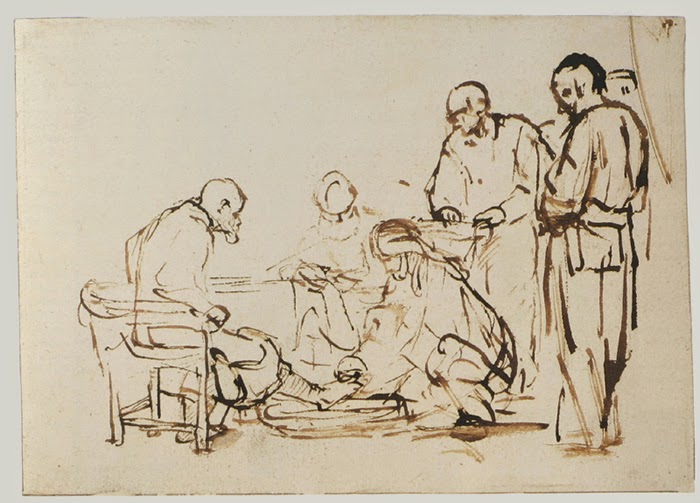
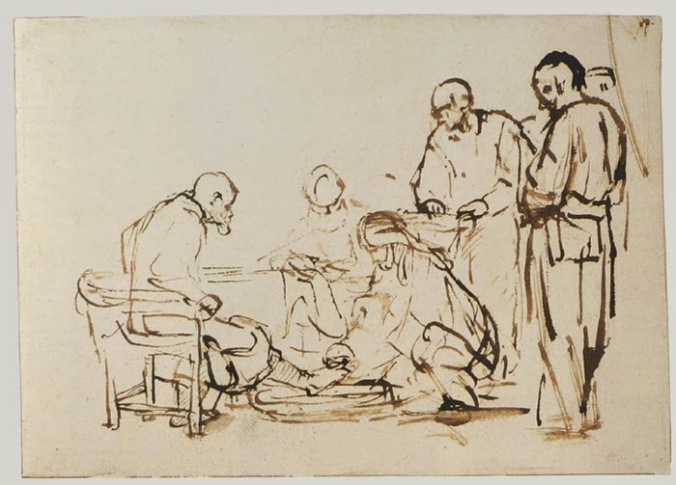
Jesus begins this evening by removing his clothes, taking water, and washing his disciples’ feet. He, the son of God, who was with His Father before the universe and time began, kneels before his disciples, and serves them. He takes the place of a slave or a servant and shows us as Christians that to follow Him is to serve. Never did a cross redeem nature from the curse: never was a lamb set upon the altar that could take away the sins of the world, until God took on the nature of the servant. We as Christians are to serve one another; we are to wash one another’s feet, to help each other to pray for each other, and not to think that any of us is better than the other.

Despite what the world may think about clergy: that we are weak, ineffectual, and well-meaning, or that we love to lord it over our flock, to stand pontificating six foot above criticism, we are in all things to fashion our life and example after Christ. In giving an example of service before the Last Supper, in praying for and setting apart his disciples as the first priests of his church, we who follow in their footsteps are shown in the clearest possible way that to love him, to care for his people is to serve them: we are to imitate the mysteries which we celebrate: offering our lives in His service and the service of His Church. It is truly extraordinary that we should have such a responsibility placed on our shoulders. We are all of us, if the truth be told, incapable of such a task if we were acting solely in our own strength and our own abilities. But through the Grace of God, and with the help of the prayers of you, God’s people, it is our hope that we may conform ourselves ever more closely to Christ, our great high priest.

Priests are amongst other things set apart for the service of God and the administration of His sacraments. At this time on this night, Jesus gives us himself, His Body and Blood to feed us, to nourish us, to strengthen us and to help us become what he is. So that we may share in the outpouring of love which is the very life of God, that we may be given a foretaste of the heavenly banquet, that we may experience something of the joy and love and life which awaits us in heaven, forever united with the triune God.

To do this Our Lord takes bread and wine, simple ordinary foodstuffs, to transform them, to make something other than they are to view them with new meaning and new life, to strengthen and heal his mystical body of the church with his own true body and blood. It is remarkable and extraordinary, words cannot fully express our awe that we poor wretched sinners, though unworthy are fed by our Lord as both priest and victim. It is not something for us to understand with our minds, but a mystery for us to enter with all our lives.

Jesus, receiving the cup, gave thanks and gave it to them saying: drink ye all of this, for this is my blood for blood of the new and everlasting covenant which will be shed for you and for many so that sins may be forgiven. This is my blood, he says, which is to be shed. The blood shed and this blood are not two different things, but one and the same. Tomorrow it shall be shed from my side, tonight you drink it and behold it in the cup.

We here, tonight, have come together as the people of God, to be fed by God to be strengthened by him, to live lives in his service. Both tonight and tomorrow, we will see how God loves us. In his service, in his giving of himself to be taken, beaten, falsely accused, scourged and crucified, God shows us what true love, true glory, and true service are. The world cannot understand this: it goes against everything people are told about putting themselves and their lives first, to judge their importance or worth by what they own, rather than how they live their lives. And yet this world is wounded by sin, the image of God is marred. In its selfish searching, what it truly wants and needs is to be healed, to be embraced by a loving God. That is why it tomorrow on the cross our Lord’s Arms will be flung wide open to embrace the world with God’s love.

Let us then prepare ourselves, let us have our feet washed by Christ, let us be fed by him, with him, strengthened by him, to fashion our lives after his. Let us prepare to go to Calvary with him, laying down our lives in his service, picking up our Cross and following him, to death and beyond, to the new life of Easter. Let us live his risen life, and share our joy with others, that the world may believe and trust in God the Father, God the Son, and God the Holy Spirit, to whom be ascribed as is most right and just all might, majesty, glory, dominion and power, now, and forever…

e726c-christ_washing

Rembrandt Christ washing the disciples’ feet, (c.1645)  Rijksmuseum, Amsterdam

Sunday, 4 January 2015

Christmas II

We live in a world which is obsessed by time. The pace of modern life is quite different to that of a generation or two ago. Despite the advent of labour-saving devices and technology we seem if anything busier than ever as other things come along to fill our time – we can feel pressured, worried, and anxious. This isn’t good; we can’t help feeling that this isn’t how it is supposed to be. Thankfully God doesn’t work like this. The people of Israel have been waiting for a Messiah, for a Saviour to be born, who will save Israel from their sins, but it isn’t a case of birth on demand. As St Paul writes to the church in Galatia (Gal 4:4-5) ‘But when the fullness of time had come, God sent forth his Son, born of woman, born under the Law, to redeem those who were under the Law, so that we might receive adoption as sons.’ God’s time is not our time, and the Incarnation happens not at a convenient time, but in the fullness of time – after the message has been proclaimed by the prophets, who prepare the way for the Saviour; after Mary has said ‘yes’ to God, a ‘yes’ which can undo the ‘no’ of Adam and Eve.
            This is why, at the start of his Gospel, St John, the beloved disciple, can begin right at the start of salvation history, indeed with Creation itself: his opening words ‘In the beginning’ point us straight back to the opening words of Genesis, in Hebrew Beresith ‘In the beginning’. This is where it all starts, where everything that is starts,  and the Word through which God speaks creation into existence, this creative power of God is what will take human flesh and be born of the Virgin Mary. The enormity of this situation should not be lost on us, we cannot think about it too much, the helpless infant born in a stable is God, who created all that is, or has been, or will be, and who comes among us weak, helpless and vulnerable, dependent upon the love and support of father and mother for everything. Christ shares our human existence from birth to death, so that we may know that ours is a God who comes among us, who comes alongside us, who is not remote, but involved, a God of love.
            St John take us back to the beginning so that we can see what we are dealing with, and how it fits into the bigger picture. What we are celebrating at Christmas is something which extends through time, both in its nature and its effects. It is why we as Christians make such a big deal of Christmas – it isn’t just something to do in the middle of winter, but along with Our Lord’s Passion, Death, and Resurrection , the most wonderful and important moment of history, which affects us here and now. What was made known to the shepherds we now proclaim to the world, what symbolically is shown in the Solemn Feast of the Epiphany, which we prepare to celebrate, where the Wise Men point to the manifestation of Christ’s Divinity to the whole world.
            ‘And the Word was made flesh and dwelt among us, and we have seen his glory, the glory as of a father’s only son, full of grace and truth.’ The reality of the Incarnation, of God with us, Emmanuel, that God lives with us, sharing our human life, shows us the glory of God, that from which Moses hid his face in the Exodus is now made plain, and displayed for all to see, a proclamation of the glory, the love, and the goodness of God, shown in our adoption as children of God, given an inheritance – eternal life and a relationship with God – a humanity restored and healed. This is the light which shines in the darkness of our world, which it cannot overcome. John the Baptist testifies to this, the Wise Men kneel in adoration before Him, bringing gold for a King, Incense for the worship of God, and myrrh which points to His Death on the Cross for our salvation. Their gifts show that they understand and value who and what Christ is, and what He does.
            Are we to be like the world, which though it was created through Him does not know him? Or like his own people, who did not accept Him? Or do we receive Him, and believe in His Name, which is above every name? Do we accept the invitation to become children of God, and do we respond to it? Do we accept the challenge to live as the family of God, loving and forgiving, as those who are loved and forgiven by God, so that our lives, yours and mine, proclaim the glory and truth of God, and the message of salvation for all the world to hear? If we accept our inheritance, the fact that there is now a familial relationship between us and God, we need to understand that with that relationship comes duty and responsibility.

            And yet we do not see this as something imposed upon us, but rather as the truth which sets us free: a relationship with a God whose service is perfect freedom. So let us walk in His light, dwell in His love, and know the fullness of His joy, let us be glad that as a pledge of His love He gives Himself, under the outward forms of bread and wine, to feed us with His Body and His Blood, a sign that His promise is true, that we can have a foretaste of Heaven, food for our journey of faith here on earth, so that we may know his love, and touch it and taste it, so that we can be strengthen to live that faith and to proclaim it by word and deed, so that all the world may enter into His joy, and live His life. 

Sunday, 16 November 2014

Living the life of the Kingdom - The parable of the Talents

Oh No! It’s a parable about money. Does it mean that the vicar is going to keep on about the Parish Share and the state of the Diocesan Finances? Well I’m sorry to disappoint you, I’m not. I just thought that I’d clear that one up right away, just to put your minds at rest, so that we can get on with the task of drawing closer to the word of God, and to be nourished and strengthened by it.
Reading Holy Scripture, the Bible, can be a strange affair: sometimes it fills us with joy, sometimes it just leaves us confused. Speaking personally, I find the parable of the talents troubling, mostly because I tend to feel rather like the slave who was given one talent and who hid it in the ground. That may well be my own sense of unworthiness informing my reading of the passage, which reminds me of the need in all things to trust in God, and for his grace to be at work in me. The judgement thankfully is not my own, but rather God’s – a loving father who runs to meet his prodigal children. This is a God we can trust, who wants to see us flourish.
No parable has been more misused than Jesus' parable of the talents. Once a parable is abstracted from Jesus proclamation of the kingdom of God, once it is divorced from its apocalyptic context – pointing to the future, such misreading is inevitable:  speculation begins, for example, about how much talent might be or whether the Master’s observation that the money could have been put in a bank might mean that Jesus approves of taking interest. Speculative uses of the parable have even been employed to justify economic practices that are antithetical to Jesus’ clear judgement that we cannot serve both God and mammon. After all, money is a means, and not an end – which is where we and the world often go wrong.
Jesus is not using this parable to recommend that we should all work hard, make all that we can, to give all that we can. Rather, the parable is a clear judgement against those who think they deserve what they have earned as well as those who do not know how precious is the gift they have been given.
          The slaves have not earned their five, two, and one talents. They have been given those talents. In the parable of the Sower, Jesus indicated that those called to the kingdom would produce different yields. These differences should not be the basis for envy and jealousy, because our differences are gifts given in service to one another – so are the talents given to the slaves of a man going on a journey. It is not unfair that the slaves were given different amounts. Rather what is crucial is how they regarded what they had been given.
          The one who received one talent feared the giver. He did so because he assumed that the gifts that could only be lost or used up. In other words the one with one talent assumed that they were part of a zero-sum game - if someone wins, someone else must lose. Those who assume that life is a zero-sum game think that if one person receives an honour someone else is made poorer. The slave who feared losing what he had, he turned his gifts into a possession – it was a thing, and it was his thing. But by contrast, the first two slaves recognised that trying to secure the gifts that they had been given means that the gifts would be lost – so they use the gifts for the glory of God. The joy of the wedding banquet is the joy into which the Master invites the slaves who did not try to protect what they had been given is the joy that comes from learning to receive the gift without regret, without fear – simply humbly, joyfully and lovingly.
          The parable of the talents just like the parable of the five wise and five foolish bridesmaids are commentaries on the slaves who continue to work,  who continue to feed their fellow slaves, until their master returns – they are parables which teach us how to be a church of loving service. Each of these parables teaches us to wait patiently as those who have received the gift of being called a disciple of Jesus. Jesus' disciples are not necessarily called to great things. Rather, Jesus’ disciples are called to do the work that Jesus has given us to do: our work is simple and it is learning to tell the truth and love our enemies. Such work is the joy that our Master invites us to share. It is in doing this work that we are separated – sheep from goats.
          It may sound pedestrian, or even humdrum, but living the Christian life, living the life of the Kingdom, is at a day to day level about keeping on keeping on – loving, forgiving, praying – nourished by the Body and Blood of Christ, fed by Him, and with Him, freed from the fear which is the antithesis of the Kingdom, rejoicing in the gifts which God gives us, being thankful for them, and using them for God’s glory. It is what each of us, and indeed all of us together are called to be, in this we can be built up in love, together, and invite others to enter into the joy of the Kingdom, so that they may come to believe in and serve God the Father, God the Son, and God the Holy Spirit, be ascribed this is most right and just all Might,  Majesty, Glory, Dominion, and Power now and for ever...

Sunday, 5 October 2014

A Harvest Sermon

It is good to celebrate Harvest because it is a celebration of what the Church is all about.
If you were about to go to a foreign country the first words you would learn would probably be ‘Please, Thank you, and I’m sorry’ ‘os gwelwch yn dda, diolch, mae’n ddrwg gen i’ along with greetings like Hello and How are you? They’re basics of conversation, they help us to be understood, they make people willing to listen to us, because to use them is polite, not to use them is impolite.
We teach them to our children and encourage them to use them. And in the same way theta they’re useful in conversation when we pray, when we talk to God, and listen to Him, as we do in Church and in our lives we need to use these words in prayer. In our prayer we ask God for things, we say thank you to God for things, and we say sorry for what we’ve done wrong or haven’t done. It is important that our prayers just like our every day conversation are appropriate and polite – it helps form our character, and helps us to live out our faith.
Harvest is mostly about saying thank you to God, for the gifts of his creation, for the food we eat, for all that the earth provides As well as recognising the gift we realise that it is also our duty to share what we are given with the hungry, the poor and the need, so that all may be fed – it is no good living in a world where people go hungry – it produces enough food so that everyone can have enough to eat, so that everyone can say thank you to God for the gifts of his creation. It is up to us as the church to ensure that we live out the generosity which we receive from God in Our Lives.
This caring sharing vision of the world is what the prophet Isaiah envisions in his vision of the Kingdom of the Messiah – That’s here and now, it’s not some future hope, but rather it’s how we’re meant to be right here and now.
The celebration of harvest is not a new thing – it goes back to the central festivals of Judaism – Jesus gave thanks for the harvest – and so should we, because in giving thanks we recognise the greatness of God’s generosity, we recognise our own dependence upon God and each other, and we help to ensure a culture of thankfulness.
        In the feeding stories in the Gospels, one of which follows our second reading, Jesus thanks God and blesses the offerings of food. When the Church celebrates the Eucharist bread and wine are taken, blessed shared and given so that we the Church can carry on doing exactly what Jesus did, not because it’s nice or fuzzy or nostalgic but because he tells us to do it, and we listen to him. Christ alone can satisfy our spiritual hunger and thirst – only when we are fed by Him, the living bread which came down from heaven can we have eternal life in Him.
As the Prophet Isaiah says: ‘For as the heavens are higher than the earth, so are my ways higher than your ways and my thoughts than your thoughts.’ We see this most fully in God’s gift of His Son, to show humanity how to live and to give Himself to die and be born again, to take away our sins and to restore our relationship with God and each other. It is an act of supreme love and generosity – giving people something which they do not deserve so that they may be transformed by it into the loving generous people God longs for us to be.
The miraculous feedings and the Eucharist point to the Cross where Christ gives himself for love of us- our response should be one of generosity and service, because it matters. The Church is decorated with the fruits of the Harvest through the generosity and effort of people who want to put their faith into action – we are grateful that they have done so much to help us celebrate – to help us to say thank you to God, to recognise all that we have to be thankful for. In our saying thanks to God, let our thankfulness not be something we do here once, but rather let it form our lives so that we may be thankful at all times and in all places. May we be grateful people, loving people, sharing people, whose faith shines through all that we are or say or do, nourished by the Word of God, by the sacraments of the Church so that we may filled with God’s love and transformed by His Grace, that we too may be an offering to God, sharing our love and our faith with the world around us, putting it into practice so that it too may reap a great harvest, a harvest of souls, to the Glory of God.
Let us work to prepare for a harvest of love, of generosity, and forgiveness, sowing seeds of love in the soil of our lives, and those of others, confident in the promises of God that He may reap the harvest, that the world may be transformed to sing his praise, to rejoice in his love, and to share it with others.

 Here is the proclamation of the covenant faithfulness of God, which finds its fulfilment in Christ, As we are mindful of this we give thanks to God and let that thankfulness become a defining characteristic of our lives, overflowing into all that we are or think or do, Thus we live out our faith, we live life in all its fullness and encourage others so to do so that they may believe and give Glory to God the Father, God the Son, and God the Holy Spirit, to whom be ascribed as is most right and just all might, majesty, glory, dominion, and power, now and forever.

Wednesday, 16 April 2014

The Mass of the Lord's Supper


Since our Divine Lord came to die, it was fitting that there be a Memorial of his death. Since he was God, as well a man, and since he never spoke of his death without speaking of his Resurrection, should he not himself institute the precise memorial of his own death? And this is exactly what he did the night of the Last Supper....His memorial was instituted, not because he would die and be buried, but because he would live again after the Resurrection. His Memorial would be the fulfillment of the Law and the prophets; it would be one in which there would be a Lamb sacrificed to commemorate spiritual freedom; above all it would be a Memorial of a New Covenant...a Testament between God and man.
Fulton J. Sheen Life of Christ

My brothers and sisters, on this most sacred night Our Lord and Saviour did three things: He washed his disciples’ feet, he instituted the Eucharist, and inaugurated the priesthood of the New Covenant. We have come together on this most holy night to enter into the Mystery of Our Lord’s Passion: to be with him in the Upper Room and in the garden of Gethsemane, and to prepare to celebrate his suffering and death – to behold the glory of the Lord and his love for the world he created and came to save.
          Obedient to the Old Covenant, Our Lord and his disciples prepare to celebrate the Passover: the mystery of Israel’s deliverance from slavery in Egypt to the new life in the Promised Land. While they are at table Our Lord lays aside his outer garments and takes a basin and a towel and washes the Apostles’ feet. He then says to them ‘Do you understand what I have done to you? You call me Teacher and Lord, and you are right, for so I am. If I then, your Lord and Teacher, have washed your feet, you also ought to wash one another's feet. For I have given you an example, that you also should do just as I have done to you. Truly, truly, I say to you, a servant is not greater than his master, nor is a messenger greater than the one who sent him. If you know these things, blessed are you if you do them.’ (Jn 13:12–16 ESV) God, who created the universe and who will redeem it, kneels and washes the feet of sinful humanity. This is true love in action. Only having done this can Jesus say ‘A new commandment I give to you, that you love one another: just as I have loved you, you also are to love one another. By this all people will know that you are my disciples, if you have love for one another.’(Jn 13:34–35 ESV) What he says to his disciples he says to us here tonight. As Christians we are to love him and one another, we are to show this love in all that we say, or think, or do, so that the world may believe.
          Christ then takes bread and wine and blesses them and gives them to his disciples. Again, this would look and feel like the Passover celebration to which they were accustomed. Except that before he broke and distributed the bread he said ‘Take, Eat. This is my body, which is given for you. Do this in remembrance of me.’ And before the Cup was distributed he said ‘Drink of it, all of you, for this is my blood of the new covenant, which is poured out for many for the forgiveness of sins. Do this, as often as you drink it, in remembrance of me.’ He feeds his disciples with his own body and blood to strengthen them, to show them what he is about to do for love of them and of the whole world. When, earlier in his public ministry, he has fed people he taught them in the synagogue at Capernaum ‘Truly, truly, I say to you, unless you eat the flesh of the Son of Man and drink his blood, you have no life in you. Whoever feeds on my flesh and drinks my blood has eternal life, and I will raise him up on the last day. For my flesh is true food, and my blood is true drink.  Whoever feeds on my flesh and drinks my blood abides in me, and I in him. As the living Father sent me, and I live because of the Father, so whoever feeds on me, he also will live because of me.’ (Jn 6:52–7 ESV). ‘Was ever another command so obeyed? For century after century, spreading slowly to every continent and country and among every race on earth, this action has been done, in every conceivable human circumstance, for every conceivable human need from infancy and before it to extreme old age and after it, ....  just to make the plebs sancta Dei—the holy common people of God’ [Dix The Shape of the Liturgy 744] Our Lord institutes the Eucharist, the Sacrament of His Body and Blood, to feed us, to nourish us, so that we may become what he is, that we may have a foretaste of heaven and the divine life of love, of the beatific vision of God, Father, Son, and Holy Spirit, the Holy, Eternal and Consubstantial Trinity. It re-presents, it makes present again, here and now, the sacrifice of Calvary, where upon the Altar of the Cross, as both priest and victim, Christ sacrifices himself for the sins of the whole world. He is the Lamb of God, foreshadowed in the ram offered by Abraham and Isaac, in the bread and wine offered by Melchisedek. In the blood and water which will flow from his side we are washed and creation is renewed. Christ gives the Church the Eucharist so that his saving work may continue, so that people may be given a pledge and token of their eternal life in him.
          Christ sets apart his disciples so that they may be priests of the new covenant in his blood, so that they may continue to share in the offering of himself for their sins and those of the whole world. They are washed, and fed, and taught – prepared for the work of the Gospel: spreading the Good News of Jesus Christ and feeding his faithful with his body and blood. They are told to do this and they still do. Never have such words and actions had such a profound effect in all of human history. This is the glory of God: in transforming bread and wine into his very self for the life of the whole world – a sign of love and a pledge and foretaste of eternal life. This is love that we can touch and feel and taste – given for us so that we might have life in him.

So let us come to him, to be fed by Him, and with Him, healed and restored by Him, through the sacraments of the Church, his body, so that we may be prepared to share in his Passion and Death and to celebrate with joy the triumph of His Paschal victory, so that we and all the earth may give praise to God the Father, God the Son, and God the Holy Spirit, to whom be ascribed as is most right and just, all might, majesty, glory dominion and power, now and forever.

Tuesday, 8 April 2014

A thought for the day from Br Roger

Assured of your salvation by the sole grace of our Lord Jesus Christ, you do not impose discipline on yourself for its own sake. Gaining mastery of yourself has no other aim than to render you more available. No pointless abstaining; keep to what God asks. Bear the burdens of others, accept the minor hurts each day brings, so as to to share concretely in the sufferings of Christ: this is our first discipline.

from the Rule of Taizé

Sunday, 16 March 2014

Homily for Lent II (John 3:1-17)


The sight of a crucifix has a continuity with Golgotha; at times its vision is embarrassing. We can keep a statue of Buddha in a room, tickle his tummy for good luck, but it is never mortifying. The crucifix somehow or other makes us feel involved. It is much more than a picture of Marie Antoinette and the death-dealing guillotine. No matter how much we thrust it away, it makes its plaguing reappearance like an unpaid bill.
Fulton J. Sheen Those Mysterious Priests 1974: 101—102

Baptism is a wonderful thing, and it is why each and every one of us is here today. It is how we enter the Church, how we become part of the body of Christ, sharing in His death, and His resurrection. It is something for which people have traditionally prepared during this season of Lent, for Baptism and Confirmation at Easter, so that they can die with Christ and be raised to new life with Him. We enter into the mystery of Christ’s saving work so that we may conformed to it and transformed by it, believing and trusting in him, publically declaring our faith in Him, and praying for His Holy Spirit, so that our lives may be transformed – living for Him, living in Him, and being transformed more and more into the likeness of Christ.
            To be drawn into His likeness means coming closer to His Cross and Passion: just as Moses lifted up the serpent in the wilderness, so must the Son of Man be lifted up (Jn 3:14). Just as the serpent in the desert brought salvation to the people of Israel, so now the Cross is our only hope – the sacrifice of God for humanity, not something we can give God, but something he gives us – a free gift of infinite value. God gives it to us and to all the world for one simple reason – love, for love of us – weak, poor, sinful humanity, so that we might be more lovely, more like Him. God sends His Son into the world not to condemn it, but so that the world might be saved through Him – an unselfish act of generosity, of grace, so that we might be saved from sin and death, from ourselves, so that we can share new life in Him.
            It is that same sacrifice which we see here, which we can taste and touch, which we can eat and drink, so that our lives and our souls can be transformed to live Christ’s risen life. It is something which we treat with the uttermost reverence because it is God, given for us, because it can transform us to live as children of the Holy Spirit, freed from the shackles of this world, free to live for Him, to live as He wants us to, His new creation, of water and the Spirit. This is what the Church has done on a hundred thousand successive Sundays, in memory of Him, to make the holy people of God. To make us holy: so that everything which we say, or think, or do, may be for His praise and glory, living out the faith which we believe in our hearts, as a sign to the world that the ways of selfishness and sin are as nothing compared with the generous love of God.
            So great is this gift, that we prepare to celebrate it with this solemn season of prayer, and fasting, and abstinence, to focus our minds and our lives on the God who loves us and who saves us. We prepare our hearts and minds and lives to celebrate the mystery of our redemption, so that our lives may reflect His glory, so that we may live for Him, fed by Him, fed with Him, with our lives and souls transformed by Him. We are transformed so that we can transform the world so that it may live for Him, living life in all its fullness: living for others, living as God wants us to live. Living the selfless love which saves us and all the world, living out our faith, and encouraging others so to do, can and will conform us to Christ, so that we may be like Him, and become ever more like Him, prepared for eternal life with Him, so that we may sing the praises of God the Father, God the Son, and God the Holy Spirit, to whom be ascribed, as is most right and just, all might, majesty, glory, dominion, and power, now and forever.