Showing posts with label Faith. Show all posts

Saturday, 26 June 2021

Trinity IV

Each and every one of us is in need of healing, be it physical, psychological or spiritual. Our bodies, minds, and souls need it. It is a truth of human existence that we are all broken, and while medicine can heal our bodies, we still long for life in all its fulness. The Kingdom of God, proclaimed and inaugurated by Jesus Christ is a place of healing, and through our relationship with Jesus we can find the wholeness for which we long. This is why the Gospels contain healing miracles. These miraculous accounts are signs of God’s restoration of creation through His Son, something which will culminate with His Passion, Death, and Resurrection. 

In the Gospel Jesus has sailed back across the Sea of Galilee to the Jewish side. On His arrival He is greeted by the leader of a local synagogue whose daughter is close to death. Jairus longs for his child to be healed, and asked Jesus to place His hands on her, so that she might be saved and live.

While Jesus is going to heal Jairus’ daughter, another miracle takes place. Lots of people are following Jesus, which is understandable since He is a charismatic preacher and teacher, who heals people. In the crowd is a woman with a gynaecological complaint. It would have made her life extremely difficult, and in Jewish ritual terms she would have been regarded as impure. She would not have been able to play her part in religious life. Also she would not have been able to bear children, and her husband, according to Jewish law, could have divorced her. She was an outcast, unclean, thrown on the metaphorical scrapheap of society. What money the woman had, she had been spent on doctors in trying to find a cure, but they only made things worse. Now she was penniless and desperate. But this pale, weak woman had an idea:

‘She had heard the reports about Jesus and came up behind him in the crowd and touched his garment. For she said, “If I touch even his garments, I will be made well.” And immediately the flow of blood dried up, and she felt in her body that she was healed of her disease.’ (Mk 5:27-29)

Despite her physical infirmity, this woman has faith. She trusts Jesus, and believes that if she touches His clothing she will be healed. Such healing would restore her to community and allow her to take part in its religious life. She places her faith in God, realising that He can do for her what humanity could not. 

Jesus then notices that power has gone out from Him. He is aware of what has happened. Having asked who touched Him, Jesus’ disciples reply that it was accidental: they are surrounded by a crowd, anyone could have brushed against Him. Our Lord remains unconvinced:

‘And he looked round to see who had done it. But the woman, knowing what had happened to her, came in fear and trembling and fell down before him and told him the whole truth. And he said to her, “Daughter, your faith has made you well; go in peace, and be healed of your disease.”’ (Mk 5:32-34)

The woman comes ‘in fear and trembling’ not because she is afraid of Jesus, but because it is the proper way for humans to act in the presence of God. She is filled with awe at her experience of divine healing. Jesus’ reply is astounding for several reasons. Firstly, that He responds at all: talking to a woman who was not a member of your family was frowned upon, let alone a woman who is a ritually unclean outcast. Jesus is breaking a social taboo. He addresses her as ‘daughter’, a reminder that Jesus’ family are not those related to Him in earthly terms, but those who do God’s will. The woman is a daughter of God and her faith in God has healed her. She trusted God to do what the physicians could not. Faith is the route to salvation and healing, trusting God to be at work. She can go in peace because she has been restored to health. Peace is God’s gift to us, that we may experience wholeness. Finally, Jesus underlines that what has happened is not a temporary healing, but a permanent state of affairs.

While Jesus is still speaking to the woman, messengers come to give Jairus a message:

“Your daughter is dead. Why trouble the Teacher any further?” (Mk 5:35)

The situation is hopeless, and in their eyes there is nothing that Jesus can do. Thankfully, Our Lord has other ideas:

‘But overhearing what they said, Jesus said to the ruler of the synagogue, “Do not fear, only believe.”’ (Mk 5:36)

This fear is not the awe shown by the woman who has been healed, but a lack of trust in God. We know from the Letter to the Hebrews that:

Faith is the assurance of things hoped for, the conviction of things not seen. (Heb 11:1)

Jairus has demonstrated his faith by prostrating himself before Jesus and asking for healing. Now, in the face of his daughter’s apparent demise, Jairus must trust God to be at work. 

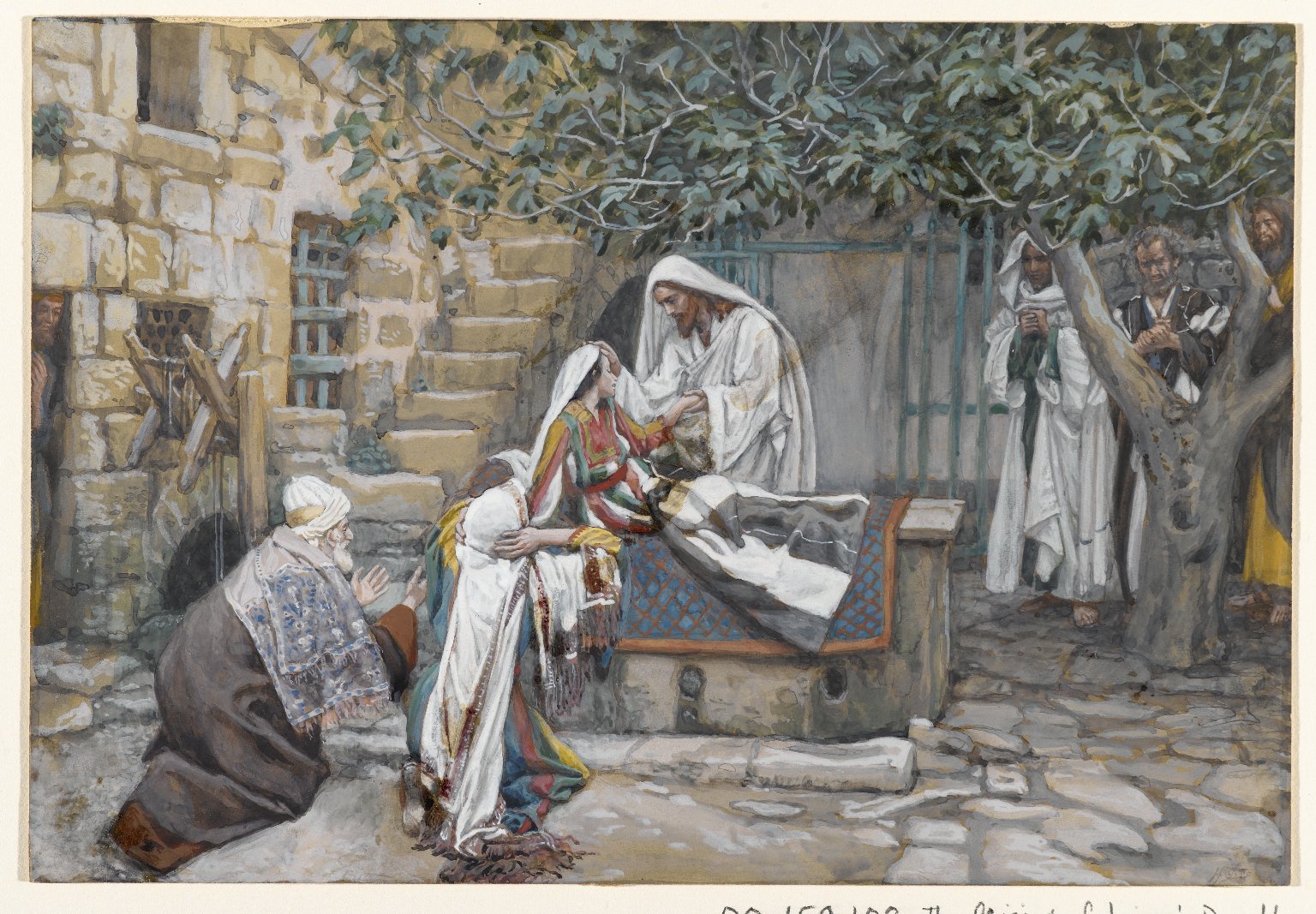
‘Taking her by the hand he said to her, “Talitha cumi”, which means, “Little girl, I say to you, arise.”’ (Mk 5:41)

Note the fact that Jesus takes the girl by the hand. To touch a dead body would make a person ritually impure. This is why the priest and Levite in the Parable of the good Samaritan pass by on the other side. Jesus disregards the taboo of uncleanness, and speaks to her. He speaks to her in Aramaic, her mother tongue, and says literally ‘little lamb, get up’. It is a term of endearment which also reminds us that Christ is the Good Shepherd who cares for His lambs, keeps them safe, and saves them from death. 

The people who are there: Jairus and his wife, Peter, James and John are all amazed. They are filled with awe, the holy fear of witnessing the mighty works of God. It reminds us that as humans we relate to God primarily through worship. Finally, Jesus tells her parents to give her something to eat, which shows us the reality of her resurrection. This also points towards the feast of the Kingdom, which we hope to enjoy in Heaven, and which is prefigured in the Eucharist. Through physical and spiritual communion Christ gives Himself to feed us, and heal our bodies and our souls, and assures us of eternal life.

Like Jairus and the haemorrhaging woman, may we have faith, and come to Jesus for healing. So that we may come to the Feast of the Lamb and may sing the praises of God the Father, God the Son, and God the Holy Spirit. To whom be ascribed, as is most right and just, all might, majesty, glory, dominion, and power, now and forever. Amen. 

James Tissot The woman with the Issue of Blood
James Tissot The Raising of Jairus’ Daughter

Saturday, 1 May 2021

Easter V

It is difficult for us to understand just how hard it was for the disciples to accept Paul of Tarsus into the Christian community. We first meet St Paul during the martyrdom of St Stephen. Paul wants to do everything he can to eradicate the Church and the followers of Jesus. He is a zealous opponent of everything the Church stands for. Paul wants to persecute the Church, but thanks to a dramatic encounter with Jesus, he undergoes a conversion. Her greatest enemy becomes her most zealous advocate. Paul goes from one extreme to another: from hating the Church to loving her. Thus is it perfectly understandable that when Paul comes to Jerusalem and tries to see the disciples, they react in a negative way. 

This is the situation in our first reading this morning from the Acts of the Apostles. The disciples are afraid, and think, understandably, that it is an elaborate hoax, a trap designed to end in their arrest and subsequent death. They are wary of Paul, and doubt that his conversion is genuine. But their natural reluctance is overcome thanks to the faith and generosity of St Barnabas. Barnabas, whose name in Hebrew means ‘son of consolation’ (Acts 4:36), literally embodies the Holy Spirit. Everything that Barnabas says or does in the Acts of the Apostles can be understood in terms of how God acts in the world through the Holy Spirit. Here he vouches for Paul, and encourages the brethren that Paul’s conversion is genuine. He bears witness to the truth, and builds up the Church. 

St Paul starts to preach in Jerusalem, and engages in debate with the Hellenists, Greek-speaking Jews from around the Mediterranean, people that he and Barnabas would know well. These people are not happy that one of their own has converted, so they plot to kill Paul. They feel betrayed, and want to take their anger out on the traitor. So the disciples take Paul to Caesarea, from where he could set sail for his native Tarsus, in Asia Minor, and be safe. Peace returns to the Holy Land, and the Church thrives. The comfort of the Holy Spirit in Acts 9:31 describes perfectly how a loving and generous Christian, such as Barnabas, acts.

Our second reading reinforces this message by reminding us that for Christians love is not a word, but an action. Love is something you do. In other words, our faith is something which we live out in our lives. We are called to believe in Jesus and to love one another. As St Thomas Aquinas explained, to love is to will the good of another. To love, then, is not simply an act of passion or emotion: something which we feel, but rather something we choose to do. To choose someone else’s good reminds us that we do not exist for our own sake, and that our lives are lived in community and relationship with others. We are called to be loving and generous, just as God has been loving and generous towards us in Christ. We are to love each other as Jesus has loved us. We are to lay down our lives, as Christ has for us. In this love and service we can truly love each other. This makes who and what we are manifest to the world around us. It makes Christianity something attractive because people can see the difference it makes. We are people of love and a community of love, cooperating with God in promoting human flourishing. Such love is a radical and world-changing idea, underpinned by selfless love, of Christ, to help transform the world so that all humanity may experience life in all its fullness. 

In today’s Gospel Jesus is speaking to His Disciples after the Last Supper. He uses the image of Himself as the Vine, and the disciples are the branches. It is a powerful vision of what the Church is, people who are grafted onto and into Christ, connected to Him, and in a relationship with Him. We entered into that relationship in our baptism, and it is a relationship which will continue throughout and after our life on earth. 

When we were baptised we were clothed with Christ, we were grafted into the vine, which is Christ. It is Christ’s will that we, as Christians, bear much fruit. This means that we live out our faith in our lives, so that it affects who and what we are, and all that we say and do. We do this because it is what Christ expects of us, but also because, as we read in the First Letter of John, 

‘The love of God was made manifest among us, that God sent his only Son into the world, so that we might live through him’ (1Jn 4:9).

Because we are grafted into Christ we are in communion with Him. Christ gives Himself to us in the Eucharist, His Body and Blood, so that we can have life in Him. He gives Himself to us out of love, so that we might have life in Him, and have it forever. It is a pledge of eternal life with Him, united in this world and the next, given to us to strengthen us on the journey of faith. Partaking in the Eucharist, physically or spiritually, helps us live out our faith in our lives: fed by and with Christ, to live in Him and for Him. 

Christ gives Himself for us, and desires that we are united with Him so that we may be strengthened to live out our faith in our lives, and to continue to proclaim the Good News of the Kingdom by word and deed. Christ desires that we stay close to Him, and be united with Him, so that we can live lives of love. As Christians we are called to be Christ’s disciples, living in Him, living for Him, proclaiming Him, and bearing much fruit. We do this so that the world may believe and give glory to God the Father, God the Son, and God the Holy Spirit, to whom be ascribed, as is most right and just, all might, majesty, glory, dominion, and power, now and forever. Amen

Saturday, 16 January 2021

The Second Sunday of Year B

There is a common misconception that when the Church talks about vocation, being called, it is referring to the call to ordained ministry, to be a deacon or a priest. Nothing could be further from the truth. While this call is an important one, there remains a fundamental call which comes to us all in our baptism: the call to follow Christ. Each and every one of us is called to be a disciple of Jesus, to listen to what He says, and to let this call affect our lives. It is both a daunting prospect, and the most normal and natural thing in the world. 

Our first reading this morning tells the story of the call of Samuel, a young boy serving at the sanctuary in Shiloh with the high priest Eli. After his mother, Hannah, had prayed to God for a child whom she would dedicate to God as a Nazirite, she became pregnant and Samuel was born. Nazirites were not allowed to cut their hair, drink wine, or touch a dead body. Eli’s predecessor, Samson, the last of the Judges in the Book of Judges, was also a  Nazirite. Samuel is called three times. Each time he goes to Eli, whom he assumes is calling him. Eventually Eli tells Samuel to reply, ‘Speak, Lord, for your servant hears.’ (1Sam 3:9). So Samuel responds to God’s invitation, and it totally changes his life. Are we willing to take that risk, and answer God’s call?

Ancient Corinth was something like a cross between London and Las Vegas. It was a rich trading centre with a reputation for sexual immorality. This morning’s second reading from St Paul’s First Letter to the Corinthians, is an attempt to argue that our embodied existence, that is how we live our lives , matters. Often, we become what we do. It is therefore important to do the right thing, and not the wrong. Paul’s argument leads to his conclusion:

You are not your own, for you were bought with a price. So glorify God in your body. (1Cor 6:19-20) 

We are not our own, we belong to God, who bought us with the price of His Son, Jesus Christ. The world likes to tell us that we are autonomous, that we can do whatever we want to, but at a fundamental level we are God’s people, and belong to the God who made us, and who redeemed us out of love for us. God sets us free to love Him and serve Him, so how we live our lives is our response to that love and an act of loving service. We can choose to glorify God, not that God needs our glory, but because it is how we should live our lives, in love and service. Our faith affects our lived existence.

In today’s Gospel we move beyond the Baptism of Christ to the events of the following day. John has testified that Jesus is the Lamb of God, who takes away the sins of the world, and that He is the Son of God. When John sees Jesus walking by he again exclaims ‘Behold the Lamb of God’ (Jn 1:36). The phrase looks back to the Suffering Servant in Isaiah 52-53 who is led like a lamb to the slaughter. The beginning of Jesus public ministry points to its end on the Cross. Jesus is the Messiah and He will die to take away our sins. Two of John’s disciples hear him saying these words and follow Jesus. When Jesus asks them what they are looking for, the disciples answer ‘Rabbi’. They acknowledge Jesus as a teacher, and ask Him where He is staying. Jesus replies, “Come and you will see.” (Jn 1:39). Jesus invites them to follow Him, to see where He is staying and to spend time with Him. These two disciples of John become followers of Jesus, literally and metaphorically. The Church continues to make the same invitation to the world, to come and see, to follow Jesus. These two disciples stay with Jesus, they listen to Him, they eat with Him, and begin to have a relationship with Him. We then discover that one of the men is Andrew, and that he has a brother, called Simon. Andrew is convinced that he has found the Messiah and brings his brother to Jesus. When Jesus meets Simon he says,

“So you are Simon the son of John? You shall be called Cephas” (which means Peter) (Jn 1:42)

Jesus gives Simon a new name. He calls him Cephas, which means ‘rock’ in Aramaic, Petros in Greek, from which our name Peter comes. Peter will be the rock upon which Christ will build His Church (Mt 16:18). The name Jesus gives points to Peter’s future role as the leader of the Apostles. Jesus takes the initiative and begins to sketch out a future for the disciples who are following Him. It is quick, and matter of fact, and yet momentous. Jesus is gathering people to help Him with this ministry.

The Church therefore begins with a few Galilean fishermen following a rabbi whom they recognise as the Messiah. Thanks to them, and their faith in Jesus, we are in the Church today. Faith, where we put our trust, is an important thing. It affects both who we are, and how we live our lives. Faith turned Peter from a fisherman into a leader of the early Christians, and it has continued to transform lives for the past two thousand years. 

In our baptism, God in Christ invites each and every one of us to follow Him, to ‘come and see’, as the first disciples did, and to invite others, as Andrew invited Simon Peter. To come and see who Jesus is, to get to know Him, and start a relationship with Him. This begins with our sharing in His Death and Resurrection, and ends in the glory of Heaven. Where we, and all the Church, give glory to God the Father, God the Son, and God the Holy Spirit, to whom be ascribed, as is most right and just, all might, majesty, glory, dominion, and power, now and forever. Amen. 

Saturday, 14 November 2020

The 33rd Sunday of Year A (Prov 31:10-13, 19-20, 30-31, 1 Thess 5:1-11, Mt 25:14-30)

In the ancient world, as in today’s world, the domestic life of women was difficult. Without modern labour-saving devices, household chores were even more laborious and time-consuming. A wife would be expected to run a household, and it was hard and difficult work. Such a demanding role means that paragons in the domestic sphere were to be praised and prized. And, in the Book of Proverbs, we see such an example of industry, of hard work. Throughout Ancient Wisdom Literature, wisdom and industry go hand in hand, they are beautiful and good, as they come from the source of all beauty and goodness, namely God. An excellent wife is more valuable than jewels, because while precious stones possess beauty and value, they are not capable of doing good. 

The heart of her husband trusts in her, and he will have no lack of gain. (Proverbs 31:11)

As a result of the relationship between a loving husband and wife, their mutual prosperity is assured. This then leads to generosity:

She opens her hand to the poor and reaches out her hands to the needy. (Proverbs 31:20)

The point of wealth is not for it to be acquired for its own sake, but so that it may be a blessing to others. God wants humanity to flourish by being loving and generous. This theme runs through all our readings this morning.

St Paul’s First Letter to the Thessalonians is written to a community that is afraid of two things: death and the return of Jesus in Judgement. These are understandable emotions. However, while death and judgement are inescapable, they do not need to be feared. They are compared with the labour pains of a pregnant woman, which are often sudden and sharp. But if we live lives characterised by love, and we have faith in Jesus Christ who died and rose again for us, we have the hope of salvation. This is good news, and leads St Paul to write:

For God has not destined us for wrath, but to obtain salvation through our Lord Jesus Christ (1Thess 5:9)

Paul’s letter is written to encourage his fellow Christians, to allay their fears and to build up their faith, hope, and love, as a community:

Therefore encourage one another and build one another up, just as you are doing (1Thess 5:11)

We all of us need encouragement, especially when times are difficult, and when we are as afraid or unsure, as we are at the moment. It is good to be reminded that, in trying to lift each others spirits, we are behaving as a Christian community should.

In today’s Gospel, Jesus continues to talk about the future using parables. Just as with the Parable of the Wise and Foolish Virgins, Jesus begins by showing that he is talking about a future reality: how things WILL BE, not how they are now. This future reality is Christ’s return. Christians believe that Jesus will come again to judge the world. The theme of today’s parable, the Parable of the Talents is judgement. These days, we are not comfortable with ideas of judgement. Many of us remember preachers using ideas of hell-fire and damnation to fill people with fear. But the heart of the Gospel is love not fear, and perfect love casts out fear. 

In the parable the master goes on a journey and entrusts his property to his servants. He puts his possessions into their care because he trusts them to look after it. The servants who are assigned five and two talents are both praised for being ‘good and faithful’. They have acted morally and demonstrated their faith, and they will be rewarded. The problem is with the servant who was given just one talent and hid it in the ground. He explains his actions, saying:

‘Master, I knew you to be a hard man, reaping where you did not sow, and gathering where you scattered no seed, so I was afraid, and I went and hid your talent in the ground. Here you have what is yours.’ (Mt 25:24-25)

This servant does not love his master, he fears him. He does not take care of what has been entrusted to him, because he simply sees it as a possession, a thing. The servant loves neither his master nor what was entrusted to him. By hiding the talent in the ground, he squanders the opportunity his master has given him, because he is jealous and resentful. As all gardeners know, seeds produce different results, just as in the Parable of the Sower, but they all need to be sown in the first place. What we learn here is that bitterness and resentment have no place in the Kingdom, they are not compatible with a Gospel of Love. The tragedy is that the fearful servant condemns himself to being outside the Kingdom, by failing to recognise both generosity, and the value of a relationship. 

The Parable of the Talents, just like the Parable of the Wise and Foolish Virgins, is a commentary on the life of the Kingdom. These are stories of servants who are prepared and continue to work, until their master returns. They are parables which teach us how to be a Church of loving generous service, not one of fear.

It may sound pedestrian, or even humdrum, but living the Christian life, living the life of the Kingdom, is, at a day to day level, boring, difficult and repetitive. It is about ‘keeping on keeping on’ — loving, forgiving, praying –- nourished by the Body and Blood of Christ, fed by Him, and with Him, freed from the fear which is the antithesis of the Kingdom, rejoicing in the gifts which God gives us, being thankful for them, and using them for God’s glory. None of us fully deserve the gift of God’s love and forgiveness in Jesus Christ: we have not earned it. It is not a reward, but rather the gift of a loving God. It is a gift which we are called to receive, and it transforms our lives. The God who will come to judge us, and all humanity, is a God of love and mercy, whose hands bear the mark of nails, wounded for love of us. Judgement and mercy go hand in hand, and if we love God and love our neighbour, we are living the life of the Kingdom, here and now, free from fear. 

So let us live out that life together, encouraging one another, so that we may all be built up in faith, hope, and love, and together share in the joy of the Kingdom, so that all may know and love God the Father, God the Son, and God the Holy Spirit, to whom be ascribed, as is most right and just, all might, majesty, glory, dominion, and power, now and forever. Amen. 

Rembrandt The Parable of the Talents

Sunday, 8 November 2020

32nd Sunday of Year A: The Parable of the Wise and Foolish Virgins

There is a tradition of writing about Wisdom which can be found in the Bible, and across the Ancient Near East. Wisdom Literature seeks to explore the perennial questions of who God is and how humanity should live. The term ‘wisdom’ means much more than knowledge. It refers to how knowledge is used with judgement, something which comes with maturity and experience, and leads to our flourishing. In our first reading this morning we see Wisdom personified as a beautiful woman . If we love Wisdom, then we will recognise her easily. It stands to reason. Wisdom is an attractive quality. 

To fix one’s thought on her is perfect understanding, and one who is vigilant on her account will soon be free from care, because she goes about seeking those worthy of her, and she graciously appears to them in their paths, and meets them in every thought. (Wisdom 6:15-16)

To be wise is to be freed from care or anxiety. Nothing in life or death can trouble us because we have fixed our thoughts on Wisdom. Such wisdom comes from God, it is divine, and not human. In fixing our minds on Wisdom, we have fixed them upon God, the source of all wisdom, or as a prayer in the Prayerbook puts it:

Almighty God, the fountain of all wisdom, which knowest our necessities before we ask, and our ignorance in asking: We beseech thee to have compassion on our infirmities; and those things which for our unworthiness we dare not, and for our blindness we cannot ask, vouchsafe to give us for the worthiness of thy Son Jesus Christ our Lord. Amen 

Our second reading, from Paul’s First Letter to the Thessalonians, deals directly with questions of death and resurrection. Clearly some people have died, and there are members of the church community who are worried by this, so Paul is trying to allay their fears. He encourages them:

‘that you may not grieve as others do who have no hope. For since we believe that Jesus died and rose again, even so, through Jesus, God will bring with him those who have fallen asleep’. (1Thess 4:13-14)

This is our hope as Christians. Because Jesus died and rose again, and we share in His Resurrection, we know that our earthly life is not all that there is, that something greater awaits us. Paul has hope for the future, which is why our passage ends: 

‘Therefore encourage one another with these words’ (1 Thess 4:18)

Paul speaks of the future and Christ’s Second Coming to encourage the Church, to give it hope, and to remind us that God keeps His promises. We can have hope, because its source is God. Our ultimate aim is to be with God forever. Through what Christ has done we can have this hope. And on this Remembrance Sunday , we remember and give thanks for those who have gone before us and we encourage each other as a community.

In today’s Gospel Jesus continues His teaching about the Kingdom. Normally He says that, ‘The Kingdom of Heaven IS like…’ whereas in this passage He says, ‘the Kingdom of Heaven will be like…’ Jesus is teaching about the future, a future reality which will come to be, rather than something which is already the case. This future reality is His return. Christians believe that Jesus will come again to judge the world. 

The parable pictures this as the return of the bridegroom. The problem is that half of the virgins were not prepared and did not have spare oil to keep their lamps lit. The bridegroom has been  delayed and the virgins have become drowsy, and have fallen asleep. When the bridegroom eventually arrives half of them are not ready, and have to go to buy oil. They therefore miss meeting the Bridegroom and so are shut out of the marriage feast. This may sound harsh, but Jesus tells the parable to warn us to be prepared, to be vigilant. 

The point of the Parable of the Wise and Foolish Virgins, is that we will not know when Jesus will return, so we need to be ready to greet Him when He comes. This is not just to be ready in practical terms, but also in spiritual ones. How are we ready to meet Jesus? Are we living out our faith in our lives? Have we got things ‘in order’? Just as wisdom comes with age, so we can use our lives to prepare. Such preparations are wise, and a joint effort: we can prepare together. That is what the Church exists for: to help us to get ready to meet Jesus. 

There are two inescapable facts in our readings this morning: first that our earthly lives are finite, they will come to an end, and secondly that Jesus has promised that He will return. Death and Judgement may not be something that we like to think about, but they will happen, and we cannot, if we are serious, simply live our lives as though neither will take place. Many in the world around us live this way. Is it wise? Not at all, it is the opposite of wisdom.At this time ofRemembrance we, therefore, also reflect on our own mortality and the way in which we are living our lives and what we are doing for those in need.

To be prepared means to know what we are facing and to be ready for it. It is a mark of spiritual maturity that we can contemplate such things without fear. If we are prepared then we have lived out our faith, and we know that the God who will judge us is a God of love and mercy. God died for love of us, and to give us the hope of eternal life with Him. This is the Heavenly Marriage Feast which we, as Christians, look forward to.

If our lives are characterised by Faith, Hope, and Love, there is no need for fear. The world around us is scared of Death and Judgement, because it has no hope of eternal life. The promises of the world are empty, whereas what Jesus promises us is real, and is for everyone who turns to Him. This is Good News, in fact it is the best news possible! Our life on earth is meant to be a prelude to an eternity with God. This is what we believe and hope for as followers of Christ.

If what we believe in our hearts and how we live our lives are in perfect synchronisation with each other, then we need have no fear, as the promise of sharing in Christ’s Resurrection is there for us. We do not need to be anxious, and we can get on with the business of living our lives secure in our faith. This is what it means to be a wise virgin with a lit lamp and a flask of oil, ready to meet our Lord . This is the purpose of the parable: to warn us in advance so that we can be prepared and not be surprised, so that we can be wise. We can therefore be lamps of faith in a dark world, ready to shine love, and hope on those around us.

May our lamps of faith be filled with oil so that they may burn brightly to the honour of God the Father, God the Son, and God the Holy Spirit, to whom be ascribed, as is most right and just, all might, majesty, glory, dominion, and power, now and forever. Amen.

32nd Sunday of Year A: The Parable of the Wise and Foolish Virgins

There is a tradition of writing about Wisdom which can be found in the Bible, and across the Ancient Near East. Wisdom Literature seeks to explore the perennial questions of who God is and how humanity should live. The term ‘wisdom’ means much more than knowledge. It refers to how knowledge is used with judgement, something which comes with maturity and experience, and leads to our flourishing. In our first reading this morning we see Wisdom personified as a beautiful woman . If we love Wisdom, then we will recognise her easily. It stands to reason. Wisdom is an attractive quality. 

To fix one’s thought on her is perfect understanding, and one who is vigilant on her account will soon be free from care, because she goes about seeking those worthy of her, and she graciously appears to them in their paths, and meets them in every thought. (Wisdom 6:15-16)

To be wise is to be freed from care or anxiety. Nothing in life or death can trouble us because we have fixed our thoughts on Wisdom. Such wisdom comes from God, it is divine, and not human. In fixing our minds on Wisdom, we have fixed them upon God, the source of all wisdom, or as a prayer in the Prayerbook puts it:

Almighty God, the fountain of all wisdom, which knowest our necessities before we ask, and our ignorance in asking: We beseech thee to have compassion on our infirmities; and those things which for our unworthiness we dare not, and for our blindness we cannot ask, vouchsafe to give us for the worthiness of thy Son Jesus Christ our Lord. Amen 

Our second reading, from Paul’s First Letter to the Thessalonians, deals directly with questions of death and resurrection. Clearly some people have died, and there are members of the church community who are worried by this, so Paul is trying to allay their fears. He encourages them:

‘that you may not grieve as others do who have no hope. For since we believe that Jesus died and rose again, even so, through Jesus, God will bring with him those who have fallen asleep’. (1Thess 4:13-14)

This is our hope as Christians. Because Jesus died and rose again, and we share in His Resurrection, we know that our earthly life is not all that there is, that something greater awaits us. Paul has hope for the future, which is why our passage ends: 

‘Therefore encourage one another with these words’ (1 Thess 4:18)

Paul speaks of the future and Christ’s Second Coming to encourage the Church, to give it hope, and to remind us that God keeps His promises. We can have hope, because its source is God. Our ultimate aim is to be with God forever. Through what Christ has done we can have this hope. And on this Remembrance Sunday , we remember and give thanks for those who have gone before us and we encourage each other as a community.

In today’s Gospel Jesus continues His teaching about the Kingdom. Normally He says that, ‘The Kingdom of Heaven IS like…’ whereas in this passage He says, ‘the Kingdom of Heaven will be like…’ Jesus is teaching about the future, a future reality which will come to be, rather than something which is already the case. This future reality is His return. Christians believe that Jesus will come again to judge the world. 

The parable pictures this as the return of the bridegroom. The problem is that half of the virgins were not prepared and did not have spare oil to keep their lamps lit. The bridegroom has been  delayed and the virgins have become drowsy, and have fallen asleep. When the bridegroom eventually arrives half of them are not ready, and have to go to buy oil. They therefore miss meeting the Bridegroom and so are shut out of the marriage feast. This may sound harsh, but Jesus tells the parable to warn us to be prepared, to be vigilant. 

The point of the Parable of the Wise and Foolish Virgins, is that we will not know when Jesus will return, so we need to be ready to greet Him when He comes. This is not just to be ready in practical terms, but also in spiritual ones. How are we ready to meet Jesus? Are we living out our faith in our lives? Have we got things ‘in order’? Just as wisdom comes with age, so we can use our lives to prepare. Such preparations are wise, and a joint effort: we can prepare together. That is what the Church exists for: to help us to get ready to meet Jesus. 

There are two inescapable facts in our readings this morning: first that our earthly lives are finite, they will come to an end, and secondly that Jesus has promised that He will return. Death and Judgement may not be something that we like to think about, but they will happen, and we cannot, if we are serious, simply live our lives as though neither will take place. Many in the world around us live this way. Is it wise? Not at all, it is the opposite of wisdom.At this time ofRemembrance we, therefore, also reflect on our own mortality and the way in which we are living our lives and what we are doing for those in need.

To be prepared means to know what we are facing and to be ready for it. It is a mark of spiritual maturity that we can contemplate such things without fear. If we are prepared then we have lived out our faith, and we know that the God who will judge us is a God of love and mercy. God died for love of us, and to give us the hope of eternal life with Him. This is the Heavenly Marriage Feast which we, as Christians, look forward to.

If our lives are characterised by Faith, Hope, and Love, there is no need for fear. The world around us is scared of Death and Judgement, because it has no hope of eternal life. The promises of the world are empty, whereas what Jesus promises us is real, and is for everyone who turns to Him. This is Good News, in fact it is the best news possible! Our life on earth is meant to be a prelude to an eternity with God. This is what we believe and hope for as followers of Christ.

If what we believe in our hearts and how we live our lives are in perfect synchronisation with each other, then we need have no fear, as the promise of sharing in Christ’s Resurrection is there for us. We do not need to be anxious, and we can get on with the business of living our lives secure in our faith. This is what it means to be a wise virgin with a lit lamp and a flask of oil, ready to meet our Lord . This is the purpose of the parable: to warn us in advance so that we can be prepared and not be surprised, so that we can be wise. We can therefore be lamps of faith in a dark world, ready to shine love, and hope on those around us.

May our lamps of faith be filled with oil so that they may burn brightly to the honour of God the Father, God the Son, and God the Holy Spirit, to whom be ascribed, as is most right and just, all might, majesty, glory, dominion, and power, now and forever. Amen.

Saturday, 31 October 2020

The Feast of All Saints (Mt 5:1-12)

“God has a plan for your life!” You may well have heard these words before, possibly from someone preaching a sermon, but they contain a truth, and are found in the Bible, in words that God speaks through the prophet Jeremiah:

For I know the plans I have for you, declares the Lord, plans for welfare and not for evil, to give you a future and a hope. (Jer 29:11)

It can be hard to hold onto promises such as these, especially when times are difficult and the outlook is bleak. We need to ask ourselves the question, ‘Can we trust God?’ If the answer is ‘Yes’ then, whatever difficulties or hardships may come our way, we know that our future is in safe hands.

Our Christian life begins with Baptism, where we are washed with water in the Name of the Father, the Son, and the Holy Spirit. Through Baptism we share in Christ’s Death and Resurrection, and are raised to new life in Him. We receive the Holy Spirit, Faith, Hope, and Love, and we are marked with the sign of the Cross to show that we belong to Christ. These are all manifestations of God’s Grace, unmerited kindness and generosity, but they are given for a reason. They are given to us so that we may love God and serve Him in this life, and be with Him in the next. Fundamentally, the point of being a Christian is to reside in Heaven. This is possible because of what Jesus Christ has done for us, out of love. This is the plan God has for our life, and this is why Jesus became man, lived, and died, and rose from the dead. God shows us both how to live, and what He has in store for us. We can have faith, and put our trust in a God who loves us. In the clear hope that, after our earthly life is over, we may enjoy eternity with God in Heaven. Most of all, in this hope, we can live lives of love, love of God and of each other, foreshadowing eternal heavenly joys. 

In our current culture we are not used to hearing this message. It sounds strange. We tend to think that holiness is for other people, certainly not us. But God wants each and every one of us to become a saint. He wants us to live in a world full of people trying to be saints. The Church is ‘a school for saints’, in which Christians try to live out their faith, cooperating with the grace of God. We do this when we let Christ live in us, so that we can say with the Apostle Paul:

‘It is no longer I who live, but Christ who lives in me.’ (Gal 2:20)

There is a paradox at work here, for when we truly let Christ live in us, we do not lose ourselves, but instead we find who we really are. We can then be the people God wants us to be, the people we were created to be. As Jesus says in Matthew’s Gospel:

For whoever would save his life will lose it, but whoever loses his life for my sake will find it. (Mt 16:25)

Today the Church celebrates the Feast of All Saints. On this day, in the eighth century AD, Pope Gregory III dedicated a chapel to All Saints in St Peter’s Basilica in Rome. It is a good thing to celebrate the fact that Heaven is full of saints, the Church Triumphant, who spend eternity praising God and praying for us. Just as we pray for our friends here on earth, it stands to reason that our friends in Heaven pray for us as well. It is reassuring to know that we are not alone in our quest to reach Heaven, and to know that those who are already there long for us to join them. 

If Heaven is our goal, how thenshould we live our lives on earth? Thankfully today’s Gospel gives us a template to follow, an example of what a Christian life looks like. 

The Sermon on the Mount (The Beatitudes) begins with the words which we have just read. It is important to notice that Jesus goes up a mountain to teach people. This brings to mind Moses ascending Mt Sinai and receiving the Ten Commandments of the Law. At one level what we have here is a New Law, a new way to understand how we should relate to God and to each other. It is a radical vision, which turns human expectations on their head. 

We constantly hear how the world around us values success and confidence, and looks up to the rich, and the powerful. In contrast to this, Jesus says to the gathered crowd:

“Blessed are the poor in spirit, for theirs is the kingdom of heaven.” (Mt 5:3)

‘Poor in spirit’ is not a term we are used to using, but it means the exact opposite of pride. It places humility as key to living a Christian life: knowing who we are, and our need for God. Only if we rely upon God, and not ourselves, and ask Him to work through us can we truly live out the Christian life. 

“Blessed are those who mourn, for they shall be comforted.” (Mt 5:4)

We mourn those we love, those whom we see no longer in this life, because we love them, we miss them, we want to see them, and hold them, and talk to them. Our parting, while temporary, is still very painful. Thankfully the Kingdom of God, which Christ comes to bring, is a place of healing and comfort with the promise of eternal life. 

“Blessed are the meek, for they shall inherit the earth.” (Mt 5:5)

Gentle people are not weak: they know how to use their strength, and how not to use it. As Jesus will later say in Matthew’s Gospel: ‘Take my yoke upon you, and learn from me, for I am gentle and lowly in heart, and you will find rest for your souls.’ (Mt 11:29). This is how God wants us to live as human beings. Christ is the example of gentleness we must follow. Once again, God’s vision of the future turns human expectations upside down. 

“Blessed are those who hunger and thirst for righteousness, for they shall be satisfied.” (Mt 5:6)

Should we be devoted to God? Absolutely! Should we pray that His will is done on earth as it is in Heaven? Of course! Jesus taught us to pray this way. Our faith should influence how we live our lives, so that we work for the coming of God’s Kingdom here on earth. Clearly God wants to see our world transformed and has invited us to help in the process; and doing so gives us fulfilment.

“Blessed are the merciful, for they shall receive mercy.” (Mt 5:7)

We see what God’s mercy looks like in Christ’s death for us on the Cross. In following Christ’s example, we ask for forgiveness for our own sins, and forgive those who sin against us. This forgiveness can transform us and the world around us, and it is how the healing and reconciliation of God’s Kingdom functions. 

“Blessed are the pure in heart, for they shall see God.” (Mt 5:8)

To be pure in heart is to want what God wants: to align our will with the will of God. It is to be saintly, and thus have the promise of Heaven, which is less of a place or a time, and much more a relationship. To see God is know Him, and to know His love for us. This is what Christ comes to restore to humanity, and it is our hope. 

“Blessed are the peacemakers, for they shall be called sons of God.” (Mt 5:9)

First and foremost, we know that Christ is the Son of God because He made ‘peace by the blood of his cross’ (Colossians 1:20). We too are called to follow Christ’s example and take up our Cross, and work for peace. Peace in our own hearts and lives, in our families and communities and in our world.

“Blessed are those who are persecuted for righteousness’ sake, for theirs is the kingdom of heaven. Blessed are you when others revile you and persecute you and utter all kinds of evil against you falsely on my account.” (Mt 5:10-11)

Following Jesus will not make us popular, often quite the opposite. If, however, we want to see God’s Kingdom as a reality in this life and the next, then we must be prepared to be shunned, or even ridiculed by others. To follow Christ is to take up the Cross, and to expect persecution, and false accusation. But we are not alone in this, Christ has gone before us, showing us that the story does not end with death on a Cross, but the glory of the Resurrection and Eternal life. 

If we want to become saints, then we have to be like Christ, share in His suffering and death, be prepared to be rejected by the world, and dismissed as irrelevant. We may not face imprisonment, torture and death in this country, but many Christians around the world do. However, we may be scorned and ignored, or patronised. What do we do in such circumstances? We are called to be loving, generous, and forgiving, because that is what Jesus has shown us. We can be different to the world around us because we belong to a new community, the community of faith, built on our relationship with Jesus Christ, who came to save humanity from itself. He came that we might have life and have it to the full, and that is what the Beatitudes mean. By living the life of God’s Kingdom here and now, we can live the life of Heaven here on earth. It may sound foolish, but it is what God wants us to do, what Jesus showed us to do. We are called to be fools for God.

So let us, on this feast of All Saints, be filled with courage, and be ready to conform our lives to God’s will and live out our baptism and our faith in the world. May we  live the life of the Kingdom together, and encourage others in order that all may join the choirs of Heaven to sing the praise of God the Father, God the Son, and God the Holy Spirit, to whom be ascribed, as is most right and just, all might, majesty, glory, dominion, and power, now and forever. Amen.

Saturday, 8 August 2020

The Nineteenth Sunday of Year A (Mt 14:22-33)

God has an amazing ability to surprise us, and confound our expectations. It is a manifestation of God’s love for us, a love which sees us change and grow. We see this clearly in our first reading this morning. Elijah the prophet has been experiencing a crisis of faith. He is being persecuted by Jezebel, the wicked idol-worshipping Queen of Israel, and filled with despair, it all seems pointless and hopeless. Then God comes to him not in the wind, nor the earthquake, but in a still, small voice. Quietly, God promises that He will be faithful to those who have not worshipped idols. No matter how bleak the situation may appear, there is a fundamental trust that God is in control, and that all will be well. Elijah has faith in God, and in the power of that faith he brings Israel back to worship God. But he needs to learn the lesson that God is the God of love and mercy, and not just zeal: Elijah has been a fierce defender of God, he has put the prophets of Baal to death on Mt Carmel, but he now must see God’s gentleness in the still small voice, not in the fire or the whirlwind . It is an important lesson of the spiritual life. The gentleness of God is shown to us first and foremost in the Incarnation, where God is born among us in the quiet of Bethlehem. Such lessons are hard to learn. The world values noise and activity, yet God works in ways which defy our expectations and surprise us. 

‘Immediately he made the disciples get into the boat and go on ahead to the other side, while he dismissed the crowds.’

This morning’s Gospel carries straight on from the miraculous feeding which we heard last week, as Jesus goes to send the crowds back home, he sends disciples ahead so that they might be ready for Him.

‘And after he had dismissed the crowds, he went up the mountain by himself to pray.’

Prayer is important, it is as important as the food we eat, the air we breathe, because it is about our relationship with God. Throughout the Gospels Jesus spends time alone, spends time close to the Father as this relationship is crucial. Where Jesus leads we should follow his example, and stay close to God in prayer. We tell God our hopes and fears and listen for Him to speak to us. Prayer precedes both the Multiplication of the Loaves and Fishes and the Walking on Water. When we start with prayer, we can let God do wonderful things.

When evening came, he was there alone, but by this time the boat, battered by the waves, was far from the land, for the wind was against them. 

It’s getting dark, and the disciples are out in the middle of the lake, in deep water; will the boat sink, what can they do? The Sea of Galilee can be a treacherous place, and they are afraid. Then something happens. 

And early in the morning he came walking towards them on the lake. But when the disciples saw him walking on the lake, they were terrified, saying, ‘It is a ghost!’ And they cried out in fear. 

But immediately Jesus spoke to them and said, ‘Take heart, it is I; do not be afraid.’

The disciples cannot believe that they are seeing Jesus, they think that it is a ghost, not a human being. But it is Jesus, and He encourages them, His presence can give them confidence. Once again, Jesus tells the disciples, and He tells us, ‘Paid ag ofni’ not to be afraid, not to fear the world, but to trust in Him. 

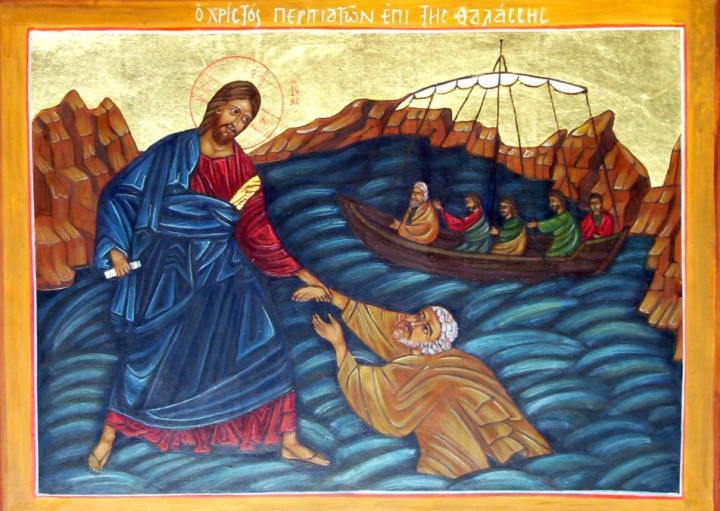
Peter answered him, ‘Lord, if it is you, command me to come to you on the water.’ He said, ‘Come.’

As usual, Peter is the first to react, he takes the lead. Jesus speaks a single word to him, ‘Come’. He speaks it to each and every one of us as Christians, to come, to follow Him. We are called to be close to Jesus, and to live out our faith in our lives strengthened by prayer. Will we trust Jesus enough to follow Him? This is the challenge of the Christian life, our challenge to accept Jesus’ invitation and walk with Him.

“So Peter got out of the boat, started walking on the water, and came towards Jesus. But when he noticed the strong wind, he became frightened, and beginning to sink, he cried out, ‘Lord, save me!’ Jesus immediately reached out his hand and caught him, saying to him, ‘You of little faith, why did you doubt?’ When they got into the boat, the wind ceased. And those in the boat worshipped him, saying, Truly you are the Son of God.’

Peter listens to what Jesus says, and obeys Him. Peter does something miraculous, something extraordinary: he walks on water, until he is distracted by the world around him, and becomes frightened. Likewise, in the power of God, we can do wonderful things, if we are not distracted by the cares of the world around us. If we listen to what Jesus tells us and do it.

But Peter becomes frightened; he starts to sink, as do we all when the cares of this world overwhelm us. His reaction is to cry ‘Lord, save me’ which Jesus does. Indeed, through Christ’s offering of himself upon the Cross Jesus saves each and every one of us, taking the sin of the world upon Himself so that we might be freed from sin, fear, and death. That same sacrifice will be made present, so that we the people of God, can be fed by God, to be strengthened to have life in Him, to be close to Him. 

Peter is rebuked for lacking faith, he still has to learn to trust Jesus. We too need to trust God, to have faith in Him, so that He can be at work in us and through us.

Once the wind has died down, the disciples bow down and worship Jesus, saying, ‘Truly you are the Son of God.’ Our fulfilment is worship. This is what we are made for as humans and as Christians. We are to worship God, in our love and our prayer, so that our whole lives are an act of worship, drawing us ever closer to the source of life and love. So that all we say or think or do may proclaim God’s love and truth to the world, so that they may believe and give glory to God the Father, God the Son, and God the Holy Spirit, to who whom be ascribed as is most right and just, all might, majesty, glory, dominion and power, now and forever. Amen. 

christusundpetrus1-2010-k