Saturday, 25 September 2021

Trinity XVII

The Book of Numbers tells the story of the journey of the people of Israel through the desert of Sinai towards the Promised Land. In Chapter 11, the people are complaining about their lack of food which leads God to send first manna, and then quail, to feed the people. While this is happening, God promises Moses that He will share his Spirit with seventy others. This is so that Moses may have some helpers to aid with leadership, to deal with complaints, and to settle disputes.

Seventy men go to the Tent of Meeting, and two men stay behind in the camp: Eldad and Medad. They are both filled with the Holy Spirit and begin to prophesy. Moses is told about this, at which point something of a dispute arises:

‘And Joshua the son of Nun, the assistant of Moses from his youth, said, “My lord Moses, stop them.” But Moses said to him, “Are you jealous for my sake? Would that all the Lord’s people were prophets, that the Lord would put his Spirit on them!”’ (Numbers 11:28-29)

Moses is not as concerned as Joshua about observing proprieties, and he recognises that there is a freedom to the Spirit: it blows where it wills (cf. Jn 3:8). God is free to work through whomsoever He chooses. Moses wishes are granted on the Day of Pentecost, when the Apostles were filled with the Holy Spirit. We too, as Christians, are dwelling-places of the Holy Spirit, which works in us and through us. 

Just as Moses is able to see the bigger picture, likewise in today’s Gospel reading we see Jesus being rather generous. The disciples have noticed some exorcisms taking place, which have not been sanctioned. However, Jesus does not want His disciples put a stop to this, so He tells them:

“Do not stop him, for no one who does a mighty work in my name will be able soon afterwards to speak evil of me. For the one who is not against us is for us. For truly, I say to you, whoever gives you a cup of water to drink because you belong to Christ will by no means lose his reward” (Mk 9:39-41)

If the point of exorcism is to heal people, then as the Kingdom is a place of healing, the more the better. Evil spirits are cast out in Jesus’ Name, because it is powerful. The point is that faith is not just a matter of belief, but rather of belief put into practice, an act of loving generosity. Putting faith into practice helps to make the Kingdom a reality in our and other people’s lives. It is easy to be exclusive, and small-minded, but thankfully God is more generous than that, and we should try to be like Him.

Then Jesus’ teaching turns to matters of wrongdoing, moral failures, and how they are viewed. It is important to state in the strongest possible terms that Jesus is not encouraging Christians to drown people, or mutilate themselves, but rather teaching His disciples about the serious nature of sin.

Jesus begins by explaining that whoever puts a stumbling block in the path of another has hindered their discipleship. This is a serious charge.

“Whoever causes one of these little ones who believe in me to sin, it would be better for him if a great millstone were hung round his neck and he were thrown into the sea.” (Mk 9:42)

In this passage Jesus is engaging in hyperbole, exaggeration for rhetorical effect, to underline the point that our actions affect others. Using exaggeration, Jesus is pointing out that living a Christian life is a serious business: His followers are called to perfection. People who are new to the Christian faith, who are learning the Way, are particularly vulnerable. If they are led astray by the wrong kind of example, by the wrong sort of teaching, then it is a serious thing. Those of us who are Christians have a great responsibility to nurture others in their faith. The disciples, however, have been petty and small-minded. They have been concerned more with their own power and prestige rather than judging the actions of those helping otherscorrectly, and seeing the situation for what it really is. 

There follows a difficult passage, which, if we were to take it literally, would see all of us blind, lame, and without hands. Clearly this cannot be God’s plan of salvation for humanity. So if we are not supposed to take Jesus literally we have to interpret His words allegorically.This means uncovering the spiritual meaning of Christ’s words. Jesus may be referring to sins committed by hand, foot, or eye, i.e., what we do, where we go, and what we look at. The cutting off may be metaphorical, referring to excommunication. This means temporarily excluding people to give them an opportunity to repent and ask for God’s forgiveness. Our sins lead to estrangement from God, characterised by Hell and unquenchable fire. This is what rejecting God means. By doing so, we confine ourselves to darkness and misery. Jesus has come to save humanity from the Hell we create. He will die to give us life. 

Only Jesus can do this for us, and we have to let Him. We need to follow Him. Only then can we be salt, flavouring and preserving the world around us. Only then can we truly be at peace with one another, and understand things properly, and act accordingly. 

Living as a Christian community means owning up to our shortcomings, and being humble enough to let God transform us, bit by bit, day by day, more and more into His likeness. We learn by carrying our Cross, a burden much lighter than our sin, a burden which can and will transform us. Pride, that great human sin, makes us think that we are important. The disciples think they are important, and lose sight of the fact that what really matters is who Jesus Christ is. We must focus on what He has done for us, dying on the Cross, and rising to new life, so that we can live in Him. This is why we come together on the first day of the week, the day Jesus rose from the dead, so that we can share His risen life, and be nourished by Him.

Today’s other text, the Letter of James has some strong words for the wealthy, and in particular those who acquire their wealth by defrauding others. Christianity is a religion of generosity, given to us by a generous God, who expects us to be generous in turn. Just like the moral shortcomings outlined in the Gospel, here we see that we are called to live in a just and loving way. As Christians we are to stand for fairness and justice for all. The temptation is always there to seek to be important, to pursue power and prestige. What matters is that we glorify God, that we advance His kingdom. This is a kingdom of love, and forgiveness and healing, where people come to know who they truly are in Christ. If we listen to what Jesus tells us, and try to live like Him, then we can help to bring about the day when God will be all in all. Then everyone will sing the praise of God the Father, God the Son, and God the Holy Spirit. To whom be ascribed, as is most right and just, all might, majesty, glory, dominion and power, now and forever. Amen.

James Tissot – Jesus teaches his disciples

Saturday, 18 September 2021

Trinity XVI

The Gospel reading this morning reaches its climax with Jesus using a child to teach the disciples a lesson in humility by presenting one of the weakest and most vulnerable people in society as an example. Jesus reminds us that all human beings are made in the image and likeness of God, and as such are of infinite worth.

Jesus and His disciples are passing through Galilee for what proves to be the last time, before He makes his way to Jerusalem for His Passion, Death, and Resurrection. Once again Christ teaches the disciples about what is going to happen. It is likely that Jesus referred to passages in Scripture which prophecy about His Passion, such as our first reading this morning from the Book of Wisdom. In the passage wicked men are plotting the downfall and death of a righteous man:

‘Let us lie in wait for the righteous man, because he is inconvenient to us and opposes our actions; he reproaches us for sins against the law, and accuses us of sins against our training.’ (Wisdom 2:12)

This verse encapsulates the approach taken by the Scribes and Pharisees in the Passion narrative. Throughout the Gospels Jesus criticises the Pharisees for keeping the Letter of the Law, but being far from its Spirit. His enemies will see Jesus condemned to a shameful death, and as He dies they wait to see if God will deliver Him. It is easy to see how before His Death it would be hard for people to understand Jesus’ teaching, but once He had died and risen again, everything would become clear. 

‘But they did not understand the saying, and were afraid to ask him.’ (Mk 9:32)

Admitting that you do not understand something is difficult. The disciples are confused and afraid. They do not want to own up to their lack of understanding, so instead, they focus upon themselves and their own importance:

‘And when he was in the house he asked them, “What were you discussing on the way?” But they kept silent, for on the way they had argued with one another about who was the greatest.’ (Mk 9:33-34)

The disciples are silent, because they are embarrassed. They know that what they were discussing was basically pointless, and against Jesus’ teaching regarding the Kingdom. Jesus does not tell His disciples off, instead He instructs them: 

‘And he sat down and called the twelve. And he said to them, “If anyone would be first, he must be last of all and servant of all.” And he took a child and put him in the midst of them, and taking him in his arms, he said to them, “Whoever receives one such child in my name receives me, and whoever receives me, receives not me but him who sent me.”’ (Mk 9:35-37)

Jesus sits down, adopting the position of the teacher in the Ancient World, and then He teaches. The Kingdom of God tends to turn human values upside down, and this is no exception. Leaders are called to be servants. The Evangelist uses the Greek word diakonos which means ‘servant’. From this we get the word ‘deacon’. Jesus is telling The Twelve that they need to be deacons, and that leadership involves serving others, not being important. To reinforce His point Jesus puts a child in front of them, and then embraces the child. In the Ancient World children lacked rights, or status, and, like children today, were dependent upon adults. By embracing someone weak and powerless, Jesus is showing the disciples that God’s Kingdom sees things differently from the world.

Christianity has been described as ‘a religion for the weak and feeble-minded, attractive to social undesirables, the silly, the mean, the stupid, women, and children’. [Origen Contra Celsum 3:44 & 3:59 ] These were the words of Celsus, a pagan critic of Christianity, quoted by Origen in the mid 3rd century AD. It is, in fact, a religion for everyone. All are welcome. At its heart, Christianity is a religion of paradox, where strength is shown in weakness. This is especially true of the Cross, where God shows us that sacrificial love can change the world, heal our wounded souls, and restore broken humanity. The Mystery of the Cross, is part of the enigma of God’s Love. In a moment of weakness and powerlessness, where evil and sin appear to have triumphed, we see the supreme demonstration of Love, an act of such generosity which has the power to reconcile and heal humanity.

Christians are called to be like this child: weak, powerless, insignificant, and humble. Through such humility God welcomes humanity back into a personal relationship, offering us His love. Opposed to this is the desire for power and prestige which sees the disciples arguing over who is the greatest, or the quarrels dealt with in the Letter of James. Rather than argument, however, a Christian community should be characterised by peace:

‘But the wisdom from above is first pure, then peaceable, gentle, open to reason, full of mercy and good fruits, impartial and sincere. And a harvest of righteousness is sown in peace by those who make peace.’ (James 3:17-18)

This is a description of love in action, lived out in a way that builds people up. It is what Christ demonstrates to us as how we should be as Christians. We are called to live in a way which offers the world an alternative to striving after power, wealth and influence. True greatness will often look like weakness and servility in the world’s eyes. It doesn’t matter. What matters is living a life characterised by sacrificial self-giving love. Love can only be offered. Love can be accepted or rejected. Love lies at the heart of any relationship.

Acknowledging our own shortcomings is the first step in a process whereby God can be at work in our lives, transforming us more and more into His likeness. We need God’s grace to be at work in us. Recognising this is a sign of humility: accepting our need for God. This is not weakness, quite the opposite. Through our complete reliance upon God and His Grace, we prepare ourselves for Heaven where we hope to sing the praises of God the Father, God the Son, and God the Holy Spirit. To whom be ascribed, as is most right and just, all might, majesty, glory, dominion and power, now and forever. Amen.

James Tissot – Jesus and the Little Child

Saturday, 11 September 2021

Trinity XV

In Today’s Gospel, Jesus asks a question, ‘Who do you say that I am?’ (Mk 8:29) Jesus asks His disciples this question, and He also asks each and every one of us the same thing.  This question is central to Mark’s Gospel, and it is crucial to our faith and understanding. Who do we say that Jesus is? Many people can see Jesus as a charismatic healer, or a revolutionary rabbi, but is that all He is, or He something more?

Our response to Jesus’ question should be the same as Peter’s, ‘You are the Christ’ (Mk 8:29). Jesus is the Messiah, the Anointed One, the Saviour, the one who brings salvation. There is some confusion among the people, who see Jesus as John the Baptist, Elijah, or one of the prophets. These prophets call people to repentance, and prepare the way for the Messiah, they point to Christ, but they are not Him. 

After Peter’s profession of faith, Jesus teaches His disciples concerning His Passion and Death, He explains what is about to happen. Jesus goes on to explain to His disciples:

‘that the Son of Man must suffer many things and be rejected by the elders and the chief priests and the scribes and be killed, and after three days rise again.’ (Mk 8:31) 

Because Jesus is who He is — that is the Messiah, the Son of God — then He has to die, and His disciples need to understand this. The first reading this morning from the prophet Isaiah is taken from one of the Servant Songs. The Servant Songs are passages which describe how God’s servant will be mistreated, falsely accused, and killed.

‘I gave my back to those who strike, and my cheeks to those who pull out the beard; I hid not my face from disgrace and spitting.’ (Isaiah 50:6)

This verse anticipates the beatings that Christ receives before and after His Trial, and His general mistreatment. People will spit at Him, insult Him, and blame Him. Jesus will become a scapegoat, He will bear our sins. Jesus teaches His disciples by explaining how this passage, and especially Chapters 52 and 53 of the prophet Isaiah, clearly foretell what is about to happen. This why they are read in church on Good Friday, grounding the most important event in salvation history in its scriptural context.

Jesus’ words about the suffering He must face have a strong effect upon Peter. He has faith, he believes that Jesus is the Messiah, the Christ, but the idea that Jesus has to suffer and die is just too much for him. So, Peter argues with Jesus:

‘And Peter took him aside and began to rebuke him. But turning and seeing his disciples, he rebuked Peter and said, “Get behind me, Satan! For you are not setting your mind on the things of God, but on the things of man.”’ (Mk 8:32-33)

Despite only a few moments ago making a groundbreaking declaration of faith, now Peter is now told off in the strongest possible terms. Peter has faith, but lacks understanding, and can only understand on a human level. His heart is in the right place, but Peter often makes a mess of things. He is impulsive, flawed, and human. Jesus has to reject the idea that He can fulfil His mission without suffering and death. He knows that was born for this: God became a human being in the womb of Mary for this reason, to suffer and die for humanity and to reconcile us to God and each other. 

Jesus then explains how the Cross is central to all who follow Him:

‘And calling the crowd to him with his disciples, he said to them, “If anyone would come after me, let him deny himself and take up his cross and follow me. For whoever would save his life will lose it, but whoever loses his life for my sake and the gospel’s will save it.”’ (Mk 8:34-35)

Not only must Jesus embrace the Cross, but He calls everyone who follows Him to do the same. You and I are called by Christ to lay down our lives and follow Him, to take up the Cross, and embrace the way of suffering love. We have to deny ourselves. Denying ourselves means that we don’t put ourselves, or our thoughts and desires at the centre of our lives — we put God there, where He belongs. God gives us grace to do this: through prayer, through reading the Bible, through the Sacraments, and through the support of our Christian community, to help us.

We have to take up our Cross. The Cross is an instrument of torture and death, and it means pain and suffering. That is not pleasant or easy. We can understand why Peter says what he does, but the Christian life is not easy or without suffering. Mother Teresa, St Teresa of Calcutta once said that: 

“Suffering is a sign that we have come so close to Jesus on the cross that he can kiss us and that he can show that he is in love with us by giving us an opportunity to share in his passion.” (My Life for the Poor, 77) 

When we suffer, we are close to Christ, we share in His Passion, and are conformed to His image. It is part of the mystery of God’s love, that it can transform us, but that transformation is not always pleasant or easy. However, becoming Christ-like enables us to more profoundly experience God’s love. 

We need to follow Jesus, we have to do what He says. This is difficult, but it is something which we do together, as a community, as a Church. Love and forgiveness sound easy in theory, but in practice they are not. They make demands on us, and compel us to do things that we might not like to do. We can, however, support each other, and also we can rely upon the grace of God to help us as we try to follow in Jesus’ footsteps.  

Our Faith is first and foremost about our relationship with the Lord Jesus Christ, who loves us so much that He dies for us. He takes away our sins, and restores our relationship with God and each other. And He gives himself here to us today, under the outward forms of bread and wine, in His Body and His Blood, to heal us, and restore us. Our faith is revealed by our actions. The Letter of James makes this very clear. Faith needs to be put into practice by how we live our lives. We carry our cross by exhibiting the same generous love that God shows us in Christ. This is how we can both cooperate with God’s grace and transform the world, so that all may come to believe and sing the praises of God the Father, God the Son, and God the Holy Spirit. To whom be ascribed, as is most right and just, all might, majesty, glory, dominion and power, now and forever. Amen.

The Primacy of St Peter – James Tissot

Saturday, 4 September 2021

Trinity XIV

Today’s readings begin with the prophet Isaiah, who is well-known for containing prophecies regarding the Messiah. His is a hopeful message, of a joyful future, which envisages the healing and restoration of Israel. These prophecies are fulfilled in Jesus Christ. 

‘Then the eyes of the blind shall be opened, and the ears of the deaf unstopped; then shall the lame man leap like a deer, and the tongue of the mute sing for joy.’ (Isaiah 35:5-6)

The Messiah helps to bring about the Kingdom of God, and the sign that it is here are these miraculous healings. They speak of a God who loves us, who longs to see humanity healed and restored. The mention of water in the desert and wilderness looks forward to John’s Gospel, where Jesus states:

“If anyone thirsts, let him come to me and drink. Whoever believes in me, as the Scripture has said, ‘Out of his heart will flow rivers of living water.’” (Jn 7:37-38)

Christ comes to give us healing and to fill us with the Holy Spirit. We experience living water in Baptism, when we are renewed and born again in Christ. The water is a sign of the Holy Spirit, God’s love active in the world, which heals and inspires His people. 

In Mark’s Gospel, Jesus leaves Capernaum after His discussions with the Pharisees and heads north, before returning to Galilee. The route He takes has troubled scholars, but rather than going over the mountains to Tyre and Sidon, Jesus goes around them, which ensures that both He and His disciples have access to fresh water, a key practical consideration in such an arid landscape. Jesus goes into a house and is approached by a woman whose daughter is suffering, begging for deliverance for her child. So Jesus replies:

‘“Let the children be fed first, for it is not right to take the children’s bread and throw it to the dogs.”’ (Mk 7: 27)

At first sight, the passage is difficult. Jesus appears to be insulting the woman because she is not Jewish, which is not a loving response. It is possible that Jesus’ reply is a reference to the following verse from the Book of Exodus:

‘“You shall be consecrated to me. Therefore you shall not eat any flesh that is torn by beasts in the field; you shall throw it to the dogs.”’ (Exodus 22:31

This makes sense given the preceding discussion of ritual purity with the Pharisees, which we read last week. Rather than seeing the Messiah as a Jewish Saviour for Jewish people, Jesus is in fact the Saviour of the world, not bound by ethnic concerns. Such concerns do not affect the mother in the Gospel, she simply wants her daughter to be healed, and has no truck with exclusive visions of religion. So she responds,

“Yes, Lord; yet even the dogs under the table eat the children’s crumbs.” (Mk 7: 28)

At which point Jesus performs a healing miracle at a distance:

‘And he said to her, “For this statement you may go your way; the demon has left your daughter.” And she went home and found the child lying in bed and the demon gone.’ (Mk 7: 29-30)

The woman makes a profession of faith. She trusts Jesus, and calls Him Lord. She understands that the Kingdom is a place for Gentiles as well as Jews. The Kingdom is for all, Jew and Greek, rich and poor alike. All are one in Christ, and God’s healing is for everyone. This reality is made manifest in the healing of the young girl. Jesus has uttered an exclusive Jewish understanding of the Messiah in order to demonstrate, through the woman’s response, that his mission is, in fact, much wider. In doing so, Jesus takes an existing common prejudice to show how God’s love, mercy, and healing are for all those who turn to Him.

As Jesus returns to Galilee, He is asked to heal a man.

‘And taking him aside from the crowd privately, he put his fingers into his ears, and after spitting touched his tongue. And looking up to heaven, he sighed and said to him, “Ephphatha”, that is, “Be opened.” And his ears were opened, his tongue was released, and he spoke plainly.’ (Mk 7:33-35)

Both healings in the Gospel are done privately, they are not done for show, and they fulfil Isaiah’s prophecy from our first reading this morning. Despite Jesus telling people not to share the news of the healing, they do. 

‘And they were astonished beyond measure, saying, “He has done all things well. He even makes the deaf hear and the mute speak.”’ (Mk 7:37)

Here Isaiah’s prophecy is quoted, as it has been fulfilled by Jesus, which is good news.  And it is good news for Jews and non-Jews, for everyone. The Kingdom of God is a place of healing and restoration for all, a fact which the Church continues to proclaim. Rather than being an exclusive event for the Chosen People, healing and salvation are for all who turn to God. All are invited, all are welcome. 

The reading from the Letter of James shows us how to live our lives as Christians in an authentic manner. We are all equal in the eyes of God. We should not make the distinctions in the way the world around us is so fond of doing. James’ letter reminds us that Christians are not supposed to judge by appearances. We are not supposed to treat the rich better than the poor, because, as Jesus has shown us, the Church is supposed to be a place which lives out a radical equality. We are all equal in the sight of God. No-one is better or worse than another.

‘Listen, my beloved brothers, has not God chosen those who are poor in the world to be rich in faith and heirs of the kingdom, which he has promised to those who love him?’ (James 2:5)

As Christians we are saved by faith in Jesus Christ, we put our trust in Him, to be at work in us, and to save us. Little by little we are being transformed into the likeness of the one in whose image we are made. This is the wondrous gift of God’s grace. It is given, just like the Eucharistic Banquet of Christ’s Body and Blood, so that God can be at work in us, and through us. It is given so that we may be healed and transformed. 

So let us pray that God may come to us, and pour out His healing love on us, and all the world. Let us pray that His will may be done, and His kingdom come, so that all may join in the praise of God the Father, God the Son, and God the Holy Spirit. To whom be ascribed, as is most right and just, all might, majesty, glory, dominion and power, now and forever. Amen.

Jesus heals the lame – James Tissot

Saturday, 28 August 2021

Trinity XIII

Our first reading this morning from Deuteronomy is taken from a speech which Moses gives to Israel before they enter the Promised Land. Moses tells the people,

‘You shall not add to the word that I command you, nor take from it, that you may keep the commandments of the Lord your God that I command you.’ (Deut 4:2)

This salutary advice refers to a common religious problem, one which the Pharisees and their successors the Rabbis found hard to comply with. They would argue that they were not creating new law, but merely commenting upon the old, and exploring its richness. There is, however, a very fine line between the two.                                                                                                                                                                                                                                                                                                                                                                                                                                                                                                                                                                                                                                                                                                                                                                                                                                                                                                                                                                                                                                                                                                                                                                                                                                                                                                                                                                                                                                                                                                                                                                                                                                                                                                                                                                         

Over the last year and a half we have become more conscious than ever of the value of good hygiene; hand-washing has become headline news. Over 200 years ago, John Wesley wrote a sermon ‘On Dress’ stating: ‘Cleanliness is next to Godliness’. This proverb has found its way into the common speech and the ‘collective unconscious’. But while it is good advice, it is not quite what the Pharisees are complaining about in this morning’s Gospel reading. 

The previous story in Mark’s Gospel is that of the Feeding of the Five Thousand, so food-related matters are on the Pharisees’ mind. They are on the lookout for any minor infringement: something to quibble about, an excuse to attack Jesus. 

‘And the Pharisees and the scribes asked him, “Why do your disciples not walk according to the tradition of the elders, but eat with defiled hands?”’ (Mk 7:5)

The point that is being made is that the disciples are washing their hands, they are being hygienic, but they are not conforming to a higher level of ritual purity. The Pharisees are calling out what they see as a failure on the part of the disciples, and especially Jesus as their teacher, to conform to a man-made standard of priestly purity. In the eyes of the Pharisees, they are not holy enough.

In reply to their criticisms, Jesus says:

‘“Well did Isaiah prophesy of you hypocrites, as it is written, ‘This people honours me with their lips, but their heart is far from me; in vain do they worship me, teaching as doctrines the commandments of men.’ You leave the commandment of God and hold to the tradition of men.”’ (Mk 7:6-8)

Jesus quotes the Greek text of Isaiah (29:13) to make His point. Religious laws are a means by which humanity is sanctified, and God is honoured. They are not an end in themselves. The Pharisees are so concerned with the correct interpretation of religious minutiae that they can no longer see the wood for the trees: they have lost sight of the bigger picture. This approach neither honours God, nor sanctifies humanity. Indeed it drives a wedge between God and His people.

Instead, Jesus offers profound moral teaching to the people about what really matters:

‘And he called the people to him again and said to them, “Hear me, all of you, and understand: There is nothing outside a person that by going into him can defile him, but the things that come out of a person are what defile him. For from within, out of the heart of man, come evil thoughts, sexual immorality, theft, murder, adultery, coveting, wickedness, deceit, sensuality, envy, slander, pride, foolishness. All these evil things come from within, and they defile a person.”’ (Mk 7:14-15 & 21-23)

Rather than parading one’s religion as a pious faรงade, Jesus teaches people to pay attention to their interior life. What we think and feel affects both who we are and how we live our lives. Jesus is mindful of God’s revelation to Samuel:

‘for the Lord sees not as man sees: man looks on the outward appearance, but the Lord looks on the heart.’ (1Samuel 16:7)

Rather than focussing on outward aspects (like the Pharisees), Jesus reminds us that our inward thoughts are usually where the real problem lies. Thoughts can turn into actions and become habits which form character. The Pharisees are in effect encouraging a thin veneer of correct behaviour, appearing to do the right thing, while covering up any thoughts and intentions that do not promote human flourishing. Jesus wants honesty, where what you see is what you get. As with much of His teaching, it is very simple in theory, and much harder in practice. We all aspire to what Our Lord teaches, but we often struggle to live it out. 

This is why faith cannot just be a personal matter. We live in community, and as a community we can help and support each other as we try to live out our faith together. We find encouragement to do this in this morning’s reading from the Letter of James. The apostle reminds us of the goodness and generosity of God, and the fact that we are created by Him, made in His image.

James encourages Christians to put their faith into practice:

‘But be doers of the word, and not hearers only, deceiving yourselves.’ (James 1:22)

These words echo those of Jesus in the Gospel. People should in all gentleness and humility both listen to the word of God and do what it says. As Christians, our thoughts and words and actions proclaim the truth that Christ died to save us from our sins, and that He rose again that we might have new life in Him. Faith needs to be real and concrete, lived out in the world in loving action.

As we try to live out our faith, in our homes and community, we can only do this together, supporting each other. We also need to be gentle and generous when we fail, as we inevitably will.  Thankfully we do not need to rely upon our own strength, but upon the love and mercy of God. Then we can be built up in love, as living stones, a temple to God’s glory, which proclaims His love and truth to the world. We are called to live lives of forgiveness and sacrificial love which build up, as opposed to being bitter, judgemental and blind to our own faults. We should not be eager to point out the sins of others. Instead, clothed in the humility of our knowledge of our need of God, His love and mercy, let us come to Him. Let us be fed by Him, and healed and restored by Him. Let us live lives which speak of the power of His kingdom, so that the world may come to believe and give glory to God the Father, God the Son, and God the Holy Spirit. To whom be ascribed as is most right and just, all might, majesty, glory, dominion, and power, now and forever. Amen.

The Pharisees question Jesus – James Tissot

Saturday, 21 August 2021

Trinity XII ‘Lord to whom should we go?’

Today’s Old Testament Reading from the last chapter of the Book of Joshua records a pivotal moment. The people of Israel have settled in the Promised Land, and Joshua calls them together at Shechem to renew their covenant with God. Joshua asks the people of Israel a question: 

“Thus says the Lord, the God of Israel, ‘Long ago, your fathers lived beyond the Euphrates, Terah, the father of Abraham and of Nahor; and they served other gods. And if it is evil in your eyes to serve the Lord, choose this day whom you will serve, whether the gods your fathers served in the region beyond the River, or the gods of the Amorites in whose land you dwell.’” (Joshua 24:2& 15)

Do the Israelites want to serve the Lord their God, or would they prefer to follow their ancestral gods, or those of the land in which they now live? Joshua tells them what he will do:

“But as for me and my house, we will serve the Lord.” (Joshua 24:15)

Joshua makes a clear choice, and the Israelites follow his example. They are mindful of what God has done for them:

“Far be it from us that we should forsake the Lord to serve other gods, for it is the Lord our God who brought us and our fathers up from the land of Egypt, out of the house of slavery, and who did those great signs in our sight and preserved us in all the way that we went, and among all the peoples through whom we passed. And the Lord drove out before us all the peoples, the Amorites who lived in the land. Therefore we also will serve the Lord, for he is our God.” (Joshua 24:16-18)

Their religious faith is a conscious act of the will, they choose to serve the God who has saved them. God has shown that He is the God of Israel. 

In this morning’s Gospel we come to the end of the Bread of Life Discourse in Chapter 6 of John’s Gospel. Jesus’ teaching has offended some people. All this talk of eating flesh and blood sounds to them like cannibalism, which was strictly taboo. The mere suggestion of it was offensive in Jewish culture; it went against everything people had been taught. It is thus hardly surprising when some of His disciples say: 

“This is a hard saying; who can listen to it?” (Jn 6: 60)

Jesus is teaching in a synagogue in Capernaum, and those present are not used to this kind of teaching. It turns everything they know on its head. In Hebrew the word for flesh (baล›ar) and the word for good news, glad tidings, or the Gospel, sound the same. Such word-play is intentional, and may be linked to the Hebrew Wisdom tradition:

“Come, eat of my bread and drink of the wine I have mixed. Leave your simple ways, and live, and walk in the way of insight.” (Proverbs 9:5-6)

Jesus notices that some of His disciples are grumbling, just like the Israelites in the Exodus story we read a few weeks ago. So he says to them: 

“Do you take offence at this? Then what if you were to see the Son of Man ascending to where he was before? It is the Spirit who gives life; the flesh is no help at all. The words that I have spoken to you are spirit and life. But there are some of you who do not believe.” (For Jesus knew from the beginning who those were who did not believe, and who it was who would betray him.) And he said, “This is why I told you that no one can come to me unless it is granted him by the Father.” (Jn 6:61-65)

This strategy seems a strange one. If people were not shocked enough to begin with, Jesus goes on to make other claims which could be taken as blasphemous. For us to have life in Jesus we need to be baptised. For our sins to be washed away, we need to hear the Good News. We need to eat the Eucharist, and to be filled with the Holy Spirit. These are all outpourings of grace, of Divine generosity, given to transform us, more and more into the likeness of God. 

Jesus’ teaching has a profound effect, rather than attracting people to follow Him, it leads to the exact opposite response:

After this many of his disciples turned back and no longer walked with him. So Jesus said to the Twelve, “Do you want to go away as well?” Simon Peter answered him, “Lord, to whom shall we go? You have the words of eternal life, and we have believed, and have come to know, that you are the Holy One of God.” (Jn 6: 66-69) 

Jesus asks the Twelve if they too would like to leave Him too, which leads to a profound declaration of faith by St Peter. They have a choice to make, and they choose Jesus, as no-one else can offer what He does. Here Peter is confessing that Jesus is the Christ, the Messiah, the Son of God. To be a Christian is to make the same confession as Peter, and to have the same hope of eternal life in and through Jesus Christ. 

Jesus’ teaching is hard to accept, and difficult to understand, but we can experience it, when we receive Holy Communion. For Peter, and for us, belief precedes knowledge. We believe and then we come to know.

It is a question of commitment, which involves love and sacrifice — the two go hand in hand. It is what marriage is all about, and it also describes God’s relationship with us, and ours with God. It will see Jesus die on the Cross for us, to show us just how much God loves us, and wants to restore our relationship with Him, and each other. To be close to God is wonderful, but it isn’t something God forces us into: we may choose to accept God’s love, or to refuse it. This love is freely given.

St Paul’s advice to the Christians in Ephesus is another difficult text, which revolves around making a choice. For St Paul Christian marriage is all about loving service of one another, as demonstrated by Christ. Jesus lays down His life for us, so we should do the same for each other. Thus, in marriage in particular, and in society in general, loving service and self-sacrifice are the ways in which we should live. It is a generous form of life, because its model is Jesus, the most unselfish person ever, who created all that there is, and who redeemed it by offering His life as a ransom for many. We see this on the Cross and we commemorate it in the Eucharist, where Christ continues to feed us His people with Himself, so that we might have life in Him. 

So let us come to Jesus, let us choose Him, and put our trust in Him. Let us be fed by Him and with Him, so that we may spend eternity singing the praises of God the Father, God the Son, and God the Holy Spirit. To whom be ascribed, as is most right and just, all might, majesty, glory, dominion and power, now and forever. Amen.

James Tissot – Jesus Discourses with His Disciples

Saturday, 14 August 2021

The Assumption 2021

Today the Church celebrates the Assumption of the Blessed Virgin Mary, which commemorates her being taken up after death, body and soul, into Heaven. It is important to stress that Assumption is something passive rather than active; Jesus ascends to Heaven, whilst Mary is assumed. This is a profound difference between the two. Jesus ascends because He is God, Mary is assumed because she is the Mother of God, and the model for all Christians to follow. Humble and obedient in her life, in her death Our Lord’s Mother shares fully in the resurrection of her Son, and points the way for us as Christians. Where Mary goes, we hope to follow, trusting in the love and mercy of God. It is a sign to us as Christians that we can trust the promises of Christ who went to prepare a place for us, that where He is, we may also be. 

From the early days of the Church there is a tradition that Mary’s tomb, in the valley of Jehoshaphat just outside Jerusalem, is empty, and that her bodily remains are not there. From this developed the belief that after her death she was given a share in her Son’s glory, victory, and eternal life. This is both a reward for her faithfulness and humility, her obedience to God, and also as a sign to us that this is what Christ came to share with us, his people. God in Christ shares our human life, from beginning to end, and offers us eternal life in Heaven, which Mary enjoys. We can trust what God promises us, because God is loving and faithful, even when we are not. He is merciful, so that we can be transformed by His Love. This is the Good News of the Kingdom. We do not deserve it, we cannot earn it, yet God gives it in loving generosity to heal all that has been marred by sin. 

In today’s first reading from the Book of Revelation, St John has a vision of Heaven:

And a great sign appeared in heaven: a woman clothed with the sun, with the moon under her feet, and on her head a crown of twelve stars (Revelation 12:1)

This is why Mary is often depicted this way in art as a woman crowned with stars. At the foot of the Cross, during Jesus’ Crucifixion, John was given a new family:

When Jesus saw his mother and the disciple whom he loved standing nearby, he said to his mother, “Woman, behold, your son!” Then he said to the disciple, “Behold, your mother!” And from that hour the disciple took her to his own home. (John 19:26-27)

John has been close to both Jesus and His Mother, Mary: in her earthly life, and now, John has a glimpse of her in Heavenly Glory, the Glory of her Son, Jesus Christ. The Church honours her as the Mother of God, Theotokos, meaning ‘God-bearer’ in Greek. Without Mary saying ‘Yes’ to God in the Annunciation, our salvation would not have been possible. Her response gives us the hope of heavenly glory, which she enjoys, close to God in this life and the next. 

John’s vision of Heaven shows us that we can have hope of eternal life, through Christ’s victory over sin and death: 

Now the salvation and the power and the kingdom of our God and the authority of his Christ have come (Revelation 12:10)

It is this hope which allows St Paul to write to the church in Corinth:

For as in Adam all die, so also in Christ shall all be made alive (1Corinthians 15:22)

Christ is the new Adam. Sunday, the day of His Resurrection is the first day of the week, and a sign of the New Creation. Likewise, Mary is the new Eve, but whereas Eve is disobedient in the Garden of Eden, Mary is obedient in the Annunciation, agreeing to bear the Son of God in her womb. Thus, Christ is born, and humanity can be saved, healed, and restored. Mary shares in her Son’s victory over sin and death as a Sign of the reality of the Resurrection, a promise made to humanity to share in God’s love and intimacy.

The Gospel reading begins with a demonstration of Mary’s care and service. She goes to stay with her older cousin, Elizabeth, who is six months pregnant, and while Elizabeth’s prayers for a child have been answered the realities of life mean that she needs help. Elizabeth’s husband, Zechariah, is busy in the Temple, so Mary lovingly comes in haste to help her cousin. As she arrives, Elizabeth’s baby leaps in her womb. John the Baptist greets Jesus and Mary with joy: even before his birth. He is a prophet, announcing the wonderful works of God. 

And Elizabeth was filled with the Holy Spirit, and she exclaimed with a loud cry, “Blessed are you among women, and blessed is the fruit of your womb!” (Luke 1:41)

Elizabeth recognises the wonderful thing that has happened, and understands that through Mary’s child God’s promise is being fulfilled. She also recognises Mary’s faith, and says to her: 

“Blessed is she who believed” (Luke 1:45)

Mary is indeed blessed in giving birth to the Saviour of humanity, blessed in her obedience, love, and service, and blessed after death to share in the Heavenly Glory of her Son. The way in which Mary trusts God, gives Christians a clear example to follow in living the life of faith. We need to be like Mary. 

This is why every evening at Vespers (Evensong), Mary’s great hymn of praise, the Magnificat, which starts, “My Soul doth Magnify the Lord” (Luke 1:46), is recited. These words reveal her complete trust in God, a God who takes it upon Himself to deal with sin and death by giving us His Son. A God who establishes a kingdom of love, forgiveness, and generosity, through which the Church continues God’s work of love and reconciliation in the world. Despite all our mistakes and failures, God showers us with His love and mercy. All the readings this morning are rooted in the simple fact that God loves us, and Mary shows us how to respond to that love. Her Assumption gives us hope that when Jesus says:

‘In my Father’s house are many rooms. If it were not so, would I have told you that I go to prepare a place for you?’ (John 14:2) 

God makes room for us, the question is can we make room for Him? Can we be like Mary, trusting God to be at work in us? Can we let His Grace perfect our nature, to live lives of hope and joyful service, so that after our earthly life we may, in the company of the Blessed Virgin Mary and all the saints, sing the praises of God the Father, God the Son, and God the Holy Spirit. To whom be ascribed, as is most right and just, all might, majesty, glory, dominion and power, now and forever. Amen.

The Assumption of the Virgin – Palma il Vecchio

Saturday, 7 August 2021

Trinity X ‘I am the living bread’

Today’s Old Testament reading from the First Book of Kings continues the theme of miraculous feedings, which we have been following for the past two weeks. The prophet Elijah is having something of a hard time, combatting King Ahab and his wife, Jezebel, and the priests of Baal. Elijah has reached the point of physical, mental, and spiritual exhaustion. He wants the pain to go away, even if it means the end of his life, and so he goes into the wilderness, sits despondent under a tree and says:

‘It is enough; now, O Lord, take away my life, for I am no better than my fathers.’ (I Kings 19:4)

Despite having reached rock bottom, Elijah prays to God, and God hears his prayer and answers him. The Almighty sends an angel to minister to Elijah’s needs. 

‘And behold, an angel touched him and said to him, “Arise and eat.” And he looked, and behold, there was at his head a cake baked on hot stones and a jar of water. And he ate and drank and lay down again.’ (I Kings 19:5-6)

Rest and nourishment are what Elijah needs, and these are provided. After resting, Elijah is fed again, to prepare him for the upcoming journey:

 ‘And the angel of the Lord came again a second time and touched him and said, “Arise and eat, for the journey is too great for you.” And he arose and ate and drank, and went in the strength of that food forty days and forty nights to Horeb, the mount of God.’ (I Kings 19:7-8)

Elijah is travelling to Horeb, to Mt Sinai, where God gave the Commandments to Moses. God strengthens and gives sustenance to Elijah for his journey of about 250 miles. This prefigures the Eucharist, our bread for the journey, which sustains us in our life of faith. 

Just like the Israelites in last week’s reading from Exodus, in today’s Gospel the Jews are grumbling. They dislike the fact that Jesus has said that He is the bread come down from Heaven. So they complain: 

“Is not this Jesus, the son of Joseph, whose father and mother we know? How does he now say, ‘I have come down from heaven’?” (John 6:42)

The problem is that they can only understand Jesus in human terms, they see a man, and nothing more. They cannot see beyond this. The Messiah whom they long for is in their midst and yet they fail to recognise him. But Jesus is both fully human and fully divine: True Man and True God. He is the son of Joseph and Mary, but He is also the Son of God, who took flesh by the power of the Holy Spirit. This is what we believe as Christians, and state in the words of the Nicene Creed, which we will soon say together, declaring our faith, and placing our trust in the God who loves us.

Jesus tells the people not to grumble among themselves. They do not need to be discontented, as what Christ has come to bring them is the source of the greatest contentment possible: God’s very self and the hope of Eternal Life with Him. This is the greatest Passover possible: to live the life of Heaven. This is why Jesus can promise: 

‘And I will raise him up on the last day.’ (John 6:44)

Jesus has come to offer Eternal Life to those who believe in Him. This is His purpose, His mission. Christ, our saviour, will lay down His life, and die on the Cross to reconcile us to God, conquer Death, and give us the hope of Heaven. Jesus then quotes from Isaiah (54:13):

“It is written in the Prophets, ‘And they will all be taught by God.’” (John 6:45)

This verse comes just before Isaiah’s hope for the future, the Messianic banquet:

‘Come, everyone who thirsts, come to the waters; and he who has no money, come, buy and eat! Come, buy wine and milk without money and without price.’ (Isa 55:1)

Jesus’ use of Isaiah both underlines the fact that those present are being taught by God, and looks forward to the fulfilment of the prophecy in the Eucharist. He is teaching them and pointing them towards the hope of the Kingdom of God. We are here today to see that hope fulfilled, so that Christ can feed us with Himself. He states:

“I am the living bread that came down from heaven. If anyone eats of this bread, he will live for ever. And the bread that I will give for the life of the world is my flesh.” (Jn 6:51)

Jesus is the living bread and if we eat Him then we will live forever. We need the Eucharist. It isn’t an occasional treat or a reward for good behaviour, it is necessary and vital, and we cannot truly live without it. The Church continues these miraculous heavenly banquets in feeding the people of Christ with Christ. This is the free gift of God, an act of radical generosity, so that we might be radical and generous in return. Jesus institutes the Eucharist on the night before He dies so that we might do this in memory of Him, so that He is ever present with us, and we are filled with His love. The Sacrament of  the Eucharist is an outward and visible sign of inward spiritual grace. Christ gives us life, so that we may live in Him. As St Paul says in his Letter to the Ephesians, 

‘Therefore be imitators of God, as beloved children. And walk in love, as Christ loved us and gave himself up for us, a fragrant offering and sacrifice to God.’ (Eph 5:1-2) 

There is something quite extraordinary and radical about this. It isn’t how most people in the world around us live. Christians are supposed to different, to live different lives in a different way, because we follow Jesus, and strive to live like Him. We operate according to different rules and standards, those of Christ, and not of the world around us. 

As Christians, we have responded to the call to follow Christ, to imitate Him, and His way of life. We are instructed to practise forgiveness, whereas the world around us is often judgemental and unkind, writing people off. Thankfully that is something which God never does. Instead, He forgives, He redeems, He heals, He restores. We pray for the world to become more Christ-like, where people are loving, forgiving, and compassionate. Where the hungry are fed, where those in need are comforted, and cared for. We pray for a more selfless world where people respond to the needs of others, especially those feeling despondent and desperate. So in the strength of this heavenly food, may we live out our faith, encouraging others, so that all may sing the praise of God the Father, God the Son, and God the Holy Spirit. To whom be ascribed, as is most right and just, all might, majesty, glory, dominion, and power, now and forever. Amen.

You follow Me for the Miracles – James Tissot

Saturday, 31 July 2021

Trinity IX ‘Give us this bread always’

Whenever I read today’s passage from Exodus, my heart really goes out to Moses. He has a thankless task leading the people of Israel, when all they seem to do is moan and complain. After spending weeks in the wilderness the Israelites are desperate and hungry. They are grumbling about the lack of food compared to their old life in Egypt. God hears their need and promises to give them meat in the evening and bread in the morning. The people of Israel are given quail, and a fine flake-like substance. They do not know what sort of food it is, and ask, ‘What is it?’ (In Hebrew Mฤn-hu, from which we get the word ‘manna’). For Christians this miraculous feeding foreshadows the great miraculous feeding of the New Testament, namely the Eucharist, where we are fed by Christ, and with Christ. 

Last week’s Gospel was the account of the miraculous Feeding of the Five Thousand. This is not a parable about sharing, but rather it is a miracle, a supernatural event where God’s generous love breaks through into our human world. In today’s Gospel, we see people who have been fed in the miraculous feast, following Jesus around. Perhaps they’re hoping for another free lunch? It is clear that they haven’t seen the signs, and they haven’t understood what is going on. Jesus feeds people not as a combination of magic trick and mass catering, but as a sign of God’s generous love. God loves us, you and me — all of us — so much, that He longs to feed us with Himself. He loves us so much that He gives Himself to be tortured and to die on the Cross for us. This is the central message of Christianity: God loves us, and wants us to share Eternal Life with Him.

In contrast to a world which views achievement as most important, God declares that it is what we believe that really matters. Whilst we celebrate with those who have won medals in Tokyo, we do so in the knowledge that Olympic glory will fade, and others will follow, who will be faster and stronger. What we should strive for is a glory which is more than gold or silver: the glory of Heaven, the joy of Eternal Life in God. We train for this by believing in our loving Creator, and doing His work in the world. 

The people ask Jesus:

“What must we do, to be doing the works of God?” 

Jesus answers them:

“This is the work of God, that you believe in him whom he has sent.” (Jn 6:28-9)

This reply, while it is clear and simple, is not entirely convincing, so the people interrogate Jesus further:

“Then what sign do you do, that we may see and believe you? What work do you perform? Our fathers ate the manna in the wilderness; as it is written, ‘He gave them bread from heaven to eat.’” (Jn 6:30-31)

The people want to see more signs. The Feeding of the Five Thousand wasn’t enough for them. Jesus asks them to believe in Him, and to put their trust in God. He then explains what is happening in the Exodus story:

Jesus then said to them, “Truly, truly, I say to you, it was not Moses who gave you the bread from heaven, but my Father gives you the true bread from heaven. For the bread of God is he who comes down from heaven and gives life to the world.” They said to him, “Sir, give us this bread always.”(Jn 6:32-4)

The people’s request, “Sir, give us this bread always” is echoed in the words of the Lord’s Prayer: ‘Dyro i ni heddiw ein bara beunyddiol, Give us this day our daily bread’. This prayer is fulfilled in the Eucharist. Here Jesus gives us the Bread of Heaven, so that we might be fed by Him, and with His Body and Blood, so that we might have a foretaste of Heaven and a pledge of Eternal Life in Christ. 

Time-wise, this conversation and the Feeding of the Five Thousand takes place around the festival of the Passover. This is the time when Israel commemorates its journey from slavery in Egypt to the freedom of the Promised Land. It is also at Passover when Jesus suffers, dies, and rises again: ‘Pasg’, ‘Easter’, the time when Jesus institutes the Eucharist on the night before He dies, in the Upper Room with His disciples. The timing is important, as under the New Covenant God’s people are fed, their sins are forgiven, and they are reconciled to God, and each other. A miraculous feeding will happen here today, when we, the people of God, united in love and faith, offer ourselves and the bread that we have, so that it may be taken, blessed, broken, and shared. It is given so that we may be partakers in the mystical supper of the Kingdom of God. We eat the Body of Christ not as ordinary food , but as spiritual nourishment so that WE may become what HE is.

Jesus said to them, “I am the bread of life; whoever comes to me shall not hunger, and whoever believes in me shall never thirst. (Jn 6:35) 

These are words we can trust: Christ yw bara bywyd, Christ is the Bread of Life. This is the first of seven sayings in John’s Gospel where Jesus describes who He is, and what He does by saying ‘I am …’ This is a direct echo of when God speaks to Moses at the Burning Bush in Exodus 3:14 and says:

‘I am who I am’

So here Jesus is telling us who He is, who God is, so that we can believe in Him. He does this so that we can be fed, and sing the praise of God the Father, God the Son, and God the Holy Spirit. To whom be ascribed, as is most right and just, all might, majesty, glory, dominion, and power, now and forever. Amen.

James Tissot – The Gathering of the Manna

Saturday, 10 July 2021

Trinity VI

For several weeks now we have had readings from the Old Testament prophets, which focus on what it means to be a prophet, and to speak God’s word to Israel. As we have already seen, confronting people with home truths often leads to rejection, and this is the case with Amos. He has been sent from the South to the Northern kingdom, to call the people back to God, exhorting them to stop exploiting the poor. The king and the priest tell Amos to go back to where he came from. They don’t want his sort turning up, and telling them off.They are haughty, dismissive, and proud. God has sent them a prophet, but they cannot and will not listen to what he says. It is sad, tragic even, that when faced with a call to repentance, all they can do is to reply with arrogance. It will lead to their downfall, and the destruction of Israel by the Assyrians. 

Amos does not claim any special status, quite the opposite, he says: 

‘I was no prophet, nor a prophet’s son, but I was a herdsman and a dresser of sycamore figs. But the Lord took me from following the flock, and the Lord said to me, “Go, prophesy to my people Israel.” Now therefore hear the word of the Lord.’ (Amos 7:14-16) 

Amos is not a prophet by occupation, or apprenticeship. He has not been trained, and yet God uses him to call Israel to repentance. Ours then is a not a God who calls the qualified, but who qualifies those whom He calls. We may well feel unworthy, or unable to carry out what God wants, yet God works through us, not because we are capable, but because we rely on Him. Amos tells the uncomfortable truth to the priest, Amaziah, and to the king of Israel, and reminds them that their actions have consequences. Israel has fallen short, and will be judged. Amos is fulfilling the role of the prophet by calling people back to God, urging them to walk in His ways, so that they may have life, and have it to the full.

In today’s Gospel reading Jesus sends out His twelve disciples to proclaim the Good News. They are sent to call  people to repentance, and to make the Kingdom a reality. They do this through the ministries of exorcism and healing. Just like the prophet Amos in our first reading, they call people to repentance, as the Church continues to do. Our turning towards God is a constant ongoing process, the work of a lifetime. 

When we are planning a journey, even just a day trip: we prepare, we pack, we take things with us. But Jesus does not do this. He gives His disciples quite different instructions:

‘He charged them to take nothing for their journey except a staff—no bread, no bag, no money in their belts— but to wear sandals and not put on two tunics.’ (Mk 6:8-9) 

Jesus’ teaching highlights the importance of the need to be dependant upon others, and especially God: not to trust in our own strength or planning, but to rely upon the generosity and help of others. To live in this way is a daunting prospect, and that is the point. It doesn’t make sense in human terms, but the Kingdom of God turns human values upside down. The Church is meant to travel light and be fleet of foot. The disciples also need to prepared to face rejection:

“And if any place will not receive you and they will not listen to you, when you leave, shake off the dust that is on your feet as a testimony against them.” (Mk 6:11)

 The offer of the Kingdom is freely made, and can be rejected. God does not compel us to believe, He invites us into a relationship. We are free to accept or reject, but both actions have consequences. At a symbolic level, this verse reminds Christians to leave behind all anger, bitterness, and judgement, and instead to be a community of love and joy. 

So they went out and proclaimed that people should repent. And they cast out many demons and anointed with oil many who were sick and healed them. (Mk 6:12-13)

We see the reality of God’s kingdom in its proclamation and the reality of healing and freedom which it promises. The disciples continue Jesus’ work and mission, giving us a template for the Church, which serves to proclaim, to heal, and to nourish God’s people. We too are heralds of the Kingdom of God, which is still an unfolding reality in the world around us. It is a work in progress until Christ comes again and renews all things in Himself. In the meantime we can rest secure that we are a part of God’s plan for the world. This is a plan of love, which sees Jesus die upon the Cross for our sins, and rise again to give us the hope of Heaven. The redemption of the world in and through Jesus Christ is a reality. This is the hope which underpins Paul’s message, both to the Church in Ephesus, and to us today.

God loves us, has a wonderful plan for us. However, in accepting His invitation, we should be aware that there are risks involved, and things may not always be comfortable or easy. It will be a challenge.  And yet, God provides all that we could ever want or need with regard to faith, hope, and love. If we trust Him and rely upon Him alone then we too can bear witness so that the world will come to believe in God the Father, God the Son, and God the Holy Spirit. To whom be ascribed, as is most right and just, all might, majesty, glory, dominion, and power, now and forever. Amen.

James Tissot – He sent them out two by two

Saturday, 3 July 2021

Trinity V

For Ezekiel, being a prophet is frequently a thankless task. People do not really like being told home truths that make them feel uncomfortable. Yet prophets are called by God to speak discomforting truths to humanity. This often leads to them being rejected and ignored, and with the prophet Ezekiel, this is clearly the case.  He is trying to bring Israel back into a right relationship with God, but this is no easy task:

‘The descendants also are impudent and stubborn: I send you to them, and you shall say to them, ‘Thus says the Lord God.’ And whether they hear or refuse to hear (for they are a rebellious house) they will know that a prophet has been among them.’ (Ezek 2:4-5)

The prophet speaks the words of the Lord (Dyma Air yr Arglwydd) to His people, and they either listen or refuse to listen. They are an obstinate people, so they choose the latter. Their refusal to listen to God and pay heed to His words is sinful, and yet God does not abandon them, He continues to send prophets to proclaim the same message, and even sends His Son, so that Israel might listen and turn back to Him.

In the reading from Mark’s Gospel, Jesus has returned home to Nazareth, where He grew up. On the Sabbath, Jesus teaches in the synagogue. Reports of His teaching and miracles have clearly spread, yet the reaction is not a positive one:

‘“Where did this man get these things? What is the wisdom given to him? How are such mighty works done by his hands? Is not this the carpenter, the son of Mary and brother of James and Joses and Judas and Simon? And are not his sisters here with us?” And they took offence at him.’ (Mk 6:2-3)

The people of Nazareth are only able to see Christ’s humanity, to see Him as the son of Joseph and Mary. As such it is understandable that they are perplexed by Jesus’ healing miracles. They cannot understand how such mighty works are done by His hands. The answer to the question  of the Nazarenes is simple: God is working through Jesus because Jesus is God made flesh. While He has earthly family members, the power of His miracles and teaching come from the fact that Jesus is God. It is God who performs miracles, not humanity. God speaks through prophets and through His Son. The people of Nazareth saw Mary and Joseph’s son grow up, and at one level they know Him, but at a deeper, more profound level, they do not. They just see the human Jesus, and are unable, or unwilling, to see His Divinity.

Christ is unable to do a mighty work in Nazareth because of their unbelief. But He does not sit around and do nothing. Firstly, He teaches in the synagogue, and proclaims the Kingdom of God. Secondly, He makes it a reality, laying His hands on sick people and healing them. In doing these things He is proclaiming the Kingdom as a place where the healing power of God’s love is poured out upon the world. Despite being rejected and faced with a lack of faith, God is still loving and active in the world. Christ’s mission then continues, with the proclamation of the Kingdom in the surrounding villages.

What the prophets announced, Christ embodied. We hear His words, and are fed with Him. Whether our communion is physical or spiritual, we are nourished with Word and Sacrament, to experience the reality of God’s Kingdom, here and now.

In today’s epistle we hear Our Lord speaking to Paul:

‘My grace is sufficient for you, for my power is made perfect in weakness.’ (2Cor 12:9) 

These are wonderful words of encouragement because, first and foremost, they remind us that it’s not about we can do, but about what God can do in and through us. This is possibly the most important lesson we can learn as a Christian. We cannot earn our way to heaven, and we do not have to. God does that for us, through His Son Jesus Christ, who dies on the Cross to give us life in and through Him. What greater demonstration could there be of weakness than in dying the death of a common criminal. God shows the world that power can paradoxically be demonstrated in abject weakness. Like Jesus and Paul, when we are weak we are strong. God’s kingdom turns human values upside down 

God enters the world in the Incarnation as a weak baby, utterly dependant upon the Holy Family of Mary and Joseph. As an adult, Christ dies rejected, and abandoned: a laughing stock, a complete failure in the eyes of the world. But this is not the end. On the third day God raises Jesus from the dead, and this sets us free, from sin and death. We are all given true life  through Christ’s Death and Resurrection: power made perfect in weakness. The example of Paul, who was once an enemy of the Church, shows us that no-one is beyond the reach of God’s love. God does wonderful things through Paul, and He can do wonderful things through us, if we let Him. Weakness here means relying upon God to be at work in us. If we listen to what God tells us through the words of Scripture, and have faith in Him, then wonderful things can and will happen.

For two thousand years the Church has proclaimed the same message: ‘Repent and believe the Good News’, and through our faith God can be at work in our lives. As Christians we are called to be holy, to live like saints here and now, and encourage others so to do. We do this so that all might sing the praises of God the Father, God the Son, and God the Holy Spirit. To whom be ascribed, as is most right and just, all might, majesty, glory, dominion, and power, now and forever. Amen. 

He did no miracles but He healed them – James Tissot

Saturday, 26 June 2021

Trinity IV

Each and every one of us is in need of healing, be it physical, psychological or spiritual. Our bodies, minds, and souls need it. It is a truth of human existence that we are all broken, and while medicine can heal our bodies, we still long for life in all its fulness. The Kingdom of God, proclaimed and inaugurated by Jesus Christ is a place of healing, and through our relationship with Jesus we can find the wholeness for which we long. This is why the Gospels contain healing miracles. These miraculous accounts are signs of God’s restoration of creation through His Son, something which will culminate with His Passion, Death, and Resurrection. 

In the Gospel Jesus has sailed back across the Sea of Galilee to the Jewish side. On His arrival He is greeted by the leader of a local synagogue whose daughter is close to death. Jairus longs for his child to be healed, and asked Jesus to place His hands on her, so that she might be saved and live.

While Jesus is going to heal Jairus’ daughter, another miracle takes place. Lots of people are following Jesus, which is understandable since He is a charismatic preacher and teacher, who heals people. In the crowd is a woman with a gynaecological complaint. It would have made her life extremely difficult, and in Jewish ritual terms she would have been regarded as impure. She would not have been able to play her part in religious life. Also she would not have been able to bear children, and her husband, according to Jewish law, could have divorced her. She was an outcast, unclean, thrown on the metaphorical scrapheap of society. What money the woman had, she had been spent on doctors in trying to find a cure, but they only made things worse. Now she was penniless and desperate. But this pale, weak woman had an idea:

‘She had heard the reports about Jesus and came up behind him in the crowd and touched his garment. For she said, “If I touch even his garments, I will be made well.” And immediately the flow of blood dried up, and she felt in her body that she was healed of her disease.’ (Mk 5:27-29)

Despite her physical infirmity, this woman has faith. She trusts Jesus, and believes that if she touches His clothing she will be healed. Such healing would restore her to community and allow her to take part in its religious life. She places her faith in God, realising that He can do for her what humanity could not. 

Jesus then notices that power has gone out from Him. He is aware of what has happened. Having asked who touched Him, Jesus’ disciples reply that it was accidental: they are surrounded by a crowd, anyone could have brushed against Him. Our Lord remains unconvinced:

‘And he looked round to see who had done it. But the woman, knowing what had happened to her, came in fear and trembling and fell down before him and told him the whole truth. And he said to her, “Daughter, your faith has made you well; go in peace, and be healed of your disease.”’ (Mk 5:32-34)

The woman comes ‘in fear and trembling’ not because she is afraid of Jesus, but because it is the proper way for humans to act in the presence of God. She is filled with awe at her experience of divine healing. Jesus’ reply is astounding for several reasons. Firstly, that He responds at all: talking to a woman who was not a member of your family was frowned upon, let alone a woman who is a ritually unclean outcast. Jesus is breaking a social taboo. He addresses her as ‘daughter’, a reminder that Jesus’ family are not those related to Him in earthly terms, but those who do God’s will. The woman is a daughter of God and her faith in God has healed her. She trusted God to do what the physicians could not. Faith is the route to salvation and healing, trusting God to be at work. She can go in peace because she has been restored to health. Peace is God’s gift to us, that we may experience wholeness. Finally, Jesus underlines that what has happened is not a temporary healing, but a permanent state of affairs.

While Jesus is still speaking to the woman, messengers come to give Jairus a message:

“Your daughter is dead. Why trouble the Teacher any further?” (Mk 5:35)

The situation is hopeless, and in their eyes there is nothing that Jesus can do. Thankfully, Our Lord has other ideas:

‘But overhearing what they said, Jesus said to the ruler of the synagogue, “Do not fear, only believe.”’ (Mk 5:36)

This fear is not the awe shown by the woman who has been healed, but a lack of trust in God. We know from the Letter to the Hebrews that:

Faith is the assurance of things hoped for, the conviction of things not seen. (Heb 11:1)

Jairus has demonstrated his faith by prostrating himself before Jesus and asking for healing. Now, in the face of his daughter’s apparent demise, Jairus must trust God to be at work. 

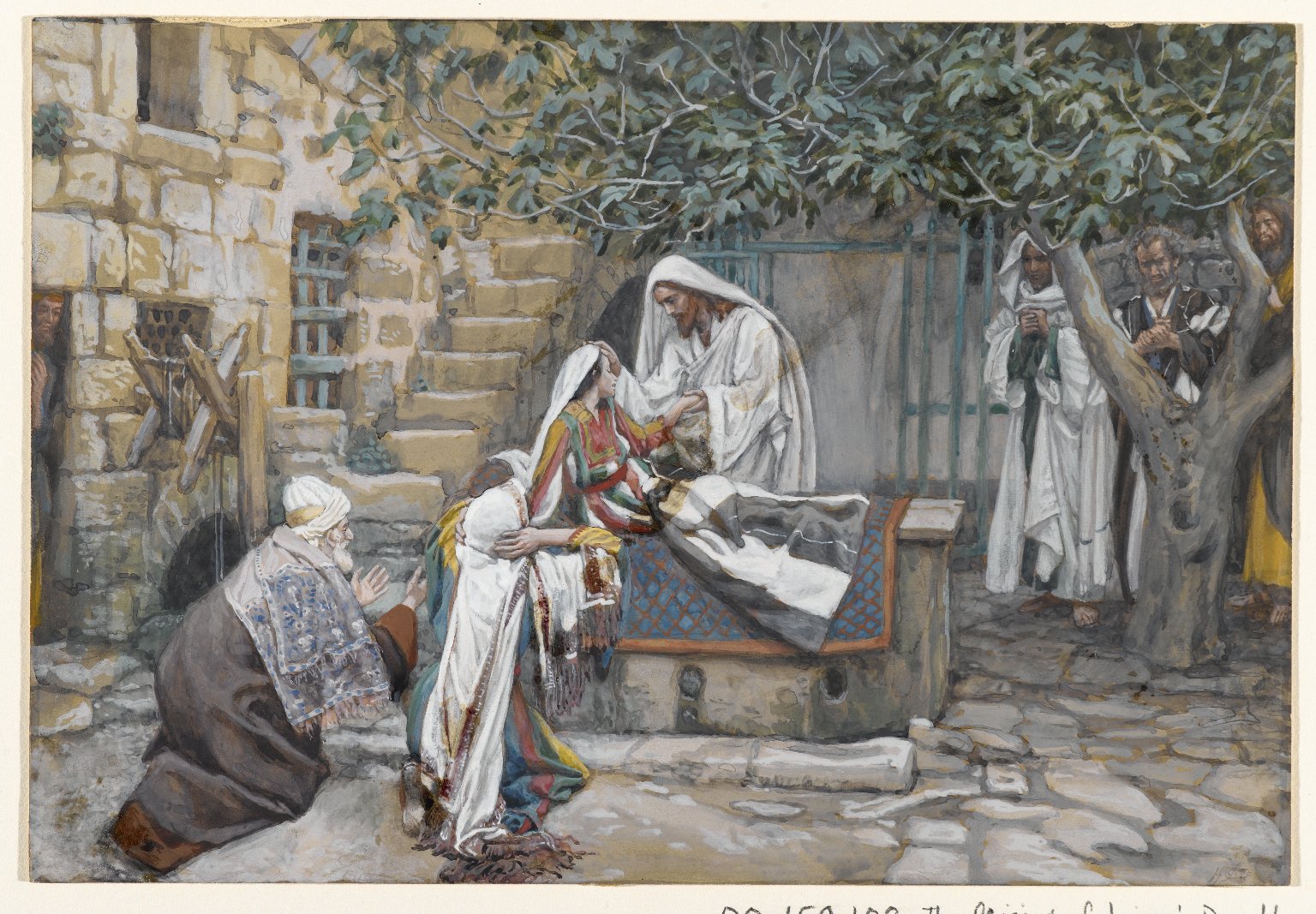
‘Taking her by the hand he said to her, “Talitha cumi”, which means, “Little girl, I say to you, arise.”’ (Mk 5:41)

Note the fact that Jesus takes the girl by the hand. To touch a dead body would make a person ritually impure. This is why the priest and Levite in the Parable of the good Samaritan pass by on the other side. Jesus disregards the taboo of uncleanness, and speaks to her. He speaks to her in Aramaic, her mother tongue, and says literally ‘little lamb, get up’. It is a term of endearment which also reminds us that Christ is the Good Shepherd who cares for His lambs, keeps them safe, and saves them from death. 

The people who are there: Jairus and his wife, Peter, James and John are all amazed. They are filled with awe, the holy fear of witnessing the mighty works of God. It reminds us that as humans we relate to God primarily through worship. Finally, Jesus tells her parents to give her something to eat, which shows us the reality of her resurrection. This also points towards the feast of the Kingdom, which we hope to enjoy in Heaven, and which is prefigured in the Eucharist. Through physical and spiritual communion Christ gives Himself to feed us, and heal our bodies and our souls, and assures us of eternal life.

Like Jairus and the haemorrhaging woman, may we have faith, and come to Jesus for healing. So that we may come to the Feast of the Lamb and may sing the praises of God the Father, God the Son, and God the Holy Spirit. To whom be ascribed, as is most right and just, all might, majesty, glory, dominion, and power, now and forever. Amen. 

James Tissot The woman with the Issue of Blood
James Tissot The Raising of Jairus’ Daughter