Showing posts with label Mercy. Show all posts

Saturday, 25 September 2021

Trinity XVII

The Book of Numbers tells the story of the journey of the people of Israel through the desert of Sinai towards the Promised Land. In Chapter 11, the people are complaining about their lack of food which leads God to send first manna, and then quail, to feed the people. While this is happening, God promises Moses that He will share his Spirit with seventy others. This is so that Moses may have some helpers to aid with leadership, to deal with complaints, and to settle disputes.

Seventy men go to the Tent of Meeting, and two men stay behind in the camp: Eldad and Medad. They are both filled with the Holy Spirit and begin to prophesy. Moses is told about this, at which point something of a dispute arises:

‘And Joshua the son of Nun, the assistant of Moses from his youth, said, “My lord Moses, stop them.” But Moses said to him, “Are you jealous for my sake? Would that all the Lord’s people were prophets, that the Lord would put his Spirit on them!”’ (Numbers 11:28-29)

Moses is not as concerned as Joshua about observing proprieties, and he recognises that there is a freedom to the Spirit: it blows where it wills (cf. Jn 3:8). God is free to work through whomsoever He chooses. Moses wishes are granted on the Day of Pentecost, when the Apostles were filled with the Holy Spirit. We too, as Christians, are dwelling-places of the Holy Spirit, which works in us and through us. 

Just as Moses is able to see the bigger picture, likewise in today’s Gospel reading we see Jesus being rather generous. The disciples have noticed some exorcisms taking place, which have not been sanctioned. However, Jesus does not want His disciples put a stop to this, so He tells them:

“Do not stop him, for no one who does a mighty work in my name will be able soon afterwards to speak evil of me. For the one who is not against us is for us. For truly, I say to you, whoever gives you a cup of water to drink because you belong to Christ will by no means lose his reward” (Mk 9:39-41)

If the point of exorcism is to heal people, then as the Kingdom is a place of healing, the more the better. Evil spirits are cast out in Jesus’ Name, because it is powerful. The point is that faith is not just a matter of belief, but rather of belief put into practice, an act of loving generosity. Putting faith into practice helps to make the Kingdom a reality in our and other people’s lives. It is easy to be exclusive, and small-minded, but thankfully God is more generous than that, and we should try to be like Him.

Then Jesus’ teaching turns to matters of wrongdoing, moral failures, and how they are viewed. It is important to state in the strongest possible terms that Jesus is not encouraging Christians to drown people, or mutilate themselves, but rather teaching His disciples about the serious nature of sin.

Jesus begins by explaining that whoever puts a stumbling block in the path of another has hindered their discipleship. This is a serious charge.

“Whoever causes one of these little ones who believe in me to sin, it would be better for him if a great millstone were hung round his neck and he were thrown into the sea.” (Mk 9:42)

In this passage Jesus is engaging in hyperbole, exaggeration for rhetorical effect, to underline the point that our actions affect others. Using exaggeration, Jesus is pointing out that living a Christian life is a serious business: His followers are called to perfection. People who are new to the Christian faith, who are learning the Way, are particularly vulnerable. If they are led astray by the wrong kind of example, by the wrong sort of teaching, then it is a serious thing. Those of us who are Christians have a great responsibility to nurture others in their faith. The disciples, however, have been petty and small-minded. They have been concerned more with their own power and prestige rather than judging the actions of those helping otherscorrectly, and seeing the situation for what it really is. 

There follows a difficult passage, which, if we were to take it literally, would see all of us blind, lame, and without hands. Clearly this cannot be God’s plan of salvation for humanity. So if we are not supposed to take Jesus literally we have to interpret His words allegorically.This means uncovering the spiritual meaning of Christ’s words. Jesus may be referring to sins committed by hand, foot, or eye, i.e., what we do, where we go, and what we look at. The cutting off may be metaphorical, referring to excommunication. This means temporarily excluding people to give them an opportunity to repent and ask for God’s forgiveness. Our sins lead to estrangement from God, characterised by Hell and unquenchable fire. This is what rejecting God means. By doing so, we confine ourselves to darkness and misery. Jesus has come to save humanity from the Hell we create. He will die to give us life. 

Only Jesus can do this for us, and we have to let Him. We need to follow Him. Only then can we be salt, flavouring and preserving the world around us. Only then can we truly be at peace with one another, and understand things properly, and act accordingly. 

Living as a Christian community means owning up to our shortcomings, and being humble enough to let God transform us, bit by bit, day by day, more and more into His likeness. We learn by carrying our Cross, a burden much lighter than our sin, a burden which can and will transform us. Pride, that great human sin, makes us think that we are important. The disciples think they are important, and lose sight of the fact that what really matters is who Jesus Christ is. We must focus on what He has done for us, dying on the Cross, and rising to new life, so that we can live in Him. This is why we come together on the first day of the week, the day Jesus rose from the dead, so that we can share His risen life, and be nourished by Him.

Today’s other text, the Letter of James has some strong words for the wealthy, and in particular those who acquire their wealth by defrauding others. Christianity is a religion of generosity, given to us by a generous God, who expects us to be generous in turn. Just like the moral shortcomings outlined in the Gospel, here we see that we are called to live in a just and loving way. As Christians we are to stand for fairness and justice for all. The temptation is always there to seek to be important, to pursue power and prestige. What matters is that we glorify God, that we advance His kingdom. This is a kingdom of love, and forgiveness and healing, where people come to know who they truly are in Christ. If we listen to what Jesus tells us, and try to live like Him, then we can help to bring about the day when God will be all in all. Then everyone will sing the praise of God the Father, God the Son, and God the Holy Spirit. To whom be ascribed, as is most right and just, all might, majesty, glory, dominion and power, now and forever. Amen.

James Tissot – Jesus teaches his disciples

Saturday, 26 June 2021

Trinity IV

Each and every one of us is in need of healing, be it physical, psychological or spiritual. Our bodies, minds, and souls need it. It is a truth of human existence that we are all broken, and while medicine can heal our bodies, we still long for life in all its fulness. The Kingdom of God, proclaimed and inaugurated by Jesus Christ is a place of healing, and through our relationship with Jesus we can find the wholeness for which we long. This is why the Gospels contain healing miracles. These miraculous accounts are signs of God’s restoration of creation through His Son, something which will culminate with His Passion, Death, and Resurrection. 

In the Gospel Jesus has sailed back across the Sea of Galilee to the Jewish side. On His arrival He is greeted by the leader of a local synagogue whose daughter is close to death. Jairus longs for his child to be healed, and asked Jesus to place His hands on her, so that she might be saved and live.

While Jesus is going to heal Jairus’ daughter, another miracle takes place. Lots of people are following Jesus, which is understandable since He is a charismatic preacher and teacher, who heals people. In the crowd is a woman with a gynaecological complaint. It would have made her life extremely difficult, and in Jewish ritual terms she would have been regarded as impure. She would not have been able to play her part in religious life. Also she would not have been able to bear children, and her husband, according to Jewish law, could have divorced her. She was an outcast, unclean, thrown on the metaphorical scrapheap of society. What money the woman had, she had been spent on doctors in trying to find a cure, but they only made things worse. Now she was penniless and desperate. But this pale, weak woman had an idea:

She had heard the reports about Jesus and came up behind him in the crowd and touched his garment. For she said, “If I touch even his garments, I will be made well.” And immediately the flow of blood dried up, and she felt in her body that she was healed of her disease.’ (Mk 5:27-29)

Despite her physical infirmity, this woman has faith. She trusts Jesus, and believes that if she touches His clothing she will be healed. Such healing would restore her to community and allow her to take part in its religious life. She places her faith in God, realising that He can do for her what humanity could not. 

Jesus then notices that power has gone out from Him. He is aware of what has happened. Having asked who touched Him, Jesus’ disciples reply that it was accidental: they are surrounded by a crowd, anyone could have brushed against Him. Our Lord remains unconvinced:

And he looked round to see who had done it. But the woman, knowing what had happened to her, came in fear and trembling and fell down before him and told him the whole truth. And he said to her, “Daughter, your faith has made you well; go in peace, and be healed of your disease.”’ (Mk 5:32-34)

The woman comes ‘in fear and trembling’ not because she is afraid of Jesus, but because it is the proper way for humans to act in the presence of God. She is filled with awe at her experience of divine healing. Jesus’ reply is astounding for several reasons. Firstly, that He responds at all: talking to a woman who was not a member of your family was frowned upon, let alone a woman who is a ritually unclean outcast. Jesus is breaking a social taboo. He addresses her as ‘daughter’, a reminder that Jesus’ family are not those related to Him in earthly terms, but those who do God’s will. The woman is a daughter of God and her faith in God has healed her. She trusted God to do what the physicians could not. Faith is the route to salvation and healing, trusting God to be at work. She can go in peace because she has been restored to health. Peace is God’s gift to us, that we may experience wholeness. Finally, Jesus underlines that what has happened is not a temporary healing, but a permanent state of affairs.

While Jesus is still speaking to the woman, messengers come to give Jairus a message:

“Your daughter is dead. Why trouble the Teacher any further?” (Mk 5:35)

The situation is hopeless, and in their eyes there is nothing that Jesus can do. Thankfully, Our Lord has other ideas:

‘But overhearing what they said, Jesus said to the ruler of the synagogue, “Do not fear, only believe.”’ (Mk 5:36)

This fear is not the awe shown by the woman who has been healed, but a lack of trust in God. We know from the Letter to the Hebrews that:

Faith is the assurance of things hoped for, the conviction of things not seen. (Heb 11:1)

Jairus has demonstrated his faith by prostrating himself before Jesus and asking for healing. Now, in the face of his daughter’s apparent demise, Jairus must trust God to be at work. 

‘Taking her by the hand he said to her, “Talitha cumi”, which means, “Little girl, I say to you, arise.”’ (Mk 5:41)

Note the fact that Jesus takes the girl by the hand. To touch a dead body would make a person ritually impure. This is why the priest and Levite in the Parable of the good Samaritan pass by on the other side. Jesus disregards the taboo of uncleanness, and speaks to her. He speaks to her in Aramaic, her mother tongue, and says literally ‘little lamb, get up’. It is a term of endearment which also reminds us that Christ is the Good Shepherd who cares for His lambs, keeps them safe, and saves them from death. 

The people who are there: Jairus and his wife, Peter, James and John are all amazed. They are filled with awe, the holy fear of witnessing the mighty works of God. It reminds us that as humans we relate to God primarily through worship. Finally, Jesus tells her parents to give her something to eat, which shows us the reality of her resurrection. This also points towards the feast of the Kingdom, which we hope to enjoy in Heaven, and which is prefigured in the Eucharist. Through physical and spiritual communion Christ gives Himself to feed us, and heal our bodies and our souls, and assures us of eternal life.

Like Jairus and the haemorrhaging woman, may we have faith, and come to Jesus for healing. So that we may come to the Feast of the Lamb and may sing the praises of God the Father, God the Son, and God the Holy Spirit. To whom be ascribed, as is most right and just, all might, majesty, glory, dominion, and power, now and forever. Amen. 

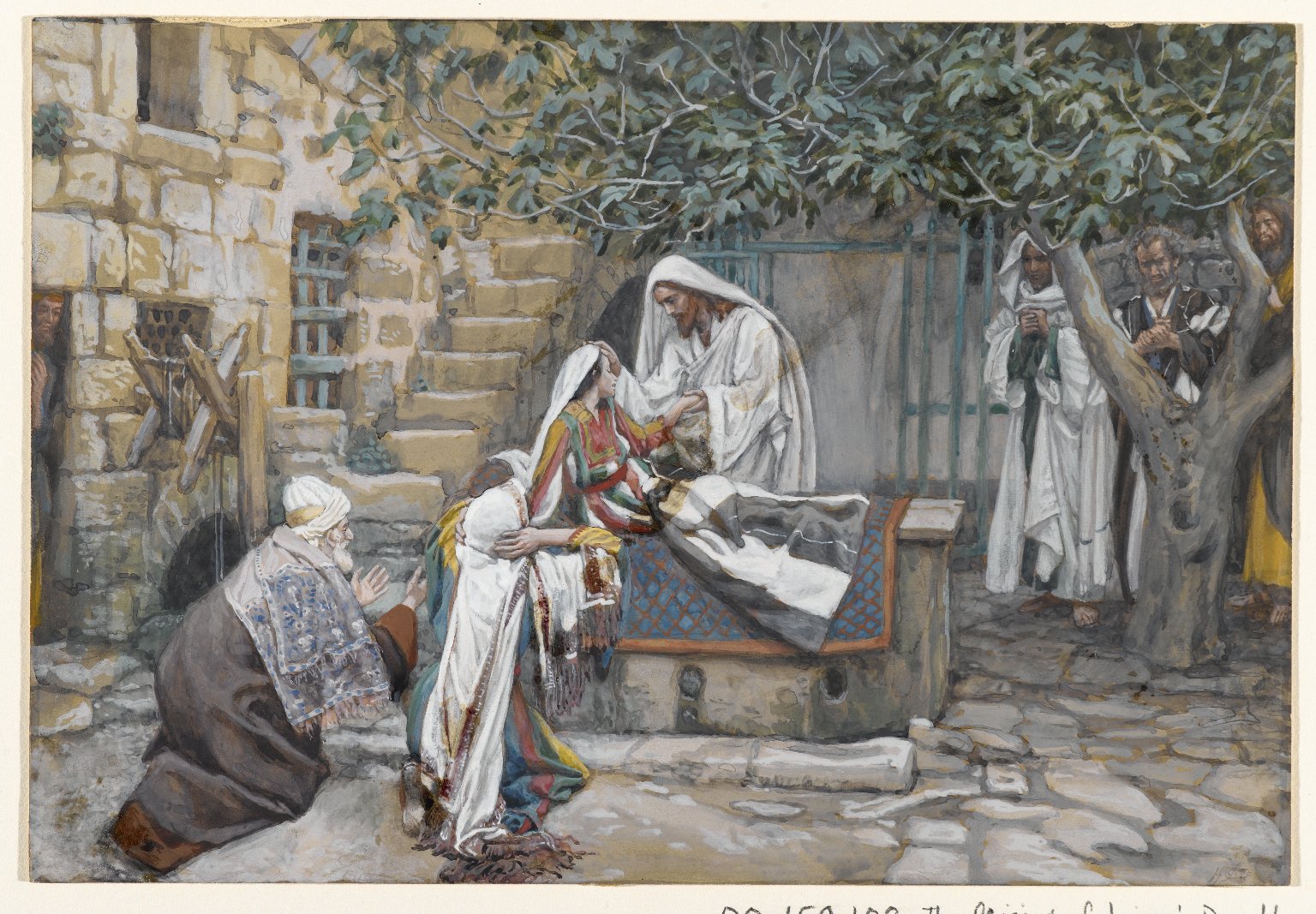
James Tissot The woman with the Issue of Blood
James Tissot The Raising of Jairus’ Daughter

Saturday, 9 January 2021

Baptism of Christ

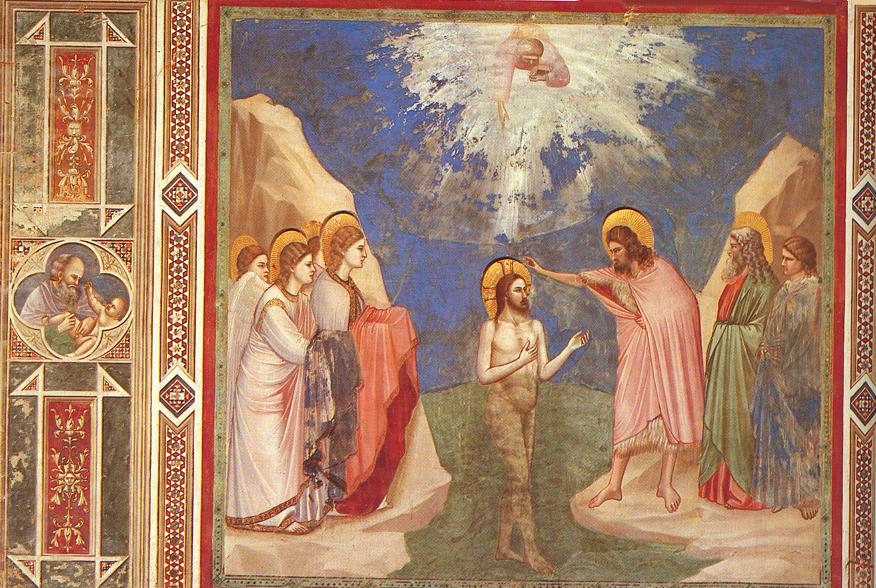
The Baptism of Christ by John the Baptist in the River Jordan at the start of His public ministry is one of the events found in all four Gospels (the others are the Feeding of the Five Thousand, and the account of the Lord’s Passion, Death, and Resurrection, from Palm Sunday to Easter Day). Each gospel contains accounts of the beginning and end of Jesus’ public ministry, as well as a miraculous feeding. If we take a moment to consider both what baptism is, and what it is for, we may come to understand why all four  gospel writers included it in their account of the life and teachings of Jesus. 

Baptism is symbolic washing with water for the forgiveness of sins. If Jesus was baptized does that mean that He sinned? The answer is, No. So, given the fact that Jesus committed no sins, did He need to be baptised by John? Again, the answer is. No. You may begin to wonder what is going on here? Why would Jesus begins His Public ministry in Galilee with a redundant action? If Jesus does not need to be baptised, what is the point of it? What is Jesus doing and why is it important for us?

Unlike all human beings, who commit sin, and become estranged from their relationship with God, Jesus is God become man. He is perfect, sinless, and united with God the Father, and the Holy Spirit, a Trinity of love. There is no need to restore the relationship, because it is one of perfect love. Mark’s account of the Baptism is prefaced by the words of John the Baptist:

After me comes he who is mightier than I, the strap of whose sandals I am not worthy to stoop down and untie. I have baptized you with water, but he will baptize you with the Holy Spirit.” (Mk 1:7-8)

John the Baptist is linking Christ’s baptism with the redemption of humanity in His death. The very beginning of Jesus’ public ministry points to the Cross, where salvation and freedom will be offered to all who turn to Christ. John baptises with water, but he looks forward to Jesus, who will baptise with the Holy Spirit. This is the baptism of the Church, to save and redeem humanity, by sharing in Christ’s Death and Resurrection.

Once Jesus has been baptised by John, extraordinary things happen:

And when he came up out of the water, immediately he saw the heavens being torn open and the Spirit descending on him like a dove. And a voice came from heaven, “You are my beloved Son; with you I am well pleased.” (Mk 1:10-11)

At the moment of Jesus’ baptism we hear God the Father, and see God the Son and God the Holy Spirit. The fulness of God is manifest to humanity in the Trinity. We can see and hear God’s saving work. Jesus does not need to be baptised, but does so for three reasons. Firstly to demonstrate His humility, and obedience to the will of the Father; secondly to sanctify the waters of baptism, and finally to act as an example for us to follow. Thus, God sends the Holy Spirit to demonstrate the bond of love between the Father and the Son. The Father speaks to demonstrate that Jesus is the Son of God. He is beloved of the Father, and His obedience and humility is pleasing in the sight of God. Jesus shows us the way back to the Father. By our own obedience and humility, by our repentance, and turning away from the ways of sin and the world, we return to the God who loves us. This is the message of the church: that God’s grace is available to us, to everybody, even though we haven’t worked for or earned it, even though we have done nothing to deserve it, God’s love and mercy is there for us. In Baptism we receive adoption, and become part of the family of God. Through Baptism we are born again, of water and the Spirit, we are ‘in Christ’, clothed with Him.

The unnecessary nature of the act of Jesus’ Baptism discloses something profound about the nature of God and His love for us. God gives us more than we ask for, because it is in God’s nature to be generous in a way which astounds us. There is something reckless, extravagant, utterly over the top, about the love of God, which should prompt us to love and care for others in a similar way.

John’s baptism of water prepares the way for the baptism of the Holy Spirit in Christ, through which we enter the Church. It shows us a new way of living. Life in the Spirit, life with God, has a profound effect on us, who we are and what we do. It opens up the possibility of living in a new way, a way of love, which mirrors the generosity shown to us by God. This way of life shows us in the Church what it is to be truly alive and how to live in a new way. It points to another act of God’s extravagant love: when Christ dies on the Cross, to take away our sin, to carry our burden, which separates us from God and each other. Our wounds are healed, the relationship is restored so that we can live the life of the Kingdom of God here and now: living out that self-giving, reckless, extravagant love and forgiveness in our own lives, and in the world around us.

Back in our first reading this morning the prophet Isaiah looks forward to the coming of the Messiah with a proclamation of extravagant generosity:

Come, everyone who thirsts, come to the waters” (Isa 55:1)

This invitation is also the invitation of the Church, for people to enter it by baptism and share in the unsearchable riches of Christ. Today we remember that salvation is offered to the world through baptism. We give thanks for the rebirth of our own baptism, and hope to share it with others. Baptism reminds us of the hope which we have in Jesus Christ, hope of new life, and eternal life with Him. Whatever is happening in the world, or in our own lives we can trust in who God is, and what He has done for us. In this trust we can live out our faith so that the world may be transformed and believe and give glory to God the Father, God the Son, and God the Holy Spirit, to whom be ascribed, as is most right and just, all might, majesty, glory, dominion, and power, now and forever. Amen. 

Saturday, 2 May 2020

Easter IV (The Good Shepherd)

We mark time: day and night, weeks, months, years, and seasons. The Church’s Liturgical Year is a very good thing indeed. It divides up time and it focusses our attention on certain things: allowing us the time to contemplate the mysteries of the Christian Faith. The Resurrection of Jesus Christ from the dead is an event which requires serious contemplation. We need time to let it sink in, and to explore what it means for us and our faith. It is the defining moment of our faith, one which gives Christians the hope that our death is not the end, that this life is not all that there is, and that because of who Christ is, namely God, and what He has done: died for us to take away our sin, and rise again to give us the hope of eternal life in Him.

In John’s Gospel, Jesus says of himself, ‘I am the Good Shepherd’ It discloses something important about Who and What He is — Jesus is one who tends, who looks after His sheep. The Jews in the Temple for the celebration of Hanukkah in the Gospel don’t seem to have been listening. Jesus has told them clearly and they do not believe that He is the Messiah. What Christ does in the Gospels testifies to Who and What He is: the Word made flesh, God with us.

Those of us who are in the Church, through our Baptism belong to Christ, we are His. So we are to listen to what Jesus tells us, in the words of Scripture and through prayer. Jesus knows us and we know him — in word and sacrament, through the outpouring of His grace, and so we follow Christ, we do what He tells us to do: to love, to forgive each other. We are humble, we don’t think of ourselves as better than we are, we know our need of, and our dependance upon God. We put our faith into practice in our lives, so that it becomes a reality in the world.

Christ offers us eternal life, as we share in His death, so we too share in His Resurrection, and are assured of eternal life with Him, something wonderful and freely given, and a reason why we, as the Church, celebrate Easter in an extravagant and exuberant way, because it is a sign that God loves us, and saves us. We are sharing in that Eternal Life here and now, as we are nourished by Him, in Word and Sacrament, strengthened by Him, to live His risen life, here and now. 

In Revelation, as St John experiences heavenly worship he states, ‘For the Lamb in the midst of the throne will be their shepherd, and he will guide them to springs of living water, and God will wipe away every tear from their eyes.’ (Revelation 7:17 ESV). The Lamb will be our shepherd: Christ will care for us, and keep us safe. A Good Shepherd lays down His life for the sheep as Christ has done through His Death and Resurrection. To drink living water is to experience the fulness of life in God, filled with the Holy Spirit. Christ guides us to that in our baptism, when we are filled with the Spirit and made part of the Church. 

So we listen to Christ’s voice, in the Bible. We hear Him speak to us, and through this we listen to Him, and obey Him. That is how we know Christ and follow Him. It affects who we are and how we live, as people of love, loved by God. We are prepared here on earth for the life of heaven, for worship, and closeness to God. We have a foretaste of that closeness in Holy Communion where Christ feeds us with His Body and Blood, so that we may be transformed by it, more and more into His likeness. It changes us, so that we, by the grace of God, in the power of His Holy Spirit, may become what we are: made in the image of God. That image is restored in us by Christ’s death and resurrection. Through it we come to share in the intimacy of the divine life. As Christ says, ‘I and the Father are one.’ (John 10:30 ESV)  As Michael Ramsay said, ‘God is Christlike, and in him is no un-Christlikeness at all’ [God, Christ & the World: A Study in Contemporary Theology, London 1969, 98] When we see Jesus, we see God, when we hear Him speak, we hear the voice of God. We can know who God is, the creator and redeemer of the universe, through His Son, Jesus Christ. God is no longer distant, or an angry man on a cloud, but a loving Father, as in the Parable of the Prodigal Son, and a Son who loves us so much that He suffers and dies for us, to give us life in Him. This is God who goes after lost sheep, who longs to love and heal and reconcile, who can heal our wounds if we let Him.

God loves us; we can say this with the utmost confidence because of the life, death, and resurrection of Jesus Christ, it all proclaims the same truth: God loves us, not because we’re worthy of it, but so that we might become what God is. It is what we celebrate at Easter, it lies at the heart, the very core of our faith as Christians. It’s why we are what we are, and why we do what we do, to proclaim this simple truth to the world.

We can have peace through our relationship with the Trinity, the source of our peace, and joy, and love. Grounded in this relationship we need not be afraid or troubled – we are free to live lives which proclaim God’s love and victory so that the world may believe. Through God loving us, we can truly love him and each other. We experience this most clearly at the Eucharist when Christ feeds us with His Body and Blood, which He as both priest and victim offers on the Altar of the Cross. That self same sacrifice which heals the world through the outpouring of God’s love feeds us here and now. We are fed so that we may be nourished and share in the divine life and the joy of heaven. We receive the free gift of God’s grace so that it may perfect our human nature, so that we may go where Our Lord is going, and share in the joy, and love, and peace of the Triune God, Father, Son, and Holy Spirit, to whom be ascribed, as is most right and just, all might, majesty, glory, dominion, and power, now and forever. Amen. 
06f84c08-66cf-4481-baf0-09d3f1849f7e

Easter IV (The Good Shepherd)

We mark time: day and night, weeks, months, years, and seasons. The Church’s Liturgical Year is a very good thing indeed. It divides up time and it focusses our attention on certain things: allowing us the time to contemplate the mysteries of the Christian Faith. The Resurrection of Jesus Christ from the dead is an event which requires serious contemplation. We need time to let it sink in, and to explore what it means for us and our faith. It is the defining moment of our faith, one which gives Christians the hope that our death is not the end, that this life is not all that there is, and that because of who Christ is, namely God, and what He has done: died for us to take away our sin, and rise again to give us the hope of eternal life in Him.

In John’s Gospel, Jesus says of himself, ‘I am the Good Shepherd’ It discloses something important about Who and What He is — Jesus is one who tends, who looks after His sheep. The Jews in the Temple for the celebration of Hanukkah in the Gospel don’t seem to have been listening. Jesus has told them clearly and they do not believe that He is the Messiah. What Christ does in the Gospels testifies to Who and What He is: the Word made flesh, God with us.

Those of us who are in the Church, through our Baptism belong to Christ, we are His. So we are to listen to what Jesus tells us, in the words of Scripture and through prayer. Jesus knows us and we know him — in word and sacrament, through the outpouring of His grace, and so we follow Christ, we do what He tells us to do: to love, to forgive each other. We are humble, we don’t think of ourselves as better than we are, we know our need of, and our dependance upon God. We put our faith into practice in our lives, so that it becomes a reality in the world.

Christ offers us eternal life, as we share in His death, so we too share in His Resurrection, and are assured of eternal life with Him, something wonderful and freely given, and a reason why we, as the Church, celebrate Easter in an extravagant and exuberant way, because it is a sign that God loves us, and saves us. We are sharing in that Eternal Life here and now, as we are nourished by Him, in Word and Sacrament, strengthened by Him, to live His risen life, here and now. 

In Revelation, as St John experiences heavenly worship he states, ‘For the Lamb in the midst of the throne will be their shepherd, and he will guide them to springs of living water, and God will wipe away every tear from their eyes.’ (Revelation 7:17 ESV). The Lamb will be our shepherd: Christ will care for us, and keep us safe. A Good Shepherd lays down His life for the sheep as Christ has done through His Death and Resurrection. To drink living water is to experience the fulness of life in God, filled with the Holy Spirit. Christ guides us to that in our baptism, when we are filled with the Spirit and made part of the Church. 

So we listen to Christ’s voice, in the Bible. We hear Him speak to us, and through this we listen to Him, and obey Him. That is how we know Christ and follow Him. It affects who we are and how we live, as people of love, loved by God. We are prepared here on earth for the life of heaven, for worship, and closeness to God. We have a foretaste of that closeness in Holy Communion where Christ feeds us with His Body and Blood, so that we may be transformed by it, more and more into His likeness. It changes us, so that we, by the grace of God, in the power of His Holy Spirit, may become what we are: made in the image of God. That image is restored in us by Christ’s death and resurrection. Through it we come to share in the intimacy of the divine life. As Christ says, ‘I and the Father are one.’ (John 10:30 ESV)  As Michael Ramsay said, ‘God is Christlike, and in him is no un-Christlikeness at all’ [God, Christ & the World: A Study in Contemporary Theology, London 1969, 98] When we see Jesus, we see God, when we hear Him speak, we hear the voice of God. We can know who God is, the creator and redeemer of the universe, through His Son, Jesus Christ. God is no longer distant, or an angry man on a cloud, but a loving Father, as in the Parable of the Prodigal Son, and a Son who loves us so much that He suffers and dies for us, to give us life in Him. This is God who goes after lost sheep, who longs to love and heal and reconcile, who can heal our wounds if we let Him.

God loves us; we can say this with the utmost confidence because of the life, death, and resurrection of Jesus Christ, it all proclaims the same truth: God loves us, not because we’re worthy of it, but so that we might become what God is. It is what we celebrate at Easter, it lies at the heart, the very core of our faith as Christians. It’s why we are what we are, and why we do what we do, to proclaim this simple truth to the world.

We can have peace through our relationship with the Trinity, the source of our peace, and joy, and love. Grounded in this relationship we need not be afraid or troubled – we are free to live lives which proclaim God’s love and victory so that the world may believe. Through God loving us, we can truly love him and each other. We experience this most clearly at the Eucharist when Christ feeds us with His Body and Blood, which He as both priest and victim offers on the Altar of the Cross. That self same sacrifice which heals the world through the outpouring of God’s love feeds us here and now. We are fed so that we may be nourished and share in the divine life and the joy of heaven. We receive the free gift of God’s grace so that it may perfect our human nature, so that we may go where Our Lord is going, and share in the joy, and love, and peace of the Triune God, Father, Son, and Holy Spirit, to whom be ascribed, as is most right and just, all might, majesty, glory, dominion, and power, now and forever. Amen. 
06f84c08-66cf-4481-baf0-09d3f1849f7e

Saturday, 14 December 2019

Advent III – He that will come

The prophet Isaiah provides our first readings during Advent this year, and he is particular strong on the idea that the Messiah will come to deliver Israel. As Christians we use the period of Advent to reflect upon the fact that Christ is coming, He is coming as a baby born in Bethlehem, He is coming to us here today in the Eucharist, and He is coming with vengeance to judge the world. Should we be afraid? On the contrary, as the prophet says, ‘Strengthen the weak hands, and make firm the feeble knees. Say to those who have an anxious heart,“Be strong; fear not! Behold, your God will come with vengeance, with the recompense of God. He will come and save you’ (Isa 35:3-4 ESV). 

Isaiah has a vision where the desert, a dry wilderness is carpeted with flowers, a sign of new life, of hope. This is the flourishing which the Messiah will bring, ‘the glory of the Lord, the majesty of our God’ (Isa 35:2 ESV). As Christ Himself says ‘I came that they may have life and have it abundantly’ (Jn 10:10 ESV) This is good news, a reason to rejoice and be glad, and to mark this the Church instead of penitential purple wears rose today, to mark the joyful character of this day, and to remind us that Christ is coming. As Isaiah says, ‘the ransomed of the Lord shall return and come to Zion with singing; everlasting joy shall be upon their heads; they shall obtain gladness and joy, and sorrow and sighing shall flee away’ (Isa 35:10 ESV).

The time is both now, and not yet. As St James writes, ‘You also, be patient. Establish your hearts, for the coming of the Lord is at hand’ (Jas 5:8 ESV). Patience is a hard thing to master. We are naturally impatient, we don’t want to wait, but we have to. The question is how we wait: in joyful expectation, preparing ourselves for what is to come? 

John the Baptist has been waiting for the Messiah, and while he leapt in his mother’s womb at the Visitation, in this morning’s Gospel he appears to be having doubts. He is expecting a Messiah of judgement, and he is isn’t sure what is going on. John has been imprisoned for criticising Herod’s marriage to his brother’s wife. He is hoping for a messiah to sweep away an unjust and corrupt regime, hence his doubts about Jesus, who doesn’t seem to be a political messiah. Jesus tells John’s disciples, ‘Go and tell John what you hear and see:  the blind receive their sight and the lame walk, lepers are cleansed and the deaf hear, and the dead are raised up, and the poor have good news preached to them’ (Mt 11:4-5 ESV). 

The vision of a messianic future envisaged by Isaiah in this morning’s first reading has become a reality: prophecy has been fulfilled, God keeps his promises. The Kingdom of God is a place of healing, and Christ is the great physician, who has come to heal our souls. Jesus is the one who is to come, He has come, and will come again. The establishment of God’s kingdom can look strange in human terms: going to those on the margins, the sick, the poor, and the oppressed and marginalised is not a grand gesture. That is the point! The greatest grand gesture Jesus will make will be in handing Himself over to be crucified and die the death of a common criminal. This is how the messiah will reign as the true King of Israel. 

It defies human expectations, which is the point: God’s ways are not our ways, nor His thoughts ours. That’s the core message of this morning’s Gospel, if we expect God’s rule to look like human kingship, then we will be disappointed. God has something else in store, something far more wonderful than we could ever imagine, and at its heart is the transformation of humanity by love. God heals His people, because God is a God of love. God loves us not because we are loveable, we are sinners, who don’t deserve to be loved, and cannot earn that love. But rather than what we are, God loves us for WHO we are, His sons and daughters, created in His image. 

This is grace: loving sinful humanity so that we may be transformed by love. Hence the focus on healing, something which only God can do, to heal our souls with His love. This is the cause of our joy, what the prophet Isaiah hoped for has been fulfilled, and continues to be fulfilled. The Church exists to carry on God’s healing in the world, to take humanity, and heal it with God’s love. This is what we are about to celebrate in the Eucharist where we thank God for loving us, and prepare to experience that healing love, so that it may transform us. We do so with reverence, because we are not simply consuming human food and drink, but the very Body and Blood of Christ, given for us, to heal us. The greatest medicine our souls could ever wish for. Soon we ‘shall see the glory of the Lord, the majesty of our God’ (Isa 35:2 ESV) God’s glory and majesty is to die on a Cross for us, and to feed us with Himself. Come to the banquet my brothers and sisters, and experience the love of God, and let it heal and transform you, so that you and all creation may sing the praises of God the Father, God the Son, and God the Holy Spirit, to whom be ascribed as is most right and just all might, majesty, glory, dominion, and power, now and forever. Amen.

Raphael_-_Madonna_in_the_Meadow_-_Google_Art_Project.jpg

Advent III – He that will come

The prophet Isaiah provides our first readings during Advent this year, and he is particular strong on the idea that the Messiah will come to deliver Israel. As Christians we use the period of Advent to reflect upon the fact that Christ is coming, He is coming as a baby born in Bethlehem, He is coming to us here today in the Eucharist, and He is coming with vengeance to judge the world. Should we be afraid? On the contrary, as the prophet says, ‘Strengthen the weak hands, and make firm the feeble knees. Say to those who have an anxious heart,“Be strong; fear not! Behold, your God will come with vengeance, with the recompense of God. He will come and save you’ (Isa 35:3-4 ESV). 

Isaiah has a vision where the desert, a dry wilderness is carpeted with flowers, a sign of new life, of hope. This is the flourishing which the Messiah will bring, ‘the glory of the Lord, the majesty of our God’ (Isa 35:2 ESV). As Christ Himself says ‘I came that they may have life and have it abundantly’ (Jn 10:10 ESV) This is good news, a reason to rejoice and be glad, and to mark this the Church instead of penitential purple wears rose today, to mark the joyful character of this day, and to remind us that Christ is coming. As Isaiah says, ‘the ransomed of the Lord shall return and come to Zion with singing; everlasting joy shall be upon their heads; they shall obtain gladness and joy, and sorrow and sighing shall flee away’ (Isa 35:10 ESV).

The time is both now, and not yet. As St James writes, ‘You also, be patient. Establish your hearts, for the coming of the Lord is at hand’ (Jas 5:8 ESV). Patience is a hard thing to master. We are naturally impatient, we don’t want to wait, but we have to. The question is how we wait: in joyful expectation, preparing ourselves for what is to come? 

John the Baptist has been waiting for the Messiah, and while he leapt in his mother’s womb at the Visitation, in this morning’s Gospel he appears to be having doubts. He is expecting a Messiah of judgement, and he is isn’t sure what is going on. John has been imprisoned for criticising Herod’s marriage to his brother’s wife. He is hoping for a messiah to sweep away an unjust and corrupt regime, hence his doubts about Jesus, who doesn’t seem to be a political messiah. Jesus tells John’s disciples, ‘Go and tell John what you hear and see:  the blind receive their sight and the lame walk, lepers are cleansed and the deaf hear, and the dead are raised up, and the poor have good news preached to them’ (Mt 11:4-5 ESV). 

The vision of a messianic future envisaged by Isaiah in this morning’s first reading has become a reality: prophecy has been fulfilled, God keeps his promises. The Kingdom of God is a place of healing, and Christ is the great physician, who has come to heal our souls. Jesus is the one who is to come, He has come, and will come again. The establishment of God’s kingdom can look strange in human terms: going to those on the margins, the sick, the poor, and the oppressed and marginalised is not a grand gesture. That is the point! The greatest grand gesture Jesus will make will be in handing Himself over to be crucified and die the death of a common criminal. This is how the messiah will reign as the true King of Israel. 

It defies human expectations, which is the point: God’s ways are not our ways, nor His thoughts ours. That’s the core message of this morning’s Gospel, if we expect God’s rule to look like human kingship, then we will be disappointed. God has something else in store, something far more wonderful than we could ever imagine, and at its heart is the transformation of humanity by love. God heals His people, because God is a God of love. God loves us not because we are loveable, we are sinners, who don’t deserve to be loved, and cannot earn that love. But rather than what we are, God loves us for WHO we are, His sons and daughters, created in His image. 

This is grace: loving sinful humanity so that we may be transformed by love. Hence the focus on healing, something which only God can do, to heal our souls with His love. This is the cause of our joy, what the prophet Isaiah hoped for has been fulfilled, and continues to be fulfilled. The Church exists to carry on God’s healing in the world, to take humanity, and heal it with God’s love. This is what we are about to celebrate in the Eucharist where we thank God for loving us, and prepare to experience that healing love, so that it may transform us. We do so with reverence, because we are not simply consuming human food and drink, but the very Body and Blood of Christ, given for us, to heal us. The greatest medicine our souls could ever wish for. Soon we ‘shall see the glory of the Lord, the majesty of our God’ (Isa 35:2 ESV) God’s glory and majesty is to die on a Cross for us, and to feed us with Himself. Come to the banquet my brothers and sisters, and experience the love of God, and let it heal and transform you, so that you and all creation may sing the praises of God the Father, God the Son, and God the Holy Spirit, to whom be ascribed as is most right and just all might, majesty, glory, dominion, and power, now and forever. Amen.

Raphael_-_Madonna_in_the_Meadow_-_Google_Art_Project.jpg

Monday, 14 October 2019

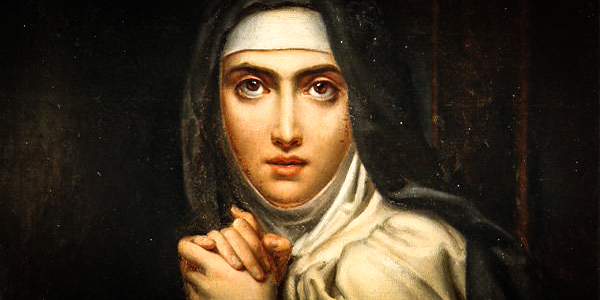
A thought from S. Teresa of Avila

Beware, daughters, of a certain kind of humility suggested by the devil which is accompanied by great anxiety about the gravity of our sins.

He disturbs souls in many ways by this means, until at last he stops them from receiving Holy Communion and from private prayer by doubts as to whether they are in a fit state for it, and such thoughts as: ‘Am I worthy of it? Am I in a good disposition?I am unfit to live in a religious community. ‘

Thus Christians are hindered from prayer, and when they communicate, the time during which they ought to be obtaining graces is spent in wondering whether they are well prepared or no.

Everything such a person says seems to her on the verge of evil, and all her actions appear fruitless, however good they are in themselves. She becomes discouraged and unable to do any good, for what is right in others she fancies is wrong in herself.

When you are in this state, turn your mind so far as you can from your misery and fix it on the mercy of God, his love for us, and all that He suffered for our sake.

The Way of Perfection 39:1, 3

web3-saint-theresa-avila-public-domain.jpg

A thought from S. Teresa of Avila

Beware, daughters, of a certain kind of humility suggested by the devil which is accompanied by great anxiety about the gravity of our sins.

He disturbs souls in many ways by this means, until at last he stops them from receiving Holy Communion and from private prayer by doubts as to whether they are in a fit state for it, and such thoughts as: ‘Am I worthy of it? Am I in a good disposition?I am unfit to live in a religious community. ‘

Thus Christians are hindered from prayer, and when they communicate, the time during which they ought to be obtaining graces is spent in wondering whether they are well prepared or no.

Everything such a person says seems to her on the verge of evil, and all her actions appear fruitless, however good they are in themselves. She becomes discouraged and unable to do any good, for what is right in others she fancies is wrong in herself.

When you are in this state, turn your mind so far as you can from your misery and fix it on the mercy of God, his love for us, and all that He suffered for our sake.

The Way of Perfection 39:1, 3

web3-saint-theresa-avila-public-domain.jpg

Saturday, 22 September 2018

25th Sunday of Year B Mark 9: 30-37

Christianity is apparently ‘a religion for the weak and feeble-minded, attractive to social undesirables, the silly, the mean, the stupid, women, and children.’ (cf. Celsus quoted in Origen Contra Celsum 3:44 & 3:59) You would be forgiven if thought these were the words of Richard Dawkins, or some other New Atheist critic of Christianity. They are in fact a paraphrase of the pagan philosopher Celsus, written around ad 175. This line of argument is something Christians have had to counter for over 1800 years.

It is not true, and it relies upon the idea that the weak are somehow worse than the strong. It’s familiar from the writings of Nietzsche and others. The culture around us despises the weak. You want to be strong. Strength is good. Sadly strength is fleeting: we are not born strong, nor do we die strong. Strength comes and goes. And none of us is as strong as we think we are, or might like to be. The simple fact is that we are weak, and that’s OK. Our human weakness is not something terrible, it is simply how we are, and reminds us that we are relational beings, we exist in relationship with others, and need to rely upon the help and support of others, and primarily God. 

Jesus begins the Gospel this morning by reiterating his teaching which we heard last week. He stresses the importance of His Death and Resurrection as the culmination of His earthly ministry. The disciples are bewildered and afraid. They cannot understand or appreciate what Jesus is saying to them. They love Jesus, and have seen Him do wonderful things: heal the sick, feed the hungry, and even walk on water. They have seen scripture fulfilled, but cannot yet understand where it is all pointing: to Jesus’ Death and Resurrection. Instead they fall back on that very human desire, to form a pecking order, to know who is the greatest of the disciples.

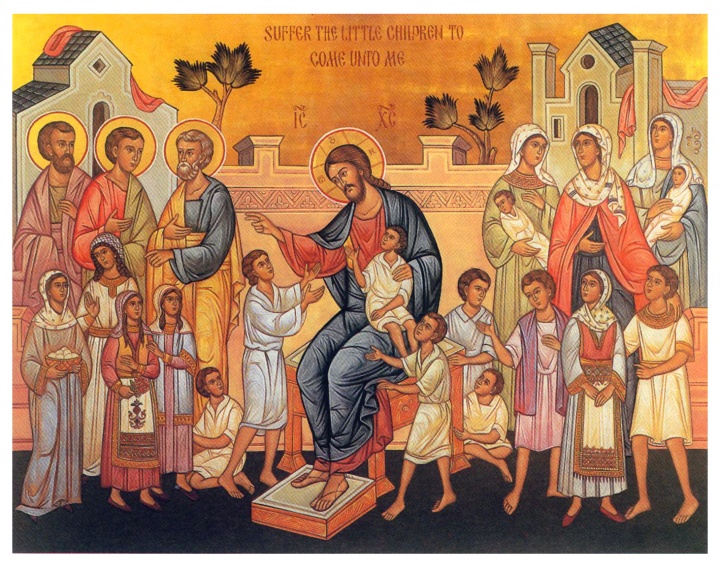
Rather than telling the disciples off for being childish, Jesus teaches them that, ‘If anyone would be first, he must be last of all and servant of all.’ (Mk 9 35 ESV) He then takes a child and says, ‘Whoever receives one such child in my name receives me, and whoever receives me, receives not me but him who sent me.’ (Mk 9 37 ESV) Children aren’t high up in the pecking order, they don’t know everything, and are dependant on their family. Jesus is proposing something of a revolution, turning human values on their head. The Incarnate Word of God will wash His disciples’ feet before the Last Supper. He embodies servant leadership, he doesn’t lord it over people. The ways of the Kingdom of God and this world are opposed to each other. True greatness will often look like weakness and servility in the world’s eyes. It doesn’t matter. What matters is living a life characterised by sacrificial self-giving love. 

As St Paul says in the opening Chapter of the First Letter to the Corinthians, God’s weakness is stronger than our strength. (1Cor 1:25) It is a paradox. This paradox is made apparent on the Cross, where God shows us that sacrificial love can change the world, and heal our wounded souls and restore broken humanity. It is part of the Mystery of the Cross, the mystery of God’s love. In a moment of weakness and powerlessness, where evil and sin appear to have triumphed, this is the supreme demonstration of LOVE, an act of such generosity which has the power to reconcile humanity. It is, with Christ’s Resurrection, the centre of our faith. 

The ways of the world can be found in the first reading this morning, from the Book of Wisdom, they point forward to Christ’s suffering and death. Christ is condemned to a ‘shameful death’ so that through it God might demonstrate His LOVE to the world.

Love can only be offered. It can be accepted or rejected, and it lies at the heart of any relationship. God gives Himself to us so that we might live in Him. He gives Himself today under the outward forms of bread and wine, so that might feast on His Body and Blood, and have life in Him. He offers himself to us, so that we might share in His Death and Risen Life. Love is vulnerable, and its vulnerability is most evident on the Cross, where Christ opens his arms to embrace the world in love.

Christ’s life on earth ends as it begins: He is naked and vulnerable. God’s weakness truly is stronger than human strength because it is the only thing which can truly change the world, heal our wounded souls, and restore broken humanity. Nothing else can. Without it we are condemned to the ways of selfishness and sin, which characterise so much of the world around us. The church is not immune as it is made up of frail, sinful human beings, just like you and me. We need God to be at work in our lives, to transform us more and more into His image. Recognising our own shortcomings is the first step in a process whereby God can be at work in our lives, transforming us more and more into His likeness. We need God’s grace to be at work in us, and recognising this is a sign of humility, that we know our need of God. This is not weakness, quite the opposite. 

We know that we have a problem, which we are unable to solve on our own. In His love and mercy, God sends His only Son to be born for us, to live and die for us, and rise again for us. He gives us His Body and Blood as a pledge and token of our future hope, to heal us and restore us, so that we might become what He is. In this we share in Christ’s suffering, as to follow Christ is to follow the Way of the Cross, a hard road, but one which leads to the joy of Easter, and New Life in Christ. We are transformed through LOVE and SUFFERING, a journey which starts with child-like trust in the God who LOVES us. It starts with humility, knowing our need of God, and trust in a God who loves us, and who can transform us. 

So my brothers and sisters, let us come to Him, trusting Him to be at work in our lives, filling us with His Love, sharing His suffering, pouring out His Grace upon us. Let us stay close to Him: nourished by His Word, the Bible, and the Sacraments, especially the Eucharist, where we receive a foretaste of the Heavenly Banquet, our food for the journey of faith, transforming us into His Divine likeness, strengthening us to live out our faith through acts of loving service, putting our faith into practice so that the world around us may repent of its foolish ways , and come to know and love God the Father, God the Son, and God the Holy Spirit, to whom be ascribed as is most right and just, all might, majesty, glory dominion, and power, now and forever. Amen. christ-children-02

Wednesday, 14 February 2018

Ash Wednesday: Rend your hearts and not your garments

Today the Church celebrates Ash Wednesday, ‘the beginning of her Lenten journey towards Easter. The entire Christian community is invited to live this period of forty days as a pilgrimage of repentance, conversion and renewal. In the Bible, the number forty is rich in symbolism. It recalls Israel’s journey in the desert: a time of expectation, purification and closeness to the Lord, but also a time of temptation and testing. It also evokes Jesus’ own sojourn in the desert at the beginning of his public ministry, a time of profound closeness to the Father in prayer, but also of confrontation with the mystery of evil. The Church’s Lenten discipline is meant to help deepen our life of faith and our imitation of Christ in his paschal mystery. In these forty days may we draw nearer to the Lord by meditating on his word and example, and conquer the desert of our spiritual aridity, selfishness and materialism. For the whole Church may this Lent be a time of grace in which God leads us, in union with the crucified and risen Lord, through the experience of the desert to the joy and hope brought by Easter.’ [1]

Fasting, repentance, prayer, and the imposition of ashes were not unknown to Jews; that is why we as Christians carry on the tradition. The advice given by the prophet Joel in today’s first reading is both wise and salutary as we enter the desert of Lent. It reminds us that, first and foremost, we are to recognise our own brokenness, our own sinfulness, our own turning away from a God of Love and Mercy. While we may recognise this, any outward sign is not good enough. There is nothing that we can do in a solely exterior fashion — ripping our clothes, placing ashes upon our foreheads, which will, in itself, make a blind bit of difference. What matters, where it really counts, is on the inside. To rend one’s heart, is to lay ourselves open, to make ourselves vulnerable, and in this openness and vulnerability, to let God do his work.

It would be all too easy when faced with today’s Gospel to argue that outward displays of fasting, piety, and penitence, are criticised, that they do not matter. But this is not what Jesus is getting at. What he criticises are deeds which are done to comply with the letter but not the spirit of the law. This mechanised approach to piety, a clinging to the external nature of religion, without any concern for its inward spiritual aspect, is where the fault lies. When things are done for show, when our piety is paraded as performance, so that the world may see how good and religious we are, then we are nothing but an empty shell, a whitened sepulchre. The reward which such people receive is likewise an empty one.

Instead, Jesus upholds the standard practice of Jewish cult, but what matters is that what is done outwardly is completely in accordance with our interior life, it is an outward manifestation of our relationship with God and with one another. So Lent is to be a time when we as Christians are to seek to be reconciled, to be in full communion with God and his church. Our outward acts of prayer, fasting, and almsgiving need to be done in tandem with, rather than instead of, paying attention to our interior life: otherwise our efforts are doomed to failure. The God whom we worship is one of infinite love and mercy, which will be demonstrated most fully and perfectly on Good Friday, when we see what that love means, when for our sake God made him who was without sin into sin, so that we in him might become the goodness of God. Or as St Isaac puts it ‘as a handful of sand thrown into the ocean, so are the sins of all flesh as compared with the mind of God.’ As dreadful as we might be, as utterly undeserving of the father’s love, nonetheless, as the parable of the prodigal son shows us, there are no lengths to which God will not go. The love and mercy which flows from Jesus’ stricken side upon the cross at Calvary are still being poured out over the world, and will continue to be so until all is reconciled in him. In his commission of Peter after his resurrection, Jesus entrusts to his church the power to forgive sins, to reconcile us to one another and to God. This reconciliation is manifested by our restoration to communion with God and his Church.

It is not the most comfortable or pleasant thing to see ourselves as we really are. To stand naked in front of a full length mirror is for most of us, I suspect, not the most pleasant experience. And yet, such a self-examination is as nothing when compared with us baring our heart and soul. It is not a pleasant task, but given that God will judge us in love and mercy, having taken away our sins upon the cross, despite our apprehension we have nothing to fear. All that awaits us is the embrace of a loving father. No matter how many times we fail, how many times we would run away or reject his love, his arms, like those of his son upon the cross, remain open to embrace the world, to heal the wounds of sin and division.

If there are any of you determined to live a more Christian life, there is one resolution you need to make which is, out of all proportion, more important than the rest. Resolve to pray, to receive the sacraments, to shun besetting sins, to do good works — all excellent resolutions; but more important than any of these is the resolution to repent. The more resolutions you make, the more you will break. But it does not matter how many you break so long as you are resolute not to put off repentance when you break them, but to give yourself up to the mercy which will not despise a broken and a contrite heart. Converted or unconverted, it remains true of you that in you, that is, in your natural being, there dwells no good thing. Saints are not people who store goodness in themselves, they are just a people who do not delay to repent, and whose repentances are honourable.[2]

So then, may this Lent be for us all a time of repentance, a time for us to turn away from all which separates us from God and neighbour, a time for reconciliation, for healing and growth, that the faith which we profess may grow in our souls and be shown forth in our lives to give Glory to God the Father, to whom with God the Son, and God the Holy Spirit, be ascribed as is most right and just all might, majesty, glory, dominion, and power, now and forever.

[1] H.H. Pope Bendict XVI Catechesis at the General Audience 22.ii.12: http://www.news.va/en/news/pope-conquering-our-spiritual-desert

[2] Farrer (1976) The Brink of Mystery (ed. C. Conti), 17, quoted in Harries, R. (ed.) (1987) The One Genius: Readings through the year with Austin Farrer, London: SPCK, 60.

manofsorrows

Saturday, 22 July 2017

Sixteenth Sunday of Year A Mt 13:24-43

If I were to mention Hell to you, you would probably expect me to also mention damnation, the wretched sinful nature of humanity, and why we all deserve to burn for ever in eternal fire and unquenchable brimstone, striking the pulpit in the manner of a Non-Conformist preacher. You would naturally think this was somewhat out of character for me. But here I stand I can do no other. This morning’s Gospel is quite stark and uncompromising in its portrayal of judgement and the afterlife, and we have a choice to make. We have got used to people not talking about Hell nowadays, we’re far too polite to mention such things. It’s certainly not the Anglican way to dwell on such matters. But we cannot simply bury our heads in the sand and forget that such things exist. We need to understand them.

One of my favourite religious anecdotes comes from Northern Ireland, and relates to this morning’s Gospel, after hearing it read someone asked, ‘What if you’ve not got any teeth?’, to which the preacher responded, ‘Teeth will be provided!’ amidst the humour there lies a serious point – It is real, and  we have a choice to make. Do we want a future without God, cut off from Him, through Sin?  Do we want to condemn ourselves to an eternity of misery, cut off from His love? Or do we want to have life in Christ, life in all its fullness.

Jesus comes to save us from Sin, Death, and Hell. He does this first by proclaiming the Good News of the Kingdom and secondly by dying for us on the Cross, bearing the burden of our sins, and overcoming the power of death and Hell, and rising again to New Life. The Church preaches Christ Crucified, and offers salvation in and through Christ alone.

But lest we get too gloomy, let us pause for a moment to consider something important. In the Gospel, the time for the separation of wheat and weeds is not yet. There is time, time for repentance, time to turn away from Sin, and to turn to Christ. The proclamation of the Kingdom is one which calls people to repent, and to believe, to have a change of heart, and to turn away from the ways of the world, the ways of selfishness, which alienate us from God and each other. It is not merely an event, but rather a process, a continual turning towards Christ, and reliance upon His love and mercy, a turning to Him in prayer, being nourished and transformed by our reading of the Bible, and being nourished with the Sacrament of His Body and Blood.

The good news is that we are not simply condemned, and we, all of us, have time to make sure that we are wheat and not weeds. Ours is a generous and a loving God, who longs to see His people reconciled, healed, and redeemed. The fact that the wheat and the weeds can grow together until the harvest is done for the sake of the wheat, lest it be pulled up by accident. Ours then is a patient God, who provides us with the opportunity for repentance, time to turn our lives around and follow him. And the Church, just like the world is people good and bad, on various stages of a journey, as earth is a preparation for heaven, we are given all the chances possible to rely on God’s transforming grace in our lives.

It is a hopeful message, a message of healing and reconciliation, that God does not simply give up on us, but rather does all he can to make sure that we are wheat and not weeds. It is the wonder of the Cross, that God sends his Son out of love for humanity, of you and me, to suffer and die for us, to show us the depth of God’s love, That he rises from the tomb so show us that death is not the end, to give us hope. It is the best news there is. And we are told about it now, so that we can do something about it, and we can tell other people too. We can share the message so that others can hear, and repent, and believe, and live new lives in Christ, freed from slavery to sin. So that all the world may believe and give glory to God the Father, God the Son, and God the Holy Spirit, to whom be ascribed as is most right and just, all might, majesty, glory, dominion, and power, now and forever.

tissot-4196


Sunday, 12 February 2017

The Sixth Sunday of Year A

Septuagesima is the Sunday roughly seventy days before Easter, or three weeks before the start of Lent.It reminds us that in the Church names and time are important things: they are used to divide and to mark, to draw our attention to things. Historically, the countdown to Lent is a chance to change our focus, with Candlemas our celebration of Christmas drew to a close, and we began to look to the Cross, to Our Lord and Saviour’s Passion. So we begin the countdown to our Lenten observance of prayer and fasting, we begin to get ready to prepare for the most solemn part of the Christian Year: Holy Week and Easter. It’s the Church’s equivalent of an advanced warning – we need to be on the lookout, we need to be prepared, if you like it is the spiritual equivalent of dealing with the current spate of bad weather and power cuts.

We have a choice. That’s what free will is, we are not compelled. We are not forced, we can choose what we want to do. We can follow the ways of the world, ways which will lead to spiritual death, or we can follow Christ, who came not to abolish the Law but to fulfil it, to show us the new Covenant in the Old, to show us that our is God of Love, of Healing, and of Reconciliation. And the Good news is that this loving God calls people to be in a covenant relationship with Him, a covenant cut on the Cross, bought with the Blood of His Son, which leads to the Resurrection, to New Life in and through Him.

What we do and how we do it are important things, and they matter – there are times when we make the sign of the Cross, when the names of the Trinity, the Father, The Son, and the Holy Spirit are mentioned, we bow our heads at the name of Jesus, and we bow or genuflect to altars and aumbries, from which we are fed with the Body and Blood of Christ to honour the God who loves us and who saves us. Many of us may receive flowers or other tokens of affection this week – they demonstrate in a physical way the feelings which we have inside. The church’s ritual is just like this – it enacts what it represents and allows us to make a physical demonstration of the faith which we have inside us. The gestures are not empty; rather they are full of meaning, and full of faith, they help us to express it and live it out in our lives.

What we say, and what we do matter. For a start being a Christian isn’t something we just do for an hour on a Sunday morning, without any connection to the other 167 hours in a week. We enter the Church through baptism, and through prayer and the sacraments, being fed with the Word of God and His Body and Blood, we can be transformed to be like the one who saves us, and who loves us. It doesn’t cost us any money, it’s free, it’s all gift – the grace of God, poured out on us, on you and me, to heal us and to restore us. You’d be a fool to turn this down, wouldn’t you?

It is free, but with it there comes a commitment: a commitment to Christ and His Church, to living our lives in a way which is recognisably Christ-like. This morning’s Gospel tells us that we need to be careful – even the words which we use and the thoughts which we have matter. They matter because they form who and what we are. To be a part of the Christian community has as its basis and starting point reconciliation: reconciliation to God and each other – we need to confess our sins, our faults, and our failings to God, and using the ministry of a priest. It isn’t something which we should leave to the secular courts, or the law of the land, because what is at stake is the state of our souls and our relationship with Christ and with His Body, the Church.

All of our life matters, even the smallest thing, even a thought or a glance. It matters because we are what we do, and what we do helps to form our moral character – we get used to it, it becomes normal and instinctive, it is how we put our faith into practice in our lives. It’s not easy, it’s difficult, and I’m certainly not standing here as a moral super-hero telling people off, but rather as a sinner redeemed by God’s love and mercy, who knows that it’s something which we cannot do alone, we need God, and we need each other – it’s a community effort, and through God’s mercy, and our prayer and support we can be built as living stones as a temple to God’s glory. We can do it together, we are doing it, but we need to keep on trying, together – living simple, transparent lives, letting our ‘Yes’ be ‘Yes’ and our ‘No’ be ‘No’, so that the whole of our lives together proclaims the faith of our hearts, that we are set free to live the life of the Kingdom here and now, that we are prepared to keep renewing our commitment to God and each other, so that the world around us may believe and give glory to God the Father, God the Son, and God the Holy Spirit, to whom be ascribed, as is most right and just, all might, majesty, glory, dominion, and power, now and forever.


Wednesday, 21 December 2016

A thought for the day from Fulton Sheen

Let go of Fear

God does not love us because we are loveable of and by ourselves, but because he has put his own love into us. He does not even wait for us to love; his own love perfects us. Letting it do this, with no resistance, no holding back for fear of what our egotism must give up, is the one way to the peace that the world can neither give nor take away

Lift up your Heart


Monday, 5 December 2016

The Only Remedy

Ours is a sick world, which longs for healing, which longs for the reconciliation which Christ alone can bring. As we prepare to welcome the Saviour, let us remember why He came among us, and why He is the Balm of Gilead which heals the sin-sick soul. Come Lord Jesus!

Here’s Sam Cooke saying more with music than I can just with words:

https://youtu.be/xaSmjdWEK9E


Wednesday, 16 November 2016

Augustine on the works of mercy

Two works of mercy set a man free: forgive and you will be forgiven, and give and you will receive.

When you pray we are all beggars before God: we stand before the great householder bowed down and weeping, hoping to be given something, and that something is God himself.

What does a poor man beg of you? Bread. What do you beg from God? – Christ, who said, ‘I am the living bread which came down from heaven’.

Do you you really want to be forgiven? Then forgive. Do you want to receive something? Then give to another. And if you want your prayer to fly up to God, give it two wings, fasting and almsgiving.

But look carefully at what you do: don’t think it is enough to fast if  it is only  a penance for sin, and does not benefit someone else. You deprive yourself of something, but to whom do you give what you do without?

Fast in such a way that you rejoice to see that dinner is eaten by another; not grumbling and looking gloomy, giving rather because the beggar wearies you than because you are feeding the hungry.

If you are sad when you give alms, you lose both bread and merit, because ‘God loves a cheerful giver’.

hyla-blue-largposter-copy


Monday, 14 November 2016

St Augustine on Ps. 19:9

The Pharisee

Shall a Christian go and live apart from the world, so that he may not be tried by false brethren? Shall he who has progressed in a righteous life separate himself so that he need not suffer from anyone? Perhaps people have suffered from before he was converted. Has no one anything to put up with from you? It would surprise me – but if it is so, then you are stronger and thus able to endure other people’s failings.

Do you propose to shut out bad men from good men’s company? if that is what you say, see if you can shut out all evil thoughts from your own heart. Every day we fight with out own heart.

You say you will go apart with a few good men and admit no wicked brother to your society. How do you recognise the man you wish to exclude? Do all come to you with their hearts bare? Those who wish to come do not know themselves, they cannot be proved unless they are tried.

Nowhere in this life are we secure, except in God’s promise – only when we have attained to it, when the gates of Jerusalem are shut behind us, shall we be perfectly safe.

Beloved, mark the apostle’s words: ‘Support one another in charity.’ You forsake the world of men and separate yourself from it. Whom will you profit? Would you have got so far if no one had profited you?

5445613926_49f4d3ed25_o-1


Thursday, 24 December 2015

Christmas 2015

Αὐτὸς γὰρ ἐνηνθρώπησεν, ἵνα ἡμεῖς θεοποιηθῶμεν· ‘He became human so that we might become divine
Athanasius De Incarnatione Dei Verbi 54.3

Love tends to become like the one loved; in fact, it even wishes to become one with the one loved. God loved unworthy man. He willed to become one, and that was the Incarnation.
Fulton Sheen The Divine Romance New York 1930: 70
3689929886_206d540f30_o.jpg
We have come here tonight to celebrate something which defies our understanding and expectations. The simple fact that the God who created all that is took flesh in the womb of the Virgin Mary and was born for us in Bethlehem as the Messiah, the Anointed of God, who would save us from our sins, should still feel strange and odd. It simply doesn’t make sense, nor indeed should it. In human terms, Mary should have been stoned to death for extra-marital infidelity, and some thirty three years later her son is executed as a blasphemer, a rabble-rouser, a trouble maker, in an awkward backwater of the Roman Empire, having gathered round himself a small group of misfits and undesirables appealing to the baser elements of society. There is nothing respectable here, just the rantings of religious extremists.
And yet here we are, some two thousand years later, celebrating the birth of a child who changed human history and human nature, because we do not judge things solely by human standards. We come together so that we may ponder the mystery of God’s love for us, a God who heals our wounds, who restores broken humanity, who offers us a fresh start, who can see beyond our failures and shortcomings, and who becomes a human being so that humanity might become divine, so that we may share in the divine life of love, both here on earth and in heaven.
If that isn’t a cause for celebration, I honestly don’t know what is. We are so familiar with the story of Christmas that I wonder whether we, myself included, really take the time to ponder, to marvel at the mystery which unfolded two thousand years ago in Bethlehem. God, who made all that is, comes among us, taking flesh in the womb of a young girl through the power of His Holy Spirit, so that in His Son we might see and experience God and His love for us. 
God comes among us not in power or splendour but as a weak, vulnerable child, depending on others for love, and food, and warmth, laid in an animal’s feeding trough, insulated from the cold hard stone by straw - beginning his life as he will end it placed in a stranger’s tomb. 
Throughout his life all that Christ says and does shows us how much God loves us. The Word becomes flesh, and enters the world, he dwells among us, a wondrous mystery which provokes us to worship, to kneel with the shepherds and to adore the God who comes among us, who shares our human life so that we might share His divine life, not because we asked for it, not because we deserve it, we haven’t worked for it, or earned it, rather it is the free gift of a loving and merciful God, this then is the glory of God - being born in simple poverty, surrounded by outcasts, on the margins of society, to call humanity to a new way of being together, where the old order is cast aside, turning the world upside down and offering us the possibility of living in a radically different way, a way of peace and love and joy, not one of power. Heaven comes to earth, born in the womb of a Virgin, so that we might behold the glory of God in a new-born child. So that we might experience the love and truth of God.
The word is made flesh so that prophesy might be fulfilled, so that the hope of salvation might be dawn, so that a people who have languished long in darkness might behold the glory of God where heaven and earth meet, in a stable in Bethlehem, where men and angels may sing together ‘Alleluia, Glory be to God on high, and on earth peace to people of goodwill’ The worship of heaven is joined with earth on this most holy night, that in the quiet and stillness all the earth might be filled with the praises of Almighty God, who stoops to save humanity in the birth of His Son. 
The Son who lives and dies and rises again for us will be here tonight under the outward forms of bread and wine so that the heavenly banquet may nourish our souls. He gives Himself so that we might share His Divinity, that God’s love can transform our human nature, having redeemed it in His Nativity. So let us come to sing his praises, and be nourished with His Body and Blood and experience here on earth the joy of Heaven and the closeness and the love of God, let it fill our souls with joy, and let us live lives which recognise the wondrous thing which happens tonight, that it may be a reality in our lives, that we may may proclaim in word and deed the reality of the Word made flesh, so that others may be drawn to kneel and worship like the shepherds, like the Holy Family of Mary and Joseph, and come to believe and give glory to God the Father, God the Son, and God the Holy Spirit, to whom be ascribed all might, majesty, glory, dominion and power, now and forever.