Showing posts with label Eucharist. Show all posts

Saturday, 26 June 2021

Trinity IV

Each and every one of us is in need of healing, be it physical, psychological or spiritual. Our bodies, minds, and souls need it. It is a truth of human existence that we are all broken, and while medicine can heal our bodies, we still long for life in all its fulness. The Kingdom of God, proclaimed and inaugurated by Jesus Christ is a place of healing, and through our relationship with Jesus we can find the wholeness for which we long. This is why the Gospels contain healing miracles. These miraculous accounts are signs of God’s restoration of creation through His Son, something which will culminate with His Passion, Death, and Resurrection. 

In the Gospel Jesus has sailed back across the Sea of Galilee to the Jewish side. On His arrival He is greeted by the leader of a local synagogue whose daughter is close to death. Jairus longs for his child to be healed, and asked Jesus to place His hands on her, so that she might be saved and live.

While Jesus is going to heal Jairus’ daughter, another miracle takes place. Lots of people are following Jesus, which is understandable since He is a charismatic preacher and teacher, who heals people. In the crowd is a woman with a gynaecological complaint. It would have made her life extremely difficult, and in Jewish ritual terms she would have been regarded as impure. She would not have been able to play her part in religious life. Also she would not have been able to bear children, and her husband, according to Jewish law, could have divorced her. She was an outcast, unclean, thrown on the metaphorical scrapheap of society. What money the woman had, she had been spent on doctors in trying to find a cure, but they only made things worse. Now she was penniless and desperate. But this pale, weak woman had an idea:

‘She had heard the reports about Jesus and came up behind him in the crowd and touched his garment. For she said, “If I touch even his garments, I will be made well.” And immediately the flow of blood dried up, and she felt in her body that she was healed of her disease.’ (Mk 5:27-29)

Despite her physical infirmity, this woman has faith. She trusts Jesus, and believes that if she touches His clothing she will be healed. Such healing would restore her to community and allow her to take part in its religious life. She places her faith in God, realising that He can do for her what humanity could not. 

Jesus then notices that power has gone out from Him. He is aware of what has happened. Having asked who touched Him, Jesus’ disciples reply that it was accidental: they are surrounded by a crowd, anyone could have brushed against Him. Our Lord remains unconvinced:

‘And he looked round to see who had done it. But the woman, knowing what had happened to her, came in fear and trembling and fell down before him and told him the whole truth. And he said to her, “Daughter, your faith has made you well; go in peace, and be healed of your disease.”’ (Mk 5:32-34)

The woman comes ‘in fear and trembling’ not because she is afraid of Jesus, but because it is the proper way for humans to act in the presence of God. She is filled with awe at her experience of divine healing. Jesus’ reply is astounding for several reasons. Firstly, that He responds at all: talking to a woman who was not a member of your family was frowned upon, let alone a woman who is a ritually unclean outcast. Jesus is breaking a social taboo. He addresses her as ‘daughter’, a reminder that Jesus’ family are not those related to Him in earthly terms, but those who do God’s will. The woman is a daughter of God and her faith in God has healed her. She trusted God to do what the physicians could not. Faith is the route to salvation and healing, trusting God to be at work. She can go in peace because she has been restored to health. Peace is God’s gift to us, that we may experience wholeness. Finally, Jesus underlines that what has happened is not a temporary healing, but a permanent state of affairs.

While Jesus is still speaking to the woman, messengers come to give Jairus a message:

“Your daughter is dead. Why trouble the Teacher any further?” (Mk 5:35)

The situation is hopeless, and in their eyes there is nothing that Jesus can do. Thankfully, Our Lord has other ideas:

‘But overhearing what they said, Jesus said to the ruler of the synagogue, “Do not fear, only believe.”’ (Mk 5:36)

This fear is not the awe shown by the woman who has been healed, but a lack of trust in God. We know from the Letter to the Hebrews that:

Faith is the assurance of things hoped for, the conviction of things not seen. (Heb 11:1)

Jairus has demonstrated his faith by prostrating himself before Jesus and asking for healing. Now, in the face of his daughter’s apparent demise, Jairus must trust God to be at work. 

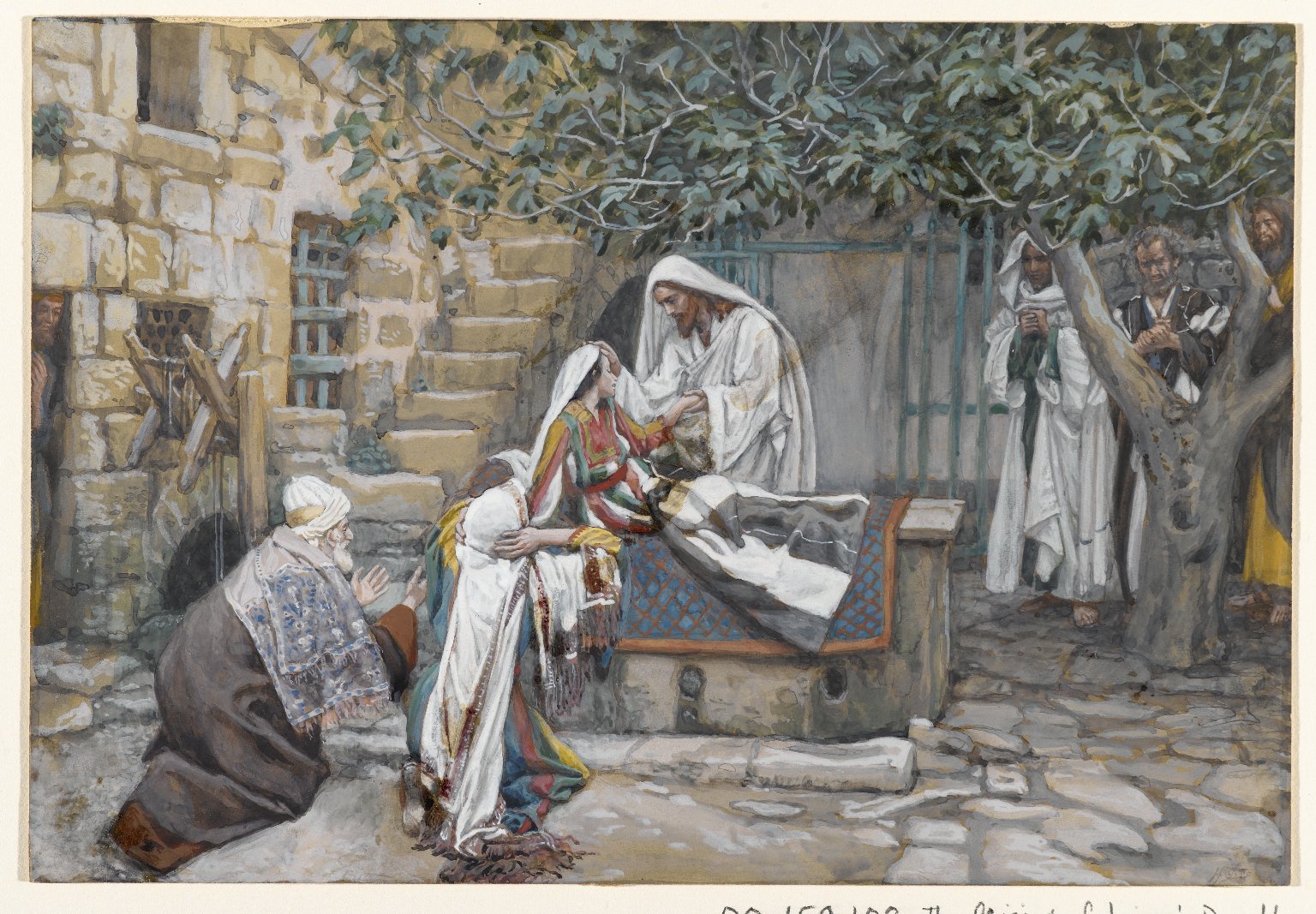
‘Taking her by the hand he said to her, “Talitha cumi”, which means, “Little girl, I say to you, arise.”’ (Mk 5:41)

Note the fact that Jesus takes the girl by the hand. To touch a dead body would make a person ritually impure. This is why the priest and Levite in the Parable of the good Samaritan pass by on the other side. Jesus disregards the taboo of uncleanness, and speaks to her. He speaks to her in Aramaic, her mother tongue, and says literally ‘little lamb, get up’. It is a term of endearment which also reminds us that Christ is the Good Shepherd who cares for His lambs, keeps them safe, and saves them from death. 

The people who are there: Jairus and his wife, Peter, James and John are all amazed. They are filled with awe, the holy fear of witnessing the mighty works of God. It reminds us that as humans we relate to God primarily through worship. Finally, Jesus tells her parents to give her something to eat, which shows us the reality of her resurrection. This also points towards the feast of the Kingdom, which we hope to enjoy in Heaven, and which is prefigured in the Eucharist. Through physical and spiritual communion Christ gives Himself to feed us, and heal our bodies and our souls, and assures us of eternal life.

Like Jairus and the haemorrhaging woman, may we have faith, and come to Jesus for healing. So that we may come to the Feast of the Lamb and may sing the praises of God the Father, God the Son, and God the Holy Spirit. To whom be ascribed, as is most right and just, all might, majesty, glory, dominion, and power, now and forever. Amen. 

James Tissot The woman with the Issue of Blood
James Tissot The Raising of Jairus’ Daughter

Saturday, 1 May 2021

Easter V

It is difficult for us to understand just how hard it was for the disciples to accept Paul of Tarsus into the Christian community. We first meet St Paul during the martyrdom of St Stephen. Paul wants to do everything he can to eradicate the Church and the followers of Jesus. He is a zealous opponent of everything the Church stands for. Paul wants to persecute the Church, but thanks to a dramatic encounter with Jesus, he undergoes a conversion. Her greatest enemy becomes her most zealous advocate. Paul goes from one extreme to another: from hating the Church to loving her. Thus is it perfectly understandable that when Paul comes to Jerusalem and tries to see the disciples, they react in a negative way. 

This is the situation in our first reading this morning from the Acts of the Apostles. The disciples are afraid, and think, understandably, that it is an elaborate hoax, a trap designed to end in their arrest and subsequent death. They are wary of Paul, and doubt that his conversion is genuine. But their natural reluctance is overcome thanks to the faith and generosity of St Barnabas. Barnabas, whose name in Hebrew means ‘son of consolation’ (Acts 4:36), literally embodies the Holy Spirit. Everything that Barnabas says or does in the Acts of the Apostles can be understood in terms of how God acts in the world through the Holy Spirit. Here he vouches for Paul, and encourages the brethren that Paul’s conversion is genuine. He bears witness to the truth, and builds up the Church. 

St Paul starts to preach in Jerusalem, and engages in debate with the Hellenists, Greek-speaking Jews from around the Mediterranean, people that he and Barnabas would know well. These people are not happy that one of their own has converted, so they plot to kill Paul. They feel betrayed, and want to take their anger out on the traitor. So the disciples take Paul to Caesarea, from where he could set sail for his native Tarsus, in Asia Minor, and be safe. Peace returns to the Holy Land, and the Church thrives. The comfort of the Holy Spirit in Acts 9:31 describes perfectly how a loving and generous Christian, such as Barnabas, acts.

Our second reading reinforces this message by reminding us that for Christians love is not a word, but an action. Love is something you do. In other words, our faith is something which we live out in our lives. We are called to believe in Jesus and to love one another. As St Thomas Aquinas explained, to love is to will the good of another. To love, then, is not simply an act of passion or emotion: something which we feel, but rather something we choose to do. To choose someone else’s good reminds us that we do not exist for our own sake, and that our lives are lived in community and relationship with others. We are called to be loving and generous, just as God has been loving and generous towards us in Christ. We are to love each other as Jesus has loved us. We are to lay down our lives, as Christ has for us. In this love and service we can truly love each other. This makes who and what we are manifest to the world around us. It makes Christianity something attractive because people can see the difference it makes. We are people of love and a community of love, cooperating with God in promoting human flourishing. Such love is a radical and world-changing idea, underpinned by selfless love, of Christ, to help transform the world so that all humanity may experience life in all its fullness. 

In today’s Gospel Jesus is speaking to His Disciples after the Last Supper. He uses the image of Himself as the Vine, and the disciples are the branches. It is a powerful vision of what the Church is, people who are grafted onto and into Christ, connected to Him, and in a relationship with Him. We entered into that relationship in our baptism, and it is a relationship which will continue throughout and after our life on earth. 

When we were baptised we were clothed with Christ, we were grafted into the vine, which is Christ. It is Christ’s will that we, as Christians, bear much fruit. This means that we live out our faith in our lives, so that it affects who and what we are, and all that we say and do. We do this because it is what Christ expects of us, but also because, as we read in the First Letter of John, 

‘The love of God was made manifest among us, that God sent his only Son into the world, so that we might live through him’ (1Jn 4:9).

Because we are grafted into Christ we are in communion with Him. Christ gives Himself to us in the Eucharist, His Body and Blood, so that we can have life in Him. He gives Himself to us out of love, so that we might have life in Him, and have it forever. It is a pledge of eternal life with Him, united in this world and the next, given to us to strengthen us on the journey of faith. Partaking in the Eucharist, physically or spiritually, helps us live out our faith in our lives: fed by and with Christ, to live in Him and for Him. 

Christ gives Himself for us, and desires that we are united with Him so that we may be strengthened to live out our faith in our lives, and to continue to proclaim the Good News of the Kingdom by word and deed. Christ desires that we stay close to Him, and be united with Him, so that we can live lives of love. As Christians we are called to be Christ’s disciples, living in Him, living for Him, proclaiming Him, and bearing much fruit. We do this so that the world may believe and give glory to God the Father, God the Son, and God the Holy Spirit, to whom be ascribed, as is most right and just, all might, majesty, glory, dominion, and power, now and forever. Amen

Sunday, 2 August 2020

The Eighteenth Sunday of Year A (Mt 14:13-21) The Feeding of the Five Thousand

I must admit that our readings this morning have unsettled me somewhat. The joyful character of both Isaiah and the account of the Feeding of the Five Thousand in Matthew’s Gospel seem far removed from how life is here and now for many people. The feelings of hope, joy, celebration, and social interaction, are far removed from the fear and concern which have been characterising our daily lives. And yet, despite our fears, there remains in Scripture a promise of hope for the future, as God says in the words of the prophet Isaiah, ‘Paid ag ofni, Fear not, for I have redeemed you; I have called you by name, you are mine.’ (Isa 43:1). We respond in trust, not that things are fine now, but that they will be. God is someone whom we can trust, who will never disappoint us. As the Psalmist says, ‘our hope and strength, a very present help in trouble’ (Ps 46:1) if we cast our burden upon Him, He will sustain us (cf. Ps 55:22). 

In our first reading this morning we hear God’s generous promise to His people. In the manner of a market trader God offers nourishment and refreshment, but not for profit! It is free! God offers water, wine, milk, and bread, food to nourish us, and drink to refresh us. It is a foretaste of the banquet of the Kingdom, in the Eucharist, where we are nourished and fed by God. The passage speaks of God’s covenant with His people, a relationship of love, that we can trust. God, who knows our needs, freely gives to his people love and grace, so that they may have life in all in all its fullness. These promises are fulfilled in Christ, who makes an everlasting covenant with us through His Body and His Blood. 

God’s generosity is freely offered, but it can be rejected. We see this in our second reading from Paul’s Letter to the Romans. Unlike the joy and optimism of the previous chapter which we heard last week, here are Israelites who reject Christ and cause St Paul great sorrow and anguish. The rejection of God’s generosity is painful, but it is the price of freedom. We cannot be compelled to accept what God offers, that would not be generous. Instead, we are free to accept or reject what God holds out for us. 

Picture the scene: Jesus has just been told that his cousin, John the Baptist, has been put in prison and killed. Jesus has lately been to Nazareth, where he was rejected, by the very people who should have accepted him. It is not for nothing that this morning’s Gospel passage begins with Jesus withdrawing to the desert: to be alone, to pray, to be close to God.

When the people hear where Jesus has gone they follow him, they walk out from the towns into the desert, wanting to see Jesus, and to hear him teach them. When Jesus gets out of the boat he sees a great mass of people and has compassion on them. He is moved by the sight of them, and their need. Jesus heals the sick to show that the Kingdom of God is a place of healing, where humanity can be restored through an encounter with the divine. Jesus’ actions and words proclaim the power of God to heal and restore humanity.

It is getting late, the sun is fast moving towards the West, and the disciples tell him to send the crowds away so that they can buy food. Instead Jesus says that the people do not need to go away, and tells the disciples to give them something to eat. The disciples obey Him, but cannot see how five loaves and two fish can possibly feed the thousands of people who have come to be close to Jesus.

The five loaves represent the five books of Moses, the Pentateuch: Genesis, Exodus, Leviticus, Numbers, Deuteronomy. The Books of the Law, the Torah, which show Israel how to live, and how to love God. The two fish represent the Law and the Prophets, so that, ‘Man shall not live by bread alone, but by every word that proceeds from the mouth of God.’ (Mt 4:4) The law and the Prophets point to Jesus, the Word made flesh: they find their fulfilment and true meaning in Him. The hopes of Israel, for the future, for a Messiah, are fulfilled in Him. Just like Israel after crossing the Red Sea here the People of God are fed by God in the desert. There is so much food left over at the end that there is enough to fill twelve baskets, one for each of the disciples, and for each tribe of Israel. In human terms, five loaves and two fish is not enough to feed everyone, but it is more than sufficient in divine terms. Just like at the Wedding feast in Cana, here we see that the Kingdom of God is a place of joy and abundance, of generosity, which isn’t concerned with scrimping or with the ‘good enough’,rather it is a place of lavish excess. This is what the church is supposed to be like: this is meant to be the model for our lives as Christians.

The multiplication of the loaves is not some conjuring trick, meant to amaze us, or to show us how powerful God is. It is a sign of God’s generous love for humanity. This is what God does for us, so that we can respond in a profound and radical way, and thereby change the world. Jesus has been rejected by the people of Nazareth and He responds by feeding people until they are satisfied, until they have had enough, and there is still plenty left over. Likewise, God’s love and mercy are inexhaustible, and are shown and poured out upon the world in Jesus Christ and in his death upon the Cross for our salvation.

Jesus takes the bread and fish, He blesses them, He breaks them and He gives them, actions which look forward to the Last Supper on the night before He died. Jesus told His disciples to carry on doing this in remembrance of Him, so that the Church could continue to be fed by Him and with Him, as a sign of His love for us, so that we might have life and forgiveness in Him.

Let us today be fed with the living bread, the bread which came down from heaven, so that it may feed our souls, so that we may be healed and restored by him. Let us be moved by the lavish generosity of God, and encouraged to live it out in our lives, in our thoughts, our words, and our actions, so that all that we are, all that we say or think or do, will proclaim the truth of God’s saving love to the world, so that we too can enter into the joy of the Lord and come to the banquet of the Kingdom, where all are welcomed, and healed.

Filled with God’s grace, may we live generously and encourage others to share in the generosity of the Kingdom, so that all come to believe believe and give glory to God the Father, God the Son, and God the Holy Spirit, to who whom be ascribed as is most right and just, all might, majesty, glory, dominion and power, now and forever. Amen. 

Brooklyn_Museum_-_The_Miracle_of_the_Loaves_and_Fishes_(La_multiplication_des_pains)_by_James_Tissot.jpg

The Eighteenth Sunday of Year A (Mt 14:13-21) The Feeding of the Five Thousand

I must admit that our readings this morning have unsettled me somewhat. The joyful character of both Isaiah and the account of the Feeding of the Five Thousand in Matthew’s Gospel seem far removed from how life is here and now for many people. The feelings of hope, joy, celebration, and social interaction, are far removed from the fear and concern which have been characterising our daily lives. And yet, despite our fears, there remains in Scripture a promise of hope for the future, as God says in the words of the prophet Isaiah, ‘Paid ag ofni, Fear not, for I have redeemed you; I have called you by name, you are mine.’ (Isa 43:1). We respond in trust, not that things are fine now, but that they will be. God is someone whom we can trust, who will never disappoint us. As the Psalmist says, ‘our hope and strength, a very present help in trouble’ (Ps 46:1) if we cast our burden upon Him, He will sustain us (cf. Ps 55:22). 

In our first reading this morning we hear God’s generous promise to His people. In the manner of a market trader God offers nourishment and refreshment, but not for profit! It is free! God offers water, wine, milk, and bread, food to nourish us, and drink to refresh us. It is a foretaste of the banquet of the Kingdom, in the Eucharist, where we are nourished and fed by God. The passage speaks of God’s covenant with His people, a relationship of love, that we can trust. God, who knows our needs, freely gives to his people love and grace, so that they may have life in all in all its fullness. These promises are fulfilled in Christ, who makes an everlasting covenant with us through His Body and His Blood. 

God’s generosity is freely offered, but it can be rejected. We see this in our second reading from Paul’s Letter to the Romans. Unlike the joy and optimism of the previous chapter which we heard last week, here are Israelites who reject Christ and cause St Paul great sorrow and anguish. The rejection of God’s generosity is painful, but it is the price of freedom. We cannot be compelled to accept what God offers, that would not be generous. Instead, we are free to accept or reject what God holds out for us. 

Picture the scene: Jesus has just been told that his cousin, John the Baptist, has been put in prison and killed. Jesus has lately been to Nazareth, where he was rejected, by the very people who should have accepted him. It is not for nothing that this morning’s Gospel passage begins with Jesus withdrawing to the desert: to be alone, to pray, to be close to God.

When the people hear where Jesus has gone they follow him, they walk out from the towns into the desert, wanting to see Jesus, and to hear him teach them. When Jesus gets out of the boat he sees a great mass of people and has compassion on them. He is moved by the sight of them, and their need. Jesus heals the sick to show that the Kingdom of God is a place of healing, where humanity can be restored through an encounter with the divine. Jesus’ actions and words proclaim the power of God to heal and restore humanity.

It is getting late, the sun is fast moving towards the West, and the disciples tell him to send the crowds away so that they can buy food. Instead Jesus says that the people do not need to go away, and tells the disciples to give them something to eat. The disciples obey Him, but cannot see how five loaves and two fish can possibly feed the thousands of people who have come to be close to Jesus.

The five loaves represent the five books of Moses, the Pentateuch: Genesis, Exodus, Leviticus, Numbers, Deuteronomy. The Books of the Law, the Torah, which show Israel how to live, and how to love God. The two fish represent the Law and the Prophets, so that, ‘Man shall not live by bread alone, but by every word that proceeds from the mouth of God.’ (Mt 4:4) The law and the Prophets point to Jesus, the Word made flesh: they find their fulfilment and true meaning in Him. The hopes of Israel, for the future, for a Messiah, are fulfilled in Him. Just like Israel after crossing the Red Sea here the People of God are fed by God in the desert. There is so much food left over at the end that there is enough to fill twelve baskets, one for each of the disciples, and for each tribe of Israel. In human terms, five loaves and two fish is not enough to feed everyone, but it is more than sufficient in divine terms. Just like at the Wedding feast in Cana, here we see that the Kingdom of God is a place of joy and abundance, of generosity, which isn’t concerned with scrimping or with the ‘good enough’,rather it is a place of lavish excess. This is what the church is supposed to be like: this is meant to be the model for our lives as Christians.

The multiplication of the loaves is not some conjuring trick, meant to amaze us, or to show us how powerful God is. It is a sign of God’s generous love for humanity. This is what God does for us, so that we can respond in a profound and radical way, and thereby change the world. Jesus has been rejected by the people of Nazareth and He responds by feeding people until they are satisfied, until they have had enough, and there is still plenty left over. Likewise, God’s love and mercy are inexhaustible, and are shown and poured out upon the world in Jesus Christ and in his death upon the Cross for our salvation.

Jesus takes the bread and fish, He blesses them, He breaks them and He gives them, actions which look forward to the Last Supper on the night before He died. Jesus told His disciples to carry on doing this in remembrance of Him, so that the Church could continue to be fed by Him and with Him, as a sign of His love for us, so that we might have life and forgiveness in Him.

Let us today be fed with the living bread, the bread which came down from heaven, so that it may feed our souls, so that we may be healed and restored by him. Let us be moved by the lavish generosity of God, and encouraged to live it out in our lives, in our thoughts, our words, and our actions, so that all that we are, all that we say or think or do, will proclaim the truth of God’s saving love to the world, so that we too can enter into the joy of the Lord and come to the banquet of the Kingdom, where all are welcomed, and healed.

Filled with God’s grace, may we live generously and encourage others to share in the generosity of the Kingdom, so that all come to believe believe and give glory to God the Father, God the Son, and God the Holy Spirit, to who whom be ascribed as is most right and just, all might, majesty, glory, dominion and power, now and forever. Amen. 
Brooklyn_Museum_-_The_Miracle_of_the_Loaves_and_Fishes_(La_multiplication_des_pains)_by_James_Tissot.jpg

Sunday, 19 January 2020

2nd Sunday of Year A – ‘Behold the Lamb of God!’

John the Baptist looked at Jesus as he walked by and said, ‘Behold the Lamb of God!’ Lambs were a central part of the Jewish festival of Passover. In order to avert the tenth plague in Egypt, the people of Israel were instructed to take a young lamb without any blemish and slaughter it. They were then to anoint the doorposts of their house with it, so that their firstborn would be saved, not killed by the Angel of Death. The lamb was to be roasted over the fire and eaten standing up whilst dressed for a journey. This festival of Passover is the high point of the Jewish religious calendar, and marks the start of their journey from slavery in Egypt to the Promised Land of Israel. It is also the time of Jesus’ Passion, Death, and Resurrection.

In order to meet the needs the large number of people celebrating the passover festival in the early 1st century AD, there needed to be a lot of shepherds raising flocks of animals for slaughter. In the Christmas story we see that the first visitors to the Holy Family in Bethlehem were shepherds. As Bethlehem is only six miles from Jerusalem, these shepherds were raising the lambs that would be consumed at Passover in nearby Jerusalem in their thousands. Jesus, like these lambs was also without blemish and would be killed at Passover. So from the very moment of Christ’s birth, His Death is foreshadowed. 

Traditionally Jesus’ death is understood to have happened at the ninth hour, 3pm, which is the same time that the passover lambs began to be slaughtered in the Temple in Jerusalem for the feast of Passover. This is not mere coincidence, but rather signal proof that Christ’s death is sacrificial, and represents the new Passover, and the freedom of the people of God. In this morning’s Gospel Jesus’s cousin, John the Baptist, greets Him, saying, ‘Behold the Lamb of God, who takes away the sins of the world’. John understands that Jesus is the passover Lamb.

The image of a lamb brings to mind a passage in the prophet Isaiah, where the Suffering Servant is compared to, ‘a lamb that is led to the slaughter, and like a sheep that before its shearers is dumb’ (Isa 53:7). This prophecy will be fulfilled in Holy Week on Good Friday. Here, at the start of John’s Gospel, just after the Baptism of Jesus in the Jordan, when John the Baptist saw the Spirit descend on Him, (before the first sign of turning water into wine at the marriage of Cana), John’s description of Jesus is a prophetic utterance which points forward to Jesus’ death on the Cross. So then, from the very start of Our lord’s life, as with the gift of myrrh at Bethlehem, the beginning points to the end: to Calvary (and beyond). 

In Genesis, we read of Abraham’s sacrifice of Isaac, who is saved when at the last moment a ram appears in a thorn bush. Isaac carrying wood for the sacrificial fire, prefigures Christ carrying the wood of the Cross. The ram in the thorns foreshadows Christ, the Lamb of God, crowned with thorns. Mt Moriah, where these events take place, is the mountain on which Jerusalem was built, and whose highest point is Golgotha, which is where Our Lord was crucified. The old foretells the new, and is completed by it.Prophecy is fulfilled. In Christ, God is glorified, and of Him the prophet Isaiah says, ‘I will make you as a light for the nations, that my salvation may reach to the end of the earth’ (Isa 49:5 ESV). 

In the Eucharist, just before we receive Communion I will repeat the words of John the Baptist, ‘Behold the Lamb of God…’ so that we may recognise Christ in our midst; we respond with the words of the Centurion, in Luke 7:6-7, ’Lord I am not worthy…’ It is this sense of unworthiness which keeps us both humble and reliant upon God to transform us. We hear John the Baptist’s words so that we may join in his confession that this is the Son of God. Christ is truly present in the Eucharist in a way which we cannot understand, which words and language cannot express, because that is how God is. As a result of the Word becoming flesh and dwelling amongst us, God incarnate makes himself known so that we might worship God, and that God might be at work in us. Unlike the sacrifices of Passover and the Day of Atonement which needed to be repeated annually, the Sacrifice of Christ on the Cross happens once, to deal with all sin, past, present, and future, to reconcile humanity to God and to each other. It is this reality which we celebrate today: we have been set free. 

This is the Good News of the Kingdom. We are loved by God, who flings His arms wide on the Cross to embrace the world with love. A God who embraces the shame of a slave’s death, the most brutal demonstration of Roman power, the most degrading way to die, to show the world love. It isn’t what you’d expect, and that’s the point. God does not want to compel us to love Him or worship Him, but rather makes a relationship possible, so that we might come to know Him, and love Him. As we approach the altar, this is what we are to receive, the Body and Blood of Christ, the self same body and blood which were nailed to the Cross for our sins and the sins of the whole world. Our hands will hold and our lips will touch him who created the entire universe. How can we not fail to be shocked by the generosity of a God who gives himself to us in such a personal way, in a way that we do not deserve? Yet, we can never deserve such a gift, that is why God takes the initiative and gives himself to us, freely and gladly. Like the Father of the Prodigal Son, God rushes to meet us, to embrace us and to celebrate with us, to show his love for us. God became a human being at Christmas so that we might become divine, through our baptism and our participation at the altar, in the feast of the Lamb.

The Eucharist is the sacrament of unity, uniting heaven and earth through the sacrifice of Calvary, allowing all humanity to share the body and blood of Our Saviour Jesus Christ, feeding on him so that we may become what he is; enabling us to share eternity with him, and to live lives of faith and hope, and love. So then, let us join the Wedding Banquet of the Lamb and enter into the mystery of God’s self-giving love, so that we may believe and give glory to God the Father, God the Son, and God the Holy Spirit, to whom be ascribed as is most right and just, all might, majesty, glory dominion and power, now, and forever.

img_0215

Sunday, 17 November 2019

Trinity XXII

As Christians are we simply satisfied with the world, with the way things are? No. Do we want things to be different? I hope so, yes. That’s good, as the prophet Malachi in our first reading this morning has a vision of the future, when the arrogant and evil doers will be like stubble in a furnace, ‘But for you who fear my name, the sun of righteousness shall rise with healing in its wings. You shall go out leaping like calves from the stall.’ (Malachi 4:2). This is a vision of a future where God is in control, and things will be put right, and at one level He already has. Christ is risen from the dead, the one who heals God’s people has risen. The time is both not yet, and now, a work in progress, and a reality. 

We have a part to play in it. We cannot just sit back and wait for God to sort everything out, we need to co-operate with God, and help to make the Kingdom a reality. Hence S. Paul’s advice to the Thessalonians, ‘As for you, brothers, do not grow weary in doing good’ (2Thess 3:13). We’ve been trying and failing for nearly two thousand years. That’s what a work in progress is. It isn’t easy, and no one can fail to notice that the world around us is often rather hostile to who we are, and what we stand for. It is not easy to be a Christian, nor has it ever been, for that matter. 

We will be hated by all people for Christ’s name’s sake (Lk 21:17). Hate is a strong word, but as we are directly opposed to many in this world, it is not surprising. With hatred comes persecution, and we only have to look to China, North Korea, the Middle East, India, and Pakistan, to see it. Christians are being killed for believing in God who loves us, who died to save from our sins. To follow Christ is to walk the way of the Cross, to risk imprisonment, torture and death, for the love of His name. But ‘there is salvation in no one else, for there is no other name under heaven given among men by which we must be saved’ (Acts 4:12). Only Jesus can save us, we cannot save ourselves. We are called to bear witness to Him. 

Jews in the first century AD loved the Temple, it was the centre of their world, it was where they could be close to God, it was where sacrifices happened which took away their sins. But less than forty years after Jesus spoke this prophecy a Roman Army destroyed it. But as Christians we know that Jesus Christ is the new Temple, the place to meet God, the place of sacrifice. Destroy it in three days, and I will raise it up. Christ speaks of His body, and that is us: we are the Body of Christ. Churches are not buildings, they are groups of people who love Jesus, and each other. Jesus speaks of false Christs, who will lead people astray, and warns ‘ do not go after them’ (Lk 21:8). It is a temptation, especially when times are hard, when there are war and natural disasters. 

But we know that Our Lord Jesus Christ is victorious, he is the true worship of God. In Him we can have confidence. He gives us Himself, His Body and Blood, to nourish us and to heal us, and give us strength to prepare us for the trials we will face. Here in Britain it is more likely to be indifference than anything else. Indifference speaks of a hardness of heart, being deaf to the Good News of the Kingdom. At its root is Sin, our separation from God by our following our will, and not God’s. We think we know better, and do what we want to do, rather than letting God work through us. The human condition hasn’t actually changed since the Garden of Eden. We continue to make the same mistakes over and over again. There is, however, a way out of this. God in Christ deals with the problem of our sin on the Cross, where He offers himself as a sacrificial victim to atone for all the sins of humanity. It’s what Christ was born for, as the angel says to Joseph, ‘She will bear a son, and you are to name him Jesus, for he will save his people from their sins.’ (Mt 1:21) The name Jesus (Hebrew Yeshua) means ‘God saves’ and He does. This is what we believe as Christians, where we put our trust, our hope, in a God who loves us and saves us, the same God who inspired the prophecies of Malachi, which look forward to Christ. 

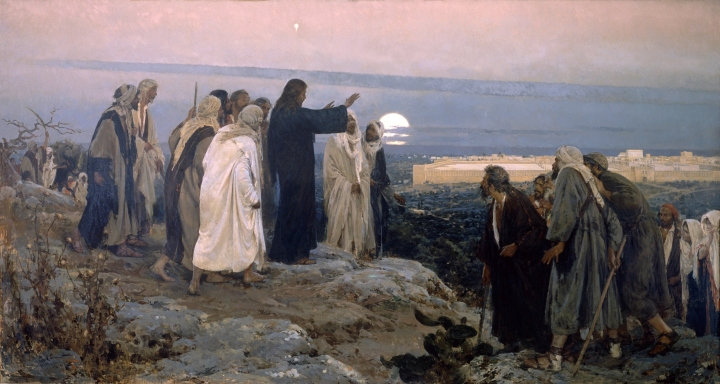
That same Christ who heals us and sustains us will be with us in our trials, and whereas our family and friends may prove false to us, we can have confidence that Christ will never let us down. He’s been through this. Through the gift of the Holy Spirit we are strengthened to bear witness to Him. For the same Christ who died for us, and rose again, who ascended into heaven, will come again to judge us and all the world. It sounds scary and intimidating, and at one level it is, and it should be. It matters; hence our urgency in proclaiming the Kingdom of God. But the one who will judge us, is the same one who died to set us free, the God who loves us, who heals us, and restores us. A God of love and mercy, risen with healing in his wings. Let us come to Him, be healed by Him, nourished with His Body and Blood and strengthened to proclaim Him in word and deed, so that the world may come to believe and sing the praises of God the Father, God the Son, and God the Holy Spirit, to whom be ascribed as is most right and just all might, majesty, glory, dominion, and power, now and forever. Amen.Enrique_Simonet_-_Flevit_super_illam_-_1892-1.jpg

Sunday, 6 October 2019

Homily for Trinity XVI

Being a Christian can be hard and difficult at times. It can be very easy to feel as though we are experiencing something of the vision of the prophet Habakkuk in this morning’s first reading. The best advice comes from St Augustine, who said the following words to his people over sixteen hundred years ago: ‘“You all say, ‘The times are troubled, the times are hard, the times are wretched.’ Live good lives and you will change the times. By living good lives you will change the times and have nothing to grumble about.”’ (Sermo 311.8). It can be easy to see bad things happening, but not realise is ours to be the change we want to see. For ‘the righteous shall live by his faith’ (Hab 2:4). If we want to live in a word filled with love, kindness and generosity, then it is up to us to do something about it. 

In Luke’s Gospel this morning the apostles ask for the Lord to increase their faith. He does this firstly after His Resurrection, and secondly with the gift of the Holy Spirit at Pentecost. Likewise our growth in faith is a gradual process: it takes time, a lifetime in fact. It happens by the grace of God. We may long for something instant, but God’s ways are not our ways. Faith is like a mustard seed, it starts small, but in time can grow into something large. How does it happen? The parable which Jesus tells gives us the answer: through service. Not the most glamorous of answers, certainly, and that’s the point. All we can say is, ‘We are unworthy servants; we have only done what was our duty.’ (Lk 17:10). We are not worthy: God makes us worthy, through His Son, who dies for us and fils us with His love. The work of the Gospel is at one level up to us, the Body of Christ, His Church. We have to live our faith out in our lives (as fine words butter no parsnips). Christianity is a way of life, a way mocked and scorned by the world around us, written off as irrelevant, and yet close to the God who loves us and saves us.

We should not be afraid as God has given us ‘a spirit not of fear but of power and love and self-control.’ (2Tim1: 7) Self-control is not exactly the most glamorous of things, but it is crucial if we want to grow in faith. Through it we grow in virtue by the grace of God. It goes hand in hand with the service envisaged by the Gospel passage this morning. We imitate the example of the saints, we ‘follow the pattern of the sound words that you have heard from me, in the faith and love that are in Christ Jesus. By the Holy Spirit who dwells within us, guard the good deposit entrusted to you.’ (2Tim 1:13-14) By imitation of virtuous examples our characters are formed. We become what we imitate, and most of all we imitate Christ, who gave himself for us, and who comes to us this morning under the outward forms of bread and wine to feed us with Himself, so that we might become what He is. So that we might be transformed, more and more into His likeness, to live out our faith in the world, and share our faith with others so that they might come to believe and sing the praise of God the Father, God the Son, and God the Holy Spirit, to whom be ascribed as is most right and just, all might, majesty, glory, dominion, and power, now and forever.

img_0270

Saturday, 28 September 2019

Homily for Trinity XV

At its very heart the Christian Faith is all about generosity: God’s generosity towards us, and our generous response in return. It is shown most fully in the life, death, and resurrection of Jesus Christ. We know this, it is our faith, but it should also lead us to action. We are called to be generous in return, generous towards others, and ourselves. Our response shows that we are living out our faith, that we haven’t simply accepted the tenets of our faith, but are putting them into action, to transform the world. 

Our readings this morning begin with a troubling word from the prophet Amos. The prophet warns those who are comfortable, those who feel secure, and he is speaking to us. Should we be worried? Yes we should, because we should be learning to be generous, sharing what we have, because it is the right and proper thing to do, it is how we flourish. Today is amongst other things the Word Day of Migrants and Refugees, which the Church has celebrated for over a hundred years. In a world like ours, where people are marginalised, persecuted, forced to flee, who long to live in peace and prosperity, how do we react? Do we want to build walls and set up borders to keep people out? They’re not like us! They don’t belong here! We don’t like them! Or do we want to do something else? To welcome people in, and share what we have with them? So that the world may reflect the values of the Kingdom of God. The choice is a clear one.

This morning’s Gospel presents us with a stark contrast. Our Lord is speaking to the Pharisees, the Jewish religious leaders, people who are sure of their position in society. There is a beggar, Lazarus, a man who has nothing, a man who is hungry and who longs to eat the scraps from the rich man’s table. He has sores, which make him unclean in Jewish eyes. He is licked by dogs, which were seen as unclean, so he’s lying there destitute, shown love only by dogs, and not by humans. He’s the lowest of the low. And yet, when he dies, he is taken to heaven. The rich man by contrast dies and goes to Hell where he endures its torments. Why? Because the rich man could have been generous, but instead he was selfish. He could have look after Lazarus, but he did nothing. It’s doubtful that his five brothers would take any notice of Lazarus, even if raised from the dead. They don’t listen to the Law and the Prophets which command them to ‘love your neighbour as yourself’ (Leviticus 9:18), ‘He has told you, O man, what is good; and what does the Lord require of you but to do justice, and to love kindness, and to walk humbly with your God?’ (Micah 6:8). Faith then is something which needs to be put into action, we show our love by loving, caring, and sharing.

It is exactly what St Paul advises Timothy in this morning’s second reading: ‘As for the rich in this present age, charge them not to be haughty, nor to set their hopes on the uncertainty of riches, but on God, who richly provides us with everything to enjoy. They are to do good, to be rich in good works, to be generous and ready to share, thus storing up treasure for themselves as a good foundation for the future, so that they may take hold of that which is truly life.’ (1Tim 6:17-19) The point of wealth is to be generous with it. If we’re honest with ourselves, don’t we long for a world like this? A world where peace, love, and generosity are lived out in a real way, to make the world better, the kind of world God wants, so that we may flourish as human beings. 

It isn’t that simple, because human beings are sinful and selfish. We’re not always generous, but we do not have to be this way. So at a time when we give thanks to God for all the good things of creation which have been harvested, and especially when we are mindful of migrants and refugees, we have to ask ourselves the question: Can we be generous? If we cannot then all we have to look forward to in the future are the eternal torments of Hell. It’s a stark uncompromising message, and a simple choice. It’s the truth of our faith. It doesn’t make us feel warm and cosy. That’s cheap grace. The idea that God doesn’t demand anything more from us than a vague superficial niceness. It will not do! The church cannot stand idly by while people consign their souls to hell because they cannot be bothered. 

We are generous because God was generous first. He gives His only Son to be born for us, and to die on the Cross for us. God is tortured and suffers for us, to bear the burden of our sins. To take what should condemn us to Hell upon Himself, to save us from it. It’s why we are here this morning to celebrate the Eucharist, the sign of God’s generosity to the world made real to us under the forms of bread and wine. We touch and taste God’s generous love for us, to that it may transform us, strengthening us to live the life of the Kingdom of God here and now. 

We are fed and sent out to live lives of radical generosity where we care for people, where we look after the migrants and refugees, welcoming them into our communities, as we are all brothers and sisters in Christ. We belong to each other, and are called to live lives of love in community. It sounds idealistic, and so it should. It reminds us that we are called to be generous, even to the point of being reckless, sitting lightly to the things of this world, and holding no store by wealth, or position, or influence, but instead giving it away, sharing it with others. If we cannot serve God and money, then as Christians we are to serve God. We serve him by being generous, and looking after those on the margins, practising the same generosity which God poured out on us, shedding His Blood to take away our sins. Let us transform the world so that it may turn away from the ways of greed and selfishness and put its trust in the true riches of the Kingdom. 

It is this generous God who comes to us today in Word and Sacrament, to heal us and restore us, to give us life in him. He entrusts to us the true riches of the Kingdom so that we may share them recklessly, generously with the world so that it may believe and sing the praises of God the Father, God the Son, and God the Holy Spirit, to whom be ascribed as is most right and just all might, majesty, glory, dominion, and power, now and forever.

Lazarus-Dives

Saturday, 2 March 2019

The Sunday before Lent (Exodus 34:29-35, 2Cor 3:12-4:2, Luke 9:28-36)

“Three important scenes of Our Lord’s life took place on mountains. On one, He preached the Beatitudes, the practice of which would bring a Cross from the world; on the second, He showed the glory that lay beyond the Cross; and on the third, He offered Himself in death as a prelude to His glory and that of all who would believe in His name”

Fulton Sheen The Life of Christ 1970: 158

Our readings this morning have an important message: being close to God changes you. At its heart Christianity is a religion of transformation: in the Incarnation Christ became what we are, so that we might become what He is. God doesn’t want us to stay as we are. God is active in the world, through the power of His Holy Spirit. When we encounter Him in prayer, in reading Holy Scripture, and in the Sacraments, we are changed by that encounter. We become something which we were not before, our faith is deepened, we grow in holiness, and we reflect more fully the light of Him in whose image we were created. 

In our reading from Exodus we see Moses’ encounter with God on Mt Sinai and its effects. The people of Israel are afraid to come near Moses because he reflects the divine radiance of God’s presence. He was to be veiled and covered because it was too much for them, they couldn’t cope. It is not so for us under the New Covenant. We have a hope, we can be bold, we can be near to Christ. He gives us the Eucharist, where we cannot only see the glory of God, but we can partake of His Very Self. 

Our reading from Luke’s Gospel this morning begins on the eighth day, the first day of the Week, the day of the New Creation. Jesus and his closest apostles go up a mountain to pray. They go to be near God, and they experience the glory of God’s presence. Jesus talks with Moses and Elijah, often understood as the Law and the Prophets. They appear in glory, the glory of God’s presence, ‘and spoke of his departure, which he was to accomplish at Jerusalem’ (Lk 9:31 RSVCE) They speak of Christ’s exodus, his departure from this life, and, after His Resurrection, His Ascension and return to the Father. They talk about Christ’s death, as He has already to His disciples. They are looking to the Cross as the final definitive manifestation of God’s Glory. As we prepare to enter Lent, a time of prayer and fasting, we too look to the Cross, our only hope, and all salvation history points to it. From Abraham’s sacrifice of Isaac, who is substituted by the ram in the thicket, a type of Christ, the Lamb of God, the bronze serpent lifted up in the desert, that those who look on it might live, the Suffering Servant in Isaiah, wounded for our transgressions, and bruised for our iniquities. Scripture points to the Cross, as the Transfiguration does, as a manifestation of God’s glory. It’s the culmination of salvation history. The Cross is the central point in the light of which everything makes sense. It gives us life, and joy, and fills us with love.

It may seem strange to see suffering and death as a manifestation of God’s Glory, but it is, because it demonstrates how much God loves us, and the healing and reconciliation which is achieved by it. It is painful, costly, and wonderful. The mystery of God’s love made manifest, for all to see. And because Christ is willing to undergo this for love of us, God can say, ‘This is my Son, my Chosen; listen to him!’ (Lk9:35 RSVCE). In Christ’s death we will see suffering transfigured by love, to make a new community of healing and reconciliation which is the Church. We, here, this morning, are part of the manifestation of God’s glory in the world. We have been changed by our encounter with God, in our Baptism and in the Eucharist, sharing His Death, and living His Risen life. 

When God speaks at the Transfiguration He tells us three things about Jesus: he is the Son of God, he is loved and we should listen to him. He is God, he is loved, and filled with love, to pour it out upon us, we should listen to Him as He shows us how to have life in all its fulness. We should imitate Him. What he says and does should affect us and our lives, that’s why we are Christians. Because of this we have to be open to the possibility of being changed by God. It’s real. I know in my own life how God has been at work in it. I’ve changed and developed. It’s not easy or even pleasant, in fact it can be quite the opposite, and that’s the point. Being conformed to Christ, and sharing in His Passion is difficult, and costly, but we trust God to be at work in us, transforming us more and more into His likeness, preparing us for Heaven, and helping us to live as saints here in earth. The church takes sinners, and tries to make them saints, it’s what we’re for, it’s what we do, each and every one of us is called to this in our baptism.

That is why we are here this morning: to see the sacrifice here with our own eyes, to touch and to taste what God’s love is really like. We are here to go up the mountain and experience the glory of God, what God is really like, so that God’s love may transform us. We are given a foretaste of heaven, and prepared to be transformed by God. This is true glory: the glory of the Cross, the glory of suffering love lavished upon the world. The Transfiguration looks to the Cross to help us prepare for Lent, to begin a period of fasting and prayer, of spiritual spring cleaning, of getting back on track with God and each other, so that we may be prepared to celebrate Our Lord’s Passion, Death and Resurrection, to behold true majesty, true love and true glory: the kind that can change the world and last forever. It’s for eternity, not like the fading glory of the world, here today and gone tomorrow, but something everlasting, and wonderful.

So let us behold God’s glory, here, this morning, let us touch and taste God’s glory, let us prepare to be transformed by his love, through the power of His Holy Spirit, built up as living stones, a temple to God’s glory. Healed, restored, and reconciled. Given a foretaste of eternal life with him, so that God may take our lives and transform us, so that everything that we say, or think, or do, may proclaim him, let us tell the world about him, so that it too may believe and trust and have new life in God the Father, God the Son, and God the Holy Spirit, to whom be ascribed, as is most right and just, all might, majesty, glory, dominion, and power, now and forever.