Showing posts with label Resurrection. Show all posts

Saturday, 26 June 2021

Trinity IV

Each and every one of us is in need of healing, be it physical, psychological or spiritual. Our bodies, minds, and souls need it. It is a truth of human existence that we are all broken, and while medicine can heal our bodies, we still long for life in all its fulness. The Kingdom of God, proclaimed and inaugurated by Jesus Christ is a place of healing, and through our relationship with Jesus we can find the wholeness for which we long. This is why the Gospels contain healing miracles. These miraculous accounts are signs of God’s restoration of creation through His Son, something which will culminate with His Passion, Death, and Resurrection. 

In the Gospel Jesus has sailed back across the Sea of Galilee to the Jewish side. On His arrival He is greeted by the leader of a local synagogue whose daughter is close to death. Jairus longs for his child to be healed, and asked Jesus to place His hands on her, so that she might be saved and live.

While Jesus is going to heal Jairus’ daughter, another miracle takes place. Lots of people are following Jesus, which is understandable since He is a charismatic preacher and teacher, who heals people. In the crowd is a woman with a gynaecological complaint. It would have made her life extremely difficult, and in Jewish ritual terms she would have been regarded as impure. She would not have been able to play her part in religious life. Also she would not have been able to bear children, and her husband, according to Jewish law, could have divorced her. She was an outcast, unclean, thrown on the metaphorical scrapheap of society. What money the woman had, she had been spent on doctors in trying to find a cure, but they only made things worse. Now she was penniless and desperate. But this pale, weak woman had an idea:

She had heard the reports about Jesus and came up behind him in the crowd and touched his garment. For she said, “If I touch even his garments, I will be made well.” And immediately the flow of blood dried up, and she felt in her body that she was healed of her disease.’ (Mk 5:27-29)

Despite her physical infirmity, this woman has faith. She trusts Jesus, and believes that if she touches His clothing she will be healed. Such healing would restore her to community and allow her to take part in its religious life. She places her faith in God, realising that He can do for her what humanity could not. 

Jesus then notices that power has gone out from Him. He is aware of what has happened. Having asked who touched Him, Jesus’ disciples reply that it was accidental: they are surrounded by a crowd, anyone could have brushed against Him. Our Lord remains unconvinced:

And he looked round to see who had done it. But the woman, knowing what had happened to her, came in fear and trembling and fell down before him and told him the whole truth. And he said to her, “Daughter, your faith has made you well; go in peace, and be healed of your disease.”’ (Mk 5:32-34)

The woman comes ‘in fear and trembling’ not because she is afraid of Jesus, but because it is the proper way for humans to act in the presence of God. She is filled with awe at her experience of divine healing. Jesus’ reply is astounding for several reasons. Firstly, that He responds at all: talking to a woman who was not a member of your family was frowned upon, let alone a woman who is a ritually unclean outcast. Jesus is breaking a social taboo. He addresses her as ‘daughter’, a reminder that Jesus’ family are not those related to Him in earthly terms, but those who do God’s will. The woman is a daughter of God and her faith in God has healed her. She trusted God to do what the physicians could not. Faith is the route to salvation and healing, trusting God to be at work. She can go in peace because she has been restored to health. Peace is God’s gift to us, that we may experience wholeness. Finally, Jesus underlines that what has happened is not a temporary healing, but a permanent state of affairs.

While Jesus is still speaking to the woman, messengers come to give Jairus a message:

“Your daughter is dead. Why trouble the Teacher any further?” (Mk 5:35)

The situation is hopeless, and in their eyes there is nothing that Jesus can do. Thankfully, Our Lord has other ideas:

‘But overhearing what they said, Jesus said to the ruler of the synagogue, “Do not fear, only believe.”’ (Mk 5:36)

This fear is not the awe shown by the woman who has been healed, but a lack of trust in God. We know from the Letter to the Hebrews that:

Faith is the assurance of things hoped for, the conviction of things not seen. (Heb 11:1)

Jairus has demonstrated his faith by prostrating himself before Jesus and asking for healing. Now, in the face of his daughter’s apparent demise, Jairus must trust God to be at work. 

‘Taking her by the hand he said to her, “Talitha cumi”, which means, “Little girl, I say to you, arise.”’ (Mk 5:41)

Note the fact that Jesus takes the girl by the hand. To touch a dead body would make a person ritually impure. This is why the priest and Levite in the Parable of the good Samaritan pass by on the other side. Jesus disregards the taboo of uncleanness, and speaks to her. He speaks to her in Aramaic, her mother tongue, and says literally ‘little lamb, get up’. It is a term of endearment which also reminds us that Christ is the Good Shepherd who cares for His lambs, keeps them safe, and saves them from death. 

The people who are there: Jairus and his wife, Peter, James and John are all amazed. They are filled with awe, the holy fear of witnessing the mighty works of God. It reminds us that as humans we relate to God primarily through worship. Finally, Jesus tells her parents to give her something to eat, which shows us the reality of her resurrection. This also points towards the feast of the Kingdom, which we hope to enjoy in Heaven, and which is prefigured in the Eucharist. Through physical and spiritual communion Christ gives Himself to feed us, and heal our bodies and our souls, and assures us of eternal life.

Like Jairus and the haemorrhaging woman, may we have faith, and come to Jesus for healing. So that we may come to the Feast of the Lamb and may sing the praises of God the Father, God the Son, and God the Holy Spirit. To whom be ascribed, as is most right and just, all might, majesty, glory, dominion, and power, now and forever. Amen. 

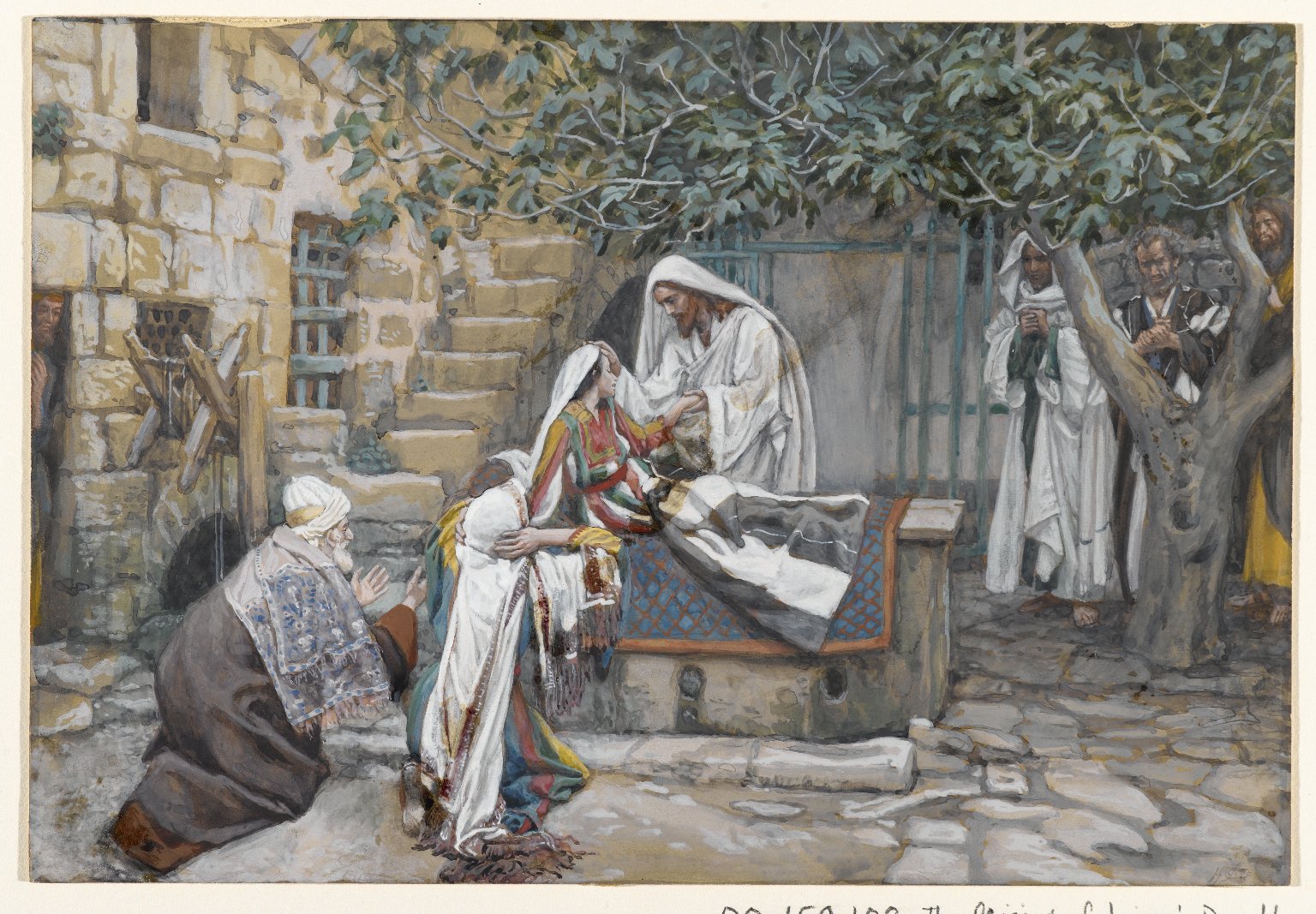
James Tissot The woman with the Issue of Blood
James Tissot The Raising of Jairus’ Daughter

Saturday, 6 March 2021

Lent III: The Cleansing of the Temple

It is hard for us to imagine just how important the Temple in Jerusalem was. It was, quite literally, the centre of the world, the most important place on earth. At its centre was the Holy of Holies which contained the Ark of the Covenant. Inside the Ark were the two tablets containing the Ten Commandments, some of the manna from the desert, and Aaron’s staff. That is why, to this day, Jews continue to pray at the Western Wall in Jerusalem. This is all that remains of the Temple after its destruction by the Romans in ad 70. At the time of Jesus, Passover was the busiest time of year in Jerusalem. As the central festival of Judaism, Passover marks the journey from slavery in Egypt to the freedom of the Promised Land, Israel. Likewise, for Christians it is the time when we celebrate our freedom from the slavery of sin through the Death and Resurrection of Jesus Christ.

In our first reading this morning from the Book of Exodus, God gives the law to Moses on Mount Sinai in the desert. It describes both how to honour God, and how humanity should live. Our duty towards God and our neighbour is clearly shown. When Moses receives the Ten Commandments from God, the first is:

I am the Lord your God, who brought you out of the land of Egypt, out of the house of slavery; you shall have no other gods before me.’ (Exod 20:2-3)

The temple traders, in their desire to profit from people’s religious observance, have broken this first and most important commandment. Their desire for making money and profit has got in the way of what the Temple is supposed to be about: namely, worshipping God. It has become a racket, a money-making scheme to fleece pilgrims who have come from far away and who do not have the right money or the correct sacrificial animals with them. This is no way to worship God, a God who loves us, and who showed that love by delivering Israel from slavery in Egypt, and who will deliver humanity by His Son.

Jesus is angry when He sees this and drives out both the money-changers and the sellers of sacrificial animals. Those who sell sheep, oxen, and pigeons, represent the status quo, a sacrificial system where animals and their blood are used to honour God. Jesus has come to do away with this system by offering Himself, as the true sacrifice. When John the Baptist first sees Jesus in John’s Gospel, he says:

Behold, the Lamb of God, who takes away the sin of the world!.” (Jn 1:29)

Jesus is the true Lamb, foreshadowed in the story of Abraham and Isaac. He will be the true Passover sacrifice, as He will be crucified and die at the time when the Passover lambs are being slaughtered in the Temple. This is a sacrifice which will not need to be repeated, as Jesus will die once, for the sins of the whole world. 

The Jews ask Jesus, 

What sign do you show us for doing these things?” (Jn 2:18)

Jesus makes a cryptic reply:

Destroy this temple, and in three days I will raise it up.” (Jn 2:19)

His audience cannot understand what Jesus means. It took almost fifty years to build the Temple. The idea of destroying it and rebuilding it in three days is crazy. However, Jesus is talking about His own Death and Resurrection. His Body is the true Temple, the True Sacrifice, and He is both Priest and Victim. God will, in the person of His Son, bring about true worship. Likewise, the Temple is supposed to be a house of prayer for all the nations (Isaiah 56:7 & Mark 11:7), but the Court of the Gentiles has been filled with stalls for money-changers and animal-sellers. By clearing them out Jesus has made room for the old Temple to be used for prayer, while prophesying that a newer, greater Temple is here, in Him.

The Jews demand a sign, and Christ prophesies that if they destroy this temple then he will raise it up in three days. He looks to His death and resurrection to show them where true worship lies — in the person of Jesus Christ. Jesus said, ‘I have come not to abolish the law and the prophets but to fulfil them’ (Matthew 5:17). The Ten Commandments are not abolished by Christ, or set aside, but rather His proclamation of the Kingdom and Repentance show us that we still need to live the Law of Moses out in our lives: to show that we honour God and live our lives accordingly. In His cleansing of the Temple, Christ looks to the Cross and to the Resurrection, as the way that God will restore our relationship with Him. The Cross is a stumbling-block to Jews, who are obsessed with the worship of the Temple, and it is foolishness to Gentiles who cannot believe that God could display such weakness, such powerlessness. Instead the Cross, the supreme demonstration of God’s love for us, shocking and scandalous though it is, is a demonstration of the utter, complete, self-giving love of God. Here, love and mercy are offered to heal each and every one of us. Here we are restored. 

It is a shock to learn that God loves us enough to do this, to suffer dreadfully and die for us, to save us from our sins. We do not deserve this, and that is the point. Through Christ we are offered the opportunity to become something other and greater than we are. By putting away the ways of the world, of power and money, selfishness and sin, we can have new life in and through Him.

Lent is the opportunity for a spiritual spring clean. It is a time to ask God to drive out all that should not be there, and for preparing for the joy of Easter. In our baptism we died with Christ and were raised to new life in the Spirit. Let us prepare to live that life, holding fast to Our Lord and Saviour, clinging to the teachings of his body, the Church. Let us turn away from the folly of this world with all its hot air, and focus on the true and everlasting joy of heaven, which awaits us. Let us proclaim God’s love in our lives, so that others may believe, and that all may praise the Father, the Son and the Holy Spirit. To whom be ascribed, as is most right and just, all might, majesty, glory, dominion, and power, now and forever. Amen.

El Greco: The Purification of the Temple

Thursday, 21 May 2020

Homily for the Ascension (Acts 1:1-11 Eph 1:17-23 Mt 28:16-20)

Today can often feel a somewhat strange day, a day of slightly mixed emotions, and this year more than most, when we are not able to be together to pray, to worship Almighty God, and be nourished with Holy Communion. We are not celebrating Jesus’ departure from the earth, but His return to God the Father, Christ’s abiding presence with us, and what He asks of us, and promises to us. It is a day of celebration and expectation, looking forward to the future in love and hope. 

The disciples have had six weeks to used to the fact that Jesus has risen from the dead, having carried the burden of our sins and experienced the pain and estrangement which separates God and humanity. That wound has been healed by His glorious wounds. Before Jesus returns to the Father, He makes the apostles a promise: they will be baptized with the Holy Spirit (Acts 1:4), receive power, and be Christ’s witnesses to the ends of the earth (Acts 1:8). Christ is looking forward to Pentecost, to the church’s future, in which we live now.

In Matthew’s Gospel, before Jesus leaves the apostles, He gives them a commission, they are sent out to do something together. Jesus begins (Mt 28:18) by stating that all authority in heaven and earth has been given to Him. He is God, God is sovereign, and rules over everything, and it reminds us of the moment during Christ’s temptation by the devil, before the start of His public ministry, which we read on the First Sunday of Lent. The devil offers the world to Jesus, but it is not his to give, it belongs to God, who created it. Our worship is rooted in the fact that we have a relationship with a God who made us, redeemed us, and loves us. 

Jesus tells the apostles (28:19) to go and make disciples of all nations, baptizing them in the name of the Father, and of the Son, and of the Holy Spirit. The church exists to be sent out to make disciples. Baptism is what makes us Christians. In it we share in Christ’s life, death, and Resurrection, and through it God gives us the virtues of Faith, Hope, and Love. Through our faith in God: Father, Son, and Holy Spirit, filled with the hope of heaven, our supernatural end, to enjoy the vision of God, who is love. Loving God and our neighbour, this is the very heart of the proclamation of the Good News of the Kingdom, along with the call of Jesus and John the Baptist that we should ‘Repent and believe the Gospel, and be baptised’. For two thousand years our message has been the same. 

Jesus tells the apostles to teach us all that He has commanded them (28:20). The Church is called to hand on what has been delivered to it, this is tradition, and it stops us from making mistakes, by deviating from what Christ teaches us through the Church. Our religion makes demands of us, and calls us to be faithful to the apostles’ teaching, and to live it out in our lives, putting theory into practice and becoming living witnesses of the Kingdom. This is difficult, and it is where Christians fall down most often. But the Good News is that in Christ we have forgiveness of sin. We can repent, and turn away from our mistakes, and turn back to a God who loves us. We are not abandoned or cast aside, but embraced in love. 

Finally Jesus says to the apostles, ‘Behold I am with you always, to the end of the age.’ (28:20) Christ is with us. How? In four ways: first in Scripture, the Word of God, which speaks of Christ, and finds its fulfilment in Him. It is true, and the source of truth. He is with us in the Sacraments, outward visible signs of the inward spiritual grace God pours out upon us, to fill us with His love. He is with us in the Holy Spirit which he pours out upon us, to strengthen us, and fill us with love. And finally He is with us in the Church, which is His Body, where we are united with Christ, in a relationship with Him, and each other. 

Jesus makes promises which are true. We can trust Him, and like the apostles we can prepare for the Coming of the Holy Spirit at Pentecost in prayer, and joyful expectation, knowing that we will never be abandoned, but that we are always united to, and loved by God the Father, God the Son, and God the Holy Spirit, to whom be ascribed as it most right and just, all might, majesty, glory, dominion, and power, now and forever. Amen

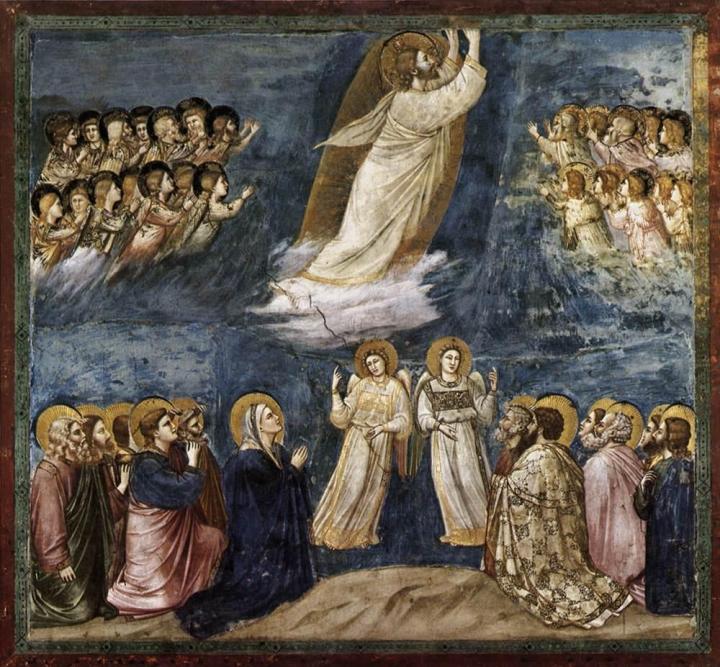
giotto_di_bondone_-_no._38_scenes_from_the_life_of_christ_-_22._ascension_-_wga09226

Homily for the Ascension (Acts 1:1-11 Eph 1:17-23 Mt 28:16-20)

Today can often feel a somewhat strange day, a day of slightly mixed emotions, and this year more than most, when we are not able to be together to pray, to worship Almighty God, and be nourished with Holy Communion. We are not celebrating Jesus’ departure from the earth, but His return to God the Father, Christ’s abiding presence with us, and what He asks of us, and promises to us. It is a day of celebration and expectation, looking forward to the future in love and hope. 

The disciples have had six weeks to used to the fact that Jesus has risen from the dead, having carried the burden of our sins and experienced the pain and estrangement which separates God and humanity. That wound has been healed by His glorious wounds. Before Jesus returns to the Father, He makes the apostles a promise: they will be baptized with the Holy Spirit (Acts 1:4), receive power, and be Christ’s witnesses to the ends of the earth (Acts 1:8). Christ is looking forward to Pentecost, to the church’s future, in which we live now.

In Matthew’s Gospel, before Jesus leaves the apostles, He gives them a commission, they are sent out to do something together. Jesus begins (Mt 28:18) by stating that all authority in heaven and earth has been given to Him. He is God, God is sovereign, and rules over everything, and it reminds us of the moment during Christ’s temptation by the devil, before the start of His public ministry, which we read on the First Sunday of Lent. The devil offers the world to Jesus, but it is not his to give, it belongs to God, who created it. Our worship is rooted in the fact that we have a relationship with a God who made us, redeemed us, and loves us. 

Jesus tells the apostles (28:19) to go and make disciples of all nations, baptizing them in the name of the Father, and of the Son, and of the Holy Spirit. The church exists to be sent out to make disciples. Baptism is what makes us Christians. In it we share in Christ’s life, death, and Resurrection, and through it God gives us the virtues of Faith, Hope, and Love. Through our faith in God: Father, Son, and Holy Spirit, filled with the hope of heaven, our supernatural end, to enjoy the vision of God, who is love. Loving God and our neighbour, this is the very heart of the proclamation of the Good News of the Kingdom, along with the call of Jesus and John the Baptist that we should ‘Repent and believe the Gospel, and be baptised’. For two thousand years our message has been the same. 

Jesus tells the apostles to teach us all that He has commanded them (28:20). The Church is called to hand on what has been delivered to it, this is tradition, and it stops us from making mistakes, by deviating from what Christ teaches us through the Church. Our religion makes demands of us, and calls us to be faithful to the apostles’ teaching, and to live it out in our lives, putting theory into practice and becoming living witnesses of the Kingdom. This is difficult, and it is where Christians fall down most often. But the Good News is that in Christ we have forgiveness of sin. We can repent, and turn away from our mistakes, and turn back to a God who loves us. We are not abandoned or cast aside, but embraced in love. 

Finally Jesus says to the apostles, ‘Behold I am with you always, to the end of the age.’ (28:20) Christ is with us. How? In four ways: first in Scripture, the Word of God, which speaks of Christ, and finds its fulfilment in Him. It is true, and the source of truth. He is with us in the Sacraments, outward visible signs of the inward spiritual grace God pours out upon us, to fill us with His love. He is with us in the Holy Spirit which he pours out upon us, to strengthen us, and fill us with love. And finally He is with us in the Church, which is His Body, where we are united with Christ, in a relationship with Him, and each other. 

Jesus makes promises which are true. We can trust Him, and like the apostles we can prepare for the Coming of the Holy Spirit at Pentecost in prayer, and joyful expectation, knowing that we will never be abandoned, but that we are always united to, and loved by God the Father, God the Son, and God the Holy Spirit, to whom be ascribed as it most right and just, all might, majesty, glory, dominion, and power, now and forever. Amen

giotto_di_bondone_-_no._38_scenes_from_the_life_of_christ_-_22._ascension_-_wga09226

Saturday, 2 May 2020

Easter IV (The Good Shepherd)

We mark time: day and night, weeks, months, years, and seasons. The Church’s Liturgical Year is a very good thing indeed. It divides up time and it focusses our attention on certain things: allowing us the time to contemplate the mysteries of the Christian Faith. The Resurrection of Jesus Christ from the dead is an event which requires serious contemplation. We need time to let it sink in, and to explore what it means for us and our faith. It is the defining moment of our faith, one which gives Christians the hope that our death is not the end, that this life is not all that there is, and that because of who Christ is, namely God, and what He has done: died for us to take away our sin, and rise again to give us the hope of eternal life in Him.

In John’s Gospel, Jesus says of himself, ‘I am the Good Shepherd’ It discloses something important about Who and What He is — Jesus is one who tends, who looks after His sheep. The Jews in the Temple for the celebration of Hanukkah in the Gospel don’t seem to have been listening. Jesus has told them clearly and they do not believe that He is the Messiah. What Christ does in the Gospels testifies to Who and What He is: the Word made flesh, God with us.

Those of us who are in the Church, through our Baptism belong to Christ, we are His. So we are to listen to what Jesus tells us, in the words of Scripture and through prayer. Jesus knows us and we know him — in word and sacrament, through the outpouring of His grace, and so we follow Christ, we do what He tells us to do: to love, to forgive each other. We are humble, we don’t think of ourselves as better than we are, we know our need of, and our dependance upon God. We put our faith into practice in our lives, so that it becomes a reality in the world.

Christ offers us eternal life, as we share in His death, so we too share in His Resurrection, and are assured of eternal life with Him, something wonderful and freely given, and a reason why we, as the Church, celebrate Easter in an extravagant and exuberant way, because it is a sign that God loves us, and saves us. We are sharing in that Eternal Life here and now, as we are nourished by Him, in Word and Sacrament, strengthened by Him, to live His risen life, here and now. 

In Revelation, as St John experiences heavenly worship he states, ‘For the Lamb in the midst of the throne will be their shepherd, and he will guide them to springs of living water, and God will wipe away every tear from their eyes.’ (Revelation 7:17 ESV). The Lamb will be our shepherd: Christ will care for us, and keep us safe. A Good Shepherd lays down His life for the sheep as Christ has done through His Death and Resurrection. To drink living water is to experience the fulness of life in God, filled with the Holy Spirit. Christ guides us to that in our baptism, when we are filled with the Spirit and made part of the Church. 

So we listen to Christ’s voice, in the Bible. We hear Him speak to us, and through this we listen to Him, and obey Him. That is how we know Christ and follow Him. It affects who we are and how we live, as people of love, loved by God. We are prepared here on earth for the life of heaven, for worship, and closeness to God. We have a foretaste of that closeness in Holy Communion where Christ feeds us with His Body and Blood, so that we may be transformed by it, more and more into His likeness. It changes us, so that we, by the grace of God, in the power of His Holy Spirit, may become what we are: made in the image of God. That image is restored in us by Christ’s death and resurrection. Through it we come to share in the intimacy of the divine life. As Christ says, ‘I and the Father are one.’ (John 10:30 ESV)  As Michael Ramsay said, ‘God is Christlike, and in him is no un-Christlikeness at all’ [God, Christ & the World: A Study in Contemporary Theology, London 1969, 98] When we see Jesus, we see God, when we hear Him speak, we hear the voice of God. We can know who God is, the creator and redeemer of the universe, through His Son, Jesus Christ. God is no longer distant, or an angry man on a cloud, but a loving Father, as in the Parable of the Prodigal Son, and a Son who loves us so much that He suffers and dies for us, to give us life in Him. This is God who goes after lost sheep, who longs to love and heal and reconcile, who can heal our wounds if we let Him.

God loves us; we can say this with the utmost confidence because of the life, death, and resurrection of Jesus Christ, it all proclaims the same truth: God loves us, not because we’re worthy of it, but so that we might become what God is. It is what we celebrate at Easter, it lies at the heart, the very core of our faith as Christians. It’s why we are what we are, and why we do what we do, to proclaim this simple truth to the world.

We can have peace through our relationship with the Trinity, the source of our peace, and joy, and love. Grounded in this relationship we need not be afraid or troubled – we are free to live lives which proclaim God’s love and victory so that the world may believe. Through God loving us, we can truly love him and each other. We experience this most clearly at the Eucharist when Christ feeds us with His Body and Blood, which He as both priest and victim offers on the Altar of the Cross. That self same sacrifice which heals the world through the outpouring of God’s love feeds us here and now. We are fed so that we may be nourished and share in the divine life and the joy of heaven. We receive the free gift of God’s grace so that it may perfect our human nature, so that we may go where Our Lord is going, and share in the joy, and love, and peace of the Triune God, Father, Son, and Holy Spirit, to whom be ascribed, as is most right and just, all might, majesty, glory, dominion, and power, now and forever. Amen. 

06f84c08-66cf-4481-baf0-09d3f1849f7e

Easter IV (The Good Shepherd)

We mark time: day and night, weeks, months, years, and seasons. The Church’s Liturgical Year is a very good thing indeed. It divides up time and it focusses our attention on certain things: allowing us the time to contemplate the mysteries of the Christian Faith. The Resurrection of Jesus Christ from the dead is an event which requires serious contemplation. We need time to let it sink in, and to explore what it means for us and our faith. It is the defining moment of our faith, one which gives Christians the hope that our death is not the end, that this life is not all that there is, and that because of who Christ is, namely God, and what He has done: died for us to take away our sin, and rise again to give us the hope of eternal life in Him.

In John’s Gospel, Jesus says of himself, ‘I am the Good Shepherd’ It discloses something important about Who and What He is — Jesus is one who tends, who looks after His sheep. The Jews in the Temple for the celebration of Hanukkah in the Gospel don’t seem to have been listening. Jesus has told them clearly and they do not believe that He is the Messiah. What Christ does in the Gospels testifies to Who and What He is: the Word made flesh, God with us.

Those of us who are in the Church, through our Baptism belong to Christ, we are His. So we are to listen to what Jesus tells us, in the words of Scripture and through prayer. Jesus knows us and we know him — in word and sacrament, through the outpouring of His grace, and so we follow Christ, we do what He tells us to do: to love, to forgive each other. We are humble, we don’t think of ourselves as better than we are, we know our need of, and our dependance upon God. We put our faith into practice in our lives, so that it becomes a reality in the world.

Christ offers us eternal life, as we share in His death, so we too share in His Resurrection, and are assured of eternal life with Him, something wonderful and freely given, and a reason why we, as the Church, celebrate Easter in an extravagant and exuberant way, because it is a sign that God loves us, and saves us. We are sharing in that Eternal Life here and now, as we are nourished by Him, in Word and Sacrament, strengthened by Him, to live His risen life, here and now. 

In Revelation, as St John experiences heavenly worship he states, ‘For the Lamb in the midst of the throne will be their shepherd, and he will guide them to springs of living water, and God will wipe away every tear from their eyes.’ (Revelation 7:17 ESV). The Lamb will be our shepherd: Christ will care for us, and keep us safe. A Good Shepherd lays down His life for the sheep as Christ has done through His Death and Resurrection. To drink living water is to experience the fulness of life in God, filled with the Holy Spirit. Christ guides us to that in our baptism, when we are filled with the Spirit and made part of the Church. 

So we listen to Christ’s voice, in the Bible. We hear Him speak to us, and through this we listen to Him, and obey Him. That is how we know Christ and follow Him. It affects who we are and how we live, as people of love, loved by God. We are prepared here on earth for the life of heaven, for worship, and closeness to God. We have a foretaste of that closeness in Holy Communion where Christ feeds us with His Body and Blood, so that we may be transformed by it, more and more into His likeness. It changes us, so that we, by the grace of God, in the power of His Holy Spirit, may become what we are: made in the image of God. That image is restored in us by Christ’s death and resurrection. Through it we come to share in the intimacy of the divine life. As Christ says, ‘I and the Father are one.’ (John 10:30 ESV)  As Michael Ramsay said, ‘God is Christlike, and in him is no un-Christlikeness at all’ [God, Christ & the World: A Study in Contemporary Theology, London 1969, 98] When we see Jesus, we see God, when we hear Him speak, we hear the voice of God. We can know who God is, the creator and redeemer of the universe, through His Son, Jesus Christ. God is no longer distant, or an angry man on a cloud, but a loving Father, as in the Parable of the Prodigal Son, and a Son who loves us so much that He suffers and dies for us, to give us life in Him. This is God who goes after lost sheep, who longs to love and heal and reconcile, who can heal our wounds if we let Him.

God loves us; we can say this with the utmost confidence because of the life, death, and resurrection of Jesus Christ, it all proclaims the same truth: God loves us, not because we’re worthy of it, but so that we might become what God is. It is what we celebrate at Easter, it lies at the heart, the very core of our faith as Christians. It’s why we are what we are, and why we do what we do, to proclaim this simple truth to the world.

We can have peace through our relationship with the Trinity, the source of our peace, and joy, and love. Grounded in this relationship we need not be afraid or troubled – we are free to live lives which proclaim God’s love and victory so that the world may believe. Through God loving us, we can truly love him and each other. We experience this most clearly at the Eucharist when Christ feeds us with His Body and Blood, which He as both priest and victim offers on the Altar of the Cross. That self same sacrifice which heals the world through the outpouring of God’s love feeds us here and now. We are fed so that we may be nourished and share in the divine life and the joy of heaven. We receive the free gift of God’s grace so that it may perfect our human nature, so that we may go where Our Lord is going, and share in the joy, and love, and peace of the Triune God, Father, Son, and Holy Spirit, to whom be ascribed, as is most right and just, all might, majesty, glory, dominion, and power, now and forever. Amen. 

06f84c08-66cf-4481-baf0-09d3f1849f7e

Sunday, 10 November 2019

Remembrance 2019

We are gathered here on this special day to do a number of things together. First and foremost we give thanks for the safe deliverance of these islands from the World Wars of the previous century. These were wars on a scale never before seen. The first was supposed to be the ‘war to end all wars’, yet within twenty years a greater conflict began which brought even more death and suffering to millions across the world. Hardly a day has gone by in the past century when there has not been a conflict somewhere in our world. 

It is now one hundred years since we first marked the anniversary of the Armistice by stopping in silence for two minutes, and praying: in remembrance of all those who gave their lives for our country, and for all who suffer as a result of war. For one hundred years we have engaged in a public act of remembrance. 

In 1919 the Prime Minister, David Lloyd George, commissioned a cenotaph (which means empty tomb) to stand in Whitehall, London, as a focus for an act of remembrance, when most of the war dead lay buried overseas. The original wood and plaster structure, designed by Sir Edward Lutyens, was only intended to stand for one week, but it proved so popular that a permanent one was created in Portland Stone ready for the 1920 Armistice Day.

Since 1919, the Cenotaph has become the central focus for national commemoration especially during the National Service of Remembrance held on Remembrance Sunday, the Sunday nearest to 11th November. Its meaning has developed and the Cenotaph now memorialises those who have given their lives in all conflicts since the First World War.

Throughout the country, local memorials were erected to remember the dead of the First and then the Second World War. Like the Cenotaph in London, these became the focus for local Remembrance ceremonies and we keep this tradition here in Maenclochog today, starting our Remembrance Service outside at our Village War Memorial. 

Our act of remembrance is not simply to recall a past event, or to bring the dead to mind, but something more. By remembering today, the sacrifice of countless men and women, we continue to show our thanks for the peace and prosperity which we now enjoy. 

We give thanks for to all those who have served, and continue to serve this country, both at home and abroad, and for the continuing work of the Royal British Legion in supporting veterans and their families. As a country we have asked much of our sons and daughters, and we continue so to do. ‘Cariad mwy na hwn nid oes gan neb; sef, bod i un roi ei einioes dros ei gyfeillion.’ ‘Greater love has no one than this, that someone lay down his life for his friends’ (Jn 15:13). They died that we might live. 

Their sacrifice calls to mind another sacrifice, made on a hill outside Jerusalem, ‘ble bu farw ein Harglwydd Iesu Grist drosom ni’. We remember this sacrifice too, as Jesus died for us. It is the heart of the Christian Faith, and the greatest demonstration possible of the saving power of love.

Love is at the heart of remembrance. Our human love comes from God, the source of all love. This love has the power to heal wounds, to comfort grief and loss. One hundred years on from the end of the First World War, the world still needs healing. This is beyond our capabilities as human beings. We need God’s help. Our God loves us, and longs to heal our wounds. He gave His Son to die for us, on the Cross, a painful death at the hands of enemy soldiers. Three days later, Jesus rose from the dead. His tomb was empty, and just as with the empty Cenotaph in London we are reminded that death is not the end. The Christian belief in the Resurrection of the dead and the life to come gives us all hope.

On the first Remembrance Day, one hundred years ago, two minutes silence was introduced. At 11 o’clock, as well as remembering the fallen, we take time to pray for peace. There are two words for peace in Welsh, ‘heddwch’, and ‘tangnefedd’. The first, ‘heddwch’ means an end to hostilities, the Armistice ceasefire which we celebrate today. But ‘tangnefedd’, the other kind of peace, is something far deeper and richer. It is the peace of God, the shalom of the Hebrew Old Testament. This is the gift of God, a feeling of wholeness, which brings about healing. So when Jesus says, ‘Blessed are the peacemakers, for they shall be called sons of God.’ ‘Gwyn eu byd y tangnefeddwyr: canys hwy a elwir yn blant i Dduw’ (Mt 5:9) He is envisaging something both radical and world-changing: something which heals, which forgives, and which loves. Today we commit ourselves to making peace a reality: here and now — in our community, in our families, in our relationships, in what we are, in what we say, and in what we do. We can never be too busy to do this. When we take the path of peace we honour the memory of those who gave their lives so that we might live. 

So let us therefore commit ourselves to help create the peace which Christ came to bring, for the glory of God, and the good of all human kind. Our Lord Jesus Christ has shown us another way to live — the way of love and gentleness. In memory of what Christ did here on earth, and continues to do, we can experience the peace of the Kingdom of God, where wounds are healed and divisions are reconciled. Today we give our thanks for those who sacrificed themselves for us, and we honour their memory by treasuring the peace won at so great a cost. 

Almighty God, hear our prayers and thanksgivings for all whom we remember this day. In the name of the Father, and of the Son, and of the Holy Spirit, Amen. 

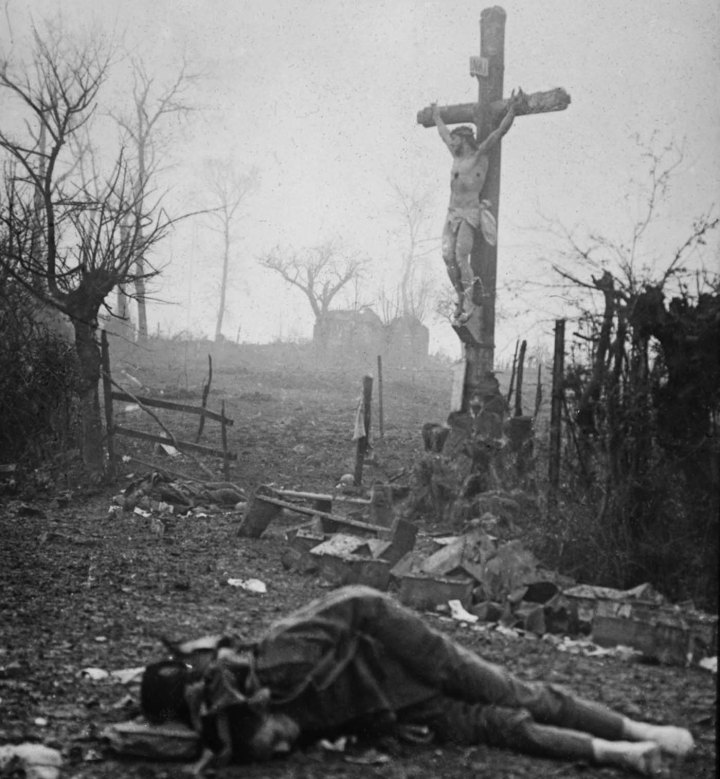
Walter Kleinfeldt’s album showing the aftermath of a skirmish during the Battle of Somme, 1916 (7).jpg

Remembrance 2019

We are gathered here on this special day to do a number of things together. First and foremost we give thanks for the safe deliverance of these islands from the World Wars of the previous century. These were wars on a scale never before seen. The first was supposed to be the ‘war to end all wars’, yet within twenty years a greater conflict began which brought even more death and suffering to millions across the world. Hardly a day has gone by in the past century when there has not been a conflict somewhere in our world. 

It is now one hundred years since we first marked the anniversary of the Armistice by stopping in silence for two minutes, and praying: in remembrance of all those who gave their lives for our country, and for all who suffer as a result of war. For one hundred years we have engaged in a public act of remembrance. 

In 1919 the Prime Minister, David Lloyd George, commissioned a cenotaph (which means empty tomb) to stand in Whitehall, London, as a focus for an act of remembrance, when most of the war dead lay buried overseas. The original wood and plaster structure, designed by Sir Edward Lutyens, was only intended to stand for one week, but it proved so popular that a permanent one was created in Portland Stone ready for the 1920 Armistice Day.

Since 1919, the Cenotaph has become the central focus for national commemoration especially during the National Service of Remembrance held on Remembrance Sunday, the Sunday nearest to 11th November. Its meaning has developed and the Cenotaph now memorialises those who have given their lives in all conflicts since the First World War.

Throughout the country, local memorials were erected to remember the dead of the First and then the Second World War. Like the Cenotaph in London, these became the focus for local Remembrance ceremonies and we keep this tradition here in Maenclochog today, starting our Remembrance Service outside at our Village War Memorial. 

Our act of remembrance is not simply to recall a past event, or to bring the dead to mind, but something more. By remembering today, the sacrifice of countless men and women, we continue to show our thanks for the peace and prosperity which we now enjoy. 

We give thanks for to all those who have served, and continue to serve this country, both at home and abroad, and for the continuing work of the Royal British Legion in supporting veterans and their families. As a country we have asked much of our sons and daughters, and we continue so to do. ‘Cariad mwy na hwn nid oes gan neb; sef, bod i un roi ei einioes dros ei gyfeillion.’ ‘Greater love has no one than this, that someone lay down his life for his friends’ (Jn 15:13). They died that we might live. 

Their sacrifice calls to mind another sacrifice, made on a hill outside Jerusalem, ‘ble bu farw ein Harglwydd Iesu Grist drosom ni’. We remember this sacrifice too, as Jesus died for us. It is the heart of the Christian Faith, and the greatest demonstration possible of the saving power of love.

Love is at the heart of remembrance. Our human love comes from God, the source of all love. This love has the power to heal wounds, to comfort grief and loss. One hundred years on from the end of the First World War, the world still needs healing. This is beyond our capabilities as human beings. We need God’s help. Our God loves us, and longs to heal our wounds. He gave His Son to die for us, on the Cross, a painful death at the hands of enemy soldiers. Three days later, Jesus rose from the dead. His tomb was empty, and just as with the empty Cenotaph in London we are reminded that death is not the end. The Christian belief in the Resurrection of the dead and the life to come gives us all hope.

On the first Remembrance Day, one hundred years ago, two minutes silence was introduced. At 11 o’clock, as well as remembering the fallen, we take time to pray for peace. There are two words for peace in Welsh, ‘heddwch’, and ‘tangnefedd’. The first, ‘heddwch’ means an end to hostilities, the Armistice ceasefire which we celebrate today. But ‘tangnefedd’, the other kind of peace, is something far deeper and richer. It is the peace of God, the shalom of the Hebrew Old Testament. This is the gift of God, a feeling of wholeness, which brings about healing. So when Jesus says, ‘Blessed are the peacemakers, for they shall be called sons of God.’ ‘Gwyn eu byd y tangnefeddwyr: canys hwy a elwir yn blant i Dduw’ (Mt 5:9) He is envisaging something both radical and world-changing: something which heals, which forgives, and which loves. Today we commit ourselves to making peace a reality: here and now — in our community, in our families, in our relationships, in what we are, in what we say, and in what we do. We can never be too busy to do this. When we take the path of peace we honour the memory of those who gave their lives so that we might live. 

So let us therefore commit ourselves to help create the peace which Christ came to bring, for the glory of God, and the good of all human kind. Our Lord Jesus Christ has shown us another way to live — the way of love and gentleness. In memory of what Christ did here on earth, and continues to do, we can experience the peace of the Kingdom of God, where wounds are healed and divisions are reconciled. Today we give our thanks for those who sacrificed themselves for us, and we honour their memory by treasuring the peace won at so great a cost. 

Almighty God, hear our prayers and thanksgivings for all whom we remember this day. In the name of the Father, and of the Son, and of the Holy Spirit, Amen. 

Walter Kleinfeldt’s album showing the aftermath of a skirmish during the Battle of Somme, 1916 (7).jpg

Saturday, 27 April 2019

Easter II [Acts 5:27-32, Revelation 1:4-8, Jn 20:19-31]

In this morning’s first reading Saint Peter and the apostles are told by the authorities not to preach in the name of Jesus. Naturally, it is impossible for them to do this; they simply have to tell the world about Him and His Resurrection. They do this so that the gospel may be proclaimed: the gospel of repentance and forgiveness of sins through Christ. To be a Christian is to turn away from the ways of sin, the ways of the world — we are obedient to God, we hear what he is said in Christ and we obey him. The Church, then, must always be on its guard lest it ceases to be obedient to God and turns instead to the ways of the world, the ways of humanity. As St Paul says in his Letter to the Romans ‘be not conformed to this world’. It is a difficult thing to do. It is hard. It takes strength of character and confidence, and it will not be popular. But just as the apostles rejoiced that they were counted worthy to suffer dishonour for the name, and did not cease teaching and preaching Jesus Christ, so the Church is always called to do the same: to risk persecution, and to speak the uncomfortable truth which the world does not want to hear. This is our calling. 

When the disciples are sat in a locked room, afraid of persecution Christ comes among them and says, ‘Tangnefedd i chwi’ ‘Peace be with you’. Christ comes to give them peace. He gives them a peace which the world cannot give, because it is not of this world. The peace Christ which comes to give us is the peace won on the Cross, which has reconciled God and humanity. This wonderful relationship leads to the disciples being sent, as Christ was, to proclaim the Good News of the Kingdom, and of new life in Christ. Christ empowers His Apostles with the Holy Spirit, to forgive sins, and carry on Christ’s work of reconciliation. The church exists to do just this, to proclaim and reconcile, to carry on Christ’s work in the world in the power of the Holy Spirit.

All of us can, I think, understand Thomas’ frustration at not being there. It isn’t that he doubts, he wants to believe, and to experience the reality of his Risen Lord, and not to be left out. It’s a very human reaction. So when Jesus is with them again on Sunday, He greets them with Peace, and offers his hands and side to Thomas. He gives Thomas what he wants, proof that it is really Jesus, that he has truly risen from the dead. When faced with the reality of the Risen Jesus, Thomas can only say, ‘My Lord and My God’. Thomas confesses that Jesus is Lord and God, the sole supreme authority, above anything of this world. He worships God in Christ. We do the same, and we are blessed because we have not seen and yet believe. We believe because of the witness of Thomas, and others, down through the centuries, who have proclaimed the Good News of Jesus Christ, even at great personal cost. As St Peter and the apostles said, ‘We must obey God rather than men’ (Acts 5:29 ESV) Christians around the world follow their lead, and to this day face imprisonment, torture, and death, for their belief in Christ. They do so gladly, because of who Christ is, and what He has done. We may not face suicide bombers in our churches, thank God. But we are no less resolved to bear witness to Christ. We may be ignored by the world around us, but we carry on bearing witness to the love and reconciliation which Christ brings, and which nothing else can. We continue, ‘so that you may believe that Jesus is the Christ, the Son of God, and that by believing you may have life in his name’ (John 20:31 ESV) Christ comes to bring us life, in His Incarnation, in His Life and Preaching, and in His Death and Resurrection. He gives us His Life, through our Baptism, and through the Eucharist. We are united with Christ, and transformed by Him, to live His life in the world, filled with His Holy Spirit. This is good news, which we long to share with others, so that they may come to know Christ, and experience His Love. The Church exists to deal with the mess we make as human beings, through what Jesus has done for us, in the power of His Holy Spirit. The Church is to be a community of reconciliation, where we are forgiven and we, in turn, forgive. It is to be a place where we are freed from sin, its power and its effects.

The disciples go from being scared and stuck in an upper room to missionaries, evangelists, spreading the Good News around the world, regardless of the cost, even of sacrificing their own lives to bear witness to the fact that Jesus Christ is the Son of God, that he died for our sins, and that he rose again, on this day for us, that God loves us and tells us to love Him and to love one another. It is a simple and effective message which people still want to hear — we need to tell it to them, in our thoughts, our words and our actions.

The heart of our faith and the Gospel is forgiveness — no matter how many times we mess things up, we are forgiven. It is this reckless generosity of spirit which people find hard to believe that they too can be forgiven, by a loving God, and by their fellow Christians. That we can, despite our manifold shortcomings be a people of love, and forgiveness, and reconciliation. That God’s Grace will in the end not abolish our nature, but perfect it, that being fed by Christ, with Christ: so that we too may become what He is. That faced with the sad emptiness of the world, and its selfishness, its greed, we can be filled with joy, and life, and hope. That like the first apostles we too can spread the Gospel: that the world may believe.

So let us be filled with the joy of the Resurrection this Easter, let us share that joy with others, may it fill our lives and those of whom we meet with the joy and love of God, who has triumphed and who offers us all new life in Him, that all that we do, all that we are, all that we say or think may give glory to God the Father, God the Son, and God the Holy Spirit, to whom be ascribed as is most right and just, all might, majesty, dominion and power, now and forever.

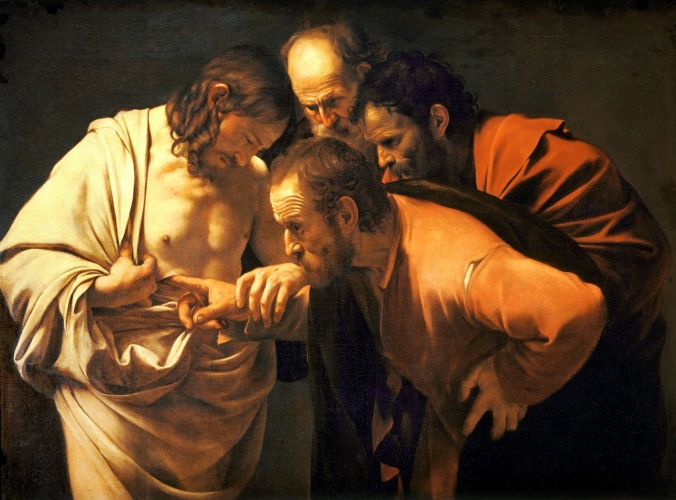
7ec0d-the_incredulity_of_saint_thomas-caravaggio_1601-2

Saturday, 16 February 2019

Sixth Sunday of Year C (Lk 6:17-26)

The world around us has many clever and subtle ways of going after false gods. One of the most prevalent in our modern world is consumerism. Feeling a bit down? Shopping will cheer you up! You don’t even have to leave the comfort of your own home, just click a button and what you want will be sent to you. But it is a transitory pleasure, it doesn’t last. As Christians we know that our source of true happiness and joy is to be found in God alone. This is something which our readings this morning make very clear.

The prophet Jeremiah shows the difference between trusting in humanity, and trusting in God. Where we put our trust matters, because it shapes who and what we are. Against a model which stresses human self-sufficiency, we see that reliance upon God leads to human flourishing, having life in all its fulness.

Our death is something which we all need to face. Each and every one of us will die, it is inescapable. But because of who Christ is, and what He has done, we do not need to be afraid. The heart of our faith is that Christ died for us, to take away our sins, and was raised from the dead, to give us the hope of eternal life in Him. If it is not true, then the church is a sham, we’ve been fed lies for two thousand years. It would be the greatest deception of humanity ever, we would be truly pitiable. But it is true, and Christ’s Death and Resurrection have in fact changed everything. We have the hope that those who are in Christ share in His Death and Resurrection through their baptism. For us life is changed and not ended, and we have the hope of being united with God in Heaven, which we prepare for here on earth.

This is what lies behind the account in Luke’s Gospel. People come from all over the place, from far and wide, to be healed by Jesus. This is what God is all about, the healing of humanity, taking away our fears, our troubles, and giving us the peace ‘which passeth all understanding’. God’s love is made manifest in the healing miracles of Jesus Christ because it represents life in all its fulness. We are loved, healed and reconciled by God, so that we can live in a new way — living the life of the Kingdom, the life of Heaven, here and now.

To be poor in the world’s eyes is to lack money, possessions, power, and influence. All these worldly things don’t matter in the grand scheme of things. We have God, and are filled with his love, and that’s what really matters. God satisfies our hunger, or as St Augustine put it, ‘You have made us for yourself, and our hearts are restless until they find their rest in You.’ (Confessions 1.1.8) We have the source of everlasting Joy in God. But being a Christian won’t make us popular in the eyes of the world, quite the opposite. We will be seen as strange, dismissed as hypocrites, because we don’t buy into the emptiness of the world around us. 

At its heart Christianity looks dangerous and suspect to the world around us, and so it should. We are not conformed to the ways of the world, but rather to the will of God. We don’t just go along with things, because that’s what everyone does, instead we follow a higher authority. We cannot be bought off with baubles and trinkets, with wealth or power, things of this world, because we acknowledge something, someone greater, namely God. We live as God wants us to live, acknowledging Him before all things. There’s something strange and different about us, because we are not like other people. 

It’s not easy being like this, in fact it’s difficult, very difficult, and it’s why we, as Christians need to support each other in living out our faith together, as a community of faith. Christians face persecution around the world, people are forbidden to convert to Christianity, they are not free to meet and worship, and risk beatings torture, imprisonment, and even death for doing so. It’s real and it is happening around the world as we speak. 

Here in this country we are more likely to face indifference, someone might say, ‘Why do you believe in all that claptrap? Christians are just a bunch of hypocrites’. Our faith is not nonsense, but rather profound, meaningful, and wonderful. We do, however, need to live it out in our lives. It needs to make a difference to who and what we are, so that others might see the truth of the Gospel lived out in our lives. What we do here in church prepares and nourishes us to love our neighbour. We hear God’s word, and are nourished by it. We pray together for the Church and the World, and those in need. 

Above all, we are nourished by Christ, with Christ, with His Body and Blood, so that He may transform us more and more into His likeness. The Eucharist makes the Church, it is the source and summit of our life together. Through it we are united with each other and with Christ in this, the sacred banquet of the Kingdom of God. This is the medicine for which our souls cry out, so that they may be healed by Christ and prepared to live out our faith in Christ’s Death and Resurrection in the world, putting our trust in God, so that He might be at work in and through us, sharing His love with a world which longs for it. 

So let us prepare to rely upon God, filled with His Joy and Love, sharing it with others so that they may come to believe and give glory to God the Father, God the Son, and God the Holy Spirit, to whom be ascribed as is most right and just, all might, majesty, glory dominion and power, now and forever. Amen. 

5481471361948_XXL

Sixth Sunday of Year C (Lk 6:17-26)

The world around us has many clever and subtle ways of going after false gods. One of the most prevalent in our modern world is consumerism. Feeling a bit down? Shopping will cheer you up! You don’t even have to leave the comfort of your own home, just click a button and what you want will be sent to you. But it is a transitory pleasure, it doesn’t last. As Christians we know that our source of true happiness and joy is to be found in God alone. This is something which our readings this morning make very clear.

The prophet Jeremiah shows the difference between trusting in humanity, and trusting in God. Where we put our trust matters, because it shapes who and what we are. Against a model which stresses human self-sufficiency, we see that reliance upon God leads to human flourishing, having life in all its fulness.

Our death is something which we all need to face. Each and every one of us will die, it is inescapable. But because of who Christ is, and what He has done, we do not need to be afraid. The heart of our faith is that Christ died for us, to take away our sins, and was raised from the dead, to give us the hope of eternal life in Him. If it is not true, then the church is a sham, we’ve been fed lies for two thousand years. It would be the greatest deception of humanity ever, we would be truly pitiable. But it is true, and Christ’s Death and Resurrection have in fact changed everything. We have the hope that those who are in Christ share in His Death and Resurrection through their baptism. For us life is changed and not ended, and we have the hope of being united with God in Heaven, which we prepare for here on earth.

This is what lies behind the account in Luke’s Gospel. People come from all over the place, from far and wide, to be healed by Jesus. This is what God is all about, the healing of humanity, taking away our fears, our troubles, and giving us the peace ‘which passeth all understanding’. God’s love is made manifest in the healing miracles of Jesus Christ because it represents life in all its fulness. We are loved, healed and reconciled by God, so that we can live in a new way — living the life of the Kingdom, the life of Heaven, here and now.

To be poor in the world’s eyes is to lack money, possessions, power, and influence. All these worldly things don’t matter in the grand scheme of things. We have God, and are filled with his love, and that’s what really matters. God satisfies our hunger, or as St Augustine put it, ‘You have made us for yourself, and our hearts are restless until they find their rest in You.’ (Confessions 1.1.8) We have the source of everlasting Joy in God. But being a Christian won’t make us popular in the eyes of the world, quite the opposite. We will be seen as strange, dismissed as hypocrites, because we don’t buy into the emptiness of the world around us. 

At its heart Christianity looks dangerous and suspect to the world around us, and so it should. We are not conformed to the ways of the world, but rather to the will of God. We don’t just go along with things, because that’s what everyone does, instead we follow a higher authority. We cannot be bought off with baubles and trinkets, with wealth or power, things of this world, because we acknowledge something, someone greater, namely God. We live as God wants us to live, acknowledging Him before all things. There’s something strange and different about us, because we are not like other people. 

It’s not easy being like this, in fact it’s difficult, very difficult, and it’s why we, as Christians need to support each other in living out our faith together, as a community of faith. Christians face persecution around the world, people are forbidden to convert to Christianity, they are not free to meet and worship, and risk beatings torture, imprisonment, and even death for doing so. It’s real and it is happening around the world as we speak. 

Here in this country we are more likely to face indifference, someone might say, ‘Why do you believe in all that claptrap? Christians are just a bunch of hypocrites’. Our faith is not nonsense, but rather profound, meaningful, and wonderful. We do, however, need to live it out in our lives. It needs to make a difference to who and what we are, so that others might see the truth of the Gospel lived out in our lives. What we do here in church prepares and nourishes us to love our neighbour. We hear God’s word, and are nourished by it. We pray together for the Church and the World, and those in need. 

Above all, we are nourished by Christ, with Christ, with His Body and Blood, so that He may transform us more and more into His likeness. The Eucharist makes the Church, it is the source and summit of our life together. Through it we are united with each other and with Christ in this, the sacred banquet of the Kingdom of God. This is the medicine for which our souls cry out, so that they may be healed by Christ and prepared to live out our faith in Christ’s Death and Resurrection in the world, putting our trust in God, so that He might be at work in and through us, sharing His love with a world which longs for it. 

So let us prepare to rely upon God, filled with His Joy and Love, sharing it with others so that they may come to believe and give glory to God the Father, God the Son, and God the Holy Spirit, to whom be ascribed as is most right and just, all might, majesty, glory dominion and power, now and forever. Amen. 
5481471361948_XXL

Saturday, 3 November 2018

All Saints – Matthew 5:1-12

The feast which we celebrate today is something  of an historical accident, it began as the dedication of a chapel to All Saints in St Peter’s in Rome by Pope Gregory III in the eighth century, as a way of commemorating all the members of the Church triumphant, thousands and thousands of them. It reminds us that our worship on earth is joined that of heaven, and we are one church together, joined in the worship of Almighty God The feast gives us a chance to consider saints, who and what they are, and what it means to be one. In short there are two things which we need to know about all the saints: that there are many of them and that they are all on our side. 

Though, at first glance, the example of the saints and their number can also appear unnerving, even off-putting: when we consider the example of the saints, of lives lived in unity with God’s will and purpose we can begin to feel that we humble Christians with our ordinary hum-drum lives and simple faith cannot live up to the example set by the saints and that heaven has no place for us.

But on this feast of All Saints, I would like to begin by considering the saints themselves. Many people, if you were to ask them what they thought about a Saint would probably reply that they are better than the rest of us, but they somehow earned their reward amongst the church triumphant, but this is quite wrong. No one can earn their way into heaven, and the church has never subscribed to a doctrine of salvation through works. This is not to say that a Saint is simply a sinner, revised and edited. The lives and examples of the saints show us the way to Heaven because they reflect the Good News and the person of Jesus Christ. 

All of us, in our baptism, receive the grace of God, his free gift whereby our souls are infused with the theological virtues of faith, hope, and love. We ALL of us receive the same grace as all the Saints Triumphant, we are given, through our baptism all that we need to get to heaven, through the free gift of God. 

In this morning’s Gospel Jesus goes up a mountain, just like Moses to teach people how God wants them to live their lives. In what He teaches them, Jesus is always the first and greatest example. and that there are saints in Heaven is because they have lived Christ-like lives, they have lived the life of the Kingdom of God among us, and now enjoy eternity in God’s presence, caught up in the outpouring of love and worship. Heaven is not so much a place, but much more about a relationship with God, made possible by Jesus Christ. 

Jesus says many things in the Gospel passage this morning which should strike us as odd if we look at them in worldly terms. That’s the point! Jesus is talking about the Kingdom of God, and about Himself. 

What greater example could there be of humility than the fact that Jesus Christ was born among us, and shared our human life. The simple fact of the Incarnation, which we will prepare to celebrate at Christmas, changes everything. He comes to share our humanity so that we might share His Divinity. It is an act of such generosity that the only proper response is worship. We honour a God who is characterised by generosity and humility. To be poor in spirit is to lack a sense of one’s own importance, it is the exact opposite of feeling self-satisfied or rejoicing in the fact that we have attained wealth or status or anything that is seen as important in the eyes of the world. The meek will inherit the earth. Because in God’s eyes their gentleness and kindness is what really matters. 

We are used nowadays to a ‘go-getting’ world where you are deemed to have succeeded by possessing a confidence bordering on arrogance, where all that matters is your own success. Whereas, in the kingdom of heaven those who are meek, and gentle and kind, those who think about others before themselves will be rewarded in a way which exceeds their expectations – Jesus’ vision of the world lived in accordance with the will of God does turn our understanding upside down.

To be poor in spirit is to be humble, to know that you’re a sinner, that you are no better than anyone else, and that you need God’s love and mercy. It is the exact opposite of pride, that first and foundational sin, whereby humanity thinks it knows better than God, and wants to go its own way. Humility is not masochism or self-pity, but instead a recognition of our reliance upon God and God alone. If the way to salvation is narrow then the door itself is low down, and only through humility may we stoop to enter. That is why Jesus says this first, because those who are poor in spirit, those who are humble and know their need of God, can live out lives in accordance with God’s will. They can live out their baptism, and share in Christ’s death and new life.

The most surprising Beatitude is the last one: ‘Blessed are you when men revile you and persecute you and utter all kinds of evil against you on my account. Rejoice and be glad, for your reward is great in heaven, for so men persecuted the prophets who were before you.’ (Mt 5:11-12 ESV) Jesus is talking to His disciples, who are following Him. He looks to their future and tells them what it will be like, it mirrors His own coming rejection and death in the Gospel. It looks to the Cross as the place of Love, Humility , and Reconciliation, where Christ will restore humanity, and inaugurate the Kingdom, in a New Covenant, in His Blood, and after three days rise again to show us that our destiny is to be with God in Heaven. God keeps his promises and loves us. If we want to be saints, then we have to be like Christ, share in His suffering and death, be prepared to be rejected by the world, and dismissed as irrelevant. 

We may not face imprisonment, torture and death in this country, but many Christians do. Instead we are scorned and ignored, or put in a corner and given a patronising pat on the head. What do we do? We are loving, and generous, and forgiving, because that is what Jesus showed us. We can confront the world around us because we belong to a new community, the community of faith, built on our relationship with Jesus Christ, who came to save humanity from itself. He came that we might have life and have it to the full, and that is what the Beatitudes mean. We live the life of God’s Kingdom here and now. We live the life of heaven here and now, because of who Christ is, and what he has done for us, to transform the world around us one soul at a time. It may sound crazy, but it is what God wants us to do, and what Jesus showed us to do, and how to do it. 

If we are courageous, kind, and humble, then we can give the world an example to follow, as opposed to the violence, greed, corruption, and a shallow cult of celebrity, which seem to characterise our modern world. We can truly offer an alternative, which shows that we are in the world but not of it, and in which the light of the Gospel will shine. 

Thus when we consider what constitutes proper behaviour for human beings and how we should live out our faith in our lives the picture of the saints in heaven becomes a far less off-putting one. What God requires of us, and what the saints have demonstrated was their willingness to do what God asks of us, no more and no less.

So let us, on this feast of All Saints, be filled with courage, ready to conform our lives to God’s will and live out our baptism and our faith in the world — as this is what we are called to do, and our reward will be great in heaven.

image

Saturday, 7 April 2018

Easter II

I have something of a confession to make: I’m a bit of a fan of St Thomas the Apostle, probably because it is my middle name, but I’ve always felt something of an affinity towards him. He is somewhat hard done by, and on the basis of this morning’s Gospel reading he is generally known as ‘Doubting Thomas’ which is something of a misnomer. If anything he should really be understood as ‘Believing Thomas’ but more about that in a minute.

None of us likes to feel left out, it crushes the soul. We’ve all experienced it at some point in our lives, and it is painful. Imagine the joy the disciples felt when Jesus appears to them on that first Easter Day. He gives them peace, and commissions them, sends them out, to be apostles, to proclaim the Good News to the world. When Jesus begins his public ministry He calls on people to repent from their sins, to turn away from them. Now that He has died for us and been raised from the dead, He commissions his apostles to forgive or retain sin. The Church exists to deal with the mess we make as human beings, through what Jesus has done for us, in the power of His Holy Spirit.

Thomas feels somewhat left out of it all. He wants to believe, but he needs to see with his own eyes, he doesn’t yet have Faith. So, a week later Jesus comes again and shows Thomas His hands and His side, the wounds of love, which take away our sin. He commands ‘Do not doubt, but believe’ and Thomas does. He says, ‘My Lord and my God!’ He confesses his belief in Jesus as Lord and God. He makes a radical statement of belief in WHO and WHAT Jesus is. He is our Lord and our God, our allegiance to Him is more important than anything else. It was this fact which caused the death of thousands of Christians over the next few hundred years. We are all used to seeing pictures of Queen Elizabeth, in homes, schools, and public buildings. Imagine for a second that had to kneel down in front of them and worship the Head of State as a god, offering prayer and incense. To us as Christians it is unthinkable — worship is something we give to God alone ‘I am the Lord your God, who brought you up out of the land of Egypt, out of the house of bondage. You shall have no other gods beside me.’ (Exodus 20:1-2). We worship Jesus because He is God. Like St Thomas we kneel before him, and confess that He is Our Lord and our God, our Saviour, who LOVES us. The world around us may find this strange, that we make such a declaration, and we are not going to compromise over it.

The Cross had asked the questions; the Resurrection had answered them…. The Cross had asked ‘Why does God permit evil and sin to nail Justice to a tree?’ The Resurrection answered: ‘That sin, having done its worst, might exhaust itself and thus be overcome by Love that is stronger than either sin or death.’

Thus there emerges the Easter lesson that the power of evil and the chaos of the moment can be defied and conquered, for the basis of our hope is not in any construct of human power but in the power of God, who has given to the evil of this earth its one mortal wound—an open tomb, a gaping sepulchre, an empty grave.

Fulton J. Sheen Cross-Ways

This morning as we rejoice in the joy of the Risen Lord, as we are filled with joy, with hope and with love, we can reflect on what the Resurrection does: when Jesus comes and stands among the disciples he says ‘Peace be with you’ Christ’s gift to the world in His Death and Resurrection is Peace, the Peace ‘which passes all understanding’. He shows the disciples His hands and side so that they can see the wounds of love, through which God’s Mercy is poured out on the world to heal it and restore it. In this peace Christ can say to them ‘As the Father sent me, so I send you’ as the baptised people of God, filled with the Holy Spirit, the Church is to be a missionary community — one sent to proclaim the Good News of Jesus Christ to the world, that it may share the joy and life of the Risen Lord.

As well as giving the Apostles the Holy Spirit, ordaining them as the first bishops of the Church, we see that the power of the Cross to bring peace to the world is also the power to absolve sins — priests and bishops can absolve the people of God in God’s name, and by God’s power — this is what the Cross achieves — reconciling us to God and each other. The Church, then, is to be a community of reconciliation, where we are forgiven and we, in turn, forgive, where we are freed from sin, its power and its effects.

When Christ breathes on the disciples and says ‘Receive the Holy Spirit’ it is this gift of God’s Holy Spirit which transforms them from frightened people sat in a locked room in fear into the confident, joyous proclaimers of the Gospel, such as Peter in his sermon to the people of Jerusalem. In Peter’s sermon we see that all that Christ is and does is confirmed by Scripture — it is the fulfilment of prophesy, such as we find in Isaiah 25:6-9:

On this mountain the Lord of hosts will make for all peoples a feast of rich food, a feast of well-aged wine, of rich food full of marrow, of aged wine well refined. And he will swallow up on this mountain the covering that is cast over all peoples, the veil that is spread over all nations. He will swallow up death for ever; and the Lord God will wipe away tears from all faces, and the reproach of his people he will take away from all the earth, for the Lord has spoken. It will be said on that day, ‘Behold, this is our God; we have waited for him, that he might save us. This is the Lord; we have waited for him; let us be glad and rejoice in his salvation.’

As the Church we know that Jesus is the Messiah, the one who gives freedom to Israel, a freedom from sin — a bringing to completion of what God started in the Exodus, in the crossing of the Red Sea — we too are free, freed by the waters of baptism, sharing in Christ’s Death and Resurrection.

Thomas was not present with the disciples, he cannot believe in the reality of Jesus’ Resurrection unless he sees with his own eyes, and feels with his own hands — such is his grief, such is his love for Jesus. Our Lord says to him, ‘Doubt no longer but believe’ which leads to his confession, ‘My Lord and my God’. Blessed are we who have not seen and yet have come to believe, and through this belief we have live in Christ’s name, we have the hope of eternal life and joy with him forever.

The disciples go from being scared and stuck in an upper room to missionaries, evangelists, spreading the Good News around the world, regardless of the cost, even of sacrificing their own lives to bear witness to the fact that Jesus Christ is the Son of God, that he died for our sins, and that he rose again, on this day for us, that God loves us and tells us to love Him and to love one another. It is a simple and effective message which people still want to hear — we need to tell it to them, in our thoughts, our words and our actions.

The heart of our faith and the Gospel is forgiveness — no matter how many times we mess things up, we are forgiven. It is this reckless generosity of spirit which people find hard to believe that they too can be forgiven, by a loving God, and by their fellow Christians. That we can, despite our manifold shortcomings be a people of love, and forgiveness, and reconciliation. That God’s Grace will in the end not abolish our nature, but perfect it, that being fed by Christ, with Christ: so that we too may become what He is. That faced with the sad emptiness of the world, and its selfishness, its greed, we can be filled with joy, and life, and hope. That like the first apostles we too can spread the Gospel: that the world may believe.

It’s a tall order, perhaps, but one which God promises us. That is what the reality of the Resurrection is all about, it’s either nothing, in which case we are the most pitiable of deluded fools — idiots who are more to be pitied than blamed, or it is the single most important thing in the world. It should affect all of us, every part of our life, every minute of every day, all that we do, all that we say, all that we are. This may not fit in with a reserved British mentality, we think we’re supposed to be polite and not force our views on others. But this simply will not do. We are, after all, dealing with people’s souls, their eternal salvation, it’s a serious matter. And what we offer people is entirely free, can change their lives for the better, and make life worth living.

So let us be filled with the joy of the Resurrection this Easter, let us share that joy with others, may it fill our lives and those of whom we meet with the joy and love of God, who has triumphed and who offers us all new life in Him, that all that we do, all that we are, all that we say or think may give glory to God the Father, God the Son, and God the Holy Spirit, to whom be ascribed as is most right and just, all might, majesty, dominion and power, now and forever.

7ec0d-the_incredulity_of_saint_thomas-caravaggio_1601-2