Sunday, 14 April 2013

Homily for the Third Sunday of Easter (Yr C) 'Feed my Sheep'


In this morning's first reading Saint Peter and the apostles are told not to preach in the name of Jesus. Naturally, it is impossible for them to do this; they have to tell the world about him and his resurrection. They do this so that the gospel may be proclaimed: the gospel of repentance and forgiveness of sins through him. To be a Christian is to turn away from the ways of sin, the ways of the world - we are obedient to God, we hear what he is said in Christ and we obey him. The church then must always be on its guard lest it ceases to be obedient to God and turns instead to the ways of the world, the ways of humanity. As St Paul says in his Letter to the Romans ‘be not conformed to this world’. It is a difficult thing to do, it is hard, it takes strength of character and confidence, and it will not be popular. But just as the apostles rejoiced that they were counted worthy to suffer dishonour for the name, and did not cease teaching and preaching Jesus Christ, so the church is always called to do the same: to risk persecution, to speak the uncomfortable truth which the world does not want to hear.
          In this morning's gospel the risen Lord gives an invitation to his disciples: ‘come and have breakfast’ he feeds his disciples before asking Peter if he loves him and commanding him to feed his lambs. He asks him the same questions three times, something which clearly looks back to Peter’s denial on the night of his arrest. Peter is upset: it's his conscience at work reminding him of his failure. But Jesus does not condemn him, he simply reminds him so that he may be encouraged in his task: to feed Christ's sheep, to be a shepherd, a good Shepherd, and to lay down his life for his sheep after the example of his Lord and Master. This is how Peter is to fulfil his command ’Follow me’.
          Peter is fed by the Lord before he is called to go and feed others, and to care for them. We too have come here today to be fed by the Lord, to be fed with the Lord, with his body and blood, under the outward forms of bread and wine, to share in his divine life, so that we may become what he is, and have a foretaste of heaven. We are fed so that we may go out and feed others, so that we may follow the example of the apostles and not cease teaching and preaching Jesus Christ. When we do this we will give honour and worship to God no different from the heavenly worship we have seen described in this morning's second reading. This is the heavenly glory of which we have a foretaste here on Earth. We are to bear witness to our faith in the world so that it may believe. We are called to be witnesses regardless of the cost. We may not face persecution in this country; we are more likely to be faced with indifference, a coldness of heart, which denies the fact that what we are and what we say is important or has value. Yet we are to live lives which proclaim the fact that our life and death have meaning and value through Jesus Christ, who loves us, who died for us, and rose again so that we might have eternal life in him. It is a gift so precious that we have to share it, we cannot keep it for ourselves. In sharing it, it becomes a greater and more wonderful gift. In sharing it we are preparing for that moment seen by St John when all of creation will sing the praise of God, filled with his love, healed and restored by him.
          We are preparing for that moment here and now preparing to be fed by him, to be fed with him, looking forward to that time when we and all creation will sing the praise of God the Father, God the Son, and God the Holy Spirit, to whom be ascribed as it most right and just, all might, majesty, glory, dominion, and power, now and forever.

Sunday, 7 April 2013

Sermon for Evensong of the First Sunday after Easter: Isaiah 52:13–53:12; Luke 23:13–35


Then they told what had happened on the road, and how he was known to them in the breaking of the bread

The Disciples on the Road to Emmaus are astounded when the man to whom they are talking does not know what has been going on: ‘Are you the only visitor to Jerusalem who does not know the things that have happened there in these days?’ He asks them so that they may tell him. They ‘hoped that he was the one to redeem Israel’, they have been told of the Empty Tomb, but do not yet believe. They need Jesus to explain the Scriptures to them in order to show them that what happened had been foretold in the Law and the Prophets.
        In this evening’s first lesson from the Prophet Isaiah we have the greatest of the prophesies of Our Lord’s Passion and Death. It is read on Good Friday because it shows us how what happened was clearly foretold. In Acts 8, when the apostle Philip meets the Ethiopian eunuch, he is reading this passage. When he is asked if he understands what he is reading he replies ‘How can I, unless someone guides me?’ Philip shows him how verses 7 & 8 of Isaiah 53 point to Jesus, the Lamb of God, who takes away the sins of the world,
The Ethiopian needs Philip, the disciples need Jesus, and we need the Church to show us how scripture is to be read: it’s meaning is not necessarily plain and while anyone could read Scripture in any way in which they chose, the Church has never said that all interpretations are ok, or that any one is as good as another. Instead, the proper interpretation of Scripture is rightly the teaching office of the Church, through the Apostolic Tradition: to unfold the mystery of Christ, to proclaim Him, and to save souls.
The Church reads the Old Testament christologically, because it points to Christ, it finds its fulfillment and its fullest and truest meaning in him, who is the Way and the Truth. As Our Lord says, ‘Was it not necessary that the Christ should suffer these things and enter into his glory?’ In other words through Our Lord’s suffering, and death, and resurrection we behold God’s glory, the glory of the divine life of love, poured out on the world to heal it and to save it. We see both what God is and how he loves us, to the extent of giving his only Son to die for us, to heal the wound of sin, to restore our humanity, and so that we may share eternal life with him.
As a foretaste of this heavenly joy he takes bread and blesses it and gives it to them. Christ, who as both priest and victim offered himself upon the altar of the Cross, as a willing, spotless pure and sinless victim, now feeds his people with himself so that they may share his risen life – so that they may be given a foretaste of the heavenly glory and the divine life of love. That is why we day by day and week by week we too come to be fed by him, so that we too may share, having first heard the Scriptures explained to us.
We see here in this evening’s second lesson how and why the Church looks and feels like it does, why it understands Scripture in the way that it does, how errors may come about, and how the Church guards against these by deciding what is authentic in terms of Scripture and Tradition. Almost two thousand years after these events took place there is something fresh and current about what we have heard read to us this evening, it doesn’t feel odd, or strange, or backward or outdated, but simply part of how the Church is. It is good that after two thousand years the message has not changed; it shows us that it is authentic: that it is of God, and not of the world.
So let us be like the disciples at Emmaus with warmed hearts, fed by our Lord with word and sacrament, sharing his Easter Joy and his victory over sin and the world and sharing his peace and joy with the world, so that it may believe and give praise to God the Father, God the Son and God the Holy Ghost, to whom be ascribed as is most right and just, all might, majesty, glory, dominion, and power, now and forever.
The First Sunday after Easter (BCP) John 20:19–23


The Disciples are afraid, tempers are still running high – they fear a backlash from the people who put Jesus to death, they have been told by Peter that the tomb was empty; Mary of Magdala has seen Jesus. They are confused – not knowing what to believe, or whom to trust. Into the midst of their fear and confusion comes Jesus, saying ‘Peace be unto you’. The first gift of the Risen Lord to his disciples is peace. He who was prophesied to be the Prince of Peace, who has brought about peace through his suffering and death, speaks what he has enacted in his own body. He shows them his hands and his side, as a sign that it is really him, that he is really alive – the Resurrection is a reality, not a fairy story, not idle gossip, not something which people want to be true but isn’t. It’s real in a flesh and blood way. It too was foretold in Scripture, and Jesus has told his disciples before his death what was to happen. But now having seen they believe.
‘Then were the disciples glad when they saw the Lord’ the peace of God leads to Joy, the joy of new life in him. This is where true joy is to be found. It is reinforced by the fact that Jesus repeats the words ‘Peace be unto you’ as it is in Christ alone that our true joy and peace can be found. It is in his death and resurrection that our relationship with God and with each other can have its truest meaning and fullest expression.
Immediately Jesus says to his disciples, ‘As the Father hath sent me, even so I send you’ The disciples are sent, sent to proclaim the Good News of Jesus, sent into the world to continue the saving work. Here we see the birth of the Church: it is thanks to them that we are here, today. Then he breathes on them, he gives them the Holy Ghost, to strengthen them, to encourage them, to equip them to be sent out to share the Good News, and build up his body, the Church. They are also empowered: ‘Whosesoever sins ye remit, they are remitted; and whosesoever sins ye retain, they are retained’. In a moment which looks and feels a lot like ordination, we see men sent out to restore humanity, to restore their relationship with God and each other. It is through Christ’s death that such a restoration can take place, and here we see both ‘power and commandment’ given to men best understood as bishops. It reminds us that the Church is to be a place of healing and restoration. The fact that it is not always should encourage us to strive to follow this example, through the grace, the free gift of God working in us. We are sinners, and by God’s gift of his Son, we can be forgiven, redeemed, healed, and restored.
It is the most wonderful news, the greatest gift we could ever wish to receive. It reminds that, in the words of this morning’s Epistle ‘whatsoever is born of God overcometh the world; and this is the victory that overcometh the world, even our faith’. We are regenerate, born again of God in our baptism, our sharing in Christ’s death, which overcomes the world; as we share in his death we also share in his new life. Our faith is in a crucified and risen Saviour, who loves us and who gave himself for us, who comes to us in word and sacrament, to feed us with himself, so that we might have life in all its fulness, life in him. It is the faith which we profess in the words of the Nicene Creed: orthodoxy rather than heresy concerning the Father, the Son and the Holy Ghost. The Church must always be reminded that in Christ it has overcome the world; it does not need to be conformed to it – to a liberal spirit of the age which seeks to remake the Church and the faith which it professes in its own image, where clergy are little more than social workers, and bishops little more than managers – how meagre, how small-minded that such a great thing should be reduced to this pitiful and wretched state. As sucessors to the Apostles they need to realise their vocation and live it out, rather than be be conformed to the ways of the world, favouring error over truth. The Church has been here before and no doubt it will again. We need to stay close to Christ, close to his word in Scripture, fed by his body and blood, believeing in the faith which comes to us from his apostles, and in the knowledge that he has overcome the world, and that we know his truth which has set us free rather than to be slaves to the spirit of the age, and sharing his peace and joy with the world, so that it may believe and give praise to God the Father, God the Son and God the Holy Ghost, to whom be ascribed as is most right and just, all might, majesty, glory, dominion, and power, now and forever.

Saturday, 30 March 2013

An Easter Thought for the Day from Metropolitan Anthony


The joy of the resurrection is something which we, too, must learn to experience, but we can experience it only if we first learn the tragedy of the cross. To rise again, we must die. Die to our hampering selfishness, die to our fears, die to everything which makes the world so narrow, so cold, so poor, so cruel. Die so that our souls may live, may rejoice, may discover the spring of life. If we do this then the resurrection of Christ will have come down to us also.
            But without the death on the cross there is no resurrection, the resurrection which is joy, the joy of life recovered, the joy of the life that no one can take away from us any more! The joy of a life which is superabundant, which like a stream runs down the hills, carrying with it heaven itself reflected in its sparkling waters.
            The resurrection of Christ is reality in history as his death on the cross was real, and it is because it belongs to history that we believe in it. It is not only with our hearts but with the totality of our experience that we know the risen Christ. We can know him day after day as the Apostles knew him. Not the Christ of the flesh, but the ever-living Christ. The Christ of the spirit of whom St Paul speaks, the risen Christ who belongs to time and eternity because he died once upon the cross but lives for ever.

Metropolitan Anthony of Sourozh Meditations on a Theme (Mowbrays, 1972) 119–20 [adapted]

Friday, 29 March 2013

Good Friday


The green tree was Christ himself; the dry tree the world. He was the green tree of life transplanted from Eden; the dry tree was Jerusalem first, and then the unconverted world. If the Romans so treated him who was innocent, how would they treat the Truth that is in his Church; in an uneasy conscience perhaps he beckoned you to his confessional; in a passing prayer he called you to greater prayerfulness....You accepted the truth, you confessed your sins, you perfected your spiritual life, and lo! in those moments when you thought you were losing everything, you found everything; when you thought you were going into your grave, you were walking in the newness of life....The antiphon of the Empty Tomb was striking on the chords of your heart. It was not you who died; it was sin. It was not Christ who died it was death.
Fulton J. Sheen The Eternal Galilean

So much of the action of this week has taken place so that Scripture may be fulfilled. What God told the people of Israel through his prophets comes about in His Son’s death. It shows us in the clearest possible way that what we see in the prophetic descriptions is true.
          If the truth be told, the suffering, the rejection, torture, and death of our Lord and Saviour, Jesus Christ, is beyond our understanding. We stand silent before the Cross, unable to take the cruelty, the horror and the profound beauty of it. It is a mystery, the mystery of God’s love: an act of loving service, the power of silent love overcoming a world of political scheming, deception, self-interest and sin. The chief priests and elders can only think of a threat to earthly power; they fail to see that here, now, is the salvation for which they long. That God’s own son should come from heaven and die to save a sinner like you or me is extraordinary. We are shown today in the clearest possible terms how much God loves us: that there is no length to which he will not go to save us, to embrace us his prodigal children. The chief priests and elders think that they're ridding themselves of an heretic, a potential troublemaker, a fool who claims to be the son of God and King of Israel. When Pilate asks “Quid est Veritas - What is Truth?” he does not wait for an answer, or understand that the source of all truth, the word of God incarnate, is stood in front of him: ‘est vir qui adest – it is the man who is present, who is standing in front of him’. He is the Way, the Truth, and the Life of the whole world.
After scourging him the soldiers put a purple robe around our Lord, they crown him with thorns, and give him a reed for a sceptre. They think they’re being clever and funny: they’re having a laugh, mocking a man about to be executed, but this is God showing the world what true kingship is: it is not pomp, or power, the ability to have one’s own way, but the Silent Way of suffering love. It shows us what God’s glory is really like: it turns our human values on their head and inaugurates a new age, according to new values, and restores a relationship broken by human sin.
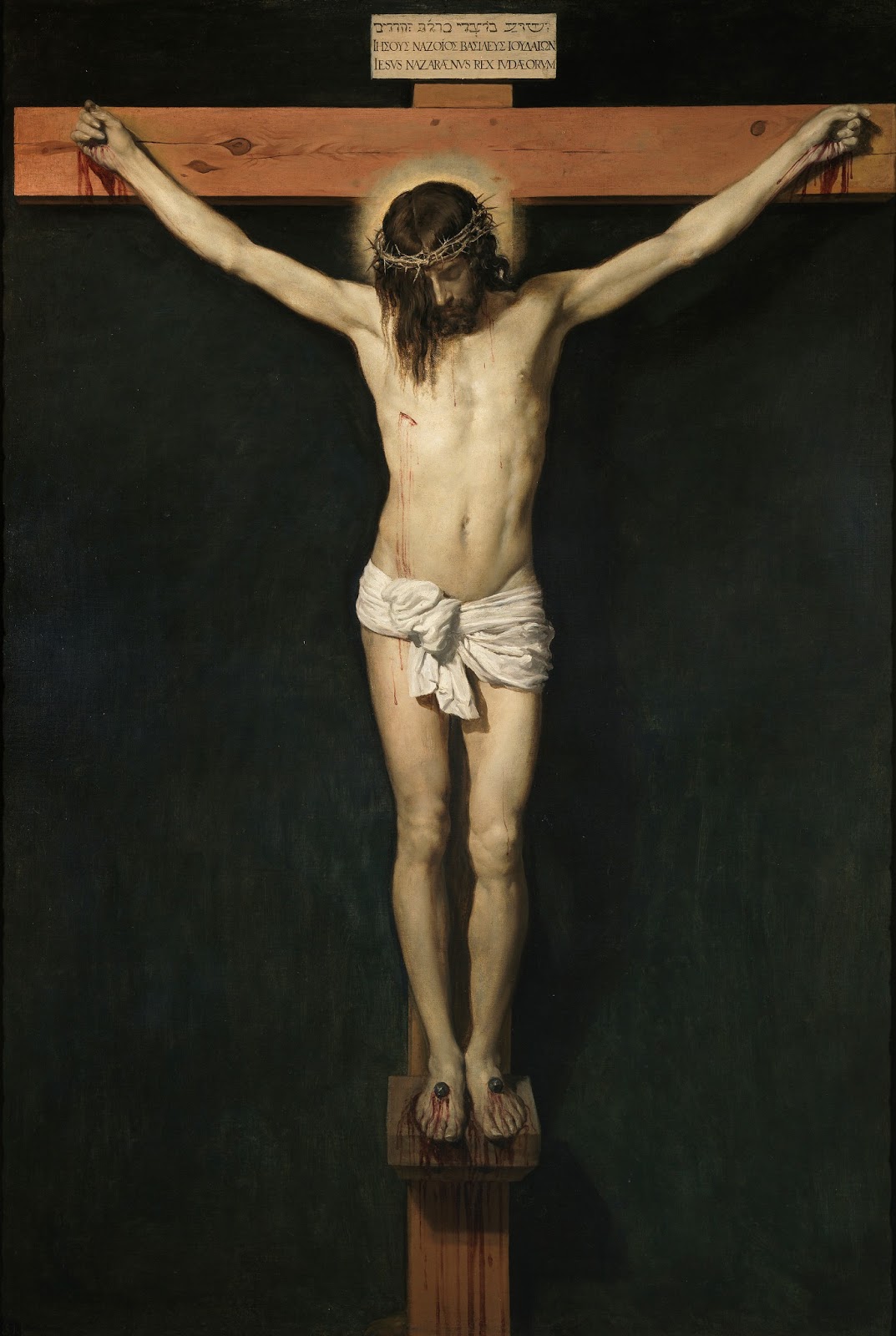
          In being raised upon the Cross, our Lord is not dying the death of a common criminal, but rather reigning in glory – the glory of God’s free love given to restore humanity, to have new life in him. His hands and feet and side are pierced, as wounds of love, to pour out God’s healing life upon the world. In his obedience to the Father’s will, he puts to an end the disobedience of humanity's first parent. Here mankind who fell because of a tree are raised to new life in Christ through his hanging on the tree.  Christ is a willing victim, the Lamb of God who takes away the sins of the world, the Silent lamb led to his slaughter, the Good Shepherd who lays down his life for his sheep that have gone astray. At the time when the Passover lambs are slaughtered in the temple, upon the Altar of the Cross, Christ as both priest and victim offers himself as the true lamb to take away the sins of the whole world, offers his death so that we may have life, new life in Him.
          Death and hell, the reward of sin, have no power over us: for in dying, and being laid in a stranger’s tomb, Christ will go down to Hell, to break down its doors, to lead souls to heaven, to alter the nature of the afterlife, once and for all. Just when the devil thinks he’s won, then in his weakness and in his silence Christ overcomes the world, the flesh, and the devil. The burden of sin which separates humanity from God is carried on the wood of the Cross.
On the way to Calvary our Lord falls three times such is the way, such was the burden, so we too as Christians, despite being reconciled to God by the Cross, will fall on our road too. We will continue to sin, but also we will continue to ask God for his love and mercy. But those arms which were opened on the cross will always continue to embrace the world with God's love.
We don’t deserve it, that’s the point, but it is there to help us become the people God wants us to be: to be strengthened, fed, healed, and restored by him: to die to sin and be raised to new life, and to share that life and love with others, that the world might believe and be saved through him. Christ pays the debt which we cannot to reconcile humanity to his loving and merciful Father. He shows us the meaning of true love: that we might live it out in our lives, forgiving one another, bearing our own cross, and living lives of love for love of him who died for love of us.
          We should glory in the Cross of our Lord Jesus Christ, for he is our salvation, our life, and our resurrection, through him we are saved and made free.

Thursday, 28 March 2013

Feria V in Cena Domini - The Mass of the Lord's Supper: Exod. 12:1-8; ICor 11:23-26; Jn 13:1-15


Since our Divine Lord came to die, it was fitting that there be a Memorial of his death. Since he was God, as well a man, and since he never spoke of his death without speaking of his Resurrection, should he not himself institute the precise memorial of his own death? And this is exactly what he did the night of the Last Supper....His memorial was instituted, not because he would die and be buried, but because he would live again after the Resurrection. His Memorial would be the fulfillment of the Law and the prophets; it would be one in which there would be a Lamb sacrificed to commemorate spiritual freedom; above all it would be a Memorial of a New Covenant...a Testament between God and man.
Fulton J. Sheen Life of Christ
My brothers and sisters, we have come together on this most holy night to enter into the Mystery of Our Lord’s Passion: to be with him in the Upper Room and in the garden of Gethsemane, and to prepare to celebrate his suffering and death – to behold the glory of the Lord and his love for the world he created and came to save.
          Obedient to the Old Covenant, Our Lord and his disciples prepare to celebrate the Passover: the mystery of Israel’s deliverance from slavery in Egypt to the new life in the Promised Land. While they are at table Our Lord lays aside his outer garments and takes a basin and a towel and washes the Apostles’ feet. He then says to them ‘Do you understand what I have done to you? You call me Teacher and Lord, and you are right, for so I am. If I then, your Lord and Teacher, have washed your feet, you also ought to wash one another's feet. For I have given you an example, that you also should do just as I have done to you. Truly, truly, I say to you, a servant is not greater than his master, nor is a messenger greater than the one who sent him. If you know these things, blessed are you if you do them.’ (Jn 13:12–16 ESV) God who created the universe and who will redeem it kneels and washes the feet of sinful humanity. This is true love in action. Only having done this can Jesus say ‘A new commandment I give to you, that you love one another: just as I have loved you, you also are to love one another. By this all people will know that you are my disciples, if you have love for one another.’(Jn 13:34–35 ESV) What he says to his disciples he says to us here tonight. As Christians we are to love him and one another, we are to show this love in all that we say, or think, or do, so that the world may believe.
          Christ then takes bread and wine and blesses them and gives them to his disciples. Again, this would look and feel like the Passover celebration to which they were accustomed. Except that before he broke and distributed the bread he said ‘Take, Eat. This is my body, which is given for you. Do this in remembrance of me.’ And before the Cup was distributed he said ‘Drink of it, all of you, for this is my blood of the new covenant, which is poured out for many for the forgiveness of sins. Do this, as often as you drink it, in remembrance of me.’ He feeds his disciples with his own body and blood to strengthen them, to show them what he is about to do for love of them and of the whole world. When, earlier in his public ministry, he has fed people he taught them in the synagogue at Capernaum ‘Truly, truly, I say to you, unless you eat the flesh of the Son of Man and drink his blood, you have no life in you. Whoever feeds on my flesh and drinks my blood has eternal life, and I will raise him up on the last day. For my flesh is true food, and my blood is true drink.  Whoever feeds on my flesh and drinks my blood abides in me, and I in him. As the living Father sent me, and I live because of the Father, so whoever feeds on me, he also will live because of me.’ (Jn 6:52–7 ESV). ‘Was ever another command so obeyed? For century after century, spreading slowly to every continent and country and among every race on earth, this action has been done, in every conceivable human circumstance, for every conceivable human need from infancy and before it to extreme old age and after it, ....  just to make the plebs sancta Dei—the holy common people of God’ [Dix The Shape of the Liturgy 744] Our Lord institutes the Eucharist, the Sacrament of His Body and Blood, to feed us, to nourish us, so that we may become what he is, that we may have a foretaste of heaven and the divine life of love, of the beatific vision of God, Father, Son, and Holy Spirit, the Holy, Eternal and Consubstantial Trinity. It re-presents, it makes present again, here and now, the sacrifice of Calvary, where upon the Altar of the Cross, as both priest and victim, Christ sacrifices himself for the sins of the whole world. He is the Lamb of God, foreshadowed in the ram offered by Abraham and Isaac, in the bread and wine offered by Melchisedek. In the blood and water which will flow from his side we are washed and creation is renewed. Christ gives the Church the Eucharist so that his saving work may continue, so that people may be given a pledge and token of their eternal life in him.
          Christ sets apart his disciples so that they may be priests of the new covenant in his blood, so that they may continue to share in the offering of himself for their sins and those of the whole world. They are washed, and fed, and taught – prepared for the work of the Gospel: spreading the Good News of Jesus Christ and feeding his faithful with his body and blood. They are told to do this and they still do. Never have such words and actions had such a profound effect in all of human history. This is the glory of God: in transforming bread and wine into his very self for the life of the whole world – a sign of love and a pledge and foretaste of eternal life. This is love that we can touch and feel and taste – given for us so that we might have life in him.
So let us come to him, to be fed by Him, and with Him, healed and restored by Him, through the sacraments of the Church, his body, so that we may be prepared to share in his Passion and Death and to celebrate with joy the triumph of His Paschal victory, so that we and all the earth may give praise to God the Father, God the Son, and God the Holy Spirit, to whom be ascribed as is most right and just, all might, majesty, glory dominion and power, now and forever

Wednesday, 27 March 2013

Catechetical Easter Homily ascribed to John Chrysostom [PG 59:721-4]

Εἴ τις εὐσεβὴς καὶ φιλόθεος, ἀπολαυέτω τῆς καλῆς ταύτης πανηγύρεως· εἴ τις δοῦλος εὐγνώμων, εἰσελθέτω χαίρων εἰς τὴν χαρὰν τοῦ Κυρίου αὐτοῦ· εἴ τις ἔκαμενηστεύων, ἀπολαβέτω νῦν τὸ δηνάριον· εἴ τις ἀπὸ πρώτης ὥρας εἰργάσατο, δεχέσθω σήμερον τὸ δίκαιον ὄφλημα· εἴ τις μετὰ τὴν τρίτην ἦλθεν, εὐχαριστῶν ἑορτάσῃ· εἴ τις μετὰ τὴν ἕκτην ἔφθασε, μηδὲν ἀμφιβαλλέτω· καὶ γὰρ οὐδὲν ζημιοῦται· εἴ τις ὑστέρησεν εἰς τὴν ἐννάτην, προσελθέτω μηδὲν ἐνδοιάζων· εἴ τις εἰς μόνην ἔφθασε τὴν ἑνδεκάτην, μὴ φοβηθῇ τὴν βραδυτῆτα. Φιλότιμος γὰρ ὢν ὁ Δεσπότης δέχεται τὸν ἔσχατον, καθάπερ καὶ τὸν πρῶτον· ἀναπαύει τὸν τῆς ἑνδεκάτης,ὡς τὸν ἐργασάμενον ἀπὸ τῆς πρώτης· καὶ τὸν ὕστερον ἐλεεῖ, καὶ τὸν πρῶτον θεραπεύει· κἀκείνῳ δίδωσι, καὶ τούτῳ χαρίζεται. Καὶ τὴν πρᾶξιν τιμᾷ, καὶ τὴν πρόθεσιν ἐπαινεῖ. Οὐκοῦν εἰσέλθητε πάντες εἰς τὴν χαρὰν τοῦ Κυρίου ἡμῶν, καὶ πρῶτοι καὶ δεύτεροι τὸν μισθὸν ἀπολάβετε, πλούσιοι καὶ πένητες μετὰ ἀλλήλων χορεύσατε, ἐγκρατεῖς καὶ ῥᾴθυμοι τὴν ἡμέραν τιμήσατε, νηστεύσαντες καὶ μὴ νηστεύσαντες εὐφράνθητε σήμερον. Ἡ τράπεζα γέμει, τρυφήσατε πάντες· ὁ μόσχος πολὺς, μηδεὶς ἐξέλθοι πεινῶν. Πάντες ἀπολαύσατε τοῦ πλούτου τῆς χρηστότητος. Μηδεὶς θρηνείτω πενίαν· ἐφάνη γὰρ ἡ κοινὴ βασιλεία· μηδεὶς ὀδυρέσθω τὰ πταίσματα· συγγνώμη γὰρ ἐκ τοῦ τάφου ἀνέτειλε· μηδεὶς φοβείσθω τὸν θάνατον· ἠλευθέρωσε γὰρ ἡμᾶς ὁ τοῦ Σωτῆρος θάνατος· ἔσβεσεν αὐτὸν ὑπ' αὐτοῦ κατεχόμενος· ἐκόλασε τὸν ᾅδην κατελθὼν εἰς τὸν ᾅδην· ἐπίκρανεν αὐτὸν γευσάμενον τῆς σαρκὸς αὐτοῦ. Καὶ τοῦτο προλαβὼν Ἡσαΐας ἐβόησεν· Ὁ ᾅδης, φησὶν, ἐπικράνθη. Συναντήσας σοι κάτω ἐπικράνθη· καὶ γὰρ καθῃρέθη· ἐπικράνθη· καὶ γὰρ ἐνεπαίχθη. Ἔλαβε σῶμα, καὶ Θεῷ περιέτυχεν· ἔλαβε γῆν, καὶ συνήντησεν οὐρανῷ· ἔλαβεν ὅπερ ἔβλεπε, καὶ πέπτωκεν ὅθεν οὐκ ἔβλεπε. Ποῦ σου, θάνατε, τὸ κέντρον; ποῦ σου, ᾅδη, τὸ νῖκος; Ἀνέστη Χριστὸς, καὶ σὺ καταβέβλησαι· ἀνέστη Χριστὸς, καὶ πεπτώκασι δαίμονες· ἀνέστη Χριστὸς, καὶ χαίρουσιν ἄγγελοι· ἀνέστη Χριστὸς, καὶ νεκρὸς οὐδεὶς ἐπὶ μνήματος. Χριστὸς γὰρ ἐγερθεὶς ἐκ νεκρῶν, ἀπαρχὴ τῶν κεκοιμημένων ἐγένετο· αὐτῷ ἡ δόξα καὶ τὸ κράτος εἰς τοὺς αἰῶνας τῶν αἰώνων. Ἀμήν.  
If anyone is a devout lover of God, let them rejoice in this beautiful radiant feast. If anyone is a faithful servant, let them gladly enter into the joy of their Lord. If any are wearied with fasting, let them now reap their reward. If any have laboured since the first hour, let them receive today their just reward. If any have come after the third hour, let them celebrate the feast with thankfulness. If any have arrived after the sixth hour, let them not doubt, for they will sustain no loss. If any have delayed until the ninth hour, let them not hesitate but draw near. If any have arrived at the eleventh hour, let them not fear their lateness. For the Master is gracious and welcomes the last no less than the first. He gives rest to those who come at the eleventh hour just as kindly as those who have laboured since the first hour. The first he fills to overflowing: on the last he has compassion. To the one he grants his favour, to the other pardon. He does not look only at the work: he looks into the intention of the heart. Enter then, all of you, into the joy of your Master. First and Last, receive alike your reward. Rich and poor dance together. You who have fasted and you who have not, rejoice today. The table is fully laden: let all enjoy it. The fatted calf is served: let no-one go away hungry. Come all of you, share in the banquet of faith: draw on the wealth of his mercy. Let no-one lament their poverty; for the universal kingdom has been revealed. Let no-one weep for their sins; for the light of the forgiveness has risen from the grave. Let no-one fear death; for the death of the Saviour has set us free. He has destroyed death by undergoing hell. He has despoiled hell by descending into hell. Hell was filled with bitterness when it tasted his flesh, as Isaiah foretold: ‘Hell was filled with bitterness when it met you face-to-face below’ - filled with bitterness, for it was brought to nothing; filled with bitterness, for it was mocked; filled with bitterness, for it was overthrown; filled with bitterness, for it was destroyed; filled with bitterness, for it was put in chains. It received a body, and encountered God. It received earth, and confronted heaven. It received what it saw, and was overpowered by what it did not see. O death, where is your sting? O hell, where is your victory? Christ is risen, and the demons are fallen. Christ is risen, and the angels rejoice. Christ is risen, and life reigns in freedom. Christ is risen, and the grave is emptied of the dead. For Christ being raised from the dead has become the first-fruits of those who sleep. To him be glory and dominion to the ages of ages. Amen.

Wednesday in Holy Week Isa 50:4–9; Mt 26:14–25

Our Lord described himself as having a baptism wherewith he was to be baptized. John gave him the baptism of water, but the Roman soldiers have him his baptism of blood. After opening his sacred flesh with violent stripes, they now put on him a purple robe which adhered to his bleeding body. Then they plaited a crown of thorns which they placed on his head. They mocked him and put a rod in his hand after beating him on the head. Then they knelt down before him in feigned adoration.
Fulton J. Sheen Life of Christ

In today’s first reading we hear ‘I gave my back to those who strike, and my cheeks to those who pull out the beard; I hid not my face from disgrace and spitting.’ (Isa 50:6 ESV) The suffering servant’s treatment points forward to Our Lord’s mistreatment at the hands of Roman soldiers and the crowd on his way to Calvary. It is brutal and unpleasant, even more so when we consider that He had preached and lived God’s love and healing and forgiveness. We see God incarnate mocked and physically abused by those he came to save. Nowadays the Church, certainly in this land, faces less scorn, hatred, and violence than elsewhere, but far more indifference, which is worse in many ways. People have grown cold to the message of love, and prefer to ignore it, safely cosseted in a cocoon of materialism, obsessed with self – spiritually empty and miserable.
          In the Gospel we see Judas is still concerned with material things, having criticised the reckless generosity of Mary’s anointing Jesus’ feet, he now goes to the chief priests and asks them ‘What will you give me if I deliver him over to you?’ (Mt 26:15 ESV). These are words for the church: we still have modern-day Judases willing to betray our Lord, his Gospel and his Church for the sake of ambition and advancement. Perhaps a pointy hat is today’s thirty pieces of silver, and too many in the church follow Judas in preferring the ways of the world to those of God. But we must follow Our Lord’s example and love them. This is after all what we are preparing to celebrate: the fact that the love of God can be ignored and rejected but never overcome – in Christ the victory of the Cross is complete and absolute, it restores our relationship with God and each other and allows us to live in a community of love, close to God, fed by him, with him, healed and restored by him, prepared for and given the hope of heaven where we may enjoy eternity in the presence of the Trinity.
          In Christ we see a life lived not for self, not to acquire wealth, or status, or power, but lived for others – to share with them the love of God, to heal and restore them – offering them an alternative to the ways of the world with its selfishness, its greed, the desire for power and domination. Instead, he offers humble service and power shown in weakness – this is the power of God to transform the world. This is what the Church is called to follow and live out in the world – a life of self-giving, sacrificial love – this is what we are called to in our baptism, that we may embody and live out the faith which we profess to help transform the world. We need to be reminded of it, day by day and year by year because the Church has to remain true to her calling to help share the love of God with the world around us, so that it may believe and be transformed after the likeness of our crucified and risen Saviour. After nearly two thousand years we have not got there yet, but we still press on, changing the world one soul at a time, confident in the victory and the saving love of him who died and rose again for us.
 So let us come to him, to be fed by Him, and with Him, healed and restored by Him, through the sacraments of the Church, his body, so that we may be prepared to celebrate with joy the triumph of His Paschal victory, so that we and all the earth may give praise to God the Father, God the Son, and God the Holy Spirit, to whom be ascribed as is most right and just, all might, majesty, glory dominion and power, now and forever

Tuesday, 26 March 2013

Tuesday in Holy Week Isa 49:1–9; Jn 13:21–38

Every unhappy soul in the world has a cross embedded in it. The cross was never meant to be on the inside, but only on the outside. When the Israelites were bitten by the serpents, and the poison seeped within, Moses planted a brazen serpent on a stick and all who looked on it were healed.... So the Son of Man came in the likeness of man, but was without sin, and all who look upon him on his cross are saved. In like manner, the inner cross disappears when one catches a vision of the great outer Cross on Calvary.
Fulton J. Sheen Peace of Soul

The last twelve months have seen plenty of glory in the media and the world around us: we’ve had triumphs in the Tour de France, the Olympic Games, even Swansea City have won a cup! There has been much in human endeavour to celebrate, but when we turn to today’s Gospel we hear Our Lord speaking: ‘Now is the Son of Man glorified, and God is glorified in him. If God is glorified in him, God will also glorify him in himself and glorify him at once.’ These words are spoken by Our Lord just after Judas has left to go and betray him. It’s a pretty funny idea of glory, certainly compared to how the world understands glory. As the servant spoken of by the prophet Isaiah in today’s first reading, his mouth is like a sharp sword, he is made a polished arrow, with a sharpness that can cut through the indifference and ignorance of the world. He is the light of the nations, a light which the darkness cannot overcome, which shines so that God’s salvation may reach to the end of the earth. The Church has its part to play in helping this to come about, but the work is Christ’s: he is the way, the truth, and the life.
The glory of which Christ speaks is that of his Passion and Death. Unlike the bronze serpent which cured the Israelites, Jesus will be lifted up to save all humanity, to restore their relationship with God and each other, to give them eternal life. Worldly glory, like the shouts of joy on Palm Sunday, is a passing thing. True glory, the glory of God, who is the source of all glory, is something quite different. In the Prologue to John’s Gospel, read on Christmas day, we hear ‘And the Word became flesh and dwelt among us, and we have seen his glory, glory as of the only Son from the Father, full of grace and truth.’ (Jn 1:14 ESV) We behold God’s glory in Christ not just in his Incarnation, but most fully in his Passion, and Death, and Resurrection.
Today’s gospel has Our Lord at Supper with his disciples. He gives the morsel to Judas: a sign of honour, a sign of love which defies our understanding. It ends with a sign that to follow Jesus is to carry our own cross and go to Calvary. It’s quite stark, quite uncompromising, and quite true. The Church is called to imitate the mystery which it celebrates: it is costly and difficult. To follow Christ means to go to the Cross, because only here can we see the depth of God’s love for us.
Here we see love: true, unconstrained, given regardless of the cost. Only through such free love can the wounds of the world be healed: this is the balm in Gilead to heal the sin-sick soul. This is true glory: the glory of God’s reconciling and healing love poured out on the world as it flows like blood and water from his stricken side. So let us come to him, to be fed by Him, and with Him, healed and restored by Him, through the sacraments of the Church, his body, so that we may be prepared to celebrate with joy the triumph of His Paschal victory, so that we and all the earth may give praise to God the Father, God the Son, and God the Holy Spirit, to whom be ascribed as is most right and just, all might, majesty, glory dominion and power, now and forever

Monday, 25 March 2013

Monday in Holy Week - Isa 42:17; Jn 12:1-11


Many a cross we bear is of our own manufacture; we made it by our sins. But the cross which the Saviour carried was not his but ours. One beam in contradiction to another beam was the symbol of our will in contradiction to his own. To the women who met him on the roadway, he said: ‘Weep not for me.’ To shed tears for the dying Saviour is to lament the remedy; it were wiser to lament the sin that caused it. If Innocence itself took a Cross, then how shall we who are guilty complain against it?
Fulton J. Sheen The World’s First Love

The Suffering Servant spoken of by the prophet Isaiah in today’s first reading has always been understood by the Church as a prophesy which points to and finds its fulfillment in Jesus Christ. He is the chosen one in whom God delights, filled with his Spirit, who will bring forth God’s justice to the nations. We must always remember that God’s idea of justice is not ours. If it were, we would not be preparing to celebrate the Passion, Death, and Resurrection of Jesus, only the condemnation of sinful humanity – there could be no such thing as hope.
                Christ, then, is a light to the nations, who will open the eyes of the blind, and free captives from prison, they will be freed from darkness by the light of the World. He frees humanity from the prison of sin, setting us free to have life in all its fullness. He is given as a new covenant in his blood to restore the relationship between humanity and God. In what he is and does we will see God’s Glory: the glory of love and absolute gift: extravagant, risky, costly.
                Those people who are forever saying that the Church must sell all its gold and silver need to remember that when they say this they are speaking the words of Judas Iscariot, who betrayed Our Lord and Saviour. The care of the poor and the needy is and will always be an important part of the Church, but social justice is not the whole of the Gospel. The Church wears beautiful vestments and uses precious metal because what it is and does is important: we wouldn’t ask people to wear wooden or ceramic wedding rings, after all. No, in today’s Gospel we see a picture of risky and costly generosity in the love and care which Mary shows for Jesus, her Lord and Saviour, which reinforces what Jesus will do for the world on Good Friday: it is the most costly and extravagant gesture there could be, which costs something which money cannot buy, and for the sake of you, and me, and all humanity! In this version of justice the judge sentences himself the death penalty instead of condemned humanity, so that we might be free.
                In taking the risk to defy convention, to be costly, risky and extravagant, not caring what the world thinks, putting aside the mundane concerns of Judas, Mary shows what it is to love and follow Jesus. She responds to the source of all love and generosity by preparing Him for his death and burial. She anticipates the act of generous love and shows the Church how it too should take risks and be extravagant in its service of Our Lord and Saviour, so that we too may share in his work of reconciling and healing humanity, anointing it with the love of God.
                The religious authorities are troubled by what has gone on: they see people following Jesus as a threat to their own power and control and they want to stop this at all costs. They stand for fear and hatred and dominance, as opposed to the freedom, and love, and new life of the Gospel. They cannot put a stop to the movement: the more they persecute the stronger it becomes because it trusts in the God who loves and who saves. It is a lesson which the repressive regimes of this world have yet to learn in the past two thousand years. It is a light which cannot be extinguished, a love which casts out fear whereby we are freed to serve the God who loves us and saves us.
Let us rejoice in this as we are fed by Word and Sacrament, strengthened to live God’s life in the world, proclaiming his truth and his victory, so that all humanity may believe and praise God the Father, God the Son, and God the Holy Spirit, to whom be ascribed as is most right and just, all might, majesty, glory dominion and power, now and forever

Saturday, 23 March 2013

Homily for Palm Sunday 2013

If anyone asks you why you are untying it [the ass the disciples were sent to find], this must be your answer, ‘The Lord has need of it’ (Lk 19:31). Perhaps no greater paradox was ever written than this – on the one hand the sovereignty of the Lord, and on the other hand his ‘need’. His combination of Divinity and dependence, of possession and poverty was a consequence of the Word becoming flesh. Truly, he who was rich became poor for our sakes, that we might become rich. Our Lord borrowed a boat from a fisherman from which to preach; he borrowed barley loaves and fishes from a boy to feed a multitude; he borrowed a grave from which he would rise; and now he borrows an ass on which to enter Jerusalem. Sometimes God preempts and requisitions the things of man, as if to remind him that everything is a gift from him.
Fulton J. Sheen Life of Christ

Pomp and ceremony seem to have been at the top of the agenda of late: in a week which saw the inaugural Mass of Pope Francis and the Installation of Justin Welby as Archbishop of Canterbury, this is hardly surprising. As triumphant entries go, the one we see in the Gospel this morning is a bit strange: generally speaking, we are used to kings riding on horses, looking like powerful military leaders. Here we see something different, something which defies our expectations and which stops us seeing things in purely human terms.
          There are people who would ask, why all this fuss? Would Jesus have wanted it, would he want us to be carry on with it? If it were something which would not want us to do he would have said so. He did it because it was important, because it fulfilled prophesy and because liturgy is an important thing in and of itself: it marks out various things as special and helps us understand both who and what we are and what we do – it forms both habit and indeed our moral character.
          The crowd cry out “Hosanna to the Son of David! Blessed is he who comes in the name of the Lord! Hosanna in the highest!” (Mt 21:9 ESV) They cry out for God to save them, and that is exactly what he will do in a few days time, upon the Cross. This is a God who keeps his promises and defies our expectations. The crowd are expecting a king of the Davidic line, which would be seen as a challenge to the ruling elite, the status quo, but in Christ God gives Israel a King of the line of David forever. Those with power are threatened by him: he is awkward, an inconvenience. Jesus does not want their power, as he has come to be and do something completely different: what is taken as a political coup is a renewal of religion, the fulfilment of prophesy, and a new hope for Israel.  
In riding into Jerusalem Jesus is fulfilling the prophesies of Zechariah (9:9) and Isaiah (62:11).  The King of Israel comes riding on a donkey: a humble beast of burden, which carried his Mother to Bethlehem for his birth. It is an act of humble leadership which fulfils what was foreseen by the prophets. It shows us that Jesus Christ is truly the one who fulfils the hopes of Israel. The Hebrew Scriptures look forward to the deliverance of Israel, which is enacted in front of their very eyes.
Today and in the coming week we will see what God’s Love and Glory are really like: it is not what people expect, it is power shown in humility, strength in weakness. As we continue our Lenten journey in the triumph of this day and looking towards the Cross and beyond to the new life of Easter, let us trust in the Lord, let us be like him, and may he transform our hearts, our minds and our lives, so that they may have live and life in all its fullness. We are fed by the word of God and by the sacrament of His Body and Blood to be strengthened, to share in His divine life, to fit us for Heaven, and to transform all of creation that it may resound his praise and share in his life of the Resurrection, washed in His Blood and the saving waters of Baptism: forgiven and forgiving so that all that we say, or think, or do, all that we are may be for the praise of God the Father, God the Son, and God the Holy Spirit, to whom be ascribed as is most right and just, all might, majesty, glory dominion and power, now and forever

A Prayer for the Day

Almighty everlasting Father, who hast promised unto thy faithful people life by thine incarnate Son, even as he liveth by thee; Grant unto us all, and especially to those whom thy Providence hath in anyway entrusted with the treasure of thy holy doctrine amongst us, thy good Spirit, always so to believe and understand, to feel and firmly to hold, to speak and think, concerning the mystery of the Communion of the Body and Blood of thy dear Son, as shall be well pleasing to thee, and profitable to our souls; through the same our Lord Jesus Christ, who liveth and reigneth with thee in the unity of the same Spirit, one God, world without end. Amen

John Keble

Sunday, 17 March 2013

Thought for the Day: The Vineyard of Souls


Love has three and only three intimacies: speech, vision, and touch. These three intimacies God has chosen to make his love intelligible to our poor hearts. God has spoken: he told us that he loves us: that is revelation. God has been seen: that is the incarnation. God has touched us by his grace: that is redemption. Well indeed, therefore, may he say: ‘What more could I do for my vineyard than I have done? What other proof could I give my love than to exhaust myself in the intimacies of love? What else could I do to show that my own Sacred Heart is not less generous than your own?’
                If we answer these questions aright, then we will begin to repay love with love .... then we will return speech with speech which will be our prayer; vision with vision which will be our faith; touch with touch which will be our communion.
Fulton J Sheen The Eternal Galilean