Showing posts with label Christian Unity. Show all posts

Sunday, 26 January 2020

3rd Sunday of Year A

There are divisions in the Church. Sadly, there have been divisions since the earliest days of Christianity, as is made clear by the opening of St Paul’s First Letter to the Corinthians. But just because something has gone on for a long time doesn’t make it right. Quite the opposite! For the last seven days Christians around the world have been praying for unity, to heal the divisions which so mar the Body of Christ, the Church. And while it is good to focus our prayers on unity for a week, I would venture to suggest that the unity of Christians is something which we should all be praying for all the time. It is shocking that the tribalism which St Paul condemns in the first century, is still alive and well today. People are still defining themselves as one sort of Christian as opposed to another, or by the place where they worship. Our culpability in this is something for which we need to repent. We need to turn away from division, and to turn back to the God of love, who longs to heal our wounds and divisions; fostering unity is following the will of God. 

This morning’s Gospel begins with the news that John the Baptist has been arrested. His criticism of the immorality of the ruling family had upset the powers that be. Calling out Herod Antipas for divorcing his wife, and then breaking Jewish law by marrying his brother Philip’s wife, seems the right thing to do. We expect our rulers to set an example. It’s only right and proper. The church continues this prophetic vocation, calling out what is evil and wrong. This may, and will, indeed make people uncomfortable: That’s the point! No one likes having their wrongdoing pointed out, I know I don’t! But unless someone does, then we’re unlikely to change our ways. 

In the Gospel, Jesus has just been in the desert for forty days, praying, fasting, being tempted by the Devil. He begins his public ministry by leaving Nazareth, the town where He grew up, and walking to Capernaum by the shore of the Sea of Galilee. It is a day’s journey. This is an important place for Jesus to start His public ministry, because it fulfils a prophecy in Isaiah, which St Matthew quotes, ‘The land of Zebulun and the land of Naphtali, the way of the sea, beyond the Jordan, Galilee of the Gentiles— the people dwelling in darkness have seen a great light, and for those dwelling in the region and shadow of death, on them a light has dawned.’ (Mt 4:15-16 ESV) This part of Israel is where people were first taken off into captivity by the Assyrians, seven hundred years before. So Our Lord’s restoration of Israel starts in the place where the Northern Kingdom first began to fall apart. 

Strikingly, Jesus begins His proclamation of the Good news of the Kingdom by repeating the exact words of His Cousin, John the Baptist: ‘Repent, for the kingdom of heaven is at hand’. Their message is the same: turn away from your sins and turn back to God, turn back to the God who loves you, and who longs to heal you. These are words of hope for the future, for restoration. This is a message which we all long to hear. 

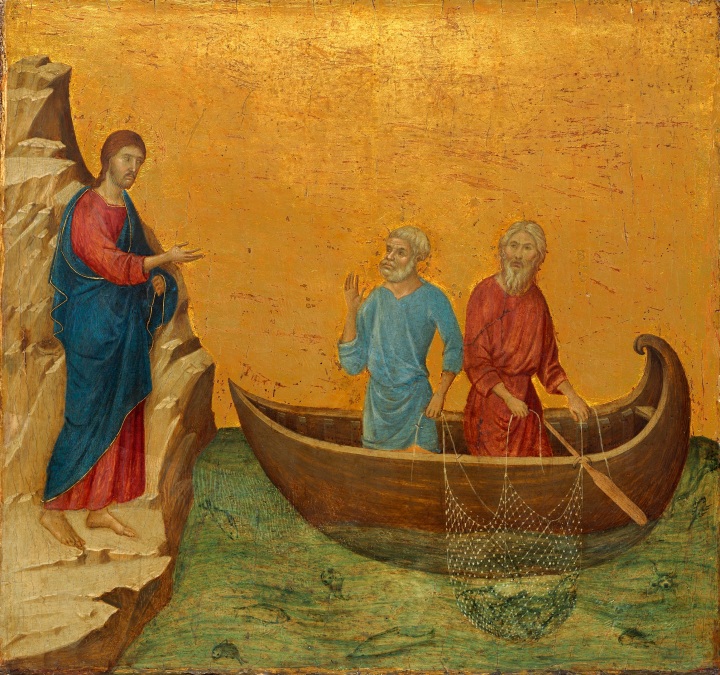
When Jesus sees two fishermen, Simon Peter and his brother, Andrew casting their nets,  and invites them to ‘Follow me, and I will make you fishers of men.’ It is quite a simple and straightforward invitation. On hearing Jesus’ words they drop everything and follow Him. Immediately! They don’t stop to put their affairs in order, or to say goodbye. A little later, James and John do the same, leaving Zebedee, their father, behind in the boat. Nothing is more important than following Jesus, but these early disciples show us that following God has a cost. It transforms our lives, totally, but not without cost. 

So what does Jesus do with this band of disciples? He takes them into synagogues, where He teaches and interprets the Jewish Scriptures, the Old Testament. Jesus proclaims the Good News of the Kingdom, that we are loved by God. He demonstrates this love in practice by healing the sick. God’s kingdom is a place where wounds are healed, where people are restored to wholeness, in mind, body and soul. There is a cost to following God, but here we see the reward of the Kingdom. Each and every one of us needs that healing and wholeness, which only God can provide. The Church continues to proclaim repentance from sin, belief in the Kingdom of God, and participates in the healing power of God. 

These things begin with us, here, today. We hear the Kingdom proclaimed, we confess our faith together, we pray for the Church and the World, and we join in the banquet of the Kingdom. The source and summit of the Christian life is the Eucharist, where Christ feeds and heals us with His Body and Blood. God’s love is a reality, with the power to transform us and our world, if we have the humility to let God be at work in our lives. He does not force Himself upon us like a tyrant, but rather gives us the free will to choose to turn to Him. 

God also wills that the Church be united, as Jesus prays in Gethsemane, ‘I do not pray for these only, but also for those who believe in me through their word, that they may all be one; even as thou, Father, art in me, and I in thee, that they also may be in us, so that the world may believe that thou hast sent me.’ (Jn 17:20-21 RSVCE) May we pray and work so that Our Lord’s will is a reality and that the world may believe and give glory to God the Father, God the Son, and God the Holy Spirit, to whom be ascribed as is most right and just, all might, majesty, glory, dominion, and power, now, and forever. Amen.
Duccio_di_Buoninsegna_036.jpg

3rd Sunday of Year A

There are divisions in the Church. Sadly, there have been divisions since the earliest days of Christianity, as is made clear by the opening of St Paul’s First Letter to the Corinthians. But just because something has gone on for a long time doesn’t make it right. Quite the opposite! For the last seven days Christians around the world have been praying for unity, to heal the divisions which so mar the Body of Christ, the Church. And while it is good to focus our prayers on unity for a week, I would venture to suggest that the unity of Christians is something which we should all be praying for all the time. It is shocking that the tribalism which St Paul condemns in the first century, is still alive and well today. People are still defining themselves as one sort of Christian as opposed to another, or by the place where they worship. Our culpability in this is something for which we need to repent. We need to turn away from division, and to turn back to the God of love, who longs to heal our wounds and divisions; fostering unity is following the will of God. 

This morning’s Gospel begins with the news that John the Baptist has been arrested. His criticism of the immorality of the ruling family had upset the powers that be. Calling out Herod Antipas for divorcing his wife, and then breaking Jewish law by marrying his brother Philip’s wife, seems the right thing to do. We expect our rulers to set an example. It’s only right and proper. The church continues this prophetic vocation, calling out what is evil and wrong. This may, and will, indeed make people uncomfortable: That’s the point! No one likes having their wrongdoing pointed out, I know I don’t! But unless someone does, then we’re unlikely to change our ways. 

In the Gospel, Jesus has just been in the desert for forty days, praying, fasting, being tempted by the Devil. He begins his public ministry by leaving Nazareth, the town where He grew up, and walking to Capernaum by the shore of the Sea of Galilee. It is a day’s journey. This is an important place for Jesus to start His public ministry, because it fulfils a prophecy in Isaiah, which St Matthew quotes, ‘The land of Zebulun and the land of Naphtali, the way of the sea, beyond the Jordan, Galilee of the Gentiles— the people dwelling in darkness have seen a great light, and for those dwelling in the region and shadow of death, on them a light has dawned.’ (Mt 4:15-16 ESV) This part of Israel is where people were first taken off into captivity by the Assyrians, seven hundred years before. So Our Lord’s restoration of Israel starts in the place where the Northern Kingdom first began to fall apart. 

Strikingly, Jesus begins His proclamation of the Good news of the Kingdom by repeating the exact words of His Cousin, John the Baptist: ‘Repent, for the kingdom of heaven is at hand’. Their message is the same: turn away from your sins and turn back to God, turn back to the God who loves you, and who longs to heal you. These are words of hope for the future, for restoration. This is a message which we all long to hear. 

When Jesus sees two fishermen, Simon Peter and his brother, Andrew casting their nets,  and invites them to ‘Follow me, and I will make you fishers of men.’ It is quite a simple and straightforward invitation. On hearing Jesus’ words they drop everything and follow Him. Immediately! They don’t stop to put their affairs in order, or to say goodbye. A little later, James and John do the same, leaving Zebedee, their father, behind in the boat. Nothing is more important than following Jesus, but these early disciples show us that following God has a cost. It transforms our lives, totally, but not without cost. 

So what does Jesus do with this band of disciples? He takes them into synagogues, where He teaches and interprets the Jewish Scriptures, the Old Testament. Jesus proclaims the Good News of the Kingdom, that we are loved by God. He demonstrates this love in practice by healing the sick. God’s kingdom is a place where wounds are healed, where people are restored to wholeness, in mind, body and soul. There is a cost to following God, but here we see the reward of the Kingdom. Each and every one of us needs that healing and wholeness, which only God can provide. The Church continues to proclaim repentance from sin, belief in the Kingdom of God, and participates in the healing power of God. 

These things begin with us, here, today. We hear the Kingdom proclaimed, we confess our faith together, we pray for the Church and the World, and we join in the banquet of the Kingdom. The source and summit of the Christian life is the Eucharist, where Christ feeds and heals us with His Body and Blood. God’s love is a reality, with the power to transform us and our world, if we have the humility to let God be at work in our lives. He does not force Himself upon us like a tyrant, but rather gives us the free will to choose to turn to Him. 

God also wills that the Church be united, as Jesus prays in Gethsemane, ‘I do not pray for these only, but also for those who believe in me through their word, that they may all be one; even as thou, Father, art in me, and I in thee, that they also may be in us, so that the world may believe that thou hast sent me.’ (Jn 17:20-21 RSVCE) May we pray and work so that Our Lord’s will is a reality and that the world may believe and give glory to God the Father, God the Son, and God the Holy Spirit, to whom be ascribed as is most right and just, all might, majesty, glory, dominion, and power, now, and forever. Amen.

Duccio_di_Buoninsegna_036.jpg

Saturday, 3 June 2017

Pentecost 2017

The feast of Pentecost was well-known to Jews in Jesus’ time. Fifty days after the Passover, they celebrated God’s giving of the Law to Moses on Mt Sinai. It was an important feast as the Jews saw their whole life as tied up with the observance of God’s law. Jerusalem was full of people from all over the Mediterranean world who had come to celebrate this festival.

Although they are present in Jerusalem, the disciples have other things on their mind. Fifty days after our Lord’s death and resurrection, the disciples are carrying out Jesus’ instructions given just before his Ascension, to stay in Jerusalem and pray for the gift of the Holy Spirit. An amazing thing happens. Suddenly, men who were once afraid to leave a locked room get up and go out to tell people what God has done in his Son, Jesus Christ. They are inspired. They are on fire.  Filled with the love of God, they are able to go and share the Good News of the Kingdom.

At the Annunciation the angel Gabriel proclaims to Mary ‘The Holy Spirit will come upon you and the power of the Most High will overshadow you’ (Lk 1:35). Jesus Christ takes flesh in the womb of his mother by the power of the Holy Spirit. We are told that the Spirit hovers over him at his Baptism, like a dove. All His life and ministry is totally connected with God the Father in the power and union of the Holy Spirit. After Jesus’ Ascension God gives the Holy Spirit to the church. This is what we celebrate today!

In the Gospel passage we have heard today Jesus twice greets the apostles with the words ‘Peace be with you’. What he offers them is not simply an absence of noise or distraction but something far more wonderful. It is something we cannot fully understand though it is something which we can experience. Through Jesus’ death and resurrection we have peace with God and each other. The Kingdom of God is a Kingdom of love and peace. Jesus then gives the apostles a commission: ‘as the Father has sent me, so I send you’ (Jn 20:21). They are sent to proclaim the good news of the Kingdom in word and deed, laying down their lives in God’s service.

Jesus breathes on them, to empower them, that they may receive the Holy Spirit. Then Jesus tells them that whoever’s sins they forgive are forgiven. This is an extraordinary claim. But Jesus can make it because he is God. Through Him the church has become a place of healing, where we may be reconciled to God and to each other. Surely my brothers and sisters, this is is the most tremendous thing, a gift of a truly generous God.

The Jews in the Acts of the Apostles are amazed to hear the Good News in their own language, spoken by a rag-tag assortment of Galilean fisherman and other ordinary men. It is incredible. It is miraculous. And it points towards the present reality where there is not a country on this earth which has not heard the good news of Jesus Christ. But there is still work to do and it is wonderful to read that the Bible is currently being translated into 250 new languages.

Thus the work of proclamation is not finished. It is thanks to the preaching of the Good News started by the Apostles at Pentecost that we are Christians today, and that millions of people have come to know, love, and serve Jesus Christ. So, for those of us who are in Christ, who have entered the church through our Baptism, we have an important job to do. We need to tell people about Jesus.

The church is wonderful in its diversity, because we are all different, we don’t speak the same language, or have the same culture. We don’t look the same, we are not clones or robots. We are empowered through our having received the Holy Spirit at our Baptism, in our Confirmation, indeed through all the sacramental actions of the church; the outward and visible signs of the inward and spiritual grace. This is how the Holy Spirit works, how it builds us up in love. Through the sacrament of our Lord’s Body and Blood, the Eucharist, we are nourished spiritually to keep doing what God wants us to do.

Paul’s words to the believers in Corinth give us a vision of how the Holy Spirit unifies the Church. When we pray ‘Thy Kingdom come’ in the Lord’s Prayer every day we are praying for the Church and the world to be filled with God’s love through the Holy Spirit. That we might be drawn ever closer together, so that we may truly be one. This is Christ’s prayer for the Church in the Garden of Gethsemane in John 17. That the church should be one, united in love and in faith. It is God’s will. We cannot ignore it. We have to do all that we can to work towards it, and it is this desire for unity in the church which has seen an initiative ‘Thy Kingdom Come’ started by The Most Rev’d Justin Welby, the Archbishop of Canterbury, be taken up across the world, so that in the days from Ascension to Pentecost the church has prayed for the gift of the Holy Spirit to bring us closer together, in love and unity, to proclaim the good news, the people may come to know Jesus. It is the start of something great, where the church is renewed through the Holy Spirit, and it is something we can join in with. So let us pray:

Renew your wonders in this our day, as by a new Pentecost.

Grant to your Church that, being of one mind and steadfast in prayer with Mary, the Mother of Jesus, and following the lead of Blessed Peter, it may advance the reign of our Divine Saviour, the reign of truth and justice, the reign of love and peace. Amen.

Come Holy Spirit, in your power and might to renew the face of the earth.

Almighty God, your ascended Son has sent us into the world to preach the good news of your kingdom: inspire us with your Spirit and fill our hearts with the fire of your love, that all who hear your Word may be drawn to you, through Jesus Christ our Lord. Amen

pentecost_maronite_icon


Sunday, 15 March 2015

Lent IV - Looking to the Cross

For God sent his Son into the world not to condemn the world, but that through him the world might be saved.

It is far too easy nowadays to see the church in a negative way –  it’s the fashionable thing to do – as the church we’re corrupt, we’re filling people’s heads with nonsense. We can be characterised as strange, quaint, and out of touch. It suits people to see us entirely in negative terms: as opposed to certain things. We are prescriptive: we limit people's freedom, and in failing to practice what we preach, we can be written off as hypocrites, with no right to proclaim objective truth, to offer the world a moral framework, within which to live its life; to offer the world an alternative paradigm, a new way of living and of being through which to have life, and have life in all its fullness. It’s less a valid criticism and more of an excuse for people not to bother. It’s an easy way out, which saves people from the more difficult task of living Christ-like lives of love and self-sacrifice. The church does not claim to be perfect, but rather a collection of sinners justified by the grace of God, through faith in Christ.
          The simple truth is that people like to moan and grumble – we all do, and I’m as guilty of it as anyone, but there is a fundamental difference between being dissatisfied with the way things are and longing for change, and hopefully bringing about good change, change in a god-ward direction, and the corrosive moaning rooted in selfishness, which betrays a lack of trust in God. The Israelites in the desert represent this negative moaning, they are unable or unwilling to trust God to lead them on a journey towards the Promised Land, and while they realise their mistake their poisonous moaning has disastrous consequences for them. And yet even in this they are not abandoned by God, they gaze on the bronze serpent, they look to that which prefigures the Cross, through which God heals his people, taking their sins upon himself. That’s why it appears in stained-glass windows in churches, because it points to the Cross, it’s why when talking about the Cross Jesus mentions it, so that people might understand how and why God loves them and how it might affect their lives.
St Paul in his letter to the Ephesians can state with confidence, ‘For by grace you have been saved through faith, and this is not your own doing; it is the gift of God – not the result of works, so that no one may boast(Eph 2:8-9). It’s not about what we can do, but about what God can do for us. Our relationship with God is the result of a gift, which we can receive and which can transform our lives, if we only let go, and let God…
          This morning’s gospel reminds us of the fundamental truth that God loves us – it is the heart of the Good News – the Gospel, what we preach and what we live as Christians. There are few words as comforting as ‘For God so loved the world that he gave his only Son, so that everyone who believes in him may not perish but may have eternal life. ‘Indeed, God did not send the Son into the world to condemn the world, but in order that the world might be saved through him’ (Jn 3:16-17). They may be familiar to us, they certainly should be, but we must not let our familiarity with them cloud the significance of simply stating that God loves us, does not condemn us, but saves us, in and through Jesus Christ. That’s why we are Christians, it’s why we’re here, and recognising God’s love for us will have a transforming effect upon our lives.
In the Incarnation Jesus comes among us as a poor helpless baby, laid to rest in the rough wood of an animals’ feeding trough. He is cared for through the love of his mother, the Blessed Virgin Mary, who in her love, her service, and obedience, stands as the model for all Christians to follow. She is the first Christian, the greatest, a pattern for us to imitate, of loving trust and obedience, of care and costly love, and a foreshadowing of our great mother the church, through which we are saved by grace through faith.
          Upon the rough wood of the cross, Jesus will suffer and die for us – such is the cost of human sin. His mother, Mary, stands by and watches and weeps. As the church we too should watch and weep for the wounds of human sin and division which still scar Christ's body. We feel helpless. What can we do? We should do all that we can to live God's life of sacrificial self giving love: living lives of light, which shine in the darkness. It isn’t easy, but if we try and do it together then all things are possible, through him who loves us.
          The salvation and eternal life which Christ offers freely to all, comes through the church, which we enter in baptism, where we are nourished in word and are sacrament, where we are nourished, given food for the journey, strengthened and taught, to live his risen life, to share in the joys of Easter.
          God cares so much about the world and its people that he takes flesh, and lives a life of love, amidst the messiness of humanity, to show us how to live lives filled with love, life in all its fullness. God in Christ comes among us not to condemn the world but to offer it a way of being, of being truly alive in Him. God has made us for himself, and our hearts are restless until they find their rest in him. The spiritual needs and searching which characterise people in the world around us can be satisfied in God and in God alone, through the church. We can rejoice, and relax our Lenten discipline for a little while to give thanks for the wonderful gift of God's love in our lives, in the church, and for the world.
          But we also need to trust God, to listen to what he says through Scripture, to be fed by him, and to live lives in accordance with his will and purpose, together, as a family, as a community of love, cared for and supported by our mother, the church. And in so doing we look to Our Lady as Mother of Our Lord and Mother of the Church, as a pattern for love and obedience, as a model for all mothers: loving and tender, putting the needs of others before self, self-giving, sacrificial, and open to both joy and pain, trusting in God.

This, as any mother can tell you, is not easy, it's difficult, really hard, but its rewards are likewise great. So let us, as we continue our Lenten journey towards the cross, where God shows his love for us most fully and completely, giving his body to be broken and his blood be shed for us, a sacrifice which will be made present here today under the outward forms of bread and wine, to strengthen us to live the risen life of Easter, to offer the world an alternative to selfishness, to self-centredness, to the sin which continues to separate us from God, an alternative shown to us in a self-giving love of mothers, and of our mother the church. So that we may join the Angels in our song of love and praise to the Trinity: Father, Son, and Holy Spirit, to whom..

Sunday, 26 January 2014

Homily for Epiphany III Matthew 4:12-23


Epiphany III Mt 4:12-23
If you go to S. Paul’s Cathedral in London or the Chapel of Keble College, Oxford, you can see one of the most popular and reproduced works of Religious Art: Holman Hunt’s painting, The Light of the World. It shows our Lord and Saviour Jesus Christ standing at a door with a lantern. The door has no handle; it needs to be opened from the inside: Jesus may be the Light of the World, but he does not force himself upon us, we have to welcome Him into our hearts and our lives. His coming into the world which we celebrate at Christmas, which was made manifest to the world at Epiphany, was not the entry of a tyrant, forcing himself upon the world, but as a vulnerable and loving baby, entirely dependent upon the love and care of others, God comes among us. His coming is foretold by the prophet Isaiah, He is the light of the nations, and a cause of great joy: to be a Christian, to follow Christ is not be filled with the joy and love which comes from God, we can be serious, but should never be miserable, our vocation is to live out our faith, in love, and hope, and joy.

There is nothing worse than to see strife and division amongst Christians, as S. Paul found in Corinth: it has no place in the church, it isn’t what God intended for us, it’s not how things should be; it has to be resisted, wounds have to be healed, transgressions forgiven. It’s part of how we live out our faith in our lives. If we turn to the words of this morning’s Gospel we see Jesus saying, “Repent, for the kingdom of heaven is at hand.” To repent is to turn away from what separates us from God and each other, it is to turn to God in Christ, to be close to Him in Word and Sacrament, to be fed by Him, to be fed with Him, with His Body and Blood, so that we might share His divine nature, so that we might be given a foretaste of heaven, so that we may be strengthened to live out our faith in our lives, so that the world may believe – the Kingdom is close at hand, and Christ calls us, the baptised people of God, to share in the work of His kingdom. He asks that we follow Him, that we go where He goes, that we do what He does – it sounds easy enough, but it’s not, it’s something which we need to do together, and while I can help you to do it, I cannot without your help, your prayers, your love, and your support. As Christians we are inter-dependent, we rely upon each other.

We need to be like those first disciples who heard what Jesus said, who listened, and did what He told them, who were close to Jesus, so that our faith is a reality in our lives, strengthened and fed by Him who is the greatest medicine for our souls, who comes to us here, this morning in His Body and Blood, to heal us, to restore us and strengthen us to follow him, so that the world may believe and and sing the praise of God the Father, God the Son, and God the Holy Spirit, to whom be ascribed as is most right and just all might, majesty, glory, dominion, and power, now and forever.

Sunday, 27 October 2013

Sermon for Evensong Trinity XXII


War may be either a crusade or a curse: either a token of man’s love of God, or the fruit of man’s godlessness; either a sign that men are with God, or a token that they are against him
Fulton Sheen Whence come Wars? 1940: 1–2


There is something about martial or manly language when used in Christian context which is apparently politically incorrect these days. We have hymn-books which no longer allow the faithful to sing ‘Onward Christian Soldiers’ instead we are supposed to sing ‘Onward Christian Pilgrims’ and other such trite nonsense because well-meaning so-called ‘liberals’ tell us that we should. Despite their best intentions the Christian life is one of constant warfare: spiritual warfare against the powers of this world, and the Prince of Lies, Satan, who though utterly defeated on the Cross still wages a campaign against the Body of Christ. Our vocation, then, is to fight, armed in the way described by St Paul in his letter to the Ephesians (Eph. 6:11–17).
        In this evening’s second lesson we see St Paul giving advice to Timothy, the Bishop of Ephesus. He addresses him as ‘my child’ not only because he is younger but also because the Church is a family, which is one in Christ – we are a family which cuts across gender, race, class, and time. Timothy is strengthened ‘by the grace that is in Christ Jesus’ it is the only source of grace, and it alone can strengthen us, the Church, and her bishops. He is encouraged to pass on to others what he has heard from St Paul in the presence of many others – the teaching office of the Church is something public, to pass on the truth and to share it with others so that they too may pass it on. It is a serious task, one which is entrusted to me, and which I am to entrust to you. We are all part of the greater whole charged with the spreading of the Good News of Jesus Christ by thought and word and deed. It is a serious business, and not to be taken lightly. It is of the utmost importance, so that we all may stand strong in the faith, entrusted to the Church.
        It is something which will lead us to share in suffering – our sharing the Good News will lead us to share the suffering of Christ, we are to be conformed to Him, sharing his pain, his trials, for His sake. The world is always ready to persecute the Church because the message of the Gospel seeks to transform it, to turn away from the ways of selfishness and greed and sin, to establish a kingdom of love. All around the world our brothers and sisters are persecuted for their faith, they have to practise it in secret; they risk imprisonment, torture, and death, all for their allegiance to Christ Jesus. As those who have been baptised, we are to share in Our Lord’s death and new life; we are to place our allegiance to Him before anything else. It is radical; it has the power to change the world. The world is rightly scared of the power of the Gospel – nothing, not even Satan himself, can stand against it.
        We are to approach our faith with the training and resolve of a soldier – we are to be single-minded, and not led astray by worldly things, so that we can do the will of Him who loves us, and who died for us. We are to be like athletes, competing to win a prize, playing by the rules, living out the love which we have received. We are to toil like a farmer – it is hard, back-breaking even, but we will receive our reward. It is through doing this and through thought and prayer that we can come to understand what God has in store for us.
        It is not an easy undertaking, it is not for the faint-hearted, and if we were to rely upon our own human strength then we would most surely fail – but if we rely upon the God who became human so that we might become divine, who understands our weakness, who proclaimed the Gospel of love, and healing, and forgiveness, then we can do marvellous things for the love of Him who loves us. It will be difficult; we will face opposition, from a world which would rather not be transformed into the image of God, but it is our calling. So let us stand firm, and fight the good fight, so that the world so that it may believe and be transformed to sing the praise of God the Father, God the Son, and God the Holy Ghost, to whom be ascribed as is most right and just all might, majesty, glory, dominion, and power, now and forever.

Thursday, 17 October 2013

A thought for the day from S. Ignatius of Antioch

Constantly pray for others; for there is still hope that they may repent so as to attain God. And so, allow them to learn from you, at least by your deeds. In response to their anger show meekness; to their boasting, be humble; to their blasphemies, offer up prayers; to their wandering in error, be firmly rooted in faith; to their savage behaviour, act civilised. Do not be eager to imitate their example. Through gentleness we should be their brothers. And we should be seen to be eager to imitate the Lord. Who was mistreated more than he? Or defrauded? Or rejected? Do this so that no weed planted by the Devil may be found in you and you may abide in Jesus Christ both in the flesh and in the spirit, with all holiness and self-control.

To the Ephesians 10