Showing posts with label Vocation. Show all posts

Saturday, 16 January 2021

The Second Sunday of Year B

There is a common misconception that when the Church talks about vocation, being called, it is referring to the call to ordained ministry, to be a deacon or a priest. Nothing could be further from the truth. While this call is an important one, there remains a fundamental call which comes to us all in our baptism: the call to follow Christ. Each and every one of us is called to be a disciple of Jesus, to listen to what He says, and to let this call affect our lives. It is both a daunting prospect, and the most normal and natural thing in the world. 

Our first reading this morning tells the story of the call of Samuel, a young boy serving at the sanctuary in Shiloh with the high priest Eli. After his mother, Hannah, had prayed to God for a child whom she would dedicate to God as a Nazirite, she became pregnant and Samuel was born. Nazirites were not allowed to cut their hair, drink wine, or touch a dead body. Eli’s predecessor, Samson, the last of the Judges in the Book of Judges, was also a  Nazirite. Samuel is called three times. Each time he goes to Eli, whom he assumes is calling him. Eventually Eli tells Samuel to reply, ‘Speak, Lord, for your servant hears.’ (1Sam 3:9). So Samuel responds to God’s invitation, and it totally changes his life. Are we willing to take that risk, and answer God’s call?

Ancient Corinth was something like a cross between London and Las Vegas. It was a rich trading centre with a reputation for sexual immorality. This morning’s second reading from St Paul’s First Letter to the Corinthians, is an attempt to argue that our embodied existence, that is how we live our lives , matters. Often, we become what we do. It is therefore important to do the right thing, and not the wrong. Paul’s argument leads to his conclusion:

You are not your own, for you were bought with a price. So glorify God in your body. (1Cor 6:19-20) 

We are not our own, we belong to God, who bought us with the price of His Son, Jesus Christ. The world likes to tell us that we are autonomous, that we can do whatever we want to, but at a fundamental level we are God’s people, and belong to the God who made us, and who redeemed us out of love for us. God sets us free to love Him and serve Him, so how we live our lives is our response to that love and an act of loving service. We can choose to glorify God, not that God needs our glory, but because it is how we should live our lives, in love and service. Our faith affects our lived existence.

In today’s Gospel we move beyond the Baptism of Christ to the events of the following day. John has testified that Jesus is the Lamb of God, who takes away the sins of the world, and that He is the Son of God. When John sees Jesus walking by he again exclaims ‘Behold the Lamb of God’ (Jn 1:36). The phrase looks back to the Suffering Servant in Isaiah 52-53 who is led like a lamb to the slaughter. The beginning of Jesus public ministry points to its end on the Cross. Jesus is the Messiah and He will die to take away our sins. Two of John’s disciples hear him saying these words and follow Jesus. When Jesus asks them what they are looking for, the disciples answer ‘Rabbi’. They acknowledge Jesus as a teacher, and ask Him where He is staying. Jesus replies, “Come and you will see.” (Jn 1:39). Jesus invites them to follow Him, to see where He is staying and to spend time with Him. These two disciples of John become followers of Jesus, literally and metaphorically. The Church continues to make the same invitation to the world, to come and see, to follow Jesus. These two disciples stay with Jesus, they listen to Him, they eat with Him, and begin to have a relationship with Him. We then discover that one of the men is Andrew, and that he has a brother, called Simon. Andrew is convinced that he has found the Messiah and brings his brother to Jesus. When Jesus meets Simon he says,

“So you are Simon the son of John? You shall be called Cephas” (which means Peter) (Jn 1:42)

Jesus gives Simon a new name. He calls him Cephas, which means ‘rock’ in Aramaic, Petros in Greek, from which our name Peter comes. Peter will be the rock upon which Christ will build His Church (Mt 16:18). The name Jesus gives points to Peter’s future role as the leader of the Apostles. Jesus takes the initiative and begins to sketch out a future for the disciples who are following Him. It is quick, and matter of fact, and yet momentous. Jesus is gathering people to help Him with this ministry.

The Church therefore begins with a few Galilean fishermen following a rabbi whom they recognise as the Messiah. Thanks to them, and their faith in Jesus, we are in the Church today. Faith, where we put our trust, is an important thing. It affects both who we are, and how we live our lives. Faith turned Peter from a fisherman into a leader of the early Christians, and it has continued to transform lives for the past two thousand years. 

In our baptism, God in Christ invites each and every one of us to follow Him, to ‘come and see’, as the first disciples did, and to invite others, as Andrew invited Simon Peter. To come and see who Jesus is, to get to know Him, and start a relationship with Him. This begins with our sharing in His Death and Resurrection, and ends in the glory of Heaven. Where we, and all the Church, give glory to God the Father, God the Son, and God the Holy Spirit, to whom be ascribed, as is most right and just, all might, majesty, glory, dominion, and power, now and forever. Amen. 

Sunday, 26 January 2020

3rd Sunday of Year A

There are divisions in the Church. Sadly, there have been divisions since the earliest days of Christianity, as is made clear by the opening of St Paul’s First Letter to the Corinthians. But just because something has gone on for a long time doesn’t make it right. Quite the opposite! For the last seven days Christians around the world have been praying for unity, to heal the divisions which so mar the Body of Christ, the Church. And while it is good to focus our prayers on unity for a week, I would venture to suggest that the unity of Christians is something which we should all be praying for all the time. It is shocking that the tribalism which St Paul condemns in the first century, is still alive and well today. People are still defining themselves as one sort of Christian as opposed to another, or by the place where they worship. Our culpability in this is something for which we need to repent. We need to turn away from division, and to turn back to the God of love, who longs to heal our wounds and divisions; fostering unity is following the will of God. 

This morning’s Gospel begins with the news that John the Baptist has been arrested. His criticism of the immorality of the ruling family had upset the powers that be. Calling out Herod Antipas for divorcing his wife, and then breaking Jewish law by marrying his brother Philip’s wife, seems the right thing to do. We expect our rulers to set an example. It’s only right and proper. The church continues this prophetic vocation, calling out what is evil and wrong. This may, and will, indeed make people uncomfortable: That’s the point! No one likes having their wrongdoing pointed out, I know I don’t! But unless someone does, then we’re unlikely to change our ways. 

In the Gospel, Jesus has just been in the desert for forty days, praying, fasting, being tempted by the Devil. He begins his public ministry by leaving Nazareth, the town where He grew up, and walking to Capernaum by the shore of the Sea of Galilee. It is a day’s journey. This is an important place for Jesus to start His public ministry, because it fulfils a prophecy in Isaiah, which St Matthew quotes, ‘The land of Zebulun and the land of Naphtali, the way of the sea, beyond the Jordan, Galilee of the Gentiles— the people dwelling in darkness have seen a great light, and for those dwelling in the region and shadow of death, on them a light has dawned.’ (Mt 4:15-16 ESV) This part of Israel is where people were first taken off into captivity by the Assyrians, seven hundred years before. So Our Lord’s restoration of Israel starts in the place where the Northern Kingdom first began to fall apart. 

Strikingly, Jesus begins His proclamation of the Good news of the Kingdom by repeating the exact words of His Cousin, John the Baptist: ‘Repent, for the kingdom of heaven is at hand’. Their message is the same: turn away from your sins and turn back to God, turn back to the God who loves you, and who longs to heal you. These are words of hope for the future, for restoration. This is a message which we all long to hear. 

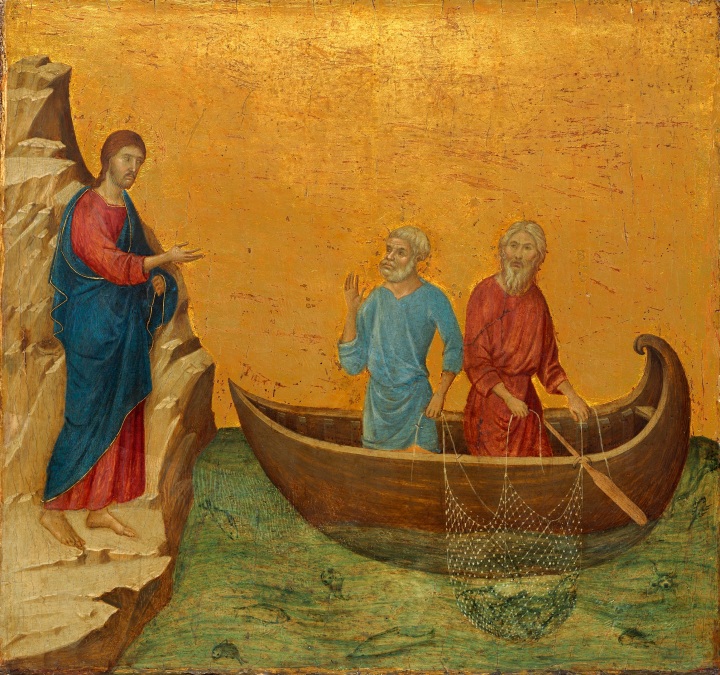
When Jesus sees two fishermen, Simon Peter and his brother, Andrew casting their nets,  and invites them to ‘Follow me, and I will make you fishers of men.’ It is quite a simple and straightforward invitation. On hearing Jesus’ words they drop everything and follow Him. Immediately! They don’t stop to put their affairs in order, or to say goodbye. A little later, James and John do the same, leaving Zebedee, their father, behind in the boat. Nothing is more important than following Jesus, but these early disciples show us that following God has a cost. It transforms our lives, totally, but not without cost. 

So what does Jesus do with this band of disciples? He takes them into synagogues, where He teaches and interprets the Jewish Scriptures, the Old Testament. Jesus proclaims the Good News of the Kingdom, that we are loved by God. He demonstrates this love in practice by healing the sick. God’s kingdom is a place where wounds are healed, where people are restored to wholeness, in mind, body and soul. There is a cost to following God, but here we see the reward of the Kingdom. Each and every one of us needs that healing and wholeness, which only God can provide. The Church continues to proclaim repentance from sin, belief in the Kingdom of God, and participates in the healing power of God. 

These things begin with us, here, today. We hear the Kingdom proclaimed, we confess our faith together, we pray for the Church and the World, and we join in the banquet of the Kingdom. The source and summit of the Christian life is the Eucharist, where Christ feeds and heals us with His Body and Blood. God’s love is a reality, with the power to transform us and our world, if we have the humility to let God be at work in our lives. He does not force Himself upon us like a tyrant, but rather gives us the free will to choose to turn to Him. 

God also wills that the Church be united, as Jesus prays in Gethsemane, ‘I do not pray for these only, but also for those who believe in me through their word, that they may all be one; even as thou, Father, art in me, and I in thee, that they also may be in us, so that the world may believe that thou hast sent me.’ (Jn 17:20-21 RSVCE) May we pray and work so that Our Lord’s will is a reality and that the world may believe and give glory to God the Father, God the Son, and God the Holy Spirit, to whom be ascribed as is most right and just, all might, majesty, glory, dominion, and power, now, and forever. Amen.

Duccio_di_Buoninsegna_036.jpg

3rd Sunday of Year A

There are divisions in the Church. Sadly, there have been divisions since the earliest days of Christianity, as is made clear by the opening of St Paul’s First Letter to the Corinthians. But just because something has gone on for a long time doesn’t make it right. Quite the opposite! For the last seven days Christians around the world have been praying for unity, to heal the divisions which so mar the Body of Christ, the Church. And while it is good to focus our prayers on unity for a week, I would venture to suggest that the unity of Christians is something which we should all be praying for all the time. It is shocking that the tribalism which St Paul condemns in the first century, is still alive and well today. People are still defining themselves as one sort of Christian as opposed to another, or by the place where they worship. Our culpability in this is something for which we need to repent. We need to turn away from division, and to turn back to the God of love, who longs to heal our wounds and divisions; fostering unity is following the will of God. 

This morning’s Gospel begins with the news that John the Baptist has been arrested. His criticism of the immorality of the ruling family had upset the powers that be. Calling out Herod Antipas for divorcing his wife, and then breaking Jewish law by marrying his brother Philip’s wife, seems the right thing to do. We expect our rulers to set an example. It’s only right and proper. The church continues this prophetic vocation, calling out what is evil and wrong. This may, and will, indeed make people uncomfortable: That’s the point! No one likes having their wrongdoing pointed out, I know I don’t! But unless someone does, then we’re unlikely to change our ways. 

In the Gospel, Jesus has just been in the desert for forty days, praying, fasting, being tempted by the Devil. He begins his public ministry by leaving Nazareth, the town where He grew up, and walking to Capernaum by the shore of the Sea of Galilee. It is a day’s journey. This is an important place for Jesus to start His public ministry, because it fulfils a prophecy in Isaiah, which St Matthew quotes, ‘The land of Zebulun and the land of Naphtali, the way of the sea, beyond the Jordan, Galilee of the Gentiles— the people dwelling in darkness have seen a great light, and for those dwelling in the region and shadow of death, on them a light has dawned.’ (Mt 4:15-16 ESV) This part of Israel is where people were first taken off into captivity by the Assyrians, seven hundred years before. So Our Lord’s restoration of Israel starts in the place where the Northern Kingdom first began to fall apart. 

Strikingly, Jesus begins His proclamation of the Good news of the Kingdom by repeating the exact words of His Cousin, John the Baptist: ‘Repent, for the kingdom of heaven is at hand’. Their message is the same: turn away from your sins and turn back to God, turn back to the God who loves you, and who longs to heal you. These are words of hope for the future, for restoration. This is a message which we all long to hear. 

When Jesus sees two fishermen, Simon Peter and his brother, Andrew casting their nets,  and invites them to ‘Follow me, and I will make you fishers of men.’ It is quite a simple and straightforward invitation. On hearing Jesus’ words they drop everything and follow Him. Immediately! They don’t stop to put their affairs in order, or to say goodbye. A little later, James and John do the same, leaving Zebedee, their father, behind in the boat. Nothing is more important than following Jesus, but these early disciples show us that following God has a cost. It transforms our lives, totally, but not without cost. 

So what does Jesus do with this band of disciples? He takes them into synagogues, where He teaches and interprets the Jewish Scriptures, the Old Testament. Jesus proclaims the Good News of the Kingdom, that we are loved by God. He demonstrates this love in practice by healing the sick. God’s kingdom is a place where wounds are healed, where people are restored to wholeness, in mind, body and soul. There is a cost to following God, but here we see the reward of the Kingdom. Each and every one of us needs that healing and wholeness, which only God can provide. The Church continues to proclaim repentance from sin, belief in the Kingdom of God, and participates in the healing power of God. 

These things begin with us, here, today. We hear the Kingdom proclaimed, we confess our faith together, we pray for the Church and the World, and we join in the banquet of the Kingdom. The source and summit of the Christian life is the Eucharist, where Christ feeds and heals us with His Body and Blood. God’s love is a reality, with the power to transform us and our world, if we have the humility to let God be at work in our lives. He does not force Himself upon us like a tyrant, but rather gives us the free will to choose to turn to Him. 

God also wills that the Church be united, as Jesus prays in Gethsemane, ‘I do not pray for these only, but also for those who believe in me through their word, that they may all be one; even as thou, Father, art in me, and I in thee, that they also may be in us, so that the world may believe that thou hast sent me.’ (Jn 17:20-21 RSVCE) May we pray and work so that Our Lord’s will is a reality and that the world may believe and give glory to God the Father, God the Son, and God the Holy Spirit, to whom be ascribed as is most right and just, all might, majesty, glory, dominion, and power, now, and forever. Amen.

Duccio_di_Buoninsegna_036.jpg

Saturday, 9 February 2019

Fifth Sunday of Year C (Luke 5:1-11)

Much of the church nowadays is anxious about where we are and where we are going. It isn’t that surprising: we live in an uncertain and anxious world. Our response as Christians is to trust in God, who says through the words of his prophet Jeremiah, ‘For I know the plans I have for you, declares the Lord, plans for welfare and not for evil, to give you a future and a hope. Then you will call upon me and come and pray to me, and I will hear you. You will seek me and find me, when you seek me with all your heart.’ (Jer 29:1-13). God has plans for us, plans for good and not evil, he has a plan for you, and for me. Indeed each of us as we enter the church through our baptism can find that God has something in store for us. Each of us is called by God to be a Christian, and to live out our faith in our lives. Each of us is an individual, unique, made in the image of God, and our callings are likewise unique. It can be a scary business answering that call. I know, I spent over twenty years running away from it, not feeling good enough for what God wanted me to do. It’s ok. It turns out that I’m in good company as our readings this morning make clear. 

In this morning’s first reading the prophet Isaiah has an experience of God’s presence in the Temple in Jerusalem. He does not describe his emotional state, other than what he says speaks of human unworthiness in the divine presence. When he is confronted by the majesty of God, the singing of angels, the smoke of incense, all he can say is ‘Woe is me. For I am lost; for I am a man of unclean lips’ Isaiah is aware of his human sinfulness and the gulf between himself and God. Yet his guilt is taken away, and his sin atoned for — the prophet who will tell of the Messiah, who will save humanity, is prepared for this by God, he is set apart. When God asks ‘Whom shall I send, who will go for me?’ Isaiah can respond ‘Here I am, send me’ It’s quite a journey in a few verses, and that’s the point. God doesn’t call those who are equipped, He equips those whom He calls.

Likewise St Paul, ‘the least of the apostles, unworthy to be called an apostle because [he] persecuted the church of God’ is living proof of the redemptive power of God’s love at work in the world. He preaches Christ crucified and resurrected, to show us that Christ died for us, and that we can have new life in him. God can (and does) take and use surprising people to show us that we are loved. That is the wonder of the Gospel, the Good News of Jesus Christ. No-one is beyond its reach, or of God’s forgiveness and loving mercy. 

In the Gospel, Jesus begins by using a fisherman’s boat, so that the large crowd at the lakeside can see and hear him, it’s simple, honest, and what’s there. When he has finished teaching Jesus tells Simon Peter to ‘Put out into the deep and let down your nets for a catch’. Peter cannot see the point — they’ve not caught anything in the entire night, he’s tired, he just doesn’t see the point. 

And yet he is obedient, he does what Jesus asks him — and they catch so many fish that their boats almost sink under the weight of them, a catch which points forward to another miraculous catch of fish after Jesus’ resurrection (in Jn 21:1–11), it is a sign of the Church: a miraculous number of people given new life in Christ. Peter is obedient, he listens to what God says and obeys, and wonderful things happen.

Peter’s response to the miracle is telling: he falls at Jesus’ knees and says, ‘Depart from me, for I am a sinful man, O Lord’. It is an authentic human response to the presence and generosity of God – and one which I recognise. Peter recognises his own unworthiness and his complete reliance upon God. Peter is not worthy of his calling, none of us are and that’s the point, but because Peter knows he isn’t that’s how God can be at work, in and through his humility and reliance upon God, not himself. The next thing Jesus says to him is ‘Do not be afraid’ – in Christ we do not need to be afraid of anything, if we trust in him, and let his love be at work in us, if we trust God.

Once they reach the land the disciples leave everything and follow him, they display metanoia: they let God change their heart, their mind and their life. This is the response of a sinner to the love of God. Now it can be all too easy to see such passages as we have this morning as solely of interest to those of a calling to the priesthood. That’s understandable, but it’s also deeply wrong. The message in our readings applies to each and every one of us, here, and all over the world. As Christians we are all to kneel in the place of Peter, to recognise our reliance upon and trust in God, and be prepared to be ‘fishers of men’. 

The calling of the disciples is the calling of the entire baptised people of God: a calling not to be afraid, but to respond to the God who loves us and saves us, a calling to live out in our lives by word and deed the saving truths of God, so God can use us for His glory and the spreading of His Kingdom, so that others may come to know His Love, Mercy, and Forgiveness. It’s what we’ve signed up for, to profess the faith of Christ Crucified, to share it with others.

This treasure has been entrusted to us, so that we can share it with others, so that the world may believe. So that it may believe and give glory to God the Father, God the Son, and God the Holy Spirit, to whom be ascribed as is most right and just, all might, majesty, glory dominion and power, now and forever. Amen

miraculous_catch_of_fish_-_sant27apollinare_nuovo_-_ravenna_2016

Fifth Sunday of Year C (Luke 5:1-11)

Much of the church nowadays is anxious about where we are and where we are going. It isn’t that surprising: we live in an uncertain and anxious world. Our response as Christians is to trust in God, who says through the words of his prophet Jeremiah, ‘For I know the plans I have for you, declares the Lord, plans for welfare and not for evil, to give you a future and a hope. Then you will call upon me and come and pray to me, and I will hear you. You will seek me and find me, when you seek me with all your heart.’ (Jer 29:1-13). God has plans for us, plans for good and not evil, he has a plan for you, and for me. Indeed each of us as we enter the church through our baptism can find that God has something in store for us. Each of us is called by God to be a Christian, and to live out our faith in our lives. Each of us is an individual, unique, made in the image of God, and our callings are likewise unique. It can be a scary business answering that call. I know, I spent over twenty years running away from it, not feeling good enough for what God wanted me to do. It’s ok. It turns out that I’m in good company as our readings this morning make clear. 

In this morning’s first reading the prophet Isaiah has an experience of God’s presence in the Temple in Jerusalem. He does not describe his emotional state, other than what he says speaks of human unworthiness in the divine presence. When he is confronted by the majesty of God, the singing of angels, the smoke of incense, all he can say is ‘Woe is me. For I am lost; for I am a man of unclean lips’ Isaiah is aware of his human sinfulness and the gulf between himself and God. Yet his guilt is taken away, and his sin atoned for — the prophet who will tell of the Messiah, who will save humanity, is prepared for this by God, he is set apart. When God asks ‘Whom shall I send, who will go for me?’ Isaiah can respond ‘Here I am, send me’ It’s quite a journey in a few verses, and that’s the point. God doesn’t call those who are equipped, He equips those whom He calls.

Likewise St Paul, ‘the least of the apostles, unworthy to be called an apostle because [he] persecuted the church of God’ is living proof of the redemptive power of God’s love at work in the world. He preaches Christ crucified and resurrected, to show us that Christ died for us, and that we can have new life in him. God can (and does) take and use surprising people to show us that we are loved. That is the wonder of the Gospel, the Good News of Jesus Christ. No-one is beyond its reach, or of God’s forgiveness and loving mercy. 

In the Gospel, Jesus begins by using a fisherman’s boat, so that the large crowd at the lakeside can see and hear him, it’s simple, honest, and what’s there. When he has finished teaching Jesus tells Simon Peter to ‘Put out into the deep and let down your nets for a catch’. Peter cannot see the point — they’ve not caught anything in the entire night, he’s tired, he just doesn’t see the point. 

And yet he is obedient, he does what Jesus asks him — and they catch so many fish that their boats almost sink under the weight of them, a catch which points forward to another miraculous catch of fish after Jesus’ resurrection (in Jn 21:1–11), it is a sign of the Church: a miraculous number of people given new life in Christ. Peter is obedient, he listens to what God says and obeys, and wonderful things happen.

Peter’s response to the miracle is telling: he falls at Jesus’ knees and says, ‘Depart from me, for I am a sinful man, O Lord’. It is an authentic human response to the presence and generosity of God – and one which I recognise. Peter recognises his own unworthiness and his complete reliance upon God. Peter is not worthy of his calling, none of us are and that’s the point, but because Peter knows he isn’t that’s how God can be at work, in and through his humility and reliance upon God, not himself. The next thing Jesus says to him is ‘Do not be afraid’ – in Christ we do not need to be afraid of anything, if we trust in him, and let his love be at work in us, if we trust God.

Once they reach the land the disciples leave everything and follow him, they display metanoia: they let God change their heart, their mind and their life. This is the response of a sinner to the love of God. Now it can be all too easy to see such passages as we have this morning as solely of interest to those of a calling to the priesthood. That’s understandable, but it’s also deeply wrong. The message in our readings applies to each and every one of us, here, and all over the world. As Christians we are all to kneel in the place of Peter, to recognise our reliance upon and trust in God, and be prepared to be ‘fishers of men’. 

The calling of the disciples is the calling of the entire baptised people of God: a calling not to be afraid, but to respond to the God who loves us and saves us, a calling to live out in our lives by word and deed the saving truths of God, so God can use us for His glory and the spreading of His Kingdom, so that others may come to know His Love, Mercy, and Forgiveness. It’s what we’ve signed up for, to profess the faith of Christ Crucified, to share it with others.

This treasure has been entrusted to us, so that we can share it with others, so that the world may believe. So that it may believe and give glory to God the Father, God the Son, and God the Holy Spirit, to whom be ascribed as is most right and just, all might, majesty, glory dominion and power, now and forever. Amen

miraculous_catch_of_fish_-_sant27apollinare_nuovo_-_ravenna_2016

Sunday, 1 October 2017

A thought for the day from S. Thérèse of Lisieux

I saw that love alone imparts life to all the members, so that should love ever fail, apostles would no longer preach the gospel and martyrs would refuse to shed their blood. Finally, I realised that love includes very vocation, that love is all things, that love is eternal, reaching down to the utmost limits of the earth.

Beside myself with joy, i cried out: ‘O Jesus, my love, my vocation is found at last – my vocation is love! I have found my place in the church, and this place, Jesus, you have given me yourself; in the heart of the Church, I will be love. In this way I will be all things and my wish will be fulfilled.

But why do I say ‘beside myself with joy’? It is, rather, peace which has claimed me, the calm, quiet peace of the sailor as he catches sight of the beacon which lights him to port. The beacon of love.

I am only a weak and helpless child but my very weakness which makes me dare to offer myself, Jesus, as a victim to your love. In the old days, only pure and spotless victims of holocaust would be accepted by God, and his justice was appeased by the most perfect sacrifices. Now the law of fear has given way to the law of love, and I have been chosen, though weak and imperfect, as love’s victim.

sugar-canes-at-st-theresa


Sunday, 12 March 2017

Jesus and Nicodemus Lent II

The sight of a crucifix has a continuity with Golgotha; at times its vision is embarrassing. We can keep a statue of Buddha in a room, tickle his tummy for good luck, but it is never mortifying. The crucifix somehow or other makes us feel involved. It is much more than a picture of Marie Antoinette and the death-dealing guillotine. No matter how much we thrust it away, it makes its plaguing reappearance like an unpaid bill.

Fulton J. Sheen Those Mysterious Priests 1974: 101—102


Our Baptism is a wonderful thing, and it is why each and every one of us is here today. It is how we enter the Church, how we become part of the body of Christ,  it is how our souls are infused with the virtues of Faith, Hope, and Charity, it is how we are regenerate, born again, sharing in His death, and His resurrection. It is something for which people have traditionally prepared during this season of Lent, for Baptism and Confirmation at Easter, so that they can die with Christ and be raised to new life with Him. We enter into the mystery of Christ’s saving work so that we may conformed to it and transformed by it, by Love, by believing and trusting in Christ, publicly declaring our faith in Him, and praying for His Holy Spirit, so that our lives may be transformed – living for Him, living in Him, and being transformed more and more into the likeness of Christ.

To be drawn into His likeness means coming closer to His Cross and Passion: just as Moses lifted up the serpent in the wilderness, so must the Son of Man be lifted up (Jn 3:14). Just as the serpent in the desert brought salvation to the people of Israel, so now the Cross is our only hope – the sacrifice of God for humanity, not something we can give God, but something he gives us – a free gift of infinite value. God gives it to us and to all the world for one simple reason – love, for love of us – weak, poor, sinful humanity, so that we might be more lovely, more like Him. God sends His Son into the world not to condemn it, but so that the world might be saved through Him – an unselfish act of generosity, of grace, so that we might be saved from sin and death, from ourselves, so that we can share new life in Him.

‘For God so loved the world, that he gave his only Son, that whoever believes in him should not perish but have eternal life. For God did not send his Son into the world to condemn the world, but in order that the world might be saved through him.’ John 3:16-17 (ESV) These few words spoken by Jesus to Nicodemus in John’s Gospel encapsulate what we believe as Christians, and why we believe it, may we live them, strengthened through prayer, our study of the Bible, nourished by Our Lord’s Body and Blood, forgiven and forgiving, preparing to be caught up forever in the love of God.

It is that same sacrifice which we see here this morning, which we can taste and touch, which we can eat and drink, so that our lives and our souls can be transformed to live Christ’s risen life. It is something which we treat with the uttermost reverence because it is God, given for us, because it can transform us to live as children of the Holy Spirit, freed from the shackles of this world, free to live for Him, to live as He wants us to, His new creation, of water and the Spirit. This is what the Church has done on a hundred thousand successive Sundays, in memory of Him, to make the holy people of God. To make us holy: so that everything which we say, or think, or do, may be for His praise and glory, living out the faith which we believe in our hearts, as a sign to the world that the ways of selfishness and sin are as nothing compared with the generous love of God.

So great is this gift, that we prepare to celebrate it with this solemn season of prayer, and fasting, and abstinence, to focus our minds and our lives on the God who loves us and who saves us. We prepare our hearts and minds and lives to celebrate the mystery of our redemption, so that our lives may reflect His glory, so that we may live for Him, fed by Him, fed with Him, with our lives and souls transformed by Him. We are transformed so that we can transform the world so that it may live for Him, living life in all its fullness: living for others, living as God wants us to live. Living the selfless love which saves us and all the world, living out our faith, and encouraging others so to do, can and will conform us to Christ, so that we may be like Him, and become ever more like Him, prepared for eternal life with Him, so that we all may sing the praises of God the Father, God the Son, and God the Holy Spirit, to whom be ascribed, as is most right and just, all might, majesty, glory, dominion, and power, now and forever.

3-agosto-crijn_hendricksz-550x400_c


Friday, 10 February 2017

A though from Teilhard de Chardin

Above all, trust in the slow work of God.We are quite naturally impatient in everything to reach the end without delay.

We should like to skip the intermediate stages.We are impatient of being on the way to something unknown, something new. And yet it is the law of all progress that it is made by passing through some stages of instability — and that it may take a very long time.

And so I think it is with you; your ideas mature gradually — let them grow, let them shape themselves, without undue haste. Don’t try to force them on, as though you could be today what time (that is to say, grace and circumstances acting on your own good will) will make of you tomorrow.
Only God could say what this new spirit gradually forming within you will be. Give Our Lord the benefit of believing that his hand is leading you, and accept the anxiety of feeling yourself in suspense and incomplete.

—Pierre Teilhard de Chardin, SJ excerpted from Hearts on Fire


Tuesday, 20 December 2016

A thought for the day from Fulton Sheen

The Soul’s Atmosphere

Once our helplessness is rendered up to the power of God, life changes and we become less and less the victims of our moods. Instead of letting the world determine our state of mind, we determine the state of our soul with which the world is to be faced. The earth carries around its atmosphere with it as it revolves about the sun; so can the soul carry the atmosphere of God with it in disregard of turbulent events in the world outside.

Lift up your Heart


Saturday, 14 February 2015

A Thought for the Day from the Desert

The fear of the Lord is our cross. Just as someone who is crucified no longer has the power of moving or turning his limbs in any direction as he pleases, so we also ought to fasten our wishes and desires, not in accordance with what is pleasant and delightful to us now, but in accordance with the law of the Lord, where it hems us in. Being fastened to the wood of the cross means: no longer considering things present; not thinking about one's preferences; not being disturbed by anxiety and care for the future; not being aroused by any desire to possess, nor inflamed by any pride or strife or rivalry; not grieving at present injuries, and not calling past injuries to mind; and while still breathing and in the present body, considering oneself dead to all earthly things, and sending the thoughts of one's heart on ahead to that place where, one does not doubt, one will soon arrive
John Cassian, Institutes, Book IV ch.35

Sunday, 9 November 2014

Trinity XXI The Conversion and Sanctification of Man

Canon Henry Liddon was quite right when he spoke to the clergy saying ‘Our end is the conversion and sanctification of man’. It’s what the church is for, and its ministerial priesthood, sharing in the priesthood of Christ, calls the common priesthood of the baptised to be conformed more and more to the image of the Crucified Lord, Our Saviour Jesus Christ.
       This is achieved by a variety of means, but particularly by prayer: where humanity speaks to and more importantly listens to God. It is a mark of the intimacy of our relationship with the divine that it is to be a regular constant conversation so that God may be at work in us. In our prayer we praise God, not because He needs it, but because it is right and good humanity, the creature to praise its Creator. We intercede for our own needs and for those of the world, and we plead the sacrifice of His Son which alone can heal the wounds of sin which mar our fallen human nature. In our humble talking to God and in the silence of our hearts there can a space for God to speak to us, to transform us, in the power of His Holy Spirit.
       When Paul writes to Titus, in this evening’s second lesson, he is concerned with the ordering of public worship, and particularly prayer. Here in a Cathedral we are not unacquainted with decent ordered worship, as one might well expect. We have standards, which are rightly high, and can serve as an example and an encouragement, but we are first and foremost a community of prayer, which invites people to draw ever closer to the God who loves us, who saves us, and redeems us.
       We pray for the Church and the World, for the living and the departed, for the sick and those in need, which is excellent and acceptable to God. We do so in order that we may strive to live an ordered, quiet, peaceable life, and thus may be drawn ever closer to the godliness which is the path to true holiness of life in Christ. His Salvation which is for all people is both an event – His sacrifice upon the Cross of Calvary, and a process – through the outpouring of His Sanctifying Grace in the Sacraments of the Church, nourished by the Word of God in Holy Scripture, the Revealed Truth of God’s love for us, and through remaining close to God in prayer, that our human nature can be transformed and perfected in Christ. It is the will of God that all people may be saved, the invitation is offered to all, freely, it costs nothing, it may be resisted and even refused, yet God in His love and mercy offers it. We do not deserve it, we cannot earn it, it is a gift which is offered and has to be accepted.
       There is one mediator between God and humanity, Our Lord and Saviour Jesus Christ, who gave himself as a ransom for all, bearing witness to the love and mercy of God, and offering himself freely as a sacrifice upon the altar of the Cross, where as priest and victim he makes the one perfect and sufficient sacrifice for the sins of the whole world. This simple world-changing fact is at the heart of our faith: Christ died for our sins, yours and mine, and was raised to give us the hope of eternal life in Him. This is what we preach, it is what we pray, and what we live, so that we may be drawn closer to Him.
       It is wonderful, and yet it is not easy – for two thousand years the church continues to call humanity to repentance, and while our human efforts may be haltering, nonetheless the call to conversion and sanctification is a constant one, of which we need to be constantly reminded, each and every one of us, so that we can support and forgive each other, and pray for and with each other.
       I would like to end with some words of Mother Mary Clare slg:
       Today we can easily become
       paralysed by a sense that
       there is nothing we can do
       in the face of so much suffering,
       such lack of love and justice
       in man’s relationship with man,
       but the Cross of Christ
       stands at the heart of it all,
       and the prayer of Christ,
       now as always
       is the answer to man’s need.


Monday, 20 October 2014

Matthew 22:15-22 Trinity XVIII 29th Sunday of Year A

Jesus and the Pharisees had something of a troubled relationship: they just don’t seem to be able to get him – to understand what he is saying or why. All they can do is to try and catch him out, to find a way to entrap him. In this morning’s gospel they must think that they have finally got him on the horns of a dilemma – they ask him the question ‘Is it lawful to pay taxes to Caesar or not?’ If he says ‘no’ then he’s allied himself with zealots, religious extremists, he has made a provocative political statement for which he can be denounced, if  he says ‘yes’ then they can write him off as a collaborator, he is not one of us – he is not a real prophet, a true son of Israel. All they are interested in is understanding what he says in political terms. Their opening pleasantries ring hollow, they don’t mean what they say; they are just trying to butter him up with empty flattery.
       He turns the tables on them by asking them to show him a coin used to pay the tax, so that he can ask ‘Whose head is this, and whose title?’ They answer ‘Caesar’s’ allowing him to say ‘Render therefore unto Caesar the things that are Caesar’s and unto God the things that are God’s’. Whereas they come filled with malice, with a desire to catch him out, Jesus uses this as an opportunity to show them the proper order of things: pay your taxes but give God what is owed to him – a heart filled with love, love of God and of each other, a life which proclaims this love in the service of others and through the worship of Almighty God. This is where real power lies, this is the truly subversive aspect of Jesus’ teaching, which he proclaims in the Temple, in the heart of the religious establishment – to show them how to live, and live life to the full.
       In the power of the Holy Spirit the Truth can be proclaimed, the truth which sets us free from the ways of the world, free to love and serve God. This freedom can be seen in the lives of the Thessalonian Christians to whom Paul writes. Rather than worshipping idols, they serve the living and true God, they are an example to Christians of how to live. Their lives proclaim the truth which they serve. This is the dark truth of which the prophet Isaiah speaks, these are the hidden riches.
       As opposed to either the collaboration of the Herodians or the rigorist harshness of the Pharisees, Jesus proclaims the freedom and love of the Kingdom of God. It is a place of welcome – the image is that of the wedding feast to which all people are invited. People are too busy or preoccupied to come; others just don’t want to be invited: they mistreat the people who invite them. This does not stop the invitation being offered to all, it still is. It is why we are here today, so that we can be nourished by Word and Sacrament, so that we can be strengthened in love and in faith, to proclaim the reality of the Kingdom of God, to be an example to others to draw them in to the loving embrace of God – to be healed and restored by Him.
       We see this love and healing most fully in the death and resurrection of Jesus Christ. This is the costly love in action which restores our relationship with God and each other. Thanks to this we are here today to be restored and renewed, to be built up in love together, it is a reality in our lives.

       Let us come to him, to be healed and renewed, strengthened, built up in love.                                            

Sunday, 7 September 2014

Sermon for Evensong Trinity XII

It has been said that in the hereafter there are two smells: brimstone and incense. Needless to say, we should prefer the latter to the former, and also it reminds us of the religious practice of our brothers in faith the Jews: incense was offered in the Temple to God every morning and evening, a laudable practice which the Church continues.
It should also remind us that the Church Militant here in Earth just like the Church Triumphant in Heaven is focussed on one thing: the worship of Almighty God. This building was built for the glory of God, to give us something of a foretaste of Heaven and as a place of worship, where the praises of God might be sung: as above, so below:
And the four living creatures, each of them with six wings, are full of eyes all round and within, and day and night they never cease to say,
“Holy, holy, holy, is the Lord God Almighty,
    who was and is and is to come!”
And whenever the living creatures give glory and honour and thanks to him who is seated on the throne, who lives for ever and ever, the twenty-four elders fall down before him who is seated on the throne and worship him who lives for ever and ever. They cast their crowns before the throne, saying,
“Worthy are you, our Lord and God, to receive glory and honour and power, for you created all things, and by your will they existed and were created.” (Rev 4:8-11)
We praise God and thank Him in our worship not because He needs or wants it, but for the simple reason that he is worth it. We are grateful for our creation, preservation, and all the blessings of this life;
but above all for thine inestimable love in the redemption of the world by our Lord Jesus Christ; for the means of grace, and for the hope of glory.
Our worship expresses our hope, our thanks and our praise, it reminds us to be grateful for what God has done for us, in giving His Son to be born for us, to proclaim the Good News of the Kingdom to us, to die for us and to rise again for us, to show us how we might have life and life in all its fullness in and through Him.
Therefore our vocation as Christians is to be a joyful people. There is nothing worse than seeing a sad miserable Christian: we are called to proclaim Good News, to live out the new life of our baptism, regenerate, born again, singing the praises of God who rather than condemn us loves us and saves us, who gives himself as priest and victim upon the altar of the Cross so that we might feed on Him, to heal our wounds, to transform us, so that His Grace can perfect rather than abolish our nature – it is wonderful, utterly mind-blowing, it has the power to transform the entire world if only we could stop getting in the way, and let the transformative power of God’s love be at work in the world.
We proclaim this Good News in our thoughts, our words, and our deeds, and the more we do it, the more it shapes our character, making us people of praise, people of worship – it can become all-encompassing, taking all of who and what we are, and using it for God’s good purposes. This is what Our Lord means when he says ‘whoever loses his life for my sake will find it.’ (Mt 16:25) This is life in all its fullness for we are never more fully alive than when we worship God, demonstrating our love for Him, and letting His love shine through us.
This characterised the first Apostles – how could they do otherwise after what God had done for them in Jesus, and we should be just like them, with the same singularity of vision and purpose.

So let us worship God not only with our lips but with our lives, so that all we are, all we say, all we think, all we do, may praise God the Father, God the Son, and God the Holy Spirit, to  whom be ascribed as is most right and just, all might, majesty, glory, dominion and power, now and forever.

Sunday, 24 August 2014

St Bartholomew

St Bartholomew is usually identified with the apostle Nathaniel, best known from his appearance in the first chapter of John’s Gospel when he asks, ‘Can anything good come out of Nazareth?’ and to whom Our Lord says, ‘Behold an Israelite in whom there is no guile.’ After Pentecost tradition holds that he went East; taking the Good News to Armenia or even India, and was martyred by being flayed alive.  He told people about Jesus and suffered a painful death for the sake of the Kingdom. He bore witness to the truth of Jesus’ life and resurrection, and lit a flame which burns to this day. We would not be here, doing what we do, believing what we do, and encouraging others so to do if it were not for the example and witness of people like St Bartholomew who preferred nothing to Christ, who was the very centre of their lives, who gave them meaning and purpose, and who told others so that they might believe and encourage others so to do.
In this morning’s Gospel we are presented with a challenging scene: it’s during the Last Supper, where Jesus takes bread and wine to feed his disciples with his Body and Blood, to explain what is about to happen, that he who was without sin might become sin so that we might have life, and life in all its fullness. In the midst of this we see the disciples arguing about who is the greatest. During the most momentous events of human history Our Lord’s closest friends are engaged in a squabble which seems childish and stupid, ‘I’m better than you’ ‘No I’m better than you’. Rather than being close to their Lord they’re involved in petty one-upmanship, thinking about themselves, about honour and position. It’s remarkably human, we can well imagine ourselves saying and doing exactly the same – we know it’s wrong, and we need to turn away from it.
      Rather than explode with anger, Our Lord makes a simple point ‘The kings of the Gentiles lord it over them; and those in authority over them are called benefactors. But not so with you; rather the greatest among you must become like the youngest, and the leader like one who serves. For who is greater, the one who is at the table or the one who serves? Is it not the one at the table? But I am among you as one who serves.’ In Christianity we have a different paradigm of leadership, that of the servant – here worldly values are turned on their head – the Kingdom offers an entirely different way of life, diametrically opposed to the ways of the world, something radical, something transformative, something which offers the world an entirely new way of living, where the service of others is seen as the most important thing. This is not power in worldly terms, the Creator and Redeemer of all humanity takes on a servile role – the greatest becomes the least, and encourages others to do likewise.
      Thus, rather than worrying about worldly power the disciples become servants, looking and acting like Jesus, they become transparent so that the light of Christ may shine through them in the world, so that their acts of loving service proclaim the truth, the beauty, and the goodness of the Kingdom. They go from worrying about power and position, the things of this world, to being concerned wholly with the Kingdom of God.
We need to do the same, nothing more, nothing less. In our baptism we put on Christ, we were clothed with Him, we shared in His Death and Resurrection, and were filled with grace and the Holy Spirit, so that we might follow Him, and encourage others so to do. We have everything we need to follow in the footsteps of the Apostles. We too are fed with the Body and Blood of Christ so that we might have life in Him, so that we can give our lives to proclaim Him to the world.

As Christians we need to live lives of service, the service of others and of the God who loves us and who saves us. We need to live out a radical alternative in the world, and for the world, to embody an alternative to the ways of selfishness and sin, proclaiming the Good News of Jesus Christ, and helping others to enter into the joy of the Lord. We need to do this together, serving and loving each other, forgiving each other, bearing witness in the world, not conformed to it, so that it may believe and give glory to God the Father, God the son, and God the Holy Spirit, to who whom be ascribed as is most right and just, all might, majesty, glory, dominion and power, now and forever.

Wednesday, 13 August 2014

A thought for the day from St Isaac the Syrian

Love is the kingdom which the Lord mystically promised to the disciples, when he said that they would eat in his kingdom; 'You shall eat and drink at my table in my kingdom' (Lk 22:30). What should they eat and drink if not love?

When we have reached love, we have reached God and our journey is complete. We have crossed over to the island which lies beyond the world, where are the Father, the Son, and the Holy Spirit; to whom be glory and dominion. May God make us worthy to fear and love him. Amen

Sunday, 10 August 2014

Walking on Water

Fear is a very human feeling, we acquire it through learning, and yet it can be overcome, if we trust in God. Christains in Iraq, China, North Korea & Palestine – they face real danger, real persecution (we’re safe and comfortable by comparison) – and yet they trust, they pray (and so should we) and we should do all that we can to help them.
Immediately he made the disciples get into the boat and go on ahead to the other side, while he dismissed the crowds.
This morning’s Gospel carries straight on from the miraculous feeding last week, as Jesus goes to send the crowds back home, he sends disciples ahead so that they might be ready.
 And after he had dismissed the crowds, he went up the mountain by himself to pray.
Prayer is important, it is as important as the food we eat, the air we breathe, because it is about our relationship with God. Throughout the Gospels Jesus spends time alone, spends time close to the Father as this relationship is crucial. Where Jesus leads we should follow, follow his example.
When evening came, he was there alone, but by this time the boat, battered by the waves, was far from the land, for the wind was against them.
It’s getting dark, and the disciples are out in the middle of the lake, in deep water; will the boat sink, what can they do?
And early in the morning he came walking towards them on the lake. But when the disciples saw him walking on the lake, they were terrified, saying, ‘It is a ghost!’ And they cried out in fear.
But immediately Jesus spoke to them and said, ‘Take heart, it is I; do not be afraid.’
The disciples cannot believe that they are seeing Jesus, so he encourages them, his presence can give them confidence.
Peter answered him, ‘Lord, if it is you, command me to come to you on the water.’ He said, ‘Come.’
As usual, Peter is the first to react, he takes the lead – Jesus speaks a single word to him, ‘Come’ he speaks it to each and every one of us as Christians, to come, to follow him, to be close to him, to live out our faith in our lives strengthened by prayer.
 So Peter got out of the boat, started walking on the water, and came towards Jesus. But when he noticed the strong wind, he became frightened, and beginning to sink, he cried out, ‘Lord, save me!’ Jesus immediately reached out his hand and caught him, saying to him, ‘You of little faith, why did you doubt?’ When they got into the boat, the wind ceased.
 And those in the boat worshipped him, saying, ‘Truly you are the Son of God.’
Peter listens to what Jesus says, and obeys him, and does something miraculous, something extraordinary, until he is distracted by the world around him, and becomes frightened, likewise we, in our lives can in the power of God do wonderful things, if we are not distracted by the cares of the world around us, if we listen to what Jesus tells us and do it.
Peter becomes frightened; he starts to sink, as do we all when the cares of this world overwhelm us. His reaction is to cry ‘Lord, save me’ which Jesus does, indeed, through his offering of himself upon the Cross he saves each and every one of us, taking the sin of the world upon himself so that we might be freed from sin, fear and death, that same sacrifice which will be made present here, so that we the people of God, can be fed by God, with God, with his Body and Blood to be strengthened to have life in him, to be close to him.
Peter is told off for lacking faith, because it is important, we need to trust God, to have faith in Him, so that He can be at work in us and through us.

At the end, once the wind has died down the disciples worship Him, saying, ‘Truly you are the Son of God.’ The end of it all is worship, it is what we as humans and as Christians are for, to worship God, in our love and our prayer, so that all of our lives are an act of worship, drawing us ever closer to the source of life and love. So that all we say or think or do may give glory to God the Father, God the Son, and God the Holy Spirit, to who whom be ascribed as is most right and just, all might, majesty, glory, dominion and power, now and forever.

Monday, 14 July 2014

National Apostasy

    Preached at St. Mary's, Oxford, on July 14, 1833
NATIONAL APOSTASY
'As for me, God forbid that I should sin against the Lord in ceasing to pray for you: but I will teach you the good and the right way.
—1 SAM xii. 23.
On public occasions, such as the present, the minds of Christians naturally revert to that portion of Holy Scripture, which exhibits to us the will of the Sovereign of the world in more immediate relation to the civil and national conduct of mankind. We naturally turn to the Old Testament, when public duties, public errors, and public dangers, are in question. And what in such cases is natural and obvious, is sure to be more or less right and reasonable. Unquestionably it is mistaken theology, which would debar Christian nations and statesmen from the instruction afforded by the Jewish Scriptures, under a notion, that the circumstances of that people were altogether peculiar and unique, and therefore irrelevant to every other case. True, there is hazard of misapplication, as there is whenever men teach by example. There is peculiar hazard, from the sacredness and delicacy of the subject; since dealing with things supernatural and miraculous as if they were ordinary human precedents, would be not only unwise, but profane. But these hazards are more than counterbalanced by the absolute certainty, peculiar to this history, that what is there commended was right, and what is there blamed, wrong. And they would be effectually obviated, if men would be careful to keep in view this caution:—suggested everywhere, if I mistake not, by the manner in which the Old Testament is quoted in the New:—that, as regards reward and punishment, God dealt formerly with the Jewish people in a manner analogous to that in which He deals now, not so much with Christian nations, as with the souls of individual Christians.
Let us only make due allowances for this cardinal point of difference, and we need not surely hesitate to avail ourselves, as the time may require, of those national warnings, which fill the records of the elder Church: the less so, as the discrepancy lies rather in what is revealed of God's providence, than in what is required in the way of human duty. Rewards and punishments may be dispensed, visibly at least, with a less even hand; but what tempers, and what conduct, God will ultimately reward and punish,—this is a point which cannot be changed: for it depends not on our circumstances, but on His essential, unvarying Attributes.
I have ventured on these few general observations, because the impatience with which the world endures any remonstrance on religious grounds, is apt to show itself most daringly, when the Law and the Prophets are appealed to. Without any scruple or ceremony, men give us to understand that they regard the whole as obsolete: thus taking the very opposite ground to that which was preferred by the same class of persons two hundred years ago; but, it may be feared, with much the same purpose and result. Then, the Old Testament was quoted at random for every excess of fanatical pride and cruelty : now, its authority goes for nothing, however clear and striking the analogies may be, which appear to warrant us in referring to it. The two extremes, as usual, meet ; and in this very remarkable point : that they both avail themselves of the supernatural parts of the Jewish revelation to turn away attention from that, which they, of course, most dread and dislike in it: its authoritative confirmation of the plain dictates of conscience in matters of civil wisdom and duty.
That portion, in particular, of the history of the chosen people, which drew from Samuel, the truest of patriots, the wise and noble sentiment in the text, must ever be an unpleasing and perplexing page of Scripture, to those, who would fain persuade themselves, that a nation, even a Christian nation, may do well enough, as such, without God, and without His Church. For what if the Jews were bound to the Almighty by ties common to no other people? What if He had condescended to know them in a way in which He was as yet unrevealed to all families of the earth besides? What if, as their relation to Him was nearer, and their ingratitude more surpassing, so they might expect more exemplary punishment? Still, after all has been said, to exaggerate their guilt, in degree, beyond what is supposed possible in any nation whatever now, what can it come to, in kind and in substance, but only this;— that they rejected God? that they wished themselves rid of the moral restraint implied in His peculiar presence and covenant? They said, what the prophet Ezekial, long after, represents their worthy posterity as saying, 'We will be as the heathen, the families of the countries.' (Ezek. xx. 32.) 'Once for all, we will get rid of these disagreeable, unfashionable scruples, which throw us behind, as we think, in the race of worldly honour and profit.' Is this indeed a tone of thought, which Christian nations cannot fall into? Or, if they should, has it ceased to be displeasing to God? In other words, has He forgotten to be angry with impiety and practical atheism? Either this must be affirmed, or men must own, (what is clear at once to plain unsophisticated readers,) that this first overt act, which began the downfall of the Jewish nation, stands on record, with its fatal consequences, for a perpetual warning to all nations, as well as to all individual Christians, who, having accepted God for their King, allow themselves to be weary of subjection to Him, and think they should be happier if they were freer, and more like the rest of the world.
I do not enter into the question, whether visible temporal judgements are to be looked for by Christian nations, transgressing as those Jews did. Surely common sense and piety unite, in representing this inquiry as, practically, one of no great importance. When it is once known for certain that such and such conduct is displeasing to the King of kings, surely common sense and piety concur in setting their mark of reprobation on such conduct, whether the punishment, sure to overtake it, come to-morrow, or a year hence, or wait till we are in another world.
Waiving this question, therefore, I proceed to others, which appear to me, I own, at the present moment especially, of the very gravest practical import.
What are the symptoms, by which one may judge most fairly, whether or no a nation, as such, is becoming alienated from God and Christ?
And what are the particular duties of sincere Christians, whose lot is cast by Divine Providence in a time of such dire calamity?
The conduct of the Jews, in asking for a king, may furnish an ample illustration of the first point : the behaviour of Samuel, then and afterwards, supplies as perfect a pattern of the second, as can well be expected from human nature.
I. The case is at least possible, of a nation, having for centuries acknowledged, as an essential part of its theory of government, that, as a Christian nation, she is also a part of Christ's Church, and bound, in all her legislation and policy, by the fundamental rules of that Church—the case is, I say, conceivable, of a government and people, so constituted, deliberately throwing off the restraint, which in many respects such a principle would impose on them, nay, disavowing the principle itself ; and that, on the plea, that other states, as flourishing or more so in regard of wealth and dominion, do well enough without it. Is not this desiring, like the Jews, to have an earthly king over them, when the Lord their God is their King? Is it not saying in other words, 'We will be as the heathen, the families of the countries,' the aliens to the Church of our Redeemer?
To such a change, whenever it takes place, the immediate impulse will probably be given by some pretence of danger from without,—such as, at the time now spoken of, was furnished to the Israelites by an incursion of the children of Ammon; or by some wrong or grievance in the executive government, such as the malversation of Samuel's sons, to whom he had deputed his judicial functions. Pretences will never be hard to find ; but, in reality, the movement will always be traceable to the same decay or want of faith, the same deficiency in Christian resignation and thankfulness, which leads so many, as individuals, to disdain and forfeit the blessings of the Gospel. Men not impressed with religious principle attribute their ill success in life,—the hard times they have to struggle with,—to anything rather than their own ill-desert: and the institutions of the country, ecclesiastical and civil, are always at hand to bear the blame of whatever seems to be going amiss. Thus, the discontent in Samuel's time, which led the Israelites to demand a change of constitution, was discerned by the Unerring Eye, though perhaps little suspected by themselves, to be no better than a fresh development of the same restless, godless spirit, which had led them so often into idolatry. 'They have not rejected thee, but they have rejected Me, that I should not reign over them. According to all the works, which they have done since the day that I brought them up out of Egypt even unto this day, wherewith they have forsaken Me, and served other gods, so do they also unto thee' (I Sam. viii. 7,8).
The charge might perhaps surprise many of them, just as, in other times and countries, the impatient patrons of innovation are surprised, at finding themselves rebuked on religious grounds. Perhaps the Jews pleaded the express countenance, which the words of their Law, in one place (Deut. xvii. 14-20), seemed, by anticipation, to lend to the measure they were urging. And so, in modern times, when liberties are to be taken, and the intrusive passions of men to be indulged, precedent and permission, or what sounds like them, may be easily found and quoted for everything. But Samuel, in God's Name, silenced all this, giving them to understand, that in His sight the whole was a question of motive and purpose, not of ostensible and colourable argument;—in His sight, I say, to Whom we, as well as they, are nationally responsible for much more than the soundness of our deductions as matter of disputation, or of law ; we are responsible for the meaning and temper in which we deal with His Holy Church, established among us for the salvation of our souls.
These, which have been hitherto mentioned as omens and tokens of an Apostate Mind in a nation, have been suggested by the portion itself of sacred history, to which I have ventured to direct your attention. There are one or two more, which the nature of the subject, and the palpable tendency of things around us, will not allow to be passed over.
One of the most alarming, as a symptom, is the growing indifference, in which men indulge themselves, to other men's religious sentiments. Under the guise of charity and toleration we are come almost to this pass; that no difference, in matters of faith, is to disqualify for our approbation and confidence, whether in public or domestic life. Can we conceal it from ourselves, that every year the practice is becoming more common, of trusting men unreservedly in the most delicate and important matters, without one serious inquiry, whether they do not hold principles which make it impossible for them to be loyal to their Creator, Redeemer, and Sanctifier? Are not offices conferred, partnerships formed, intimacies courted,—nay, (what is almost too painful to think of,) do not parents commit their children to be educated, do they not encourage them to intermarry, in houses, on which Apostolical Authority would rather teach them to set a mark, as unfit to be entered by a faithful servant of Christ?
I do not now speak of public measures only or chiefly; many things of that kind may be thought, whether wisely or no, to become from time to time necessary, which are in reality as little desired by those who lend them a seeming concurrence, as they are, in themselves, undesirable. But I speak of the spirit which leads men to exult in every step of that kind; to congratulate one another on the supposed decay of what they call an exclusive system.
Very different are the feelings with which it seems natural for a true Churchman to regard such a state of things, from those which would arise in his mind on witnessing the mere triumph of any given set of adverse opinions, exaggerated or even heretical as he might deem them. He might feel as melancholy,—he could hardly feel so indignant.
But this is not a becoming place, nor are these safe topics, for the indulgence of mere feeling. The point really to be considered is, whether, according to the coolest estimate, the fashionable liberality of this generation be not ascribable, in a great measure, to the same temper which led the Jews voluntarily to set about degrading themselves to a level with the idolatrous Gentiles? And, if it be true anywhere, that such enactments are forced on the Legislature by public opinion, is APOSTASY too hard a word to describe the temper of that nation?
The same tendency is still more apparent, because the fair gloss of candour and forbearance is wanting, in the surly or scornful impatience often exhibited, by persons who would regret passing for unbelievers, when Christian motives are suggested, and checks from Christian principles attempted to be enforced on their public conduct. I say, 'their public conduct,' more especially ; because in that, I know not how, persons are apt to be more shameless, and readier to avow the irreligion that is in them ;—amongst other reasons, probably, from each feeling that he is one of multitude, and fancying, therefore, that his responsibility is divided.
For example:—whatever be the cause, in this country of late years, (though we are lavish in professions of piety,) there has been observable a growing disinclination, on the part of those bound by VOLUNTARY OATHS, to whatever reminds them of their obligation ; a growing disposition to explain it all away. We know what, some years ago, would have been thought of such uneasiness, if betrayed by persons officially sworn, in private, legal, or commercial life. If there be any subjects or occasions, now, on which men are inclined to judge of it more lightly, it concerns them deeply to be quite sure, that they are not indulging or encouraging a profane dislike of God's awful Presence ; a general tendency, as a people, to leave Him out of all their thoughts.
They will have the more reason to suspect themselves, in proportion as they see and feel more of that impatience under pastoral authority, which our Savior Himself has taught us to consider as a never-failing symptom of an unchristian temper. 'He that heareth you, heareth Me ; and he that despiseth you, despiseth Me' (S. Luke x. 16). Those words of divine truth put beyond all sophistical exception, what common sense would lead us to infer, and what daily experiences teaches;—that disrespect to the Successors of the Apostles, as such, is an unquestionable symptom of enmity to Him, Who gave them their commission at first, and has pledged Himself to be with them for ever. Suppose such disrespect general and national, suppose it also avowedly grounded not on any fancied tenet of religion, but on mere human reasons of popularity and expediency, either there is no meaning at all in these emphatic declarations of our Lord, or that nation, how highly soever she may think of her religion and morality, stands convicted in His sight of a direct disavowal of His Sovereignty.
To this purpose it may be worth noticing, that the ill-fated chief, whom God gave to the Jews, as the prophet tells us, in His anger (Hosea xiii. II), and whose disobedience and misery were referred by himself to his 'fearing the people, and obeying their voice' (I Sam. xv. 24), whose conduct, therefore, may be fairly taken as a sample of what public opinion was at that time supposed to require,—his first step in apostasy was, perhaps, an intrusion on the sacrificial office (I Sam. xiii. 8-14), certainly an impatient breach of his engagement with Samuel, as the last and greatest of his crimes was persecuting David, whom he well knew to bear God's special commission. God forbid, that any Christian land should ever, by her prevailing temper and policy, revive the memory and likeness of Saul, or incur a sentence of reprobation like his. But if such a thing should be, the crimes of that nation will probably begin in infringement on Apostolical Rights ; she will end in persecuting the true Church ; and in the several stages of her melancholy career, she will continually be led on from bad to worse by vain endeavours at accommodation and compromise with evil. Sometimes toleration may be the word, as with Saul when he spared the Amalekites ; sometimes state security, as when he sought the life of David; sometimes sympathy with popular feeling, as appears to have been the case, when violating solemn treaties, he attempted to exterminate the remnant of the Gibeonites, in his zeal for the children of Israel and Judah (2 Sam. xxi. 2). Such are the sad but obvious results of separating religious resignation altogether from men's notions of civil duty.
II. But here arises the other question, on which it was proposed to say a few words ; and with a view to which, indeed, the whole subject must be considered, if it is to lead to any practical improvement. What should be the tenor of their conduct, who find themselves cast on such times of decay and danger? How may a man best reconcile his allegiance to God and his Church with his duty to his country, that country, which now, by the supposition, is fast becoming hostile to the Church, and cannot therefore long be the friend of God?
Now in proportion as any one sees reason to fear that such is, or soon may be, the case in his own land, just so far may he see reason to be thankful, especially if he be called to any national trust, for such a complete pattern of his duty, as he may find in the conduct of Samuel. That combination of sweetness with firmness, of consideration with energy, which constitutes the temper of a perfect public man, was never perhaps so beautifully exemplified. He makes no secret of the bitter grief and dismay, with which the resolution of his countrymen had filled him. He was prepared to resist it at all hazards, had he not received from God Himself directions to give them their own way; protesting, however, in the most distinct and solemn tone, so as to throw the whole blame of what might ensue on their wilfulness. Having so protested, and found them obstinate, he does not therefore at once forsake their service, he continues discharging all the functions they had left him, with a true and loyal, though most heavy, heart. 'God forbid that I should sin against the Lord in ceasing to pray for you : but I will teach you the good and the right way.'
Should it ever happen (which God avert, but we cannot shut our eyes to the danger) that the Apostolical Church should be forsaken, degraded, nay trampled on and despoiled by the State and people of England, I cannot conceive a kinder wish for her, on the part of her most affectionate and dutiful children, than that she may, consistently, act in the spirit of this most noble sentence ; nor a course of conduct more likely to be blessed by a restoration to more than her former efficiency. In speaking of the Church, I mean, of course, the laity, as well as the clergy in their three orders,—the whole body of Christians united, according to the will of Jesus Christ, under the Successors of the Apostles. It may, by God's blessing, be of some use, to show how, in the case supposed, the example of Samuel might guide her collectively, and each of her children individually, down even to minute details of duty.
The Church would, first of all, have to be constant, as before, in INTERCESSION. No despiteful usage, no persecution, could warrant her in ceasing to pray, as did her first fathers and patterns, for the State, and all who are in authority. That duty once well and cordially performed, all other duties, so to speak, are secured. Candour, respectfulness, guarded language,— all that the Apostle meant, in warning men not to 'speak evil of dignities,' may then, and then only, be practised, without compromise of truth and fortitude, when the habit is attained of praying as we ought for the very enemies of our precious and holy cause.
The constant sense of God's presence and consequent certainty of final success, which can be kept up no other way, would also prove an effectual bar against the more silent but hardly less malevolent feeling, of disgust, almost amounting to misanthropy, which is apt to lay hold on sensitive minds, when they see oppression and wrong triumphant on a large scale. The custom of interceding, even for the wicked, will keep the Psalmist's reasoning habitually present to their thoughts: 'Fret not thyself because of the ungodly, neither be thou envious against the evil doers : for they shall soon be cut down like the grass, and be withered even as the green herb. . . . Leave off from wrath, and let go displeasure : fret not thyself, else shalt thou be moved to do evil' (Ps. xxxvii. 1, 2, 8).
Thus not only by supernatural aid, which we have warrant of God's word for expecting, but even in the way of natural consequence, the first duty of the Church and of Churchmen, INTERCESSION, sincerely practised, would prepare them for the second;—which, following the words of Samuel as our clue, we may confidently pronounce to be REMONSTRANCE. 'I will teach you the good and the right way.' REMONSTRANCE, calm, distinct, and persevering, in public and in private, direct and indirect, by word, look, and demeanour, is the unequivocal duty of every Christian, according to his opportunities, when the Church landmarks are being broken down.
Among laymen, a deep responsibility would appear to rest on those particularly, whose profession leads them most directly to consider the boundaries of the various rights and duties, which fill the space of civilized Society. The immediate machinery of change must always pass through their hands : and they have also very great power in forming and modifying public opinion. The very solemnity of this day may remind them, even more than others, of the close amity which must [20/21] ever subsist between equal justice and pure religion ; Apostolical religion, more especially, in proportion to her superior truth and exactness. It is an amity, made still more sacred, if possible, in the case of the Church and Law of England, by historical recollections, associations, and precedents, of the most engaging and ennobling cast.
But I return to the practical admonition afforded her, in critical periods, by Samuel's example.
After the accomplishment of the change which he deprecated, his whole behaviour, to Saul especially, is a sort of expansion of the sentiment in the text. It is all earnest INTERCESSION with God, grave, respectful, affectionate REMONSTRANCE with the misguided man himself. Saul is boldly rebuked, and that publicly, for his impious liberality in sparing the Amalekites, yet so as not to dishonour him in the presence of the people. Even when it became necessary for God's prophet to show that he was in earnest, and give the most effectual of warnings, by separating himself from so unworthy a person,—when Samuel came no more to see Saul' (I Sam. xv. 35)—even then, we are told, he still 'mourned for him.'
On the same principle, come what may, we have ill learned the lessons of our Church, if we permit our patriotism to decay, together with the protecting care of the State. 'The powers that be are ordained of God,' whether they foster the true church or no. Submission and order are still duties. They were so in the days of pagan persecution ; and the more of loyal and affectionate feeling we endeavour to mingle with our obedience, the better.
After all, the surest way to uphold or restore our endangered Church, will be for each of her anxious children, in his own place and station, to resign himself more thoroughly to his God and Saviour in those duties, public and private, which are not immediately affected by the emergencies of the moment: the daily and hourly duties, I mean, of piety, purity, charity, justice. It will be a consolation understood by every thoughtful Churchman, that let his occupation be, apparently, never so remote from such great interests, it is in his power, by doing all as a Christian, to credit and advance the cause he has most at heart; and what is more, to draw down God's blessing upon it. This ought to be felt, for example, as one motive more to exact punctuality in those duties, personal and official, which the return of an Assize week offers to our practice ; one reason more for veracity in witnesses, fairness in pleaders, strict impartiality, self-command, and patience, in those on whom decisions depend ; and for an awful sense of God's presence in all. An Apostle once did not disdain to urge good conduct upon his proselytes of lowest condition, upon the ground, that, so doing, they would adorn and recommend the doctrine of God our Savior (Titus ii. 10). Surely, then, it will be no unworthy principle, if any man be more circumspect in his behaviour, more watchful and fearful of himself, more earnest in his petitions for spiritual aid, from a dread of disparaging the holy name of the English Church, in her hour of peril, by his own personal fault or negligence.
As to those who, either by station or temper, feel themselves most deeply interested, they cannot be too careful in reminding themselves, that one chief danger, in times of change and excitement, arises from their tendency to engross the whole mind. Public concerns, ecclesiastical or civil, will prove indeed ruinous to those, who permit them to occupy all their care and thoughts, neglecting or undervaluing ordinary duties, more especially those of a devotional kind.
These cautions being duly observed, I do not see how any person can devote himself too entirely to the cause of the Apostolical Church in these realms. There may be, as far as he knows, but a very few to sympathize with him. He may have to wait long, and very likely pass out of this world before he see any abatement in the triumph of disorder and irreligion. But, if he be consistent, he possesses, to the utmost, the personal consolations of a good Christian : and as a true Churchman, he has that encouragement, which no other cause in the world can impart in the same degree:—he is calmly, soberly, demonstrably, SURE, that, sooner or later, HIS WILL BE THE WINNING SIDE, and that the victory will be complete, universal, eternal.
He need not fear to look upon the efforts of anti-Christian powers, as did the holy Apostles themselves, who welcomed the first persecution in the words of the Psalmist:
'Why do the heathen rage, and the people imagine a vain thing?
'The kings of the earth stand up, and the rulers take counsel together, against the Lord, and against His Anointed.
'For of a truth against Thy Holy Child Jesus, Whom Thou hast anointed, both Herod and Pontius Pilate, with the Gentiles, and the people of Israel, were gathered together,
'FOR TO DO WHATSOEVER THY HAND AND THY COUNSEL DETERMINED BEFORE TO BE DONE' (Acts iv. 25-28).