Showing posts with label Mary. Show all posts

Saturday, 22 December 2018

Advent IV Year C

The journey from Nazareth to Bethlehem would have taken Mary and Joseph about a week on foot, it’s hard work, and uphill all the way. Bethlehem was associated with two figures in the Bible: David, Israel’s second king, and his ancestor Ruth, the Moabitess, whose love and devotion to her mother in law Naomi are inspiring. It is a hill town, and source of water about five miles south of Jerusalem, where shepherds would raise sheep for the Passover sacrifice in the Temple, first-born males, holy to the Lord. A fertile, fruitful place, a place of promise. It is a place with the prophet Micah sees as the starting place for a future for Israel. One ‘whose coming forth is from of old, from ancient days’ (Micah 5:2 ESV) The Incarnate Word of God, who has always been, and will always be: Our Lord and Saviour Jesus Christ. The Good Shepherd, who will ‘shepherd his flock in the strength of the Lord, in the majesty of the name of the Lord his God. And they shall dwell secure, for now he shall be great to the ends of the earth. And he shall be their peace.’ (Micah 5:4-5a ESV) He will be our peace, because He makes peace, ‘For in him all the fullness of God was pleased to dwell, and through him to reconcile to himself all things, whether on earth or in heaven, making peace by the blood of his cross.’ (Colossians 1:19-20 ESV) What is prophesied by Micah is fulfilled in Jesus. All scripture points to Him, and finds its fulfilment in Him, the Word made Flesh. 

In the letter to the Hebrews we see the prophecy of Psalm 40:6-8 fulfilled in Christ. The sacrifices of the old covenant are replaced in the new covenant with the sacrifice of God for humanity. Sacrifice is fulfilled and completed, once and for all. It is this sacrifice, which the church pleads and re-presents. The eternal offering of a sinless victim, to free humanity of its sins, to restore our relationship with God and one another. It is an act of perfect obedience: the body prepared by God for Christ to do His will and sanctify humanity, to heal us and restore us.

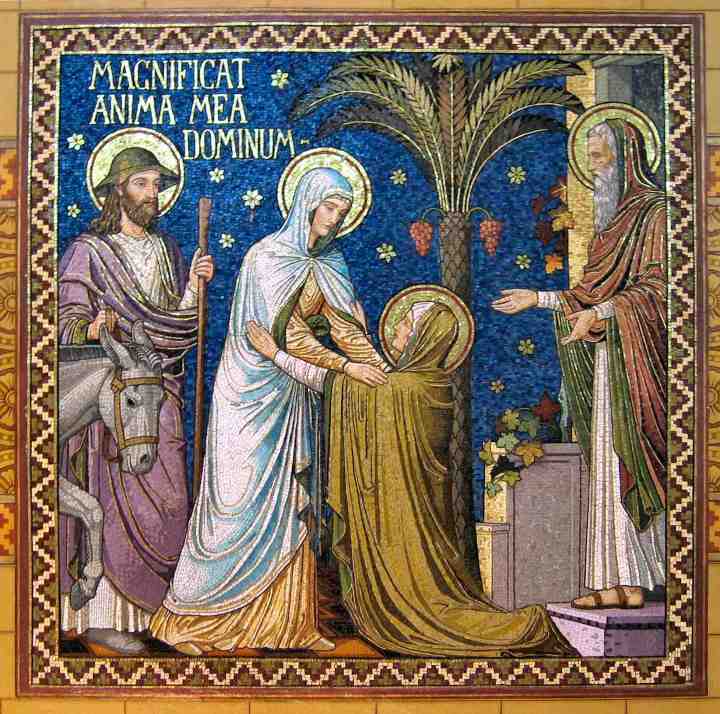
In this morning’s Gospel Mary does not tell Elizabeth that she is pregnant. By the power of the Holy Spirit, John the Baptist, the last of the prophets, announces the coming of the Saviour by leaping for joy in his mother’s womb. It’s important. There’s no time to waste: Mary arose and went with haste to see her cousin Elizabeth and tell her the Good News. Time is of the essence for us too: not for the frantic fulfilment of consumerism and the world around us: last-minute presents, or enough food to satisfy even the most gluttonous. No, we have to prepare our hearts, our minds, and our lives, so that Christ may be born again in US, so that we may live His life and proclaim his truth to the world.

Through the prompting of her son and the gift of the Holy Spirit, Elizabeth can cry ‘Blessèd are you among women, and blessèd is the fruit of your womb!’ Elizabeth recognises that Mary’s obedience, her humble ‘Yes’ to God undoes the sinfulness of Eve. That she who knew no sin might give birth to Him who would save us and all humanity from our sin. It is through the love and obedience of Mary that God’s love and obedience in Christ can be shown to the world, demonstrated in absolute perfection, when for love of us he opens his arms to embrace the world with the healing love of God on the Cross. He will be the good Shepherd, laying down his life for his flock that we may dwell secure. We prepare to celebrate Christmas because it points us to the Cross and beyond, in showing us once and for all that God loves us.

We honour Mary because in all things she points to her Son, Jesus. It’s not about her, it’s all about Him. We honour the Mother of God; we worship the Son of God. We worship Him who died for love of us, who gave himself, as the Lamb of God, that takes away the sins of the world, to die so that we might live. The process of salvation starts with a young woman being greeted by an angel, and saying, ‘Yes’ to God. Her cousin Elisabeth recognises this. Elizabeth’s son, John the Baptist, leaps in her womb. While not yet born, he recognises the presence of a Saviour, and proclaims Him. Our salvation is very close indeed. We can feel it. We know that God keeps His promises. We can prepare to celebrate the festival with JOY, because we know what is about to happen: a baby will be born who will save humanity from their sins, whom John the Baptist will recognise as the Lamb of God, who takes away the sins of the world.This is the Good news we share with the world around us: that God loves us, was born for us, and dies for us. Everything, all that Jesus is and says and does, from His taking flesh in the womb of His mother, His Birth, His life, Death and Resurrection proclaim God’s love to us:

“Behold, the days are coming, declares the Lord, when I will fulfil the promise I made to the house of Israel and the house of Judah. In those days and at that time I will cause a righteous Branch to spring up for David, and he shall execute justice and righteousness in the land. In those days Judah will be saved, and Jerusalem will dwell securely. And this is the name by which it will be called: ‘The Lord is our righteousness.’” (Jeremiah 33:14-16 ESV)

‘For I know the plans I have for you, declares the Lord, plans for welfare and not for evil, to give you a future and a hope. Then you will call upon me and come and pray to me, and I will hear you. You will seek me and find me, when you seek me with all your heart.’ (Jeremiah 29:11-13 ESV)

So my dear brothers and sisters let us prepare to meet Him, living out our faith in our lives, and encourage others so to do. So that that the world may come to believe and give glory to God the Father, God the Son, and God the Holy Spirit, to whom be ascribed as is most right and just, all might, majesty, glory, dominion, and power, now and forever.
BVM-Visitation-web

Friday, 23 December 2016

A thought for the day from Fulton Sheen

Our own fiat

It makes no difference what you do here on earth; what matters is the love with which you do it. The street cleaner who accepts in God’s name a cross arising from his state of life, such a person is the scorn of his peers; the mother who pronounces her fiat to the Divine Will as she raises a family for the kingdom of God; the afflicted in hospitals who say fiat to their cross of suffering are the uncanonised saints, for what is sanctity but fixation in goodness by abandonment to God’s Holy Will?

Seven words of Jesus and Mary


Sunday, 30 March 2014

Lent IV Year A


As we celebrate motherhood, the love and nurture of mothers, the selflessness and devotion for which everyone one of us has great cause to be thankful, we need to remember that Christian motherhood finds its greatest expression in the example of the Blessed Virgin Mary, and is rooted in the motherhood of the Church, which nurtures us in our faith, which cares for us, so that we may grow in our faith and develop into fully-grown adult Christians, regular in our prayer and our attendance Sunday by Sunday, formed evermore into the likeness of Christ, fed by Him with Word and Sacrament, nourished and nurtured by Him.
          In this morning’s Gospel we see a man in need, it is not question of his sin, or his parents’ sin, but rather of a human being in need of healing, like each and every one of us. He wants to see, while those around him, who can see display blindness. He is told to go and wash in the pool of Siloam, he obeys and is healed. The Pharisees cannot agree as to who or what Jesus is; the man can state that Jesus is a prophet, but it does not end there. The Pharisees insist on questioning the man again, he can only reply ‘I have told you already, and you would not listen.’ When he meets Jesus again, he can say regarding the Son of Man ‘tell me, so that I may believe in him.’ Jesus tells him that he is speaking to him, and he says ‘Lord I believe’ and he worshipped him.  We see a man on a journey of faith, like each and every one of us, who experiences the healing presence of God in his life, and is brought to a deeper faith in God. He is nurtured, and through his belief, his trust in God, his life is changed.
          As we continue our Lenten pilgrimage, through prayer, fasting and works of charity, we prepare ourselves and our lives to celebrate the Passion, Death, and Resurrection of Our Lord and Saviour, Jesus Christ, we should be encouraged that at its heart what we celebrate is the self-giving love of God, poured out on the world to heal us, to restore our humanity, so that we like the blind man may see, so that we may understand what God does for us, so that we may have life in all its fullness in Him. We need to have faith and trust in Him, nurtured by the Church, built up in love, fed by God, fed with God, so that we can have a foretaste of heaven, and the joy of eternal life with Christ, healed and restored by Him. This is no private matter, something we put on for an hour on Sunday morning, but rather an all-encompassing reality which has the power to change our lives and transform the entire world, a world in need of the healing love of God, to turn from the blindness of this world to the new sight of the Kingdom, a place of nurture and healing, where we can all experience the love of God, shown to us in Christ, who gave Himself for love of us, so that we might see, so that we might be fully alive, encouraged and built up in love, and sharing that love with others in everything which we say, or think, or do, so that the world may believe and give glory to God the Father, God the Son, and God the Holy Spirit, to whom be ascribed as is most right and just, all might, majesty, glory, dominion, and power, now and forever.

Sunday, 2 February 2014

Homily for Candlemas

Today the Church celebrates the Presentation of Christ in the Temple, also known as the Purification of the Blessed Virgin Mary and commonly called Candlemas. We are not quite so used to ideas of ritual purity inherent in the Thanksgiving for a woman after Childbirth, which used to be described as the Churching of Women. The Holy Family go to the Temple to give thanks to God and to comply with the Law: they demonstrate obedience, they listen to what God says and do it – as such they are a model for all Christian families to follow.
            When they go to the Temple the Holy Family encounter Simeon, a man of faith and holiness, devoted to God, and looking for the consolation of Israel, he knows that he will not die until he sees the Messiah, the Lord’s Anointed, and the Saviour of the World. As he takes the child Jesus in his arms he prays ‘Lord, now lettest thou thy servant depart in peace : according to thy word. For mine eyes have seen : thy salvation, Which thou hast prepared : before the face of all people; To be a light to lighten the Gentiles : and to be the glory of thy people Israel.’ The promise made to him by, revealed through His Holy Spirit has been fulfilled in the six-week-old infant in his arms. As Christ was made manifest to the Gentiles at Epiphany, so now His saving message is proclaimed, so that the world may know that its salvation has come in the person of Jesus Christ. Simeon speaks to Our Lord’s Mother of her Son’s future, and the pain she will endure. Before he dies Simeon is looking to the Cross, the means by which our salvation is wrought, the Cross at which Mary will stand to see humanity freed from its sin through the love and mercy of God, through grace, the free gift of God in Christ. So as Candlemas concludes our Celebration of Christmas, of the mystery of the Incarnation, so to it points to that which gives it its true meaning: the Death and Resurrection of Jesus Christ.
            That is why we are here this morning, to be fed by Christ, to be fed with Christ, truly present in His Body and Blood, Soul and Divinity – God whom we can touch and taste. A God who shares His Divine Life with us, so that we can be transformed by Him, built up as living stones as a temple to His Glory, given a foretaste of Heaven here on Earth. This is our soul’s true food, the bread for the journey of faith, a re-presentation of the sacrifice which sets us free to live for Him, to live with Him, through Him and in Him.
            The significance of what is happening is not just recognised by Simeon, but also by Anna, a holy woman, a woman of prayer, a woman who is close to God – she to recognises what God is doing in Christ, and she proclaims it, so that God’s redemption of His people may be known. Let us be like her, and let all of our lives, everything which we say, or think, or do, proclaim the saving truth of God’s love to the world. Let us burn, like the candles which God has blessed to give light and warmth to the world, so that it may believe and give glory to God the Father, God the Son, and God the Holy Spirit, to whom be ascribed as is most right and just all might, majesty, glory, dominion, and power, now and forever.


Saturday, 4 January 2014

Homily for the Epiphany


What Christ did in his own human nature in Galilee, he is doing today ... in every city and hamlet of the world where souls are vivified by his Spirit. He is still being born in other Bethlehems of the world, still coming into his own and his own receiving him not, still instructing the learned doctors of the law and answering their questions, still labouring at a carpenter’s bench, still ‘[going] about doing good’ (see Acts 10:34–43), still preaching, governing, sanctifying, climbing other Calvaries, and entering into the glory of his Father.
Fulton J. Sheen In the Fullness of Time

The Manifestation of Our Lord to the Gentiles, which the church celebrates today, is a deepening of the splendour of the Incarnation – the mystery is made manifest. With the arrival of the Wise Men from the East, the entire World is told that God is with us. Gentiles are made co-heirs, ‘members of the same body, and partakers of the promise in Christ Jesus through the gospel’. The Good news is for everybody.
          The promise is made through the words of the prophet Isaiah in this morning’s first reading. The light which is shown by the star which the Wise Men follow is the Light of the World: the true light, which gives light to all. Kings and the nations come to its brightness, they come to worship God made man; they come to pay their homage to the Saviour born among them. They come with camels, bringing gold and frankincense to worship their king and their God. They come to a stable in Bethlehem, to kneel before a manger where animals feed, and not to a royal palace, not to a throne. This is what true kingship is, true love, true glory: that of God and not of humanity.
          Herod is afraid, he fears for his own position; he worries about power, and commits infanticide to make sure of it. This very human response should stand as a warning to those who wish to follow the ways of the world. Herod clings to power; God becomes a vulnerable baby, totally dependent on others. Herod can only bring death; whereas Christ comes to bring life and life in all its fullness. Herod says he wants to worship, but it is the Wise Men who kneel before God incarnate and worship Him. They offer gold to honour a king, frankincense to worship God, and myrrh which speaks of His death. At the moment when Christ is made manifest to the world we are to look to the Cross, where the love of God will be shown must fully, and to the tomb in which his body will be laid, which will be empty.
          Likewise as we celebrate the Epiphany we also look forward to Our Lord’s Baptism in the River Jordan and his first miracle at the Wedding at Cana. He who is without sin shows humanity how to be freed from sin and to have new life in Him. In turning water into wine we see that the kingdom of God is a place of generous love, a place of joy, and of life in all its fullness.
It is a sign of the banquet where Christ feeds the faithful with the Sacrament of His Body and Blood, where God, who came to share our human nature, gives himself to us so that we might share His Divine nature, a treasure far greater and more valuable than gold, or frankincense, or myrrh – a treasure which can transform our souls and our lives, which can transform the entire world.
          So let us be filled with joy and love, may we live lives of joy, and love, and service of God and one another, which proclaim in word and deed the love of God to the world, that it may believe: so that all creation may resound with the praise of God the Father, God the Son, and God the Holy Spirit, to whom be ascribed as is most right and just, all might, majesty, glory, dominion, and power, now and forever.

The Holy Family


The Church celebrates the birth of Jesus Christ, the Son of God, not as an excuse for the saccharin-sweet pictures of babies and family much loved by advertising executives, and secular descriptions of Christmas and the family in general. We celebrate the Holy Family of Jesus, Mary and Joseph as the paradigm of human life and love. The union of husband, wife, and child is the basis of human life, human society, and the church. It brings both rights and responsibilities – it shows us how to live and how to flourish. It is rooted in love – it is costly, it requires sacrifice. As parents and children we know this all too well. The loving care and nurture we see embodied in the Holy Family reminds us of our duty to live out the same in our lives, so that we may truly flourish as human beings made in the image of God through walking in His ways.
This morning’s Old Testament Reading reminds us of the need to respect and care for our parents, to do for them what they did for us. Such gentleness and care is at the heart of our faith insofar as it allows us to live out in our lives something of the love and care shown to us by God in Christ, the love and care shown to Him by his own mother and father – the care for Him, His safety and well-being which define the relationship of love. As opposed to the fear of Herod who can only see the coming of the Christ-child as a threat to his own earthy power, in Joseph we see a father who is protective, who puts his family’s needs before his own. This generous self-giving love lies at the heart of our faith: it is shown in every part of Our Lord’s life: from the Annunciation, in his Birth, His life, His proclamation of the Good News of the Kingdom, in His healing of the sick, His forgiveness of sins, in His Passion, His Death and Resurrection.  It is central to S. Paul’s understanding of how Christians should live together: in love – letting everything we say or think or do be rooted in that genuine, costly, self-giving love which comes from God.
          This love lies at the heart of our faith, of our understanding of the human family, and how we seek to live out our faith in our lives, fashioning human society as one rooted in generous love. It makes us as the Church, a family, all equal, loved and redeemed by God, a family which we enter through our baptism, where we are clothed with Christ, where God enters a new covenant with humanity, a new covenant in the body and blood of His Son, which is given to us in Communion, so that we feast in the Banquet of the Kingdom, where humanity is given a foretaste of heaven, where we come to share in the divine life of love shown to the world in Christ Jesus Our Lord and Saviour. So let us live out this love in Our lives, may all that we think, or say, or do, proclaim the love shown to us in Christ and the Holy Family, for our good, and that of the world, that it may see and believe and sing the praise of God the Father, God the Son, and God the Holy Spirit, to whom be ascribed as is most right and just all might, majesty, glory, dominion, and power, now and forever.

Sunday, 22 December 2013

Advent IV (Year A) Still Waiting


We always make the fatal mistake of thinking that it is what we do that matters, when really what matters is what we let God do to us. God sent the angel to Mary, not to ask her to do something, but to let something be done. Since God is a better artisan than you, the more you abandon yourself to him, the happier he can make you.
 Fulton Sheen Seven Words of Jesus and Mary

The world around us can get things so wrong: with all the build-up around us we might easily think that it was already Christmas Day, that the true message of Christmas was one of conspicuous consumption, and spending money. Every year it seems that the decorations go up a bit earlier, and yet here we are in church, still waiting. I don’t know about you, but I for one am not overly keen on waiting, and yet it is what the church is called to be, to live out in the world. We are to be a people who watch and wait, in joyful hope and expectation – we are to be like Mary and Joseph – people who are waiting for God. In the prophesy of Isaiah we see the hope of salvation dawning in God-with-us, Emmanuel. God’s promise is fulfilled through the patience of Mary & Joseph, and their obedience to God’s will: ‘he did what the Angel of the Lord told him to do’. It is an obedience to the Father’s will borne out through suffering, death & resurrection which characterises the mission of the Son, this is what brings about our salvation. We in obedience look for his second coming as our Saviour and our Judge, and as the Church we have an opportunity to ponder these mysteries – to stop for a while amid the business of our modern existence and reflect upon the wondrous nature of God’s love for us and all humanity: we can stop for a moment and consider both what it means and how it affects our lives.
          As the Church, the people of God, which we enter through our baptism, we are called to proclaim the Good News, to live out the story of Jesus in our lives, and we call the world to stop and to consider exactly what we are celebrating at Christmas: a free gift, of hope and salvation for all people, in a baby, born in a stable, among the poor and the marginalised.
          The world around us is quick to judge, it wants to do the right thing – it is a bit like Joseph trying to save Mary the embarrassment and the shame. Thankfully God has other ideas, because he who will be born will save his people from their sins – what wonderful news this is. Those sins which separate us from each other and from God, this falling short of what we know we could or should be – this is what Jesus saves us from. We are to take this opportunity to stop and to ponder this wondrous fact, to reflect upon what ‘God-with-us’ means to us and our lives.
          The act of love which we will experience in Our Lord’s Nativity should draw us to love God and our neighbour, to live out the love which becomes flesh in the womb of the Virgin Mary, which will become flesh and blood that we can touch and taste, here, this morning, to feed us, so that we might share His divine life. So let us imitate the mystery we celebrate, let us be filled with and transformed by the divine life of love, let us like Mary and Joseph wait on the Lord, and be transformed by him, to live out our faith in our lives so that the world might believe and sing the praise of God the Father, God the Son, and God the Holy Spirit, to whom be ascribed as is most right and just all might, majesty, glory, dominion, and power, now and forever.