Showing posts with label Advent. Show all posts

Saturday, 5 December 2020

Advent II

Our first reading this morning from the prophet Isaiah is joyful and optimistic. It speaks of a future for Israel after exile in Babylon, and a return home. Through the prophet, God speaks words of comfort to His people. These are words we always need to hear, but especially during this time of lockdowns when many of us are exiled from our families and friends. We can be assured that God is working wonders and even though it might not feel currently like it. We can trust that all will be well in the end. The words of Isaiah are quoted in Mark’s Gospel because they look forward to the coming of the Messiah, Jesus Christ, the fulfilment of all prophecy in the Bible: in Him the glory of the Lord is revealed.

Mark’s Gospel begins with the words:

The beginning of the Good News of Jesus the Messiah, Son of God (Mk 1:1)

Followed by quotations from Malachi and Isaiah:

“Behold, I send my messenger, and he will prepare the way before me. And the Lord whom you seek will suddenly come to his temple; and the messenger of the covenant in whom you delight, behold, he is coming, says the Lord of hosts. (Malachi 3:1)

A voice cries: “In the wilderness prepare the way of the Lord; make straight in the desert a highway for our God. (Isaiah 40:3)

Mark includes these texts this to show us that, from the beginning, prophecy is being fulfilled in Jesus. John is the messenger, preparing the community for the coming of the Messiah: Jesus, who is God.

First appearing in the wilderness, John proclaims a baptism of repentance for the forgiveness of sins. He then chooses a point where the busy road from Jerusalem crosses the River Jordan and challenges all those he meets to change their ways. The Baptist calls people to repentance, to turn away from sin and to turn back to God. It is good to be reminded that God’s love and mercy are available to all of us, when we fall short of what God wants us to be. This is why the story of Jesus’ public ministry begins with His Baptism in the Jordan, and points to Golgotha, where Christ will die taking our sins, and those of all humanity upon Himself. Christ’s Death demonstrates God’s love for us and His mercy towards us. It is hard to comprehend how God could love us that much. And yet Christ gives us Himself in the Eucharist, so that His Body and Blood can transform us, so that we can share in His life on Earth and in Heaven.

John the Baptist is the last of the prophets and the voice crying in the wilderness of which the prophet Isaiah spoke. He has a challenging and uncompromising message: repent for the Kingdom of God is close at hand. It may not be what many people want to hear nowadays, but it is, however, what people need to hear. Those who flock to him are aware of their sin, and aware of their need of God’s love, mercy, and forgiveness. John the Baptist’s message may not be an easy one, but it is actually Good News. Our prayers are answered: that for which we hope, for which our soul deeply longs can be ours. Through our baptism, we share in Christ’s Death and Resurrection, and we are washed from sin and given the gift of the Holy Spirit. It is difficult to make a similar proclamation to John to today’s society, where the Church is increasingly marginalised. Yet our message must still be ‘Repent!’ because the world needs to repent, to turn away from sin and selfishness, and back to a God of love, who longs for us to have life in all its fullness. 

Words can only go so far, they need to be lived out in action, and made concrete in people’s lives and communities. When we live out the love and reconciliation we have received from Jesus Christ, we are helping to make the Kingdom of God a reality. We are showing the world that there is an alternative to the path of greed and selfishness, anger and bitterness, which blights so many lives. The world can be freed from these shackles by Christ by who He is, and what He has done. 

Advent is a penitential season, so we use the colour purple, which is dark and sombre. We do not say the Gloria (Glory be to God on high) because it is a song of celebration. We fast from it now so that we may celebrate with greater joy at Christmas. Advent is a season of repentance when we turn away from our sins, and turn back to the God who comes among us as a baby in Bethlehem and who will come as our Judge and Saviour. 

This what repentance means: turning to God so that He can transform our life and the lives of those around us. It is both an event and a process, something  we need to keep on doing, together. This is the life of faith which Christ calls us to live.So let us in this Advent season live together:

in lives of holiness and godliness, waiting for and hastening the coming of the day of God, (2Peter 3: 11-12)

Let us prepare to meet Christ filled with His love, so that we may join in the song of praise to God the Father, God the Son, and God the Holy Spirit, to whom be ascribed, as is most right and just, all might, majesty, glory, dominion and power, now and forever. Amen.

Saturday, 21 December 2019

Advent IV ‘He will save his people from their sins’

The story of salvation history, of humanity’s relationship with God can be characterised by one phrase: , ‘Paid ag ofni, Do not be afraid!’ Again and again God speaks to His people to tell them to be of good heart, to reassure and encourage them. This morning’s readings are a case in point. Joseph is afraid at the fact that his intended wife, Mary is with child. Rather than take her to court and divorce her publicly for infidelity, he intends to deal with the matter privately. Joseph is a just man, one who walks in the Law of the Lord. Joseph is someone close to God, so it is no surprise that God speaks to him in a dream. The angel is clear: the child that will be born is of the Holy Spirit, He will be the Son of God, and His name will be Jesus, because He will save His people from their sins. 

St Matthew clearly understands the Birth of Jesus as fulfilling the prophecy of Isaiah, which we heard as our first reading this morning. You ‘shall call his name Immanuel.’ (Isa 7:14 ESV) Jesus: God saves, Immanuel, God is with us. Names matter. What does is mean to say that God is with us? Is it an expression of solidarity? Or something more? In Jesus God is with us, and shares our human life, from birth to death. This is not some remote divine figure, but one intimately acquainted with all of human existence. This changes the dynamics of our relationship somewhat. God is not external, but someone who understands us, and loves us, whose entire existence is about communicating Divine Love and Reconciliation. This is all the Church has been about at its core for the past two thousand years, proclaiming the same message of hope and salvation.

He will save his people from their sins: the angel’s words to Joseph could not be clearer. Jesus is God’s rescue mission, to save humanity from their sins. It leads to the Cross, and so as we prepare to celebrate His Birth, we know that His life will end here, on Cross, where He who was without sin, became sin, experiencing all the alienation and estrangement which it produces. As we prepare the most joyous of feasts, we are mindful of the cost of God’s love. This is a love which will see the bonds of love which unite Father, Son, and Holy Spirit, ruptured, as the Son experiences death and desolation, so that we no longer have to. This is the Good News of the Kingdom of God, which the Church exists to proclaim and live out, to continue God’s work of love and reconciliation. 

Jesus will be born so that Scripture might be fulfilled, or as St Paul puts it in the beginning of his Letter to the Romans: ‘which he promised beforehand through his prophets in the holy Scriptures’ (Rom 1:2 ESV). The Church has always proclaimed this truth, because it is true. On the road to Emmaus, before He reveals Himself to them in the Eucharist,  Jesus explains the Hebrew Scriptures to them: ‘And beginning with Moses and all the Prophets, he interpreted to them in all the Scriptures the things concerning himself’ (Lk 24:27 ESV) The Church interprets Scripture as pointing to Jesus Christ because that is what Our Lord Himself does. We follow His example. It is how the Apostle Philip explains Scripture to the Ethiopian eunuch in Acts 8:35. Scripture, the Word of God, points to the Word made flesh who dwelt among us. He is its author, its focus, and the interpretative key, who unlocks its meaning. 

The final words Jesus says to His disciples before His Ascension are ‘And behold, I am with you always, to the end of the age.’ (Matt 28:20 ESV) The one who is God with us, as he departs this earth, promises to remain with us. And through His Holy Spirit, he does. He is with us in Scripture, and especially in the Eucharist, when we feast on His Body and Blood, given for us, so that we might have life in Him. God gives Himself for us, so that we might become what He is, so that we might share the Divine life of love forever. This is what salvation looks like, and tastes like. The act of love which we are preparing to celebrate in Our Lord’s Nativity should draw us to love God and our neighbour, to live out the love which becomes flesh in the womb of the Virgin Mary, which will become flesh and blood that we can touch and taste, here, this morning, to feed us, so that we might share His divine life. So let us imitate the mystery we celebrate, let us be filled with and transformed by the divine life of love, let us like Mary and Joseph wait on the Lord, and be transformed by him, to live out our faith in our lives so that the world might believe and sing the praise of God the Father, God the Son, and God the Holy Spirit, to whom be ascribed as is most right and just all might, majesty, glory, dominion, and power, now and forever. Amen.

T'oros_Roslin_-_Joseph's_Dream_-_Walters_W53917R_-_Detail_A.jpg

Advent IV ‘He will save his people from their sins’

The story of salvation history, of humanity’s relationship with God can be characterised by one phrase: , ‘Paid ag ofni, Do not be afraid!’ Again and again God speaks to His people to tell them to be of good heart, to reassure and encourage them. This morning’s readings are a case in point. Joseph is afraid at the fact that his intended wife, Mary is with child. Rather than take her to court and divorce her publicly for infidelity, he intends to deal with the matter privately. Joseph is a just man, one who walks in the Law of the Lord. Joseph is someone close to God, so it is no surprise that God speaks to him in a dream. The angel is clear: the child that will be born is of the Holy Spirit, He will be the Son of God, and His name will be Jesus, because He will save His people from their sins. 

St Matthew clearly understands the Birth of Jesus as fulfilling the prophecy of Isaiah, which we heard as our first reading this morning. You ‘shall call his name Immanuel.’ (Isa 7:14 ESV) Jesus: God saves, Immanuel, God is with us. Names matter. What does is mean to say that God is with us? Is it an expression of solidarity? Or something more? In Jesus God is with us, and shares our human life, from birth to death. This is not some remote divine figure, but one intimately acquainted with all of human existence. This changes the dynamics of our relationship somewhat. God is not external, but someone who understands us, and loves us, whose entire existence is about communicating Divine Love and Reconciliation. This is all the Church has been about at its core for the past two thousand years, proclaiming the same message of hope and salvation.

He will save his people from their sins: the angel’s words to Joseph could not be clearer. Jesus is God’s rescue mission, to save humanity from their sins. It leads to the Cross, and so as we prepare to celebrate His Birth, we know that His life will end here, on Cross, where He who was without sin, became sin, experiencing all the alienation and estrangement which it produces. As we prepare the most joyous of feasts, we are mindful of the cost of God’s love. This is a love which will see the bonds of love which unite Father, Son, and Holy Spirit, ruptured, as the Son experiences death and desolation, so that we no longer have to. This is the Good News of the Kingdom of God, which the Church exists to proclaim and live out, to continue God’s work of love and reconciliation. 

Jesus will be born so that Scripture might be fulfilled, or as St Paul puts it in the beginning of his Letter to the Romans: ‘which he promised beforehand through his prophets in the holy Scriptures’ (Rom 1:2 ESV). The Church has always proclaimed this truth, because it is true. On the road to Emmaus, before He reveals Himself to them in the Eucharist,  Jesus explains the Hebrew Scriptures to them: ‘And beginning with Moses and all the Prophets, he interpreted to them in all the Scriptures the things concerning himself’ (Lk 24:27 ESV) The Church interprets Scripture as pointing to Jesus Christ because that is what Our Lord Himself does. We follow His example. It is how the Apostle Philip explains Scripture to the Ethiopian eunuch in Acts 8:35. Scripture, the Word of God, points to the Word made flesh who dwelt among us. He is its author, its focus, and the interpretative key, who unlocks its meaning. 

The final words Jesus says to His disciples before His Ascension are ‘And behold, I am with you always, to the end of the age.’ (Matt 28:20 ESV) The one who is God with us, as he departs this earth, promises to remain with us. And through His Holy Spirit, he does. He is with us in Scripture, and especially in the Eucharist, when we feast on His Body and Blood, given for us, so that we might have life in Him. God gives Himself for us, so that we might become what He is, so that we might share the Divine life of love forever. This is what salvation looks like, and tastes like. The act of love which we are preparing to celebrate in Our Lord’s Nativity should draw us to love God and our neighbour, to live out the love which becomes flesh in the womb of the Virgin Mary, which will become flesh and blood that we can touch and taste, here, this morning, to feed us, so that we might share His divine life. So let us imitate the mystery we celebrate, let us be filled with and transformed by the divine life of love, let us like Mary and Joseph wait on the Lord, and be transformed by him, to live out our faith in our lives so that the world might believe and sing the praise of God the Father, God the Son, and God the Holy Spirit, to whom be ascribed as is most right and just all might, majesty, glory, dominion, and power, now and forever. Amen.
T'oros_Roslin_-_Joseph's_Dream_-_Walters_W53917R_-_Detail_A.jpg

Saturday, 14 December 2019

Advent III – He that will come

The prophet Isaiah provides our first readings during Advent this year, and he is particular strong on the idea that the Messiah will come to deliver Israel. As Christians we use the period of Advent to reflect upon the fact that Christ is coming, He is coming as a baby born in Bethlehem, He is coming to us here today in the Eucharist, and He is coming with vengeance to judge the world. Should we be afraid? On the contrary, as the prophet says, ‘Strengthen the weak hands, and make firm the feeble knees. Say to those who have an anxious heart,“Be strong; fear not! Behold, your God will come with vengeance, with the recompense of God. He will come and save you’ (Isa 35:3-4 ESV). 

Isaiah has a vision where the desert, a dry wilderness is carpeted with flowers, a sign of new life, of hope. This is the flourishing which the Messiah will bring, ‘the glory of the Lord, the majesty of our God’ (Isa 35:2 ESV). As Christ Himself says ‘I came that they may have life and have it abundantly’ (Jn 10:10 ESV) This is good news, a reason to rejoice and be glad, and to mark this the Church instead of penitential purple wears rose today, to mark the joyful character of this day, and to remind us that Christ is coming. As Isaiah says, ‘the ransomed of the Lord shall return and come to Zion with singing; everlasting joy shall be upon their heads; they shall obtain gladness and joy, and sorrow and sighing shall flee away’ (Isa 35:10 ESV).

The time is both now, and not yet. As St James writes, ‘You also, be patient. Establish your hearts, for the coming of the Lord is at hand’ (Jas 5:8 ESV). Patience is a hard thing to master. We are naturally impatient, we don’t want to wait, but we have to. The question is how we wait: in joyful expectation, preparing ourselves for what is to come? 

John the Baptist has been waiting for the Messiah, and while he leapt in his mother’s womb at the Visitation, in this morning’s Gospel he appears to be having doubts. He is expecting a Messiah of judgement, and he is isn’t sure what is going on. John has been imprisoned for criticising Herod’s marriage to his brother’s wife. He is hoping for a messiah to sweep away an unjust and corrupt regime, hence his doubts about Jesus, who doesn’t seem to be a political messiah. Jesus tells John’s disciples, ‘Go and tell John what you hear and see:  the blind receive their sight and the lame walk, lepers are cleansed and the deaf hear, and the dead are raised up, and the poor have good news preached to them’ (Mt 11:4-5 ESV). 

The vision of a messianic future envisaged by Isaiah in this morning’s first reading has become a reality: prophecy has been fulfilled, God keeps his promises. The Kingdom of God is a place of healing, and Christ is the great physician, who has come to heal our souls. Jesus is the one who is to come, He has come, and will come again. The establishment of God’s kingdom can look strange in human terms: going to those on the margins, the sick, the poor, and the oppressed and marginalised is not a grand gesture. That is the point! The greatest grand gesture Jesus will make will be in handing Himself over to be crucified and die the death of a common criminal. This is how the messiah will reign as the true King of Israel. 

It defies human expectations, which is the point: God’s ways are not our ways, nor His thoughts ours. That’s the core message of this morning’s Gospel, if we expect God’s rule to look like human kingship, then we will be disappointed. God has something else in store, something far more wonderful than we could ever imagine, and at its heart is the transformation of humanity by love. God heals His people, because God is a God of love. God loves us not because we are loveable, we are sinners, who don’t deserve to be loved, and cannot earn that love. But rather than what we are, God loves us for WHO we are, His sons and daughters, created in His image. 

This is grace: loving sinful humanity so that we may be transformed by love. Hence the focus on healing, something which only God can do, to heal our souls with His love. This is the cause of our joy, what the prophet Isaiah hoped for has been fulfilled, and continues to be fulfilled. The Church exists to carry on God’s healing in the world, to take humanity, and heal it with God’s love. This is what we are about to celebrate in the Eucharist where we thank God for loving us, and prepare to experience that healing love, so that it may transform us. We do so with reverence, because we are not simply consuming human food and drink, but the very Body and Blood of Christ, given for us, to heal us. The greatest medicine our souls could ever wish for. Soon we ‘shall see the glory of the Lord, the majesty of our God’ (Isa 35:2 ESV) God’s glory and majesty is to die on a Cross for us, and to feed us with Himself. Come to the banquet my brothers and sisters, and experience the love of God, and let it heal and transform you, so that you and all creation may sing the praises of God the Father, God the Son, and God the Holy Spirit, to whom be ascribed as is most right and just all might, majesty, glory, dominion, and power, now and forever. Amen.

Raphael_-_Madonna_in_the_Meadow_-_Google_Art_Project.jpg

Saturday, 7 December 2019

Advent II Yr A – REPENT

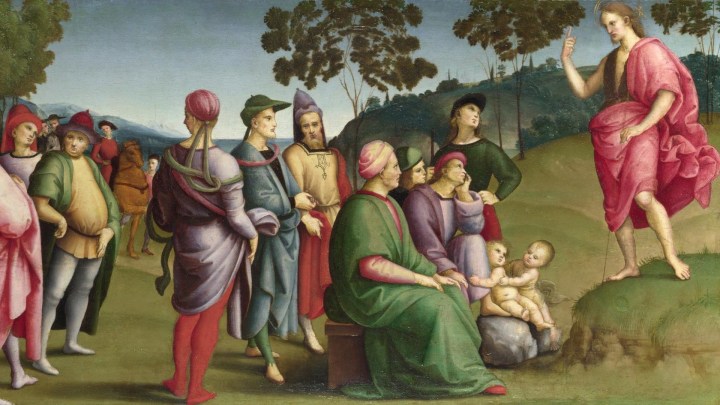
John the Baptist appears in this morning’s Gospel in stark un-compromising fashion. His message is simple, ‘Repent, for the Kingdom of God is at hand’ (Mt 3:2 ESV). It is a clear message, but to understand it takes some work. To repent means to change ones mind: to turn away from sin, and turn back to God. We are called to think differently, and as a result of this to act differently, to follow Jesus, and thereby to change the world, by co-operating with God to make the Kingdom a lived reality here and now, and to share in it forever. To repent is to turn away from sin, which separates us from God, and each other. Sin makes us selfish, self-absorbed, concerned with pleasure, wealth, power. It’s all about ME, how I feel, what I want. The proclamation of the Kingdom of God tells us that another way is possible, by the grace of God. It sounds exciting, doesn’t it? Freeing, liberating: living for others rather than ourselves. At its heart the Kingdom is a place of generosity and real love, life in all its fullness. The Church exists to proclaim this same message, and to say to the world: Another way is possible.

It is not surprising that in those times people came out into the desert to hear John. He was charismatic, his message was a refreshing antidote to the Religious Establishment of his day. People come, confess their sins, and are baptised, they are washed clean, to serve God, and to love Him. They also come because in John the people of Israel see prophecy fulfilled, and a new Elijah is in their midst. One who points to the Messiah, and has done ever since he leapt in his mother Elizabeth’s womb at the Visitation. Before John was even born he proclaimed that Jesus was the Christ, the Messiah, the One who would save Israel from their sins. We see this Messianic kingdom hoped for in the vision of Isaiah in this morning’s first reading. The branch which comes forth from the stem of Jesse is the Blessed Virgin Mary, who filled with God’s Holy Spirit, conceived and bore Our Saviour, the true King of all that is, or has been, or will be. He will be on the side of the poor and the meek, people who are left behind, and ignored because they are not rich or powerful. It’s a radical vision, which reminds us that we still have some way to go in order to put it into practice in the world around us. Isaiah’s vision of Messianic peace looks impossible, but it signifies a world-changing peace, which alters how things are, how we behave. For with, and through God another way is possible. It is not simple, or easy, but it is possible, if we rely upon God to help us. As St Paul says to the Christians in Rome, ‘May the God of endurance and encouragement grant you to live in such harmony with one another, in accord with Christ Jesus, that together you may with one voice glorify the God and Father of our Lord Jesus Christ. Therefore welcome one another as Christ has welcomed you, for the glory of God.’ (Romans 15:5-7 ESV) and again ‘May the God of hope fill you with all joy and peace in believing, so that by the power of the Holy Spirit you may abound in hope’ (Romans 15:13 ESV). We receive the Holy Spirit in our Baptism and Confirmation to strengthen us to live out our faith in our lives.

Hope can feel in pretty short supply when we look at the world around us, and if we look to humanity we will be disappointed. Our hope comes from God, our hope is God, God with us, whose Birth we are preparing to celebrate at Christmas. Advent is a time of preparation, when we prepare for Christ to come, both as a baby in Bethlehem, and as our saviour and our Judge. As the son of Jesse, and the son of David, Jesus is Israel’s true king, who rules over all. Isaiah has hope in the peace the Messiah will bring. Injustice and affliction, the fruit of sin is dealt with on the Cross, where He ‘shall stand as a signal for the peoples’ (Isa 11:10 ESV). Christ comes to die, out of love for humanity. In Him God can make things put right, and restore Creation, so that the entire Universe may praise the God who created it. 

Our Saviour is also our judge. ‘His winnowing fork is in his hand, and he will clear his threshing floor and gather his wheat into the barn, but the chaff he will burn with unquenchable fire.’ (Matt 3:12 ESV) It’s real, and it should make us stop and think for a moment. Are we living the way God wants us to? If we are not then we need to repent, say sorry, and live the way God wants us to live. This is how we flourish as people. John the Baptist calls us to make a spiritual u- turn, to turn our life around, to turn away from what separates us from God, our sins. He calls us to the waters of baptism, so that we can be healed and restored by God, filled with his grace, and prepared to receive the Holy Spirit: “I baptize you with water for repentance, but he who is coming after me is mightier than I, whose sandals I am not worthy to carry. He will baptize you with the Holy Spirit and fire” (Mt 3:11). The problem with the Pharisees and Sadducees who come to John is that they do not show the repentance necessary, they haven’t made the u-turn, they don’t have the humility to recognise there sinfulness, and the need to be washed in the waters of baptism. They are confident that they are children of Abraham; they don’t have the right attitude for God to be at work in their lives.

As well as seeing Jesus as our Saviour, John the Baptist sees Jesus as Our Judge, he points to the second coming of the Lord when, as St John of the Cross puts it, ‘we will be judged by love alone’.  It is love that matters – in Christ we see what love means it is costly, self-giving and profound. As we are filled with His Spirit, nourished by Word and Sacrament, we need to live out this love in our lives. This is how we prepare to meet him as we prepare to celebrate His Birth and look forward to his Second Coming. So let us be prepared, let us live out God’s love in our lives, let us turn away from everything which separates us from God and each other, let us live out that costly, self-giving love in our lives, as this is what God wants us to do. It is through doing this that the world around us can see what our faith means in practice, how it affects our lives, and why they could and should follow Him, and sing the praises of God the Father, God the Son, and God the Holy Spirit, to whom be ascribed as is most right and just all might, majesty, glory, dominion, and power, now and forever. Amen.  

n-6480-00-000022-hd.jpg

Saturday, 30 November 2019

Advent I (Year A)

Just over one hundred and one years ago a war ended that was supposed to be ‘the war to end all wars’. Instead the last century has seen very little peace. We are lucky in Western Europe that we have experienced 70 years without conflict, but there have been wars elsewhere. Humanity is still plagued by warfare: the loss of life, the crimes committed, lives blighted. So when we hear the prophecy of Isaiah in this morning’s first reading it is truly joyful. Beating swords into ploughshares and turning spears into pruning hooks sounds wonderful indeed. Growing crops and tending vines provides us with food and drink. It is a sign of peace, joy, and prosperity. And at the time when Christ was born, and we are preparing to celebrate the yearly memorial of his birth at Christmas, this prophecy was fulfilled. There was peace in the Roman World when Christ was born, scripture was fulfilled. And we look forward to such peace coming again, and we work for it, together. The messianic age which we look forward to  shows us what truly following Christ looks like in practice. If we walk in the light of the Lord, we are freed from the darkness of sin and destruction, which threatens to overwhelm us. 

This same message is found in St Paul’s Letter to the Romans, our second reading this morning. It is an encouraging message, that another way is possible. Instead of sleep-walking towards damnation and destruction, we can be awake and ready to follow Christ. Every day is another day closer to Christ’s Second Coming. He will come again, as our Saviour and our Judge. We need to be ready, putting on the armour of light, putting on Christ, through our baptism, and living out the faith of our baptism in our lives. The capital of the Roman Empire was renowned for tolerating some pretty immoral behaviour. It was everywhere, all around the Christian community there. Were they tempted to join in? Of course! But St Paul advises them to resist the pleasures of the flesh, drunkenness, quarrelling, nastiness: all the sorts of things we can get up to if left to our own devices.

St Paul speaks to us, to encourage the church and its members, you and me, not to give into the culture of the world around us, but to stay close to Christ. It is easy in theory, but tricky in practice. It’s easier when you’re part of a community. We can help and support each other, in good times and bad. It’s why people join Slimming World or Weightwatchers. They’re trying to change their lifestyle and eating habits, and find the support of a group a great help. Never think that small groups do not have the power to change the world. We are living proof of it as Christians, and it is why we are HERE today: to support each other, to be built up in love together, to turn away from the ways of the world, and to follow Christ. 

We follow Christ and we are ready. We prepare for Christ to come among us. That’s what Advent means, Christ’s coming. We prepare for three comings: the first our annual commemoration of His birth in Bethlehem, at Christmas, where the Word became flesh and dwelt among us. The second coming of Christ will be at the end of time, when He will be our Saviour and our Judge. The third coming we prepare for is even nearer. It happens day by day, and week when Christ comes to us in the Eucharist, in His Body and Blood, under the outward forms of Bread and Wine, the Banquet of the Kingdom, anticipated by the ploughshares and pruning hooks of Isaiah, tools to help produce Bread and Wine, a prophecy which looks forward to the peace of the Messiah and a banquet of Bread and Wine. Food of the Kingdom, food for our journey of faith, to give us strength and new life in Christ. Christ comes to us in the Eucharist to give us strength and to transform us, into His likeness. This is the reality of God’s love for us, shown to us on the Cross, and in the Resurrection, a pledge, a sure sign of love, love we can touch and taste, love which transforms us.

We need it, and we need it together. It is why we gather together on the day when Christ rose from the dead to celebrate His triumph, and ask for His prayers. Because as St Matthew’s Gospel tells us, we need to be ready. We need to be ready because ‘the Son of Man is coming at an hour you do not expect.’ (Mt 24:44 ESV) It could be that between my writing these words and delivering them, Christ will come. Christ could come today, or in thousands of years’ time. It doesn’t matter when He comes. We need to be ready, prepared to meet Him, freed from sin, and living out our faith in our lives, having heeded the warnings to prepare ourselves. That’s why Advent is a penitential season, we are reminded of how we fall short, and try, with God’s grace, to amend our lives and follow Christ.

That is why in this morning’s Gospel reading Christ says, ‘For as were the days of Noah, so will be the coming of the Son of Man.’ (Mt 24:37 ESV). Before the flood in Genesis we se that humanity was corrupt and violent, and sinful. The point Christ is making is that this is how the world will be; Christians should not be like this, because we have put on Christ, we are walking in the light, supporting each other, as a community of faith, living out the love we have been shown in Christ. At a time we do not expect, Our Lord will return, so we need to be ready, so that whenever He comes Christ may find us ready, and prepared to meet him.  

We need to prepare our hearts, our souls, our minds, all of our life, we need to live and act, to think and speak like the people of God, fully alive in him, having turned away from the ways of the world, to live fully in him, we are to live this way, and invite others so to do, so that the Kingdom of God’s peace and love may truly be found here in earth, where humanity is truly valued, where violence, death, murder, and immorality are no more.

The time is short, the time is now, it really matters; we need to come to the Lord, learn his ways and walk in his paths, living decently, living vigilantly, preferring nothing to Christ, and inviting all the world to come to the fullness of life in Him. This is how we celebrate His coming at Christmas and as Our Saviour and Judge, by following him, fed by Him, restored and healed by Him, and sharing His church’s message with all the world, so that it too may believe and sing the praise of God the Father, God the Son, and God the Holy Spirit, to whom be ascribed as is most right and just all might, majesty, glory, dominion, and power, now and forever.

Last_Judgement_(Michelangelo).jpg

Saturday, 22 December 2018

Advent IV Year C

The journey from Nazareth to Bethlehem would have taken Mary and Joseph about a week on foot, it’s hard work, and uphill all the way. Bethlehem was associated with two figures in the Bible: David, Israel’s second king, and his ancestor Ruth, the Moabitess, whose love and devotion to her mother in law Naomi are inspiring. It is a hill town, and source of water about five miles south of Jerusalem, where shepherds would raise sheep for the Passover sacrifice in the Temple, first-born males, holy to the Lord. A fertile, fruitful place, a place of promise. It is a place with the prophet Micah sees as the starting place for a future for Israel. One ‘whose coming forth is from of old, from ancient days’ (Micah 5:2 ESV) The Incarnate Word of God, who has always been, and will always be: Our Lord and Saviour Jesus Christ. The Good Shepherd, who will ‘shepherd his flock in the strength of the Lord, in the majesty of the name of the Lord his God. And they shall dwell secure, for now he shall be great to the ends of the earth. And he shall be their peace.’ (Micah 5:4-5a ESV) He will be our peace, because He makes peace, ‘For in him all the fullness of God was pleased to dwell, and through him to reconcile to himself all things, whether on earth or in heaven, making peace by the blood of his cross.’ (Colossians 1:19-20 ESV) What is prophesied by Micah is fulfilled in Jesus. All scripture points to Him, and finds its fulfilment in Him, the Word made Flesh. 

In the letter to the Hebrews we see the prophecy of Psalm 40:6-8 fulfilled in Christ. The sacrifices of the old covenant are replaced in the new covenant with the sacrifice of God for humanity. Sacrifice is fulfilled and completed, once and for all. It is this sacrifice, which the church pleads and re-presents. The eternal offering of a sinless victim, to free humanity of its sins, to restore our relationship with God and one another. It is an act of perfect obedience: the body prepared by God for Christ to do His will and sanctify humanity, to heal us and restore us.

In this morning’s Gospel Mary does not tell Elizabeth that she is pregnant. By the power of the Holy Spirit, John the Baptist, the last of the prophets, announces the coming of the Saviour by leaping for joy in his mother’s womb. It’s important. There’s no time to waste: Mary arose and went with haste to see her cousin Elizabeth and tell her the Good News. Time is of the essence for us too: not for the frantic fulfilment of consumerism and the world around us: last-minute presents, or enough food to satisfy even the most gluttonous. No, we have to prepare our hearts, our minds, and our lives, so that Christ may be born again in US, so that we may live His life and proclaim his truth to the world.

Through the prompting of her son and the gift of the Holy Spirit, Elizabeth can cry ‘Blessèd are you among women, and blessèd is the fruit of your womb!’ Elizabeth recognises that Mary’s obedience, her humble ‘Yes’ to God undoes the sinfulness of Eve. That she who knew no sin might give birth to Him who would save us and all humanity from our sin. It is through the love and obedience of Mary that God’s love and obedience in Christ can be shown to the world, demonstrated in absolute perfection, when for love of us he opens his arms to embrace the world with the healing love of God on the Cross. He will be the good Shepherd, laying down his life for his flock that we may dwell secure. We prepare to celebrate Christmas because it points us to the Cross and beyond, in showing us once and for all that God loves us.

We honour Mary because in all things she points to her Son, Jesus. It’s not about her, it’s all about Him. We honour the Mother of God; we worship the Son of God. We worship Him who died for love of us, who gave himself, as the Lamb of God, that takes away the sins of the world, to die so that we might live. The process of salvation starts with a young woman being greeted by an angel, and saying, ‘Yes’ to God. Her cousin Elisabeth recognises this. Elizabeth’s son, John the Baptist, leaps in her womb. While not yet born, he recognises the presence of a Saviour, and proclaims Him. Our salvation is very close indeed. We can feel it. We know that God keeps His promises. We can prepare to celebrate the festival with JOY, because we know what is about to happen: a baby will be born who will save humanity from their sins, whom John the Baptist will recognise as the Lamb of God, who takes away the sins of the world.This is the Good news we share with the world around us: that God loves us, was born for us, and dies for us. Everything, all that Jesus is and says and does, from His taking flesh in the womb of His mother, His Birth, His life, Death and Resurrection proclaim God’s love to us:

“Behold, the days are coming, declares the Lord, when I will fulfil the promise I made to the house of Israel and the house of Judah. In those days and at that time I will cause a righteous Branch to spring up for David, and he shall execute justice and righteousness in the land. In those days Judah will be saved, and Jerusalem will dwell securely. And this is the name by which it will be called: ‘The Lord is our righteousness.’” (Jeremiah 33:14-16 ESV)

‘For I know the plans I have for you, declares the Lord, plans for welfare and not for evil, to give you a future and a hope. Then you will call upon me and come and pray to me, and I will hear you. You will seek me and find me, when you seek me with all your heart.’ (Jeremiah 29:11-13 ESV)

So my dear brothers and sisters let us prepare to meet Him, living out our faith in our lives, and encourage others so to do. So that that the world may come to believe and give glory to God the Father, God the Son, and God the Holy Spirit, to whom be ascribed as is most right and just, all might, majesty, glory, dominion, and power, now and forever.

BVM-Visitation-web

Sunday, 2 December 2018

Advent I Year C: Jer 33:14-16; 1Thess 3:9-4:2; Lk 21:25-36

Advent is a time to be alert, to be watchful, because we are to be ready for Christ when He comes: in our hearts, through faith, in our annual remembrance of His birth at Christmas, and when He will come again as our Saviour and our Judge. We need to be ready, which is why we have this season of preparation, to help us. We don’t say the Gloria in excelsis, so that it may ring out with joy, as we join our voices with the angels celebrating Christ’s birth at Christmas.We use purple, a dark colour which reminds us both of royalty and penitence. We serve a King, and we are aware of our own shortcomings, and our need to prepare to meet Christ. It is good and healthy to be reminded of how we have all fallen short, to ask God for forgiveness and mercy, and to be reminded that God is loving and merciful, and has taken away our sins on the Cross, to save us.

In our first reading this morning, the prophet Jeremiah declares that God fulfils His promises: we can trust Him. He will cause a righteous branch to spring forth, His Son, Jesus, who embodies justice and righteousness. Jesus shows us how to live, declares God’s love, and dies for love of us. In the Letter to the Thessalonians   we see the injunction to be loving one another and all people, because LOVE is the heart of the Gospel, the Good News of Jesus Christ. God loves us, so we should love one another. This is how we should live and be pleasing to God, and prepare for the fact that Jesus is coming again. 

If we consider the parable in today’s Gospel, the parable of the Fig Tree, two things are apparent, firstly fig trees are clearly visible and easily recognisable in the Middle Eastern Landscape – when Our Lord comes it will be apparent to all and sundry. Secondly, figs, as fruit take a long time to ripen, so as their visibility shows us that the Kingdom of God is close at hand, their long ripening shows us that we need to be prepared to wait, for all things will happen at their appointed time, a time which even the Son Himself does not know.

In the meantime we need to guard against Drunkenness and Hangovers (not those caused by the inevitable Christmas party) but the metaphorical kind –- a lack of alertness, a sluggishness with regard to the Gospel, and an excessive concern with the worries of this life, instead we need be alert and watchful which will allow us to ‘stand tall when others faint’. We need to be prepared to meet Jesus as our Saviour and our Judge, freed from the cares of this world

God has made a promise, through the mouth of His prophet, Jeremiah, a promise of salvation and safety, which is brought about through the Blessed Virgin Mary’s ‘Yes’ to God, which will lead to the Incarnation and thereby the Salvation of the whole world wrought upon the altar of the Cross. It is this faithful and loving God whom we wait for, a merciful judge. Thus, Advent, the preparation for the coming of Jesus as new-born infant and Judge is a time of hope and joy. We can like the Apostle Paul in his letter to the Church in Thessalonica be filled with joy for the Lord, resolute in our prayer for and encouragement of one another as a Christian family. 

This prayer and encouragement leads to an increase of love for both God and our neighbour. This is what living the Christian life means, something we do all through the week. This is the preparation we, as Christians, need. It is something which we cannot do on our own; we need to do it together, encouraging one another to live lives filled with the love which comes from God, which is God’s very nature as a Trinity of persons. This love and a freedom from the cares of this world is what Jesus comes to bring us, this is our deliverance, our liberation from sin. It is this love and freedom which makes God give himself to us this morning under the outward forms of Bread and Wine, a love we can touch and taste, which will transform us, and fill us with His love.

What greater present could we offer to the Infant Jesus than hearts filled with love and lives lived in the true freedom proclaimed by the Gospel. Thus, at one level it doesn’t matter whether the Second Coming is today or in a million years time, what matters is living lives infused with the values of the Kingdom of God, a joyful and yet a serious business. We know what we should be doing, and this is something we as Christians need to do together, praying for the Grace of God to help us, to strengthen us and fill us with that Love which comes from Him. We may feel unsure, unsafe, and worried but relying on God as part of His family, the Church, we can take courage and be alert to take part in that great adventure which is the Kingdom of God.

50e5f-1st_sun_of_advent_pic

Saturday, 16 December 2017

Advent III Year B

As Christians our vocation is a simple one: joy. This is not, however, worldly joy, the fruit of consumerist excess, a joy of stuff: what we have, what we can buy, or own, or sell, but something far deeper and far richer, which comes from God. We are to be people of JOY, filled with it, and sharing it with others.

We rejoice that our yearly memorial of Our Lord’s nativity is drawing near – a birth which changes everything, which brings about the salvation of humanity. This is the most wonderful news that the world could ever hear, and hear it they must.

In this morning’s Gospel John the Baptist has been preaching a baptism of repentance, a turning away from sin towards the arms of a loving God. He has been stark and uncompromising in his message, as a prophet should be. The people to whom he has been preaching find themselves in an awkward situation, and yet they are drawn to the Good News. They can’t quite understand what’s going on: Is John the Messiah? If he isn’t, who then is he? He calls people to the baptism of repentance in the knowledge that Christ’s gift of His Spirit is coming. He is preparing for the Kingdom of God to be a reality in people’s hearts, and minds, and lives

The state, the church, and the world around us all seem to be in a mess. There is political instability, fears for the future, tyrants and demagogues in power. The peace which the Messiah came to bring it seems as elusive as ever, whereas the human capacity to create misery in the most dreadful ways makes us realise that we still have some considerable distance to travel. One possible answer is the need for repentance: to change our hearts and minds and to follow Christ.

Our readings this morning speak of the kingdom of God. It is a kingdom of love and freedom: good news to those who are oppressed, a healing love which binds up the broken-hearted, a kingdom of healing and of renewal, which proclaims liberty, which releases prisoners. It turns the world on its head, and offers something completely different: comfort to those who mourn, a mantle of praise, a garment of joy and salvation, which we have put on in our baptism.

In all our sadness and sin, we look forward to our yearly remembrance of our Lord’s incarnation. We prepare our hearts, our minds, and our lives, to go to Bethlehem, to see God come into the world naked, vulnerable, and homeless, utterly reliant on Mary and Joseph. We also prepare to meet him as he will come again, as our Saviour and our Judge. It is a daunting prospect, yet we know and trust that he saves us, that by his wounds on the cross we are healed, our sins are forgiven.

We are to rejoice, strange though it might seem, just like the people of Israel in captivity, in a God who loves us, who heals and restores us, who gives us real hope for the future. In the midst of our sorrow we are to place all our hope and trust in God who loves us, and who saves us.

We are to rejoice, as S. Paul reminds the Thessalonians, we are to be filled with a joy which leads to prayer, to a relationship with God. We give thanks to God for what Christ has achieved and will achieve. It encourages us to hold fast to what is good and abhor what is evil. In living out our faith we are drawn ever closer to the God who loves us and saves us. We draw close to Jesus in His word, and in the Sacrament of the Altar, where we are fed with His Body and Blood, so that we can be sanctified by God, and share in his divine life and joy.

We are to share this joy with others, to share the good news of Jesus Christ with all people, and not just in our words but our deeds. If we share what we have, if we are generous, if we work for justice and are clothed with humility, showing our joy in mutual love, God’s kingdom will be advanced. We, here, now, know that Jesus will come and will judge us by the standard of love which he set for us to follow. Let us trust God and share that trust in prayer, that his will may be done, and that he may fill us with his love.

The world around us is full of pain and anguish, and the only way for it to be healed is in Christ, who was bruised for our transgressions and wounded for our iniquities. He still bears those wounds as the wounds of love. As he flung out his arms on the cross, so he longs to embrace the world and fill it with his peace and love. He will not force us; he is no tyrant in the sky. It is the world which must turn to him in love and in trust, and turn away from sin. Our task is always only all things to be joyful in the Lord, and to live out our faith to help the world turn to him.

It isn’t an easy thing to do, and after 2000 years of trying we may seem as far away as when John proclaimed the coming of God’s kingdom. We could just give up, or we can try, and keep trying, no matter how many times we fail, secure in the knowledge that God loves us and forgives us. The One who calls us is faithful, and He will do this. Let us trust in Him, be fed and nourished by Him, with Him, filled with His Holy Spirit, so that all the world may come to believe and trust in Him, and give glory to God the Father, God the Son, and God the Holy Spirit, to whom be ascribed as is most right and just, all might, majesty, glory, dominion, and power, now and forever.

3rd_Sun_of_Advent_Pic.jpg


Sunday, 10 December 2017

Advent II Mark 1:1-8

If you ask children and young people today what they want to be when they grow up most will now answer that they want to be famous, they want to be a celebrity, not famous for being something, just famous. Such isthe power of the modern idea of celebrity, people famous for being famous. Such is the world in which we live: shallow, skin-deep, concerned with self above all else, selfish, self-absorbed, and sinful.

In the beginning of Mark’s Gospel we see Jesus’ cousin, John the Baptist, someone who has clearly got something of a reputation: people are coming from all over Judaea to hear him preach. John does not use this as an opportunity for his own glorification, but rather points to the one who is to come after him, the Messiah, Jesus Christ. Unlike celebrities who point to themselves John the Baptist points to another – it’s all about Him, not me. This is humility in action – being firmly rooted and knowing your need for God.

Advent is a season of penitence and preparation, saying sorry and getting ready. Recognising that we fall short of what God expects of us, and yet also remembering that He is a God of love and mercy. This is shown clearly in the opening of this morning’s first reading from the prophet Isaiah. God speaks through the prophet saying, ‘Comfort my people’ a God who longs for healing and restoration, and who will bring it about in the person of His Son, Jesus Christ, the Messiah. The prophets look for the coming of one who will ‘feed his flock like a shepherd’ who will ‘gather the lambs in his arms, and carry them in his bosom, and gently lead the mother sheep.’ (Isa 40:11). Jesus is the Good Shepherd, and John the Baptist is the one who will say to the people of Judah ‘Behold your God’ (Isa 40:9). In the church we prepare to do exactly the same thing, to say to the world, ‘Here is your God’.

At the heart of it all lies the proclamation of the Gospel, St Mark’s Gospel, which we begin this morning. At the start of a new liturgical year we can proclaim a new beginning, just like John the Baptist. It is a change to start off with a clean, fresh page. The Good News of Jesus Christ is a proclamation, like that in the prophet Isaiah which says, ‘Behold your God’. That is who and what Jesus IS. The Messiah, the Son of God, the one who fulfils, scripture, in this case Malachi (3:1) Moses (Exod 23:20) and Isaiah (40:3). John the Baptist, the last of the prophets, proclaims a baptism of repentance for the forgiveness of sins. He calls the people of Israel to turn away from what separates them from God and each other, and to seek God’s forgiveness. It sounds simple enough, but facing up to the wrong that we say, think, and do, is no easy thing at all. Recognising that we have fallen short of what God expects of us is the first step to turning back. It’s hard to face up to the truth, but we have to if we want God to do something about it. We need to remember that God loves us and is merciful. This is the reason why He sends us His Son, to be born for us, to live for us, to die for us, to rise again for us, to send us His Holy Spirit, and to come again to judge us. Our God is not a tyrant in the sky, but a loving Father.

It probably does us all some good to think like this from time to time, not so that we feel wretched and depressed, but so that we recognise our need for God, that we turn to him again, that this time of Advent is part of our ongoing spiritual journey – turning away from sin and towards Christ. The Christian faith is the work of a lifetime, and of a community: it is something we all have to do together.

In the Gospel the people of Israel recognise the proclamation of John the Baptist; they come to him and confess their sins and are baptised. His message is a simple one, Repent for the Kingdom of God is at hand. He calls people to turn back to a God of love, and he points forward to the one who is to come, he points to Jesus, who will baptise with the Holy Spirit.

The Church exists to carry on the same proclamation, the same message, to point to the same Saviour. At one level, the idea of judgement worries me deeply, as I suspect if I were all up to me and my efforts, and were I simply to be judged on my own life I would not get to heaven – I cannot earn my way there. I, like all of you, and indeed all of humanity, are simply miserable sinners in need of God’s grace, his love and his mercy. We need Christ to be born, we need Him to die for our sins, and to rise again to give us the hope of eternal life with Him.

Thankfully, we as Christians know that he will come to be our judge is our redeemer, who bore our sins upon the cross, he is loving and merciful. Just as the arms of the prodigal son’s father are wide open to embrace him, so too Christ’s arms are flung wide upon the cross to embrace the world, our judge will come bearing wounds in his hands, his feet, and his side, because they are the wounds of love. We can have hope and confidence in this.

John the Baptist’s message is uncomfortable and yet it is GOOD NEWS – our prayers are answered- that for which we hope, for which our soul deeply longs is truly ours. It may not be what people want to hear, but it is, however, what people NEED to hear. Thus people flock to him, they are aware of their sin, aware of their need of God, of His love, mercy, and forgiveness. His message is one of repentance, of turning away from sin, from the ways of the world, a world which seeks to change our celebration of our Lord’s nativity into an orgy of consumerist excess. His is the birth, his is the way by which we can find true peace, we can turn to Christ, we can be like Him.

How then do we respond? We respond by living lives of godliness and holiness, by striving to be found by him at peace, a peace which prepares for His coming. We are patient, we wait in expectant hope, living out our faith, and encouraging others so to do so that all the world may be saved and give glory to God the Father, God the Son, and God the Holy Spirit, to whom be ascribed as is most right and just, all might, majesty, glory, dominion, and power, now and to the ages of ages.

Season_of_Advent.jpg


Saturday, 9 December 2017

Advent II Mark 1:1-18

If you ask children and young people today what they want to be when they grow up most will now answer that they want to be famous, they want to be a celebrity, not famous for being something, just famous. Such is the power of the modern idea of celebrity, people famous for being famous. Such is the world in which we live: shallow, skin-deep, concerned with self above all else, selfish, self-absorbed, and sinful.
In the beginning of Mark’s Gospel we see Jesus’ cousin, John the Baptist, someone who has clearly got something of a reputation: people are coming from all over Judaea to hear him preach. John does not use this as an opportunity for his own glorification, but rather points to the one who is to come after him, the Messiah, Jesus Christ. Unlike celebrities who point to themselves John the Baptist points to another - it’s all about Him, not me. This is humility in action - being firmly rooted and knowing your need for God.
Advent is a season of penitence and preparation, saying sorry and getting ready. Recognising that we fall short of what God expects of us, and yet also remembering that He is a God of love and mercy. This is shown clearly in the opening of this morning’s first reading from the prophet Isaiah. God speaks through the prophet saying, ‘Comfort my people’ a God who longs for healing and restoration, and who will bring it about in the person of His Son, Jesus Christ, the Messiah. The prophets look for the coming of one who will ‘feed his flock like a shepherd’ who will ‘gather the lambs in his arms, and carry them in his bosom, and gently lead the mother sheep.’ (Isa 40:11). Jesus is the Good Shepherd, and John the Baptist is the one who will say to the people of Judah ‘Behold your God’ (Isa 40:9). In the church we prepare to do exactly the same thing, to say to the world, ‘Here is your God’.
At the heart of it all lies the proclamation of the Gospel, St Mark’s Gospel, which we begin this morning. At the start of a new liturgical year we can proclaim a new beginning, just like John the Baptist. It is a change to start off with a clean, fresh page. The Good News of Jesus Christ is a proclamation, like that in the prophet Isaiah which says, ‘Behold your God’. That is who and what Jesus IS. The Messiah, the Son of God, the one who fulfils, scripture, in this case Malachi (3:1) Moses (Exod 23:20) and Isaiah (40:3). John the Baptist, the last of the prophets, proclaims a baptism of repentance for the forgiveness of sins. He calls the people of Israel to turn away from what separates them from God and each other, and to seek God’s forgiveness. It sounds simple enough, but facing up to the wrong that we say, think, and do, is no easy thing at all. Recognising that we have fallen short of what God expects of us is the first step to turning back. It’s hard to face up to the truth, but we have to if we want God to do something about it. We need to remember that God loves us and is merciful. This is the reason why He sends us His Son, to be born for us, to live for us, to die for us, to rise again for us, to send us His Holy Spirit, and to come again to judge us. Our God is not a tyrant in the sky, but a loving Father.
It probably does us all some good to think like this from time to time, not so that we feel wretched and depressed, but so that we recognise our need for God, that we turn to him again, that this time of Advent is part of our ongoing spiritual journey – turning away from sin and towards Christ. The Christian faith is the work of a lifetime, and of a community: it is something we all have to do together.
In the Gospel the people of Israel recognise the proclamation of John the Baptist; they come to him and confess their sins and are baptised. His message is a simple one, Repent for the Kingdom of God is at hand. He calls people to turn back to a God of love, and he points forward to the one who is to come, he points to Jesus, who will baptise with the Holy Spirit.
The Church exists to carry on the same proclamation, the same message, to point to the same Saviour. At one level, the idea of judgement worries me deeply, as I suspect if I were all up to me and my efforts, and were I simply to be judged on my own life I would not get to heaven – I cannot earn my way there. I, like all of you, and indeed all of humanity, are simply miserable sinners in need of God’s grace, his love and his mercy. We need Christ to be born, we need Him to die for our sins, and to rise again to give us the hope of eternal life with Him.
Thankfully, we as Christians know that he will come to be our judge is our redeemer, who bore our sins upon the cross, he is loving and merciful. Just as the arms of the prodigal son's father are wide open to embrace him, so too Christ's arms are flung wide upon the cross to embrace the world, our judge will come bearing wounds in his hands, his feet, and his side, because they are the wounds of love. We can have hope and confidence in this.
John the Baptist’s message is uncomfortable and yet it is GOOD NEWS – our prayers are answered- that for which we hope, for which our soul deeply longs is truly ours. It may not be what people want to hear, but it is, however, what people NEED to hear. Thus people flock to him, they are aware of their sin, aware of their need of God, of His love, mercy, and forgiveness. His message is one of repentance, of turning away from sin, from the ways of the world, a world which seeks to change our celebration of our Lord’s nativity into an orgy of consumerist excess. His is the birth, his is the way by which we can find true peace, we can turn to Christ, we can be like Him.
How then do we respond? We respond by living lives of godliness and holiness, by striving to be found by him at peace, a peace which prepares for His coming. We are patient, we wait in expectant hope, living out our faith, and encouraging others so to do so that all the world may be saved and give glory to God the Father, God the Son, and God the Holy Spirit, to whom be ascribed as is most right and just, all might, majesty, glory, dominion, and power, now and to the ages of ages.