Showing posts with label Joy. Show all posts

Saturday, 23 May 2020

Easter VII (The Sunday after Ascension) Acts 1:12-14, 1Peter 4:13-14, John 17:1-11

So that they may be one, as we are one

The ten days between Ascension and Pentecost is something of a strange time, a time of waiting, of anticipation, which speaks very powerfully to our present predicament. It is a time to wait and pray, which feels particularly apposite at this moment in time. Likewise the advice of the First Letter of Peter speaks powerfully when it says, ‘But rejoice insofar as you share Christ’s sufferings, … because the Spirit of glory and of God rests upon you’ (1Peter 4:13-14 ESV) We receive the Spirit in Baptism and Confirmation. He lives in us, and we can unite our sufferings with those of Christ, and be drawn ever closer to Him.

The Gospel this morning has taken us back to the Garden of Gethsemane, where in the seventeenth Chapter of John’s Gospel , after celebrating the Last Supper with His disciples, Jesus goes out to spend time in prayer. It can seem strange to suddenly look back to Maundy Thursday seven weeks after we have celebrated Jesus’ resurrection, but there is a very good reason to do such a thing. The prayer we have just heard is a conversation between God the Son and God the Father. It is a moment of intimacy, a private moment which shows us their relationship, something extraordinary, something wonderful, we don’t often think of prayer in these terms, but currently there is a world-wide initiative, called ‘Thy Kingdom Come’ which calls upon Christians everywhere to do something wonderful together. Between the Ascension and Pentecost we are asked to be like the Apostles in the first chapter of the Book of the Acts of the Apostles, and pray for the gift of the Holy Spirit, just like they did, and for us all to do this together, to pray for unity and the gift of the Holy Spirit. 

Prayer is a funny old thing, and most people probably think of it as asking God for things: please watch over my parents as they travel, please help me pass this examination, hopefully in our language of prayer we can also find time to say thank you for all the good things of this life, and to say sorry for when we’ve not been good enough, and also time to say, ‘I love you’ the prayer of adoration that we may be drawn closer to God. It’s a powerful thing, and a wonderful thing. It is ordinary, yet able to do amazing things:

It can be all to easy in life to think that what God wants is something big and difficult, when actually the opposite is what is required. The key to it all is humility: knowing our need of God. Those who are poor in Spirit, those who are humble can be filled with God’s Spirit, because they rely upon Him, they know their need of him. They know that God can do what we cannot, and they trust Him.

There it is plain and simple: prayer, it can change the world, and for the last two thousand years it has been changing the church and the world, one soul at a time, the wonderful revolution of God’s love at work in the world. In His prayer before his Passion, Jesus prays that we may be one, as He and the Father are one. He prays for unity, it is Jesus’ will for the church, and it is clear that the first apostles did what Jesus wanted them to do, as we can see form the Acts of the Apostles. They listened to Jesus, and did what He told them to do. We have to do the same.

‘And when they had entered, they went up to the upper room, where they were staying, Peter and John and James and Andrew, Philip and Thomas, Bartholomew and Matthew, James the son of Alphaeus and Simon the Zealot and Judas the son of James. All these with one accord were devoting themselves to prayer, together with the women and Mary the mother of Jesus, and his brothers.’ (Acts 1:13-14 ESV)

Here is unity, unity of will and purpose, and we hope to share that here and now. They are devoted to prayer, and we can be too. While the church is not as united as we would like it to be, or as God would like it to be, we can at least say that we are trying to do God’s will. It is something that we can all try and do together. So let us do it. Let us pray for unity, and the outpouring of God’s Holy Spirit, to fill the Church with love, with grace, with forgiveness, with reconciliation, that we can heal the wounds of the past, and be drawn into unity and love, by the power of the Holy Spirit, knowing our need of God, and our reliance upon Him. If we ask, God will both hear our request, and grant it (if it is His will). 

So as we stay put, and wait and pray with the Apostles for the gift of the Holy Spirit let us pray that God may be at work in us, that He will fill us with his love, and transform our lives, building us up, and giving us strength to live His life and to proclaim His truth, to offer the world that which it most earnestly desires, a peace, a joy and a freedom which pass human understanding, and the gift of eternal life in Christ. Let us pray that we are strengthened so that we can proclaim in word and deed what wonderful things God has done through his Son, Our Saviour Jesus Christ. That all that we are and do may confess that Jesus Christ is Lord to the glory of the Father, and that the world may be filled with his love so that all may come to believe and give glory to God the Father, God the Son, and God the Holy Spirit, to whom be ascribed as is most right and just, all might, majesty, glory, dominion, and power, now and forever. Amen. 

3a8ed5baf8ee2d2d1cfd265911689e5b

Easter VII (The Sunday after Ascension) Acts 1:12-14, 1Peter 4:13-14, John 17:1-11

So that they may be one, as we are one

The ten days between Ascension and Pentecost is something of a strange time, a time of waiting, of anticipation, which speaks very powerfully to our present predicament. It is a time to wait and pray, which feels particularly apposite at this moment in time. Likewise the advice of the First Letter of Peter speaks powerfully when it says, ‘But rejoice insofar as you share Christ’s sufferings, … because the Spirit of glory and of God rests upon you’ (1Peter 4:13-14 ESV) We receive the Spirit in Baptism and Confirmation. He lives in us, and we can unite our sufferings with those of Christ, and be drawn ever closer to Him.

The Gospel this morning has taken us back to the Garden of Gethsemane, where in the seventeenth Chapter of John’s Gospel , after celebrating the Last Supper with His disciples, Jesus goes out to spend time in prayer. It can seem strange to suddenly look back to Maundy Thursday seven weeks after we have celebrated Jesus’ resurrection, but there is a very good reason to do such a thing. The prayer we have just heard is a conversation between God the Son and God the Father. It is a moment of intimacy, a private moment which shows us their relationship, something extraordinary, something wonderful, we don’t often think of prayer in these terms, but currently there is a world-wide initiative, called ‘Thy Kingdom Come’ which calls upon Christians everywhere to do something wonderful together. Between the Ascension and Pentecost we are asked to be like the Apostles in the first chapter of the Book of the Acts of the Apostles, and pray for the gift of the Holy Spirit, just like they did, and for us all to do this together, to pray for unity and the gift of the Holy Spirit. 

Prayer is a funny old thing, and most people probably think of it as asking God for things: please watch over my parents as they travel, please help me pass this examination, hopefully in our language of prayer we can also find time to say thank you for all the good things of this life, and to say sorry for when we’ve not been good enough, and also time to say, ‘I love you’ the prayer of adoration that we may be drawn closer to God. It’s a powerful thing, and a wonderful thing. It is ordinary, yet able to do amazing things:

It can be all to easy in life to think that what God wants is something big and difficult, when actually the opposite is what is required. The key to it all is humility: knowing our need of God. Those who are poor in Spirit, those who are humble can be filled with God’s Spirit, because they rely upon Him, they know their need of him. They know that God can do what we cannot, and they trust Him.

There it is plain and simple: prayer, it can change the world, and for the last two thousand years it has been changing the church and the world, one soul at a time, the wonderful revolution of God’s love at work in the world. In His prayer before his Passion, Jesus prays that we may be one, as He and the Father are one. He prays for unity, it is Jesus’ will for the church, and it is clear that the first apostles did what Jesus wanted them to do, as we can see form the Acts of the Apostles. They listened to Jesus, and did what He told them to do. We have to do the same.

‘And when they had entered, they went up to the upper room, where they were staying, Peter and John and James and Andrew, Philip and Thomas, Bartholomew and Matthew, James the son of Alphaeus and Simon the Zealot and Judas the son of James. All these with one accord were devoting themselves to prayer, together with the women and Mary the mother of Jesus, and his brothers.’ (Acts 1:13-14 ESV)

Here is unity, unity of will and purpose, and we hope to share that here and now. They are devoted to prayer, and we can be too. While the church is not as united as we would like it to be, or as God would like it to be, we can at least say that we are trying to do God’s will. It is something that we can all try and do together. So let us do it. Let us pray for unity, and the outpouring of God’s Holy Spirit, to fill the Church with love, with grace, with forgiveness, with reconciliation, that we can heal the wounds of the past, and be drawn into unity and love, by the power of the Holy Spirit, knowing our need of God, and our reliance upon Him. If we ask, God will both hear our request, and grant it (if it is His will). 

So as we stay put, and wait and pray with the Apostles for the gift of the Holy Spirit let us pray that God may be at work in us, that He will fill us with his love, and transform our lives, building us up, and giving us strength to live His life and to proclaim His truth, to offer the world that which it most earnestly desires, a peace, a joy and a freedom which pass human understanding, and the gift of eternal life in Christ. Let us pray that we are strengthened so that we can proclaim in word and deed what wonderful things God has done through his Son, Our Saviour Jesus Christ. That all that we are and do may confess that Jesus Christ is Lord to the glory of the Father, and that the world may be filled with his love so that all may come to believe and give glory to God the Father, God the Son, and God the Holy Spirit, to whom be ascribed as is most right and just, all might, majesty, glory, dominion, and power, now and forever. Amen. 

3a8ed5baf8ee2d2d1cfd265911689e5b

Sunday, 12 April 2020

Easter 2020 [John 20:1-9]

Easter is for Christians a time of celebration, a feast which we continue to celebrate for fifty days until Pentecost. We do this because it is the most important day of the year for us, because Jesus Christ not only died for us on the Cross, but rose again from the dead. For Christians Death does not have the last word, it is not the end, quite the opposite, it is the start of New Life.

We are used to hearing the proclamation of the Easter message, to the point that we can run the risk of becoming immune to the strangeness of what we are celebrating. Easter is odd: bodies don’t usually rise from tombs. In today’s Gospel, Mary of Magdala simply cannot understand what is going on. St Peter goes into the tomb and sees the cloths lying there, but only the other disciple, St John, both sees and believes, because he looks with the eyes of faith. John has listened to what Jesus has said, and understands what has happened, and how it has been foretold in the Hebrew Scriptures. He sees and understands because he LOVES.

This Easter we are not able to worship together, as we usually do. Instead, for our own safety and the safety of others, we have to worship on our own. But this does not mean that our worship ceases, not at all. This is a hard and a painful time for all of us, because as Christians we are a family, we worship TOGETHER. But while we are not able to do this together physically, we can still be united spiritually. So what can we do? We can read scripture, and we can pray: for the church, for the world, for each other, for all dealing with the current pandemic, for the sick and suffering, and for the dead and dying. We do this because God hears our prayers, and because prayer changes us. It makes us more loving, more generous, more forgiving, and more keen to seek forgiveness. 

This is how we grow in faith, and we can do it whether we are together, or we are apart. It is difficult in this current isolation, but it is by no means impossible. We are an Easter people, and ‘Alleluia’ is our song. We are called to rejoice, regardless of what is happening, regardless of what we may face in this life, because the source of our joy is God, as the prophet Nehemiah says, ‘Go on your way. Eat the fat and drink sweet wine and send portions to anyone who has nothing ready, for this day is holy to our Lord. And do not be grieved, for the joy of the Lord is your strength.’ (Nehemiah 8:10 ESV) God does not disappoint us, and Christ’s resurrection is as true today as it ever was. Christ has conquered sin and death, and risen victorious from the grave, breaking down the bars of Hell and leading souls to Heaven, so we rejoice. As St Paul writes to the Church in Rome: ‘Who shall separate us from the love of Christ? Shall tribulation, or distress, or persecution, or famine, or nakedness, or danger, or sword? As it is written, “For your sake we are being killed all the day long; we are regarded as sheep to be slaughtered.” No, in all these things we are more than conquerors through him who loved us. For I am sure that neither death nor life, nor angels nor rulers, nor things present nor things to come, nor powers, nor height nor depth, nor anything else in all creation, will be able to separate us from the love of God in Christ Jesus our Lord.’ (Romans 8:35-39 ESV) So, my brothers and sisters in Christ, ‘Pasg hapus i chi gyd!’ ‘A Happy Easter to you all!’ May the joy and peace of the Risen Lord fill your hearts and lives, both now and always. Amen. 

If you wish to, you can make a Spiritual Communion: the means of grace by which someone, prevented from sharing in a celebration of the Eucharist, nonetheless shares in the communion of Jesus Christ. Please pray the prayer below:

My Jesus, I believe that You are present in the Most Holy Sacrament. I love You above all things, and I desire to receive You into my soul. Since I cannot at this moment receive You sacramentally, come at least spiritually into my heart. I embrace You as if You were already there and unite myself wholly to You. Never permit me to be separated from You. Amen.

7a55c-anastasischora

Easter 2020 [John 20:1-9]

Easter is for Christians a time of celebration, a feast which we continue to celebrate for fifty days until Pentecost. We do this because it is the most important day of the year for us, because Jesus Christ not only died for us on the Cross, but rose again from the dead. For Christians Death does not have the last word, it is not the end, quite the opposite, it is the start of New Life.

We are used to hearing the proclamation of the Easter message, to the point that we can run the risk of becoming immune to the strangeness of what we are celebrating. Easter is odd: bodies don’t usually rise from tombs. In today’s Gospel, Mary of Magdala simply cannot understand what is going on. St Peter goes into the tomb and sees the cloths lying there, but only the other disciple, St John, both sees and believes, because he looks with the eyes of faith. John has listened to what Jesus has said, and understands what has happened, and how it has been foretold in the Hebrew Scriptures. He sees and understands because he LOVES.

This Easter we are not able to worship together, as we usually do. Instead, for our own safety and the safety of others, we have to worship on our own. But this does not mean that our worship ceases, not at all. This is a hard and a painful time for all of us, because as Christians we are a family, we worship TOGETHER. But while we are not able to do this together physically, we can still be united spiritually. So what can we do? We can read scripture, and we can pray: for the church, for the world, for each other, for all dealing with the current pandemic, for the sick and suffering, and for the dead and dying. We do this because God hears our prayers, and because prayer changes us. It makes us more loving, more generous, more forgiving, and more keen to seek forgiveness. 

This is how we grow in faith, and we can do it whether we are together, or we are apart. It is difficult in this current isolation, but it is by no means impossible. We are an Easter people, and ‘Alleluia’ is our song. We are called to rejoice, regardless of what is happening, regardless of what we may face in this life, because the source of our joy is God, as the prophet Nehemiah says, ‘Go on your way. Eat the fat and drink sweet wine and send portions to anyone who has nothing ready, for this day is holy to our Lord. And do not be grieved, for the joy of the Lord is your strength.’ (Nehemiah 8:10 ESV) God does not disappoint us, and Christ’s resurrection is as true today as it ever was. Christ has conquered sin and death, and risen victorious from the grave, breaking down the bars of Hell and leading souls to Heaven, so we rejoice. As St Paul writes to the Church in Rome: ‘Who shall separate us from the love of Christ? Shall tribulation, or distress, or persecution, or famine, or nakedness, or danger, or sword? As it is written, “For your sake we are being killed all the day long; we are regarded as sheep to be slaughtered.” No, in all these things we are more than conquerors through him who loved us. For I am sure that neither death nor life, nor angels nor rulers, nor things present nor things to come, nor powers, nor height nor depth, nor anything else in all creation, will be able to separate us from the love of God in Christ Jesus our Lord.’ (Romans 8:35-39 ESV) So, my brothers and sisters in Christ, ‘Pasg hapus i chi gyd!’ ‘A Happy Easter to you all!’ May the joy and peace of the Risen Lord fill your hearts and lives, both now and always. Amen. 

If you wish to, you can make a Spiritual Communion: the means of grace by which someone, prevented from sharing in a celebration of the Eucharist, nonetheless shares in the communion of Jesus Christ. Please pray the prayer below:

My Jesus, I believe that You are present in the Most Holy Sacrament. I love You above all things, and I desire to receive You into my soul. Since I cannot at this moment receive You sacramentally, come at least spiritually into my heart. I embrace You as if You were already there and unite myself wholly to You. Never permit me to be separated from You. Amen.

7a55c-anastasischora

Wednesday, 25 December 2019

Christmas 2019

We have come here this morning because something wonderful happened two thousand years ago in Bethlehem. It is the single most important event in human history, summed up in St John’s memorable phrase, ‘And the Word became flesh and dwelt among us’ (Jn 1:14 ESV). The Word, through which God spoke all creation into being, the Son eternally begotten of the Father, who, through the power of the Holy Spirit, took flesh in the womb of His mother, the Blessed Virgin Mary, is born for us, and lives among us. The verb translated as ‘dwelt’ means to live in a tent, and thus to settle, which conveys something both temporary and permanent at the same time. This is the paradoxical quality of the Incarnation, which looks back to the Exodus when the people of Israel spent forty years in tents before they got to the Promised Land, and that God’s presence was with them, as then so now. God is with us, Emmanuel, He is with us now in the words of Holy Scripture and will be with us in the Eucharist.

Today is a day to be encouraged, and the message of Isaiah is one of joy. The birth of the Messiah, Jesus Christ, is good news, He comes to bring true peace to humanity. Our God reigns as a little baby, lying in a manger. Christ’s gift to us is peace and goodwill to all humanity. He can give us these gifts because He who is born for us today will die for us. The one wrapped in swaddling clothes will be wrapped in linen cloths in a tomb once He has died for us on the Cross. The beginning of His earthly life points to its end to remind us of the love of God for humanity. With joy the prophet can proclaim, ‘and all the ends of the earth shall see the salvation of our God.’ (Isa 52:10 ESV) Today salvation has indeed come to the whole world, for in His Birth and Death we are saved. 

The author of the Letter to the Hebrews understands that God speaks through his prophets, who look forward to the birth of the Son of God as the defining event, the turning point of human history. Prophets tell us both how things are and how they WILL BE, thus we have a vision of God’s future, we have the hope of glory in the one who is born today. We glimpse true glory in the vulnerability of the baby lying in the manger, dependant upon others for love, and food, and warmth. God’s glory confounds our expectations, and that’s the point. God’s ways are not our ways, nor his thoughts ours. In the same way that God saves us not because we ARE lovable, but so that we might become so. Humanity is saved in order to be transformed, and the Church exists to extend that transformation across space and time. 

Such is the mystery of God’s love, something so wonderful that we cannot fully understand it, but we can experience it, and through experiencing it, be transformed by it. As Austin Farrer wrote: 

God does not give us explanations; we do not comprehend the world, and we are not going to. It is and it remains for us a confused mystery of bright and dark. God does not give us explanations; he gives us a Son. Such is the spirit of the angel’s message to the shepherds: “Peace upon earth, good will to men … and this shall be the sign unto you: ye shall find a babe wrapped in swaddling clothes, and lying in a manger.” A Son is better than an explanation. The explanation of our death leaves us no less dead than we were; but a Son gives us a life, in which to live.’ [Austin Farrer Said or Sung pp. 27, 28]

As St John says, ‘ In him was life, and the life was the light of men.’ (Jn 1:4 ESV) Just as the star gives light to Bethlehem and guides the wise men on their way, so Christ gives light to a world filled with Darkness. Christ is the true light, and comes to give us true life in Him. ‘But to all who did receive him, who believed in his name, he gave the right to become children of God, who were born, not of blood nor of the will of the flesh nor of the will of man, but of God.’ (Jn 1:12-13 ESV) In the Church we are born again by water and the Holy Spirit, sharing in Christ’s Death and Resurrection, to have new life IN HIM. We are IN CHRIST, and are fed with HIS BODY AND BLOOD so that we may continue to be transformed by Him. Christ comes to give us life, new life, eternal life in Him, so that cleansed from our sins and transformed by the love of God we may live the life of the Kingdom, the life of heaven here and now. This is ‘glory as of the only Son from the Father, full of grace and truth.’ (Jn 1:14 ESV) given to humanity so that we may live as God intended us to. To us is offered through Christ the chance to return to Eden, to see Creation restored, and all things set right through Him. This is no pipe dream, but the reality of God’s love freely given to restore our fallen state. So let us live it and encourage others to so that all humanity may sing the praise of God the Father, God the Son, and God the Holy Spirit, to whom be ascribed as is most right and just all might, majesty, glory, dominion, and power, now and forever.

Christmas 2019

We have come here this morning because something wonderful happened two thousand years ago in Bethlehem. It is the single most important event in human history, summed up in St John’s memorable phrase, ‘And the Word became flesh and dwelt among us’ (Jn 1:14 ESV). The Word, through which God spoke all creation into being, the Son eternally begotten of the Father, who, through the power of the Holy Spirit, took flesh in the womb of His mother, the Blessed Virgin Mary, is born for us, and lives among us. The verb translated as ‘dwelt’ means to live in a tent, and thus to settle, which conveys something both temporary and permanent at the same time. This is the paradoxical quality of the Incarnation, which looks back to the Exodus when the people of Israel spent forty years in tents before they got to the Promised Land, and that God’s presence was with them, as then so now. God is with us, Emmanuel, He is with us now in the words of Holy Scripture and will be with us in the Eucharist.

Today is a day to be encouraged, and the message of Isaiah is one of joy. The birth of the Messiah, Jesus Christ, is good news, He comes to bring true peace to humanity. Our God reigns as a little baby, lying in a manger. Christ’s gift to us is peace and goodwill to all humanity. He can give us these gifts because He who is born for us today will die for us. The one wrapped in swaddling clothes will be wrapped in linen cloths in a tomb once He has died for us on the Cross. The beginning of His earthly life points to its end to remind us of the love of God for humanity. With joy the prophet can proclaim, ‘and all the ends of the earth shall see the salvation of our God.’ (Isa 52:10 ESV) Today salvation has indeed come to the whole world, for in His Birth and Death we are saved. 

The author of the Letter to the Hebrews understands that God speaks through his prophets, who look forward to the birth of the Son of God as the defining event, the turning point of human history. Prophets tell us both how things are and how they WILL BE, thus we have a vision of God’s future, we have the hope of glory in the one who is born today. We glimpse true glory in the vulnerability of the baby lying in the manger, dependant upon others for love, and food, and warmth. God’s glory confounds our expectations, and that’s the point. God’s ways are not our ways, nor his thoughts ours. In the same way that God saves us not because we ARE lovable, but so that we might become so. Humanity is saved in order to be transformed, and the Church exists to extend that transformation across space and time. 

Such is the mystery of God’s love, something so wonderful that we cannot fully understand it, but we can experience it, and through experiencing it, be transformed by it. As Austin Farrer wrote: 

God does not give us explanations; we do not comprehend the world, and we are not going to. It is and it remains for us a confused mystery of bright and dark. God does not give us explanations; he gives us a Son. Such is the spirit of the angel’s message to the shepherds: “Peace upon earth, good will to men … and this shall be the sign unto you: ye shall find a babe wrapped in swaddling clothes, and lying in a manger.” A Son is better than an explanation. The explanation of our death leaves us no less dead than we were; but a Son gives us a life, in which to live.’ [Austin Farrer Said or Sung pp. 27, 28]

As St John says, ‘ In him was life, and the life was the light of men.’ (Jn 1:4 ESV) Just as the star gives light to Bethlehem and guides the wise men on their way, so Christ gives light to a world filled with Darkness. Christ is the true light, and comes to give us true life in Him. ‘But to all who did receive him, who believed in his name, he gave the right to become children of God, who were born, not of blood nor of the will of the flesh nor of the will of man, but of God.’ (Jn 1:12-13 ESV) In the Church we are born again by water and the Holy Spirit, sharing in Christ’s Death and Resurrection, to have new life IN HIM. We are IN CHRIST, and are fed with HIS BODY AND BLOOD so that we may continue to be transformed by Him. Christ comes to give us life, new life, eternal life in Him, so that cleansed from our sins and transformed by the love of God we may live the life of the Kingdom, the life of heaven here and now. This is ‘glory as of the only Son from the Father, full of grace and truth.’ (Jn 1:14 ESV) given to humanity so that we may live as God intended us to. To us is offered through Christ the chance to return to Eden, to see Creation restored, and all things set right through Him. This is no pipe dream, but the reality of God’s love freely given to restore our fallen state. So let us live it and encourage others to so that all humanity may sing the praise of God the Father, God the Son, and God the Holy Spirit, to whom be ascribed as is most right and just all might, majesty, glory, dominion, and power, now and forever.

Sunday, 8 September 2019

Homily for Trinity XII

At one level things could not be simpler: we have a choice between life and prosperity or death and adversity. It all depends on whether we love God, obey His commandments and walk in His ways, or go after false gods and die. This morning’s first reading from Deuteronomy presents us with the choice at the heart of the moral life. Do we walk in the way which leads to human flourishing or not? In the short term it is more challenging, but the pay off in the long term is clearly worth it. There is also the simple fact that it is the right thing to do. It may seem a little old fashioned, but as Christians we do things because they are right, not because they are easy. Also we do them TOGETHER. Our religion is a corporate matter, and not just an individual choice. 

What we do and how we live affects other people, and this is nowhere more apparent than in this morning’s reading from Paul’s Letter to Philemon. The Apostle is writing to a fellow Christian, sending back to him his slave, Onesimus. The letter encourages Philemon to be generous and loving and to treat Onesimus not like a slave, but like a beloved brother. There is at the heart of the Christian Faith a radical equality. We are all the same, you and I, and all human distinctions of class, wealth, or status disappear, because we are all one in Christ. It’s a radical, counter-cultural message, the same nowadays as it was two thousand years ago. It encourages us to live differently, not conformed to the ways of the world, but living in the love and freedom of the Gospel, which while it looks like slavery is in fact the most liberating way to live.

The Christian faith can appear paradoxical. We are called to love our enemies, but also to hate our parents, our family, our nearest and dearest. It seems strange, and it is. Our Lord uses strong and disturbing language to shock us, and remind us that in Him we are called to a new relationship which takes us away from traditional social structures, so that we can see everyone in the Church as our brother and sister, and that our primary responsibility is to love Christ, and follow Him, imitating Him, and taking up our own Cross. 

While our mother gives us life, it is holy mother Church who, through Christ gives us eternal life, and feeds us not with earthly food, but heavenly food, food which lasts for ever, food which strengthens us to live the life of faith: the Eucharist. 

It is why we gather week by week, to hear God’s word read and explained, to pray together, and to be nourished together. We do this so that we may grow together in love, and also so that we might embrace the Cross, having died with Christ in our baptism, and being raised to new life with Him, we live out our faith in our lives. Our discipleship is costly and difficult, it calls us to renounce the world and rely upon God, together, as a community of faith. A new community where old ties and distinctions are done away with, where we have a new identity, and are called to a higher purpose. 

It’s difficult, and for two thousand years the Church has been trying to do it, and failing. But ours is a God who forgives sins and failings, who understands humanity from the inside, we are not written off, or cast aside. We are not abandoned or discarded, because we are all made in God’s image, people of infinite intrinsic value. Christ died for us, to give us eternal life, to heal our wounds. He calls us to follow Him, so that we may find His freedom, and share in His triumph over death and sin. 

We are called to something great and wonderful, to stand, like Christ as a contradiction, offering the world a new way to live, a way of life not of death. A way of generosity and not of selfishness, renouncing the world to embrace the freedom, joy, and life of the Kingdom of God. 

It is truly liberating to look at the world and say that it doesn’t really matter. All that really does is loving God, and loving our neighbour. It can be difficult, especially when times are uncertain, but we know that we can trust the God who loves us, who gives His life for us, who comes to us to feed us with Himself. So let us come and follow him and invite others to do so, so that all may sing the praises of God the Father, God the Son, and God the Holy Spirit, to whom be ascribed as is most right and just all might, majesty, glory, dominion, and power, now and forever. Amen.

sorrow5

Homily for Trinity XII

At one level things could not be simpler: we have a choice between life and prosperity or death and adversity. It all depends on whether we love God, obey His commandments and walk in His ways, or go after false gods and die. This morning’s first reading from Deuteronomy presents us with the choice at the heart of the moral life. Do we walk in the way which leads to human flourishing or not? In the short term it is more challenging, but the pay off in the long term is clearly worth it. There is also the simple fact that it is the right thing to do. It may seem a little old fashioned, but as Christians we do things because they are right, not because they are easy. Also we do them TOGETHER. Our religion is a corporate matter, and not just an individual choice. 

What we do and how we live affects other people, and this is nowhere more apparent than in this morning’s reading from Paul’s Letter to Philemon. The Apostle is writing to a fellow Christian, sending back to him his slave, Onesimus. The letter encourages Philemon to be generous and loving and to treat Onesimus not like a slave, but like a beloved brother. There is at the heart of the Christian Faith a radical equality. We are all the same, you and I, and all human distinctions of class, wealth, or status disappear, because we are all one in Christ. It’s a radical, counter-cultural message, the same nowadays as it was two thousand years ago. It encourages us to live differently, not conformed to the ways of the world, but living in the love and freedom of the Gospel, which while it looks like slavery is in fact the most liberating way to live.

The Christian faith can appear paradoxical. We are called to love our enemies, but also to hate our parents, our family, our nearest and dearest. It seems strange, and it is. Our Lord uses strong and disturbing language to shock us, and remind us that in Him we are called to a new relationship which takes us away from traditional social structures, so that we can see everyone in the Church as our brother and sister, and that our primary responsibility is to love Christ, and follow Him, imitating Him, and taking up our own Cross. 

While our mother gives us life, it is holy mother Church who, through Christ gives us eternal life, and feeds us not with earthly food, but heavenly food, food which lasts for ever, food which strengthens us to live the life of faith: the Eucharist. 

It is why we gather week by week, to hear God’s word read and explained, to pray together, and to be nourished together. We do this so that we may grow together in love, and also so that we might embrace the Cross, having died with Christ in our baptism, and being raised to new life with Him, we live out our faith in our lives. Our discipleship is costly and difficult, it calls us to renounce the world and rely upon God, together, as a community of faith. A new community where old ties and distinctions are done away with, where we have a new identity, and are called to a higher purpose. 

It’s difficult, and for two thousand years the Church has been trying to do it, and failing. But ours is a God who forgives sins and failings, who understands humanity from the inside, we are not written off, or cast aside. We are not abandoned or discarded, because we are all made in God’s image, people of infinite intrinsic value. Christ died for us, to give us eternal life, to heal our wounds. He calls us to follow Him, so that we may find His freedom, and share in His triumph over death and sin. 

We are called to something great and wonderful, to stand, like Christ as a contradiction, offering the world a new way to live, a way of life not of death. A way of generosity and not of selfishness, renouncing the world to embrace the freedom, joy, and life of the Kingdom of God. 

It is truly liberating to look at the world and say that it doesn’t really matter. All that really does is loving God, and loving our neighbour. It can be difficult, especially when times are uncertain, but we know that we can trust the God who loves us, who gives His life for us, who comes to us to feed us with Himself. So let us come and follow him and invite others to do so, so that all may sing the praises of God the Father, God the Son, and God the Holy Spirit, to whom be ascribed as is most right and just all might, majesty, glory, dominion, and power, now and forever. Amen.

sorrow5

Sunday, 18 August 2019

Homily for the Ninth Sunday after Trinity

Fire is a powerful thing. It gives us heat and light. It cooks our food. When fire is controlled is a source of great joy. But when it is unchecked it is destructive and deadly. 

In the Church we are most used to the imagery of fire at Pentecost, when flames appear on the heads of the disciples as they are filled with the Holy Spirit. That same Spirit is given to us, in our Baptism, at ourConfirmation, and in the Sacraments of the Church. It is in the Spirit that we are be built up, and made holy, so that the image of God may be restored in us. It inspires us, and equips us to proclaim the Good News of the Kingdom of God.

In our first reading this morning from the prophet Jeremiah we hear the continuation of the argument against false shepherds and prophets who have been leading Israel astray. God reminds us that He is near, and has not abandoned us, even though falsehood is uttered in His Name. Thanks to the faithfulness of men like Jeremiah the truth will out in the end. As He says, ‘let him who has my word speak it faithfully’ (Jer 23:28 ESV). The faithful proclamation of the Word of God, first in Israel, and now in the Church, is truly Good News. ‘Is not my word like fire, declares the Lord’ (Jer 23:29 ESV). As Christians we follow the Word made flesh, who sends the Holy Spirit, which came like fire, so that we might be united with the God who loves us and saves us. 

In our reading from the Letter to the Hebrews, which continues where last week’s reading finished, we hear more of salvation history. The Exodus, and Israel’s entry into the Promised Land, are presented as examples of living by faith. The writer develops this to explain that through who Christ is, and what He has done for us, we have a greater Passover, from death and sin, to eternal life. We are surrounded by ‘a great cloud of witnesses’ by the providence of God, and His love for humanity. First and foremost we look to Jesus Christ, ‘the founder and perfecter of our faith, who for the joy that was set before him endured the cross, despising the shame, and is seated at the right hand of the throne of God.’ (Heb 12:2 ESV).

At the heart of it all is the Cross, which has reconciled us to God, and to each other. By the power of the Holy Spirit He took flesh in the womb of His mother, the Blessed Virgin Mary, and was born for us, so that he might be offered as a lamb without blemish, a perfect offering of love to God the Father. 

In the Gospel, Our Lord says that He came to cast fire on the earth, and looks towards His Passion. The fire speaks of a choice to be made, a decision on our part, whether we will follow Him, or not. It also anticipates to the sending of the Holy Spirit at Pentecost. This is a fire of renewal and inspiration, to fill His Church with life and power. From the Incarnation, Christ comes to infuse us with the love of God. The outpouring of the Holy Spirit is nothing more than humanity being completely filled with God’s love. 

We have been imbued with the same Spirit as the first apostles. The same love should burn in our hearts. Has God abandoned us? Surely not! Then we must pray that God will kindle that fire in our hearts. 

Holy Spirit, Divine Consoler, We adore You as our true God, with God the Father and God the Son. Amen. 

We pray that God pours out His Holy Spirit upon us so that we are built up in love, together. We pray that we are inspired to continue the work of God’s kingdom, here and now. So that we and all creation will sing the praise of God the Father, God the Son, and God the Holy Spirit, to whom be ascribed as is most right and just all might, majesty, glory, dominion, and power, now and forever. Amen. 
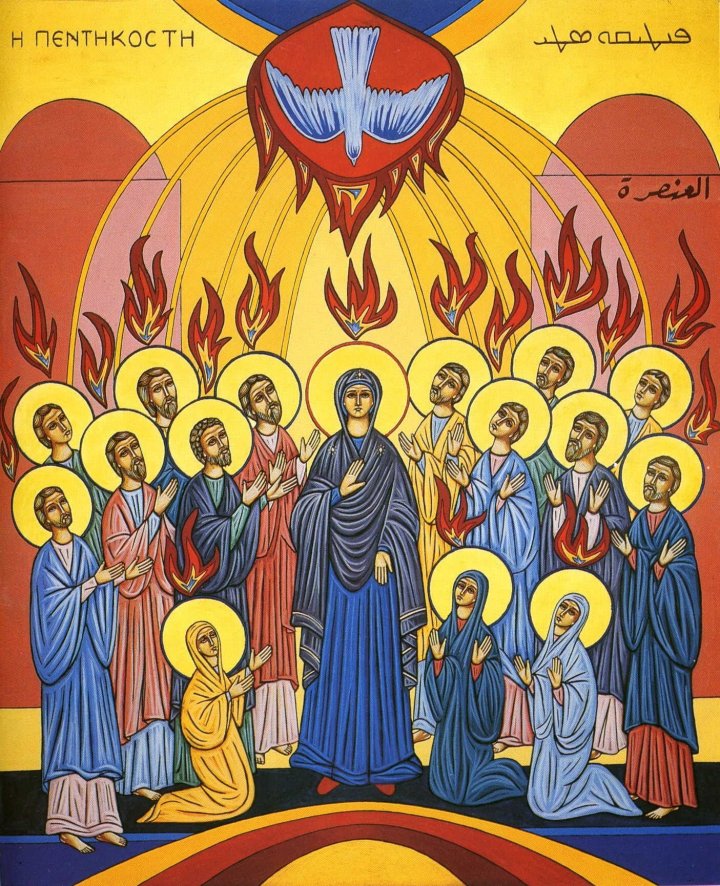
pentecost_maronite_icon

Homily for the Ninth Sunday after Trinity

Fire is a powerful thing. It gives us heat and light. It cooks our food. When fire is controlled is a source of great joy. But when it is unchecked it is destructive and deadly. 

In the Church we are most used to the imagery of fire at Pentecost, when flames appear on the heads of the disciples as they are filled with the Holy Spirit. That same Spirit is given to us, in our Baptism, at ourConfirmation, and in the Sacraments of the Church. It is in the Spirit that we are be built up, and made holy, so that the image of God may be restored in us. It inspires us, and equips us to proclaim the Good News of the Kingdom of God.

In our first reading this morning from the prophet Jeremiah we hear the continuation of the argument against false shepherds and prophets who have been leading Israel astray. God reminds us that He is near, and has not abandoned us, even though falsehood is uttered in His Name. Thanks to the faithfulness of men like Jeremiah the truth will out in the end. As He says, ‘let him who has my word speak it faithfully’ (Jer 23:28 ESV). The faithful proclamation of the Word of God, first in Israel, and now in the Church, is truly Good News. ‘Is not my word like fire, declares the Lord’ (Jer 23:29 ESV). As Christians we follow the Word made flesh, who sends the Holy Spirit, which came like fire, so that we might be united with the God who loves us and saves us. 

In our reading from the Letter to the Hebrews, which continues where last week’s reading finished, we hear more of salvation history. The Exodus, and Israel’s entry into the Promised Land, are presented as examples of living by faith. The writer develops this to explain that through who Christ is, and what He has done for us, we have a greater Passover, from death and sin, to eternal life. We are surrounded by ‘a great cloud of witnesses’ by the providence of God, and His love for humanity. First and foremost we look to Jesus Christ, ‘the founder and perfecter of our faith, who for the joy that was set before him endured the cross, despising the shame, and is seated at the right hand of the throne of God.’ (Heb 12:2 ESV).

At the heart of it all is the Cross, which has reconciled us to God, and to each other. By the power of the Holy Spirit He took flesh in the womb of His mother, the Blessed Virgin Mary, and was born for us, so that he might be offered as a lamb without blemish, a perfect offering of love to God the Father. 

In the Gospel, Our Lord says that He came to cast fire on the earth, and looks towards His Passion. The fire speaks of a choice to be made, a decision on our part, whether we will follow Him, or not. It also anticipates to the sending of the Holy Spirit at Pentecost. This is a fire of renewal and inspiration, to fill His Church with life and power. From the Incarnation, Christ comes to infuse us with the love of God. The outpouring of the Holy Spirit is nothing more than humanity being completely filled with God’s love. 

We have been imbued with the same Spirit as the first apostles. The same love should burn in our hearts. Has God abandoned us? Surely not! Then we must pray that God will kindle that fire in our hearts. 

Holy Spirit, Divine Consoler, We adore You as our true God, with God the Father and God the Son. Amen. 

We pray that God pours out His Holy Spirit upon us so that we are built up in love, together. We pray that we are inspired to continue the work of God’s kingdom, here and now. So that we and all creation will sing the praise of God the Father, God the Son, and God the Holy Spirit, to whom be ascribed as is most right and just all might, majesty, glory, dominion, and power, now and forever. Amen. 

pentecost_maronite_icon

Sunday, 31 March 2019

Lent IV Year C: The Prodigal Son

Today is a day for celebration. a day for rejoicing, just like every Sunday, as we rejoice that it was on a Sunday that Jesus rose from the dead. This day of the week is special for Christians. And the time is soon coming when we will remember how Jesus suffered and died for love of us. We get ready to celebrate through fasting and prayer, through giving things up, and today we don’t have to. The rules are relaxed, we can have a day off. We mark this in a variety of ways: since Ash Wednesday I’ve worn purple vestments in Church on Sundays, but today I’m wearing something different. They’re rose-coloured, it’s a lighter, more joyful colour. There are flowers in church, some of which will be blessed and distributed later. Today was a day when servants had the day off, and could go home, to see their family, and visit the church where they were baptized, and as they went there they would pick flowers. It’s Spring, and there are many signs of joy and new life around us. 

So we give thanks to God for our mothers, who gave us life and showed us love, and for Mother Church, in which we were baptized, and given new life in Christ. As we give thanks for them, we are mindful of the love they have shown us, and the life they have given us, which leads us God, who while we tend to address Him as ‘Father’ loves us like a mother. In the Gospel this morning Jesus tells the story of the Prodigal Son, who runs away, and does what he wants to, wastes his inheritance and comes back penniless and sorry. It’s how we are with God. But God, like the Father in the parable loves his children, and longs to welcome us back, and embrace us in love. God loves us, and will do anything to see us back where we belong, back home, embraced, restored, and made whole again. It is the central message of the Christian Faith: GOD LOVES US! We don’t deserve to be loved, we have turned away from God’s love, but God doesn’t abandon us, or reject us, but welcomes us back, so that we may be transformed by that love. Love and forgiveness have the power to change us like nothing else. We see this throughout the Bible, think of Joseph and his brothers in Egypt. We see this most of all in Jesus, who loves us so much that He dies on the Cross for us. This love transforms the world. God then, is generous, extravagant, and loves us more than we can know or fully understand. But we can experience that love, in the Church, when we read the Bible, in our Baptism, in the forgiveness of sin, and in the Eucharist, where God’s love is made real, and we receive that generosity. We receive it and are transformed by it. It changes us, makes us more generous and loving, and builds up a community transformed by love, which can change the world. 

0824d8dbffcf13bdc31bb56746e99abf

Lent IV Year C: The Prodigal Son

Today is a day for celebration. a day for rejoicing, just like every Sunday, as we rejoice that it was on a Sunday that Jesus rose from the dead. This day of the week is special for Christians. And the time is soon coming when we will remember how Jesus suffered and died for love of us. We get ready to celebrate through fasting and prayer, through giving things up, and today we don’t have to. The rules are relaxed, we can have a day off. We mark this in a variety of ways: since Ash Wednesday I’ve worn purple vestments in Church on Sundays, but today I’m wearing something different. They’re rose-coloured, it’s a lighter, more joyful colour. There are flowers in church, some of which will be blessed and distributed later. Today was a day when servants had the day off, and could go home, to see their family, and visit the church where they were baptized, and as they went there they would pick flowers. It’s Spring, and there are many signs of joy and new life around us. 

So we give thanks to God for our mothers, who gave us life and showed us love, and for Mother Church, in which we were baptized, and given new life in Christ. As we give thanks for them, we are mindful of the love they have shown us, and the life they have given us, which leads us God, who while we tend to address Him as ‘Father’ loves us like a mother. In the Gospel this morning Jesus tells the story of the Prodigal Son, who runs away, and does what he wants to, wastes his inheritance and comes back penniless and sorry. It’s how we are with God. But God, like the Father in the parable loves his children, and longs to welcome us back, and embrace us in love. God loves us, and will do anything to see us back where we belong, back home, embraced, restored, and made whole again. It is the central message of the Christian Faith: GOD LOVES US! We don’t deserve to be loved, we have turned away from God’s love, but God doesn’t abandon us, or reject us, but welcomes us back, so that we may be transformed by that love. Love and forgiveness have the power to change us like nothing else. We see this throughout the Bible, think of Joseph and his brothers in Egypt. We see this most of all in Jesus, who loves us so much that He dies on the Cross for us. This love transforms the world. God then, is generous, extravagant, and loves us more than we can know or fully understand. But we can experience that love, in the Church, when we read the Bible, in our Baptism, in the forgiveness of sin, and in the Eucharist, where God’s love is made real, and we receive that generosity. We receive it and are transformed by it. It changes us, makes us more generous and loving, and builds up a community transformed by love, which can change the world. 

0824d8dbffcf13bdc31bb56746e99abf

Sunday, 24 February 2019

The Seventh Sunday of Year C

All of Salvation History, the entirety of the Bible, and the history of the Christian Church is at a profound level the story of God’s Generosity. The creation of the universe out of nothing, and the salvation of humanity though the Incarnation, Death and Resurrection of Jesus Christ are demonstrations of the scale of that Generosity. It’s hard to get your head around the extent to which God’s love is poured out on the world.We don’t deserve it, we cannot earn it, nonetheless we continue to receive it through the Church, through prayer, the sacraments, Holy Scripture, in the power of the Holy Spirit. 

In our first reading this morning we see an encounter between David and Saul. David could kill Saul. Abishai wants to. David, however, will not put forth his hand against the Lord’s anointed. Saul is the anointed King of Israel, and despite their differences, David shows generosity of spirit, because ‘The Lord rewards every man for his righteousness and his faithfulness’ (1Sam 26:23). We have received generously from God, and we should thus be generous as a result. 

In the Epistle we see the difference between the first Adam, and the Second one, who is Christ. The first brought death and sin, the second brings life and reconciliation. Christians are to follow the example of Christ, who transforms our humanity, and manifests the loving and generous nature of God to us.

There is at the heart of Christianity a radical idea, love your enemies. It seems counter-intuitive. Our enemies want to harm us, we should resist them, we should crush them. No we are to love them, because love is the heart of the Gospel. God is loving towards us, being born as one of us to transform us, by His Grace. He gives himself to die, for love of us, that we might be healed and reconciled. Love can end conflict. This is what Christ shows us. He ends the enmity between God and humanity by dying for us. As Christians we are to follow Christ’s example and put love into practice in our lives. Jesus asks us to follow His example, living it out in a way which is radically different to the ways of the world.

The world around us isn’t good at forgiveness, or turning the other cheek. It prefers to write people off: that’s how they are, and how they’re going to stay. Well, they will, unless we do something about it. In showing forgiveness and generosity we recognise the fact that we are human, flawed, and we make mistakes, and that change is possible: things don’t have to stay the same. Everyone loves those who love them. The point is in loving those who do not love us, that they become lovely to us, and loveable in themselves. Only love can transform what is filled with hate and anger. 

As St John writes, ‘Beloved, let us love one another; for love is of God, and he who loves is born of God and knows God. He who does not love does not know God; for God is love. In this the love of God was made manifest among us, that God sent his only Son into the world, so that we might live through him. In this is love, not that we loved God but that he loved us and sent his Son to be the expiation for our sins. Beloved, if God so loved us, we also ought to love one another. No man has ever seen God; if we love one another, God abides in us and his love is perfected in us.’ (1John 4:7-12) At the heart of it all is the Cross, the great demonstration of God’s love. All that Christ teaches us in this morning’s gospel is made manifest on the Cross. We see God die for us, and in the Eucharist, Christ gives us His Body and Blood so that we can be transformed to do His Will, and live His Risen life, preparing us for Heaven, here and now. 

God gives Himself for us: ‘for he is kind to the ungrateful and the selfish. Be merciful, even as your Father is merciful.’ (Lk 6:35-36) We can be merciful because God has shown us mercy, and continues so to do. The transforming power of God’s love and mercy is shown fully in the Mystery of the Eucharist, where we are fed by God, fed with God, so that His Love might transform us. This is generosity, shown to us so that we might be generous in return. Through God’s generosity we have the opportunity to live in a different way, and encourage others so to do. It offers the world a way out of selfishness and sin, a chance to be God’s people living life in all its fulness. Is it easy? By no means! What Jesus proposes is something costly and difficult, which requires us to go against the human instincts which lead us to be selfish, judgmental and unkind. But if we all try to do this together then we will be built up as a community of loving generosity, which makes it possible for people to be transformed into the people God wants us to be. It’s what the world wants, and longs for. 

So how do we live the life God wants us to live? The simple answer is by trying, failing, and keeping on trying. The Christian faith has at its centre Love and Forgiveness. God shows these to us in Jesus Christ, and we have to show them to one another. The Church, you and I, all of us, are called to love and forgive each other, as we will fail. And we will fail often. We can’t earn our way to Heaven through what we do, Jesus has paved the way for us through His Death and Resurrection. We can, however, try to live out our faith in our lives, loving and forgiving each other when we fall short.Not being judgemental and overcritical. Then we can be built up in love, together, as a community reconciled to God and each other. It sounds simple and straightforward, but in practice it is really difficult. This is why we have to keep trying, allowing God transform us more and more into his likeness, through His Grace.

Through the love of God being poured into our hearts, and through that love forming who we are and what we do, that self-giving sacrificial love shown to us by Our Lord and Saviour Jesus Christ, in his dying for us, so that we might live in Him, let us be attentive to the Word of God, the Word made flesh, and not simply listen but also act –- relying not upon our own strength but upon the love and mercy of God, seeking His forgiveness, to do His Will.

When we are formed by God together then we can be built up in love, as living stones, a temple to God’s glory. We proclaim God’s love and truth to the world, through forgiveness and sacrificial love. Clothed in the humility of our knowledge of our need of God’s love and mercy, let us come to Him, to be fed by Him, to be fed with Him, to be healed and restored by him, so that we can live lives which speak of the power of his kingdom so that the world may believe and give glory to God the Father, God the Son, and God the Holy Spirit, to whom be ascribed as is most right and just, all might, majesty, glory, dominion, and power, now and forever. Amen

hyla-blue-largposter-copy

The Seventh Sunday of Year C

All of Salvation History, the entirety of the Bible, and the history of the Christian Church is at a profound level the story of God’s Generosity. The creation of the universe out of nothing, and the salvation of humanity though the Incarnation, Death and Resurrection of Jesus Christ are demonstrations of the scale of that Generosity. It’s hard to get your head around the extent to which God’s love is poured out on the world.We don’t deserve it, we cannot earn it, nonetheless we continue to receive it through the Church, through prayer, the sacraments, Holy Scripture, in the power of the Holy Spirit. 

In our first reading this morning we see an encounter between David and Saul. David could kill Saul. Abishai wants to. David, however, will not put forth his hand against the Lord’s anointed. Saul is the anointed King of Israel, and despite their differences, David shows generosity of spirit, because ‘The Lord rewards every man for his righteousness and his faithfulness’ (1Sam 26:23). We have received generously from God, and we should thus be generous as a result. 

In the Epistle we see the difference between the first Adam, and the Second one, who is Christ. The first brought death and sin, the second brings life and reconciliation. Christians are to follow the example of Christ, who transforms our humanity, and manifests the loving and generous nature of God to us.

There is at the heart of Christianity a radical idea, love your enemies. It seems counter-intuitive. Our enemies want to harm us, we should resist them, we should crush them. No we are to love them, because love is the heart of the Gospel. God is loving towards us, being born as one of us to transform us, by His Grace. He gives himself to die, for love of us, that we might be healed and reconciled. Love can end conflict. This is what Christ shows us. He ends the enmity between God and humanity by dying for us. As Christians we are to follow Christ’s example and put love into practice in our lives. Jesus asks us to follow His example, living it out in a way which is radically different to the ways of the world.

The world around us isn’t good at forgiveness, or turning the other cheek. It prefers to write people off: that’s how they are, and how they’re going to stay. Well, they will, unless we do something about it. In showing forgiveness and generosity we recognise the fact that we are human, flawed, and we make mistakes, and that change is possible: things don’t have to stay the same. Everyone loves those who love them. The point is in loving those who do not love us, that they become lovely to us, and loveable in themselves. Only love can transform what is filled with hate and anger. 

As St John writes, ‘Beloved, let us love one another; for love is of God, and he who loves is born of God and knows God. He who does not love does not know God; for God is love. In this the love of God was made manifest among us, that God sent his only Son into the world, so that we might live through him. In this is love, not that we loved God but that he loved us and sent his Son to be the expiation for our sins. Beloved, if God so loved us, we also ought to love one another. No man has ever seen God; if we love one another, God abides in us and his love is perfected in us.’ (1John 4:7-12) At the heart of it all is the Cross, the great demonstration of God’s love. All that Christ teaches us in this morning’s gospel is made manifest on the Cross. We see God die for us, and in the Eucharist, Christ gives us His Body and Blood so that we can be transformed to do His Will, and live His Risen life, preparing us for Heaven, here and now. 

God gives Himself for us: ‘for he is kind to the ungrateful and the selfish. Be merciful, even as your Father is merciful.’ (Lk 6:35-36) We can be merciful because God has shown us mercy, and continues so to do. The transforming power of God’s love and mercy is shown fully in the Mystery of the Eucharist, where we are fed by God, fed with God, so that His Love might transform us. This is generosity, shown to us so that we might be generous in return. Through God’s generosity we have the opportunity to live in a different way, and encourage others so to do. It offers the world a way out of selfishness and sin, a chance to be God’s people living life in all its fulness. Is it easy? By no means! What Jesus proposes is something costly and difficult, which requires us to go against the human instincts which lead us to be selfish, judgmental and unkind. But if we all try to do this together then we will be built up as a community of loving generosity, which makes it possible for people to be transformed into the people God wants us to be. It’s what the world wants, and longs for. 

So how do we live the life God wants us to live? The simple answer is by trying, failing, and keeping on trying. The Christian faith has at its centre Love and Forgiveness. God shows these to us in Jesus Christ, and we have to show them to one another. The Church, you and I, all of us, are called to love and forgive each other, as we will fail. And we will fail often. We can’t earn our way to Heaven through what we do, Jesus has paved the way for us through His Death and Resurrection. We can, however, try to live out our faith in our lives, loving and forgiving each other when we fall short.Not being judgemental and overcritical. Then we can be built up in love, together, as a community reconciled to God and each other. It sounds simple and straightforward, but in practice it is really difficult. This is why we have to keep trying, allowing God transform us more and more into his likeness, through His Grace.

Through the love of God being poured into our hearts, and through that love forming who we are and what we do, that self-giving sacrificial love shown to us by Our Lord and Saviour Jesus Christ, in his dying for us, so that we might live in Him, let us be attentive to the Word of God, the Word made flesh, and not simply listen but also act –- relying not upon our own strength but upon the love and mercy of God, seeking His forgiveness, to do His Will.

When we are formed by God together then we can be built up in love, as living stones, a temple to God’s glory. We proclaim God’s love and truth to the world, through forgiveness and sacrificial love. Clothed in the humility of our knowledge of our need of God’s love and mercy, let us come to Him, to be fed by Him, to be fed with Him, to be healed and restored by him, so that we can live lives which speak of the power of his kingdom so that the world may believe and give glory to God the Father, God the Son, and God the Holy Spirit, to whom be ascribed as is most right and just, all might, majesty, glory, dominion, and power, now and forever. Amen

hyla-blue-largposter-copy

Sunday, 3 February 2019

Candlemas

Not all that long ago it was not uncommon to hear of the Churching of Women, sometimes called Thanksgiving after Childbirth, as it was after all a dangerous and risky business. We are perhaps now not quite so used to ideas of ritual purity inherent in the Thanksgiving for a Woman after Childbirth, or her re-admission into society after a period of confinement. But the Law of Moses required that forty days after giving birth the mother was purified in a mikvah, a ritual bath and that her son, as a first-born male was presented to the Lord. This week the Church celebrates the Presentation of Christ in the Temple, also known as the Purification of the Blessed Virgin Mary and commonly called Candlemas, from the ceremonies which saw the candles for the coming year blessed at this service, so that they may burn as lights which proclaim Christ, the true Light, the light to lighten the Gentiles. They are different titles, but one feast, which make us think about who and what Jesus Christ is, and what he does.

This feast then is the fulfilment of the prophecy spoken by Malachi, which also looks to our purification in and through the death of Christ and his atoning sacrifice of himself, which will be be re-presented here, made present so that we can share in it, so that we can be healed and restored by the very Body and Blood of Our Lord and Saviour Jesus Christ. As the Letter to the Hebrews puts it:

Therefore he had to become like his brothers and sisters in every respect, so that he might be a merciful and faithful high priest in the service of God, to make a sacrifice of atonement for the sins of the people. Because he himself was tested by what he suffered, he is able to help those who are being tested. 

It is hard to see how it could be any clearer. Just as Abraham was willing to sacrifice Isaac on Mt Moriah, so now God will gladly give His only Son, Jesus Christ, on the altar of the Cross, to restore our relationship with Him.

The Holy Family go to the Temple to give thanks to God and to comply with the Law, just as they had in circumcising their baby on the eighth day: and in so doing they demonstrate obedience, they listen to what God says and do it and as such they are a model for all Christian families to follow – we need to be like them, listening to what God tells us and doing it, regardless of the cost.

When the Holy Family go to the Temple they encounter Simeon, a man of faith and holiness. A man devoted to God, who is looking for the consolation of Israel. He knows that he will not die until he sees the Messiah, the Lord’s Anointed, and the Saviour of the World. As he takes the child Jesus in his arms he prays: ‘Lord, now lettest thou thy servant depart in peace : according to thy word. For mine eyes have seen : thy salvation, Which thou hast prepared : before the face of all people; To be a light to lighten the Gentiles : and to be the glory of thy people Israel.

The promise made to him by God, revealed through the Holy Spirit, has been fulfilled in the six-week-old infant in his arms. Simeon can prepare to meet his God happy in the knowledge that Salvation has dawned in this little child. As Christ was made manifest to the Gentiles at Epiphany, so now His saving message is proclaimed, so that the world may know that its salvation has come in the person of Jesus Christ. Simeon speaks to Our Lord’s Mother of her Son’s future, and the pain she will endure at the foot of the Cross. Before he dies Simeon is looking to the Cross, the means by which our salvation is wrought, the Cross at which Mary will stand to see humanity freed from its sin through the love and mercy of God, through grace, the free gift of God in Christ. So as Candlemas concludes our celebration of Christmas, and the mystery of the Incarnation, so to it points to that which gives it its true meaning: the Death and Resurrection of Jesus Christ. The Feast prepares for the coming season of Lent by changing our focus and attention from Jesus’ birth to His death, for our sins, upon the Cross.

That is why we are here this morning, to be fed by Christ, to be fed with Christ, truly present in His Body and Blood, Soul and Divinity. A God whom we can touch and taste. A God who shares His Divine Life with us, so that we can be transformed by Him, built up as living stones as a temple to His Glory, and given a foretaste of Heaven here on Earth. This is our soul’s true food, the bread for the journey of faith, a re-presentation of the sacrifice which sets us free to live for Him, to live with Him, through Him and in Him.

The significance of what is happening is not just recognised by Simeon, but also by Anna, a holy woman, a woman of prayer, a woman who is close to God, she recognises what God is doing in Christ, and she proclaims it, so that God’s redemption of His people may be known. Let us be like her, and let all of our lives, everything which we say, or think, or do, proclaim the saving truth of God’s love to the world.

And finally the Holy Family go back to Nazareth, and Jesus begins to grow up, in the favour of God, obedient to God and His parents in the Gospel we see all of human life: birth, death, work, normality hallowed by the God who loves us, who gives His Son for us. God shares our human life, as He will share our death, to restore us, to heal us,

So let us burn, like the candles which God has blessed, let our faith be active to give light and warmth and hope to the world, so that it may feel that love and warmth, and come to believe and give glory to God the Father, God the Son, and God the Holy Spirit, to whom be ascribed as is most right and just all might, majesty, glory, dominion, and power, now and forever.

6567

Candlemas

Not all that long ago it was not uncommon to hear of the Churching of Women, sometimes called Thanksgiving after Childbirth, as it was after all a dangerous and risky business. We are perhaps now not quite so used to ideas of ritual purity inherent in the Thanksgiving for a Woman after Childbirth, or her re-admission into society after a period of confinement. But the Law of Moses required that forty days after giving birth the mother was purified in a mikvah, a ritual bath and that her son, as a first-born male was presented to the Lord. This week the Church celebrates the Presentation of Christ in the Temple, also known as the Purification of the Blessed Virgin Mary and commonly called Candlemas, from the ceremonies which saw the candles for the coming year blessed at this service, so that they may burn as lights which proclaim Christ, the true Light, the light to lighten the Gentiles. They are different titles, but one feast, which make us think about who and what Jesus Christ is, and what he does.

This feast then is the fulfilment of the prophecy spoken by Malachi, which also looks to our purification in and through the death of Christ and his atoning sacrifice of himself, which will be be re-presented here, made present so that we can share in it, so that we can be healed and restored by the very Body and Blood of Our Lord and Saviour Jesus Christ. As the Letter to the Hebrews puts it:

Therefore he had to become like his brothers and sisters in every respect, so that he might be a merciful and faithful high priest in the service of God, to make a sacrifice of atonement for the sins of the people. Because he himself was tested by what he suffered, he is able to help those who are being tested. 

It is hard to see how it could be any clearer. Just as Abraham was willing to sacrifice Isaac on Mt Moriah, so now God will gladly give His only Son, Jesus Christ, on the altar of the Cross, to restore our relationship with Him.

The Holy Family go to the Temple to give thanks to God and to comply with the Law, just as they had in circumcising their baby on the eighth day: and in so doing they demonstrate obedience, they listen to what God says and do it and as such they are a model for all Christian families to follow – we need to be like them, listening to what God tells us and doing it, regardless of the cost.

When the Holy Family go to the Temple they encounter Simeon, a man of faith and holiness. A man devoted to God, who is looking for the consolation of Israel. He knows that he will not die until he sees the Messiah, the Lord’s Anointed, and the Saviour of the World. As he takes the child Jesus in his arms he prays: ‘Lord, now lettest thou thy servant depart in peace : according to thy word. For mine eyes have seen : thy salvation, Which thou hast prepared : before the face of all people; To be a light to lighten the Gentiles : and to be the glory of thy people Israel.

The promise made to him by God, revealed through the Holy Spirit, has been fulfilled in the six-week-old infant in his arms. Simeon can prepare to meet his God happy in the knowledge that Salvation has dawned in this little child. As Christ was made manifest to the Gentiles at Epiphany, so now His saving message is proclaimed, so that the world may know that its salvation has come in the person of Jesus Christ. Simeon speaks to Our Lord’s Mother of her Son’s future, and the pain she will endure at the foot of the Cross. Before he dies Simeon is looking to the Cross, the means by which our salvation is wrought, the Cross at which Mary will stand to see humanity freed from its sin through the love and mercy of God, through grace, the free gift of God in Christ. So as Candlemas concludes our celebration of Christmas, and the mystery of the Incarnation, so to it points to that which gives it its true meaning: the Death and Resurrection of Jesus Christ. The Feast prepares for the coming season of Lent by changing our focus and attention from Jesus’ birth to His death, for our sins, upon the Cross.

That is why we are here this morning, to be fed by Christ, to be fed with Christ, truly present in His Body and Blood, Soul and Divinity. A God whom we can touch and taste. A God who shares His Divine Life with us, so that we can be transformed by Him, built up as living stones as a temple to His Glory, and given a foretaste of Heaven here on Earth. This is our soul’s true food, the bread for the journey of faith, a re-presentation of the sacrifice which sets us free to live for Him, to live with Him, through Him and in Him.

The significance of what is happening is not just recognised by Simeon, but also by Anna, a holy woman, a woman of prayer, a woman who is close to God, she recognises what God is doing in Christ, and she proclaims it, so that God’s redemption of His people may be known. Let us be like her, and let all of our lives, everything which we say, or think, or do, proclaim the saving truth of God’s love to the world.

And finally the Holy Family go back to Nazareth, and Jesus begins to grow up, in the favour of God, obedient to God and His parents in the Gospel we see all of human life: birth, death, work, normality hallowed by the God who loves us, who gives His Son for us. God shares our human life, as He will share our death, to restore us, to heal us,

So let us burn, like the candles which God has blessed, let our faith be active to give light and warmth and hope to the world, so that it may feel that love and warmth, and come to believe and give glory to God the Father, God the Son, and God the Holy Spirit, to whom be ascribed as is most right and just all might, majesty, glory, dominion, and power, now and forever.

6567