Showing posts with label Mission. Show all posts

Friday, 31 May 2019

The Sunday after Ascension (Jn 17:20-26)

The Sunday after the Ascension, the Seventh Sunday of Easter, is one of those strange in-between times, not quite Pentecost yet. So we wait with the Apostles for the outpouring of the Holy Spirit. We wait, and we pray fervently that God will pour His Spirit into our hearts, and our lives, to fill us with His Love. 

In the Gospel this morning we are in the middle of Jesus’ High Priestly Prayer, which is the summit of His teaching just before His arrest and Passion. It is a moment of profound intimacy where Christ prays to God the Father. He prays not only for His disciples, but for those who will believe in Him through their word. That’s you, and me, and countless Christians down through the ages. Just before Christ’s arrest and Passion He prays for us. Such generosity and love should amaze us. Christ prays that we should be one, that there should be unity in the church. Sadly throughout its history this has not been the case, and it should shock us to the core. Unity is Christ’s will for His Church. It puts our petty human divisions into perspective. They’re bad and wrong; they’re not the will of God. It’s serious, and it matters, and we shouldn’t be making it worse, we should be growing together in love. We should do this because it is Christ’s will, we listen to Him, and do what He tells us. That isn’t the only reason, however. Christ prays that the Church may be one, ‘so that the world may believe that you have sent me.’ (17:21 ESV) In other words the truth of our witness and proclamation of the Gospel is contingent upon our unity. If we’re divided people won’t believe us. Which is the right or the proper bit? How can you tell? It isn’t always easy. 

Christ gives us His glory, which is His Passion and Death. To follow Christ leads to a Cross, and onward to new life. But if we want to follow Christ then we cannot ignore pain and suffering. We’ve signed up for it. All of us have, in our baptism, when we received the water of life without price. We have to bear witness to Christ regardless of the cost. People may well think we are fools for believing what we do. The idea that Christians are simple-minded, or deluded, or weak, has been around for a long time. A religion for women, slaves, and children, said the pagan Celsus around AD 180 (cf. Orig. contra Celsum 344) It’s a silly idea, but plenty of people still believe it, even today. We can convince them otherwise by means of rational argument, but also by the example of our lives, as authentic faith is attractive, real, and convincing. 

Christ speaks to us, and teaches us so that our joy may be complete in Him, filled with His love, and the Holy Spirit. The world’s reaction to this is a negative one: because what we are, what we stand for, and how we live as Christians is to be opposed to what the world around us stands for: selfishness, greed, which it makes into false gods, as though material wealth, or power, or status could save us – such things are transient and fleeting. The world offers us a short-cut, an easy road. Whereas if we are following Christ, then we are walking the way of his Passion, we are walking the Way of the Cross, dying daily to sin, and letting God’s grace be at work in and through us. It is not easy, it is difficult, most of us are unable to manage, we will fail, and we need the love and support of the Christian community to help us, even the first Christians, those who had been with Jesus, needed each other’s help and support, so they can continue what Jesus started.

We need to be together, to meet together to pray for our needs and those of the world, and to be nourished by the word of God, the Bible, and the Sacrament of Our Lord’s Body and Blood, not because they’re something nice to do on a Sunday morning: an add-on, an optional extra that we can opt into and out of as we feel like, but because as Christians they are crucial to who and what we are, if we are to remain in the love of God then we have to live this way. Only then can we offer the world an alternative to the ways of selfishness and sin. It will hate us for doing this, it will despise us and persecute us, it will call us hypocrites when we fail to live up to the example of Jesus; but as Christians who live in the love of God we forgive each other our trespasses, so that we can live out that same radical love and forgiveness which sees Jesus die upon the Cross for love of us and all the world, this is love which can transform the world. It is a message of such love, such forgiveness that the world cannot or does not want to understand it. We may not understand it, but we know that it can be experienced, and we are living testimony to its power. It turns our lives around and sets us free to live for God and to proclaim his saving truth in our words and actions, calling the world to repentance, to turn to Christ, and to be renewed in and through Him. In his power, with His Truth, filled with His Love we can transform the world, one soul at a time.

So as we wait with the Apostles for the gift of the Holy Spirit let us pray that Christ may come, and send His Holy Spirit, that God may be at work in us, building us up, and giving us strength to live his life and to proclaim his truth, to offer the world that which it most earnestly desires, a peace, a joy, a freedom which passes human understanding, and the gift of eternal life in Christ. Let us proclaim it so that all the world may come to know and love God the Father, God the Son, and God the Holy Spirit, to whom be ascribed as is most right and just all might, majesty, glory, dominion, and power, now and forever.
dsc_0038.jpg

The Sunday after Ascension (Jn 17:20-26)

The Sunday after the Ascension, the Seventh Sunday of Easter, is one of those strange in-between times, not quite Pentecost yet. So we wait with the Apostles for the outpouring of the Holy Spirit. We wait, and we pray fervently that God will pour His Spirit into our hearts, and our lives, to fill us with His Love. 

In the Gospel this morning we are in the middle of Jesus’ High Priestly Prayer, which is the summit of His teaching just before His arrest and Passion. It is a moment of profound intimacy where Christ prays to God the Father. He prays not only for His disciples, but for those who will believe in Him through their word. That’s you, and me, and countless Christians down through the ages. Just before Christ’s arrest and Passion He prays for us. Such generosity and love should amaze us. Christ prays that we should be one, that there should be unity in the church. Sadly throughout its history this has not been the case, and it should shock us to the core. Unity is Christ’s will for His Church. It puts our petty human divisions into perspective. They’re bad and wrong; they’re not the will of God. It’s serious, and it matters, and we shouldn’t be making it worse, we should be growing together in love. We should do this because it is Christ’s will, we listen to Him, and do what He tells us. That isn’t the only reason, however. Christ prays that the Church may be one, ‘so that the world may believe that you have sent me.’ (17:21 ESV) In other words the truth of our witness and proclamation of the Gospel is contingent upon our unity. If we’re divided people won’t believe us. Which is the right or the proper bit? How can you tell? It isn’t always easy. 

Christ gives us His glory, which is His Passion and Death. To follow Christ leads to a Cross, and onward to new life. But if we want to follow Christ then we cannot ignore pain and suffering. We’ve signed up for it. All of us have, in our baptism, when we received the water of life without price. We have to bear witness to Christ regardless of the cost. People may well think we are fools for believing what we do. The idea that Christians are simple-minded, or deluded, or weak, has been around for a long time. A religion for women, slaves, and children, said the pagan Celsus around AD 180 (cf. Orig. contra Celsum 344) It’s a silly idea, but plenty of people still believe it, even today. We can convince them otherwise by means of rational argument, but also by the example of our lives, as authentic faith is attractive, real, and convincing. 

Christ speaks to us, and teaches us so that our joy may be complete in Him, filled with His love, and the Holy Spirit. The world’s reaction to this is a negative one: because what we are, what we stand for, and how we live as Christians is to be opposed to what the world around us stands for: selfishness, greed, which it makes into false gods, as though material wealth, or power, or status could save us – such things are transient and fleeting. The world offers us a short-cut, an easy road. Whereas if we are following Christ, then we are walking the way of his Passion, we are walking the Way of the Cross, dying daily to sin, and letting God’s grace be at work in and through us. It is not easy, it is difficult, most of us are unable to manage, we will fail, and we need the love and support of the Christian community to help us, even the first Christians, those who had been with Jesus, needed each other’s help and support, so they can continue what Jesus started.

We need to be together, to meet together to pray for our needs and those of the world, and to be nourished by the word of God, the Bible, and the Sacrament of Our Lord’s Body and Blood, not because they’re something nice to do on a Sunday morning: an add-on, an optional extra that we can opt into and out of as we feel like, but because as Christians they are crucial to who and what we are, if we are to remain in the love of God then we have to live this way. Only then can we offer the world an alternative to the ways of selfishness and sin. It will hate us for doing this, it will despise us and persecute us, it will call us hypocrites when we fail to live up to the example of Jesus; but as Christians who live in the love of God we forgive each other our trespasses, so that we can live out that same radical love and forgiveness which sees Jesus die upon the Cross for love of us and all the world, this is love which can transform the world. It is a message of such love, such forgiveness that the world cannot or does not want to understand it. We may not understand it, but we know that it can be experienced, and we are living testimony to its power. It turns our lives around and sets us free to live for God and to proclaim his saving truth in our words and actions, calling the world to repentance, to turn to Christ, and to be renewed in and through Him. In his power, with His Truth, filled with His Love we can transform the world, one soul at a time.

So as we wait with the Apostles for the gift of the Holy Spirit let us pray that Christ may come, and send His Holy Spirit, that God may be at work in us, building us up, and giving us strength to live his life and to proclaim his truth, to offer the world that which it most earnestly desires, a peace, a joy, a freedom which passes human understanding, and the gift of eternal life in Christ. Let us proclaim it so that all the world may come to know and love God the Father, God the Son, and God the Holy Spirit, to whom be ascribed as is most right and just all might, majesty, glory, dominion, and power, now and forever.
dsc_0038.jpg

Saturday, 7 July 2018

14th Sunday of Yr B Ezek 2:1-5, 2Cor 12:2-10, Mk 6:1-13

Appearances can be deceptive, things are not always what they seem. Much of what we do in church is much more than it seems, what can seem simple and straightforward is, in fact, much more complex. The simple pouring of water in Baptism, or the taking of Bread and Wine in the Eucharist, seem simple enough, and yet through them God is at work in our world, doing wonderful things, pouring out His Grace and His Love on us, to make us Holy. 

Our first reading this morning reminds us that it is not always comfortable or easy listening to a prophet — we have to hear uncomfortable truth. Prophets call us to repent from sin and turn back to God a call which lies at the heart of Christian Baptism It is identical with the message preached by John the Baptist, and Jesus, and the church exists to proclaim the same message, and to call people to be Holy, to live like saints here and now, and encourage others so to do.

In this morning’s epistle we hear the words of the Risen Lord Jesus to Paul, ‘My grace is sufficient for you, for my power is made perfect in weakness.’ (2Cor 12:9 ESV) They are wonderful words of encouragement, because first and foremost they remind us that it’s not about WE can do, but about what God can do in and through us. This is possibly the most important lesson we can learn as a Christian — we cannot earn our way to heaven, God does that for us, through His Son Jesus Christ, who dies on the Cross to give us life in and through Him. What greater demonstration could there be of weakness than in dying the death of a common criminal. God shows the world that power can paradoxically be demonstrated in abject weakness. As Christians we celebrate something shameful in the eyes of the world, because it is in fact the demonstration of God’s LOVE for us. 

God enters the world in the Incarnation as a weak baby, utterly dependant upon the Holy Family, Mary and Joseph, and dies rejected, and abandoned, a laughing stock, a complete failure in the eyes of the world, and yet it sets us free, it gives us life through His death, power made perfect in weakness. God does wonderful things through Paul, who was once an enemy of the church, no-one is beyond the reach of God’s love and he can do wonderful things through us, if we let Him.

The Christian life starts with Baptism, which is how we enter the church and we are filled with the grace of God, and prepared for the life of faith. It is the start of a process which should lead to heaven: by growing in faith, and being fed by Christ, with Christ, in Word and Sacrament; through prayer, and good works, where faith is lived out in our lives.It sounds simple enough, but it is actually difficult, it requires the love and support of a family, and that wider family we call the church, so that we can all support each other in living the Christian life together. 

In this morning’s gospel people misread Jesus, they fail to recognize who or what he is, they are amazed and in doubting Jesus they doubt God to be at work in the world. We need to believe that God can and will be at work, in and through us. They can only see Jesus in terms of the members of his earthly family. It’s understandable, I can remember going back to the church where I grew up to preach and celebrate for their patronal festival, I was worried how people who had known me all my life would react, would they see a small boy in shorts and spectacles. I needn’t have worried, they saw a priest and were thrilled to see me at the altar. Therein lies the difference, the people of Nazareth see Jesus and can only think, ‘carpenter’s son’. They cannot recognize the Messiah in their midst. 

We need to know who and what Jesus is. The world around us rejects Jesus, rather like the people of Nazareth, or fail to accept him as true God and true man. They doubt who he was, what he did, and what he said. But we are different, we are here because we do not. We can tell people about him, but unless they WANT to believe then they won’t, no amount of forcing will make them. If, however, they see Christians living out their faith in an attractive way, then all things are possible. 

Jesus sends the disciples out in pairs, not alone: their ministry is rooted in co-operation, working together to build up the Kingdom of God. The twelve travel light, and are utterly dependant upon God and the charity and goodwill of others. It looks radical, and it is. They proclaim the need for repentance, turn away from sin and the ways of the world, and to turn back to God. They display the healing of the Kingdom: ours is a God who longs to heal our wounds, to restore us, and offer us a radical alternative to the ways of the world. The church is a revolutionary organisation, which seeks to change the world one soul at a time, so that humanity is transformed more and more into the likeness of the God who loves them, into the likeness of Jesus Christ, who lived among us and died for us, through the power of the Holy Spirit. It may sound crazy, but that is what we have been doing for nearly two thousand years, and will carry on doing until Jesus comes again. We continue to offer new life in Christ through baptism, and to feed God’s people with the Body and Blood of Christ, so that they may have life in and through Christ, nourished by Christ and fed with Christ, to be transformed more and more into His likeness so that they and all creation may give glory to God the Father, God the Son, and God the Holy Spirit, to whom be ascribed as is most right and just all might, majesty, glory, dominion, and power, now and forever.

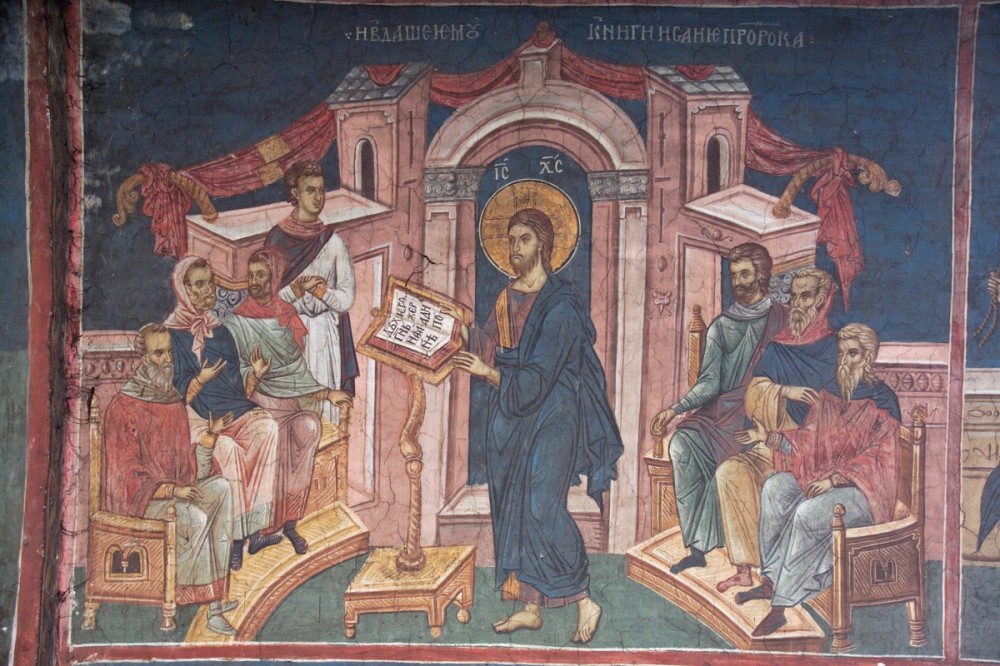
christ-preaching-in-the-synagogue-at-nazareth-14th-c-fresco-visoki-decani-monastery-kosovo

Monday, 14 November 2016

St Augustine on Ps. 19:9

The Pharisee

Shall a Christian go and live apart from the world, so that he may not be tried by false brethren? Shall he who has progressed in a righteous life separate himself so that he need not suffer from anyone? Perhaps people have suffered from before he was converted. Has no one anything to put up with from you? It would surprise me – but if it is so, then you are stronger and thus able to endure other people’s failings.

Do you propose to shut out bad men from good men’s company? if that is what you say, see if you can shut out all evil thoughts from your own heart. Every day we fight with out own heart.

You say you will go apart with a few good men and admit no wicked brother to your society. How do you recognise the man you wish to exclude? Do all come to you with their hearts bare? Those who wish to come do not know themselves, they cannot be proved unless they are tried.

Nowhere in this life are we secure, except in God’s promise – only when we have attained to it, when the gates of Jerusalem are shut behind us, shall we be perfectly safe.

Beloved, mark the apostle’s words: ‘Support one another in charity.’ You forsake the world of men and separate yourself from it. Whom will you profit? Would you have got so far if no one had profited you?

5445613926_49f4d3ed25_o-1


Sunday, 18 October 2015

St Luke


One of the penalties of being religious is to be mocked and ridiculed. If Our Lord submitted Himself to the ribald humour of a degenerate Tetrarch, we may be sure that we, His followers, will not escape. The more Divine a religion is, the more the world will ridicule you, for the spirit of the world is the enemy of Christ
Fulton Sheen, Characters of the Passion, 1946: 56

St Luke was a physician by profession and having learned to cure the body, he met Him who could cure both body and soul, his Gospel is filled with healing miracles, here is a God who cares for the weak, the marginalised, the vulnerable. It also fulfils prophesy, such as that of Isaiah, who looks forward to the coming of the Messiah as a time of healing, this is a God who keeps his promise, who restores his people.  It reminds us that true peace and healing are the gift of God, and a sign of his love. It is a love shown in its fullness in the person and life of Jesus Christ; it is His suffering and death which bring us peace beyond our understanding.
            In this mornings Gospel we see something of the early spread of the Gospel, people are sent out by Jesus to prepare the way for Him, they are to be prophets, heralds, announcing the nearness of the Kingdom of God. They are sent out as lambs in the midst of wolves it sounds risky and vulnerable, its not easy or comfortable, it doesnt make sense, but thats the point: only then can we be like the Lamb of God, and proclaim his message of healing and reconciliation. If were concerned about the shortage of labourers in the Lords vineyard, then we need to pray, to ask God to provide, to trust and rely upon Him, and in His strength alone. Only then are we looking at things the right way: if we trust ourselves, our strength and abilities, we will surely fail. But if we trust in God, all things are possible. Its a hard lesson, and in two thousand years we havent managed to learn it and completely put it into practice, but we can, however, keep trying, as ours is a God of love, of mercy, compassion, and forgiveness.
            The heralds of the kingdom travel light, unlike most of us nowadays: they are unencumbered by stuff, and instead they are reliant upon others to provide what they do not have. They are dependent upon the charity of others they rely upon God and his people. They live out a faith which stresses our interconnectedness, our reliance upon those other than ourselves. Its quite strange for us to hear, were used to being told that its all about me: what I am, what I can do, what I have. These are the values and ideas of the world; those of the kingdom are entirely different. The interesting thing is that the seventy (which includes St Luke) listen to what Jesus tells them, they obey Him, and when they return they have done what He asked them to do. Their obedience bears fruit amidst the disobedience of the world, of selfishness and sin - they are sent out like lambs in the midst of wolves so that they can trust in God and not in themselves, and through their reliance upon Him and not their own efforts or strength they bear fruit for the glory of his kingdom. Here then is the pattern for our lives, Christ calls us to follow in the footsteps of the seventy, to fashion our lives after their example, so that we too might be heralds of the Kingdom, who rely upon God rather than humanity. So that we can say with the Apostle Paul in his Letter to the Galatians: But far be it from me to boast except in the cross of our Lord Jesus Christ, by which the world has been crucified to me, and I to the world (Gal 6:14).
            Such is the power of the Cross: this instrument of humiliation and torture displays Gods glory and saving love to the world. That is why we are here today to see the continuation of that sacrifice enacted in front of our very eyes, so that we are able to eat Christs Body and drink His Blood, so that our human nature may be transformed by His Grace, we are fed by God, with God, strengthened to live out our faith in our lives, to walk in the light of this faith, as heralds of the Kingdom, proclaiming the Gospel of repentance, of healing and reconciliation, brought about by Christ on the Cross, so that the world may share in the new life of Easter, lled with the Holy Spirit.
It is not an easy task, or indeed a pleasant one, the world will mock us, as it mocked Him. It will tell us that we are irrelevant and turn its back on us, just us it ignored Him. Let us trust in Him, proclaiming His peace and mercy, so that the world may believe and may be healed and be transformed and give glory to God the Father, God the Son, and God the Holy Spirit, to whom be ascribed as is most right and just all might, majesty, glory, dominion, and power, now and forever.

Saturday, 27 September 2014

Some words of St Vincent de Paul

Serving the poor is to be preferred above all things

Even though the poor are often rough and unrefined, we must not judge them from external appearances nor from the mental gifts they seem to have received. On the contrary, if you consider the poor in the light of faith, then you will observe that they are taking the place of the Son of God who chose to be poor.
  Although in his passion he almost lost the appearance of a man and was considered a fool by the Gentiles and a stumbling block by the Jews, he showed them that his mission was to preach to the poor: He sent me to preach the good news to the poor. We also ought to have this same spirit and imitate Christ’s actions, that is, we must take care of the poor, console them, help them, support their cause.
  Since Christ willed to be born poor, he chose for himself disciples who were poor. He made himself the servant of the poor and shared their poverty. He went so far as to say that he would consider every deed which either helps or harms the poor as done for or against himself. Since God surely loves the poor, he also loves those who love the poor. For when one person holds another dear, he also includes in his affection anyone who loves or serves the one he loves. That is why we hope that God will love us for the sake of the poor. So when we visit the poor and needy, we try to understand the poor and weak. We sympathise with them so fully that we can echo Paul’s words: I have become all things to all men. Therefore, we must try to be stirred by our neighbours’ worries and distress. We must beg God to pour into our hearts sentiments of pity and compassion and to fill them again and again with these dispositions.
  It is our duty to prefer the service of the poor to everything else and to offer such service as quickly as possible. If a needy person requires medicine or other help during prayer time, do whatever has to be done with peace of mind. Offer the deed to God as your prayer. Do not become upset or feel guilty because you interrupted your prayer to serve the poor. God is not neglected if you leave him for such service. One of God’s works is merely interrupted so that another can be carried out. So when you leave prayer to serve some poor person, remember that this very service is performed for God. Charity is certainly greater than any rule. Moreover, all rules must lead to charity. Since she is a noble mistress, we must do whatever she commands. With renewed devotion, then, we must serve the poor, especially outcasts and beggars. They have been given to us as our masters and patrons.

Sunday, 24 August 2014

St Bartholomew

St Bartholomew is usually identified with the apostle Nathaniel, best known from his appearance in the first chapter of John’s Gospel when he asks, ‘Can anything good come out of Nazareth?’ and to whom Our Lord says, ‘Behold an Israelite in whom there is no guile.’ After Pentecost tradition holds that he went East; taking the Good News to Armenia or even India, and was martyred by being flayed alive.  He told people about Jesus and suffered a painful death for the sake of the Kingdom. He bore witness to the truth of Jesus’ life and resurrection, and lit a flame which burns to this day. We would not be here, doing what we do, believing what we do, and encouraging others so to do if it were not for the example and witness of people like St Bartholomew who preferred nothing to Christ, who was the very centre of their lives, who gave them meaning and purpose, and who told others so that they might believe and encourage others so to do.
In this morning’s Gospel we are presented with a challenging scene: it’s during the Last Supper, where Jesus takes bread and wine to feed his disciples with his Body and Blood, to explain what is about to happen, that he who was without sin might become sin so that we might have life, and life in all its fullness. In the midst of this we see the disciples arguing about who is the greatest. During the most momentous events of human history Our Lord’s closest friends are engaged in a squabble which seems childish and stupid, ‘I’m better than you’ ‘No I’m better than you’. Rather than being close to their Lord they’re involved in petty one-upmanship, thinking about themselves, about honour and position. It’s remarkably human, we can well imagine ourselves saying and doing exactly the same – we know it’s wrong, and we need to turn away from it.
      Rather than explode with anger, Our Lord makes a simple point ‘The kings of the Gentiles lord it over them; and those in authority over them are called benefactors. But not so with you; rather the greatest among you must become like the youngest, and the leader like one who serves. For who is greater, the one who is at the table or the one who serves? Is it not the one at the table? But I am among you as one who serves.’ In Christianity we have a different paradigm of leadership, that of the servant – here worldly values are turned on their head – the Kingdom offers an entirely different way of life, diametrically opposed to the ways of the world, something radical, something transformative, something which offers the world an entirely new way of living, where the service of others is seen as the most important thing. This is not power in worldly terms, the Creator and Redeemer of all humanity takes on a servile role – the greatest becomes the least, and encourages others to do likewise.
      Thus, rather than worrying about worldly power the disciples become servants, looking and acting like Jesus, they become transparent so that the light of Christ may shine through them in the world, so that their acts of loving service proclaim the truth, the beauty, and the goodness of the Kingdom. They go from worrying about power and position, the things of this world, to being concerned wholly with the Kingdom of God.
We need to do the same, nothing more, nothing less. In our baptism we put on Christ, we were clothed with Him, we shared in His Death and Resurrection, and were filled with grace and the Holy Spirit, so that we might follow Him, and encourage others so to do. We have everything we need to follow in the footsteps of the Apostles. We too are fed with the Body and Blood of Christ so that we might have life in Him, so that we can give our lives to proclaim Him to the world.

As Christians we need to live lives of service, the service of others and of the God who loves us and who saves us. We need to live out a radical alternative in the world, and for the world, to embody an alternative to the ways of selfishness and sin, proclaiming the Good News of Jesus Christ, and helping others to enter into the joy of the Lord. We need to do this together, serving and loving each other, forgiving each other, bearing witness in the world, not conformed to it, so that it may believe and give glory to God the Father, God the son, and God the Holy Spirit, to who whom be ascribed as is most right and just, all might, majesty, glory, dominion and power, now and forever.

Sunday, 15 June 2014

Trinity Sunday

“One in essence, distinction of persons, such is the mystery of the Trinity, such is the inner life of God. The three angles of a triangle do not make three triangles but one; as the heat, power, and light of the sun do not make three suns but one; as water, air, and steam are all manifestations of the one substance; as the form, color, and perfume of the rose do not make three roses, but one; as our soul, our intellect, and our will do not make three substances, but one; as one times one times one times one does not equal three, but one, so too in some much more mysterious way, there are three Persons in God and yet only one God.”

Archbishop Fulton Sheen (The Divine Romance)


Anglican Clergy can be strange. Amongst their peculiarities possibly the most galling has to be the habit of finding someone other than themselves: a curate, a visiting preacher, a lay reader, to preach this Sunday. On the First Sunday after Pentecost, since at least 1334 when it was granted an official place in the Calendar of the Western Church, and in some form since the Arian Controversy of the 4th Century, the Church has celebrated the mystery of God’s very self: a Trinity of Persons, consubstantial, co-equal and co-eternal.
I suspect that the problem lies with fact that the clergy themselves are frightened of the thought of preaching about a theological concept which they do not really understand, and which they fear their congregations will not either. I cannot claim to understand the mystery of the Holy and Undivided Trinity, but I’m certainly not going to patronise you by assuming that you cannot or do not wish to understand it. At the start of this morning’s Eucharist our worship began by invoking the Name of the Trinity and making the sign of the Cross, just as Christians have done for two thousand years. As Christians we are baptised in the name of the Father, Son, & Holy Spirit. We will soon say the Nicene Creed to profess our faith in the Triune God – it’s what makes us Christians and we express that faith in our worship of Almighty God. In the Offices of the Church, Psalms conclude with the Doxology: Glory be to the Father and to the Son and to the Holy Spirit. This is because we SAY what our worship DOES – we give Glory to God, who created us, who redeemed us, and who sanctifies and strengthens us. Thus we celebrate not a theological concept or philosophical proposition, but rather a relationship. When we say ‘Glory be to the Father and to the Son and to the Holy Ghost’ we are expressing what we as orthodox Christians believe. You cannot truly worship God and deny the divinity of Jesus Christ, or the procession of the Holy Spirit, for what we say and believe affects our lives and our relationship with God.
       At the end of his Second Letter to the Corinthians, St Paul says to them ‘The Grace of the Lord Jesus Christ and the love of God and the fellowship of the Holy Spirit, be with you all’. They are words which we continue to use, to this day because they encapsulate our faith. We celebrate the fact that God the Father loves us, and spared not His Only Son for love of us, that His Son saves us by grace, through faith, so that we are built up in love, by the Spirit.
       Our relationship with the Divine is intimate: the name Father speaks of a relationship, His Son taught us to pray to Him as Our Father, and dies for us, to heal us, restore us and save us from our sins, and sends His Spirit to strengthen us. This is the faith of our baptism, by which we enter the Church, in which we are nourished by Word and Sacrament, and which gives us the Hope of eternal life in the embrace of a loving God.
       The words we use to worship God matter in that they express the faith which we believe, they form us into a community of belief where what we believe affects who we are and what we do. The gift of faith, and the life of love, and the hope of eternal life are something which we do not jealously guard but rather share with the world – we are called to make disciples, to share what we have received, so that others may experience the love of God.

And like all relationships, this goes beyond words, it is something which needs to be experienced, and which we can share. It is only in our experience of this relationship that we can begin to come to understand, and we will only do so fully when we experience this in heaven, in our contemplation of the beatific vision, when we see and experience the fullness of God's love. So then let us prepare for this by sharing in God’s self giving love at this Eucharist - where God gives himself for us, to feed us, to strengthen us, to bind us together in love for one another and him, our bread for the journey which finds its end in the contemplation of God's love in all its fullness, and which calls us to share with the world so that it may believe and give glory to God the Father, God the Son, and God the Holy Spirit, to whom be ascribed as is most right and just all might, majesty, glory, dominion, and power, now and forever.

Saturday, 1 March 2014

A thought for the day from Mother Mary Clare

We must try to understand the meaning of the age in which we are called to bear witness. We must accept the fact that this is an age in which the cloth is being unwoven. It is  therefore no good trying to patch. We must, rather, set up the loom on which the coming generations may weave new cloth according to the pattern God provides.