Sunday, 22 December 2013

Advent IV (Year A) Still Waiting


We always make the fatal mistake of thinking that it is what we do that matters, when really what matters is what we let God do to us. God sent the angel to Mary, not to ask her to do something, but to let something be done. Since God is a better artisan than you, the more you abandon yourself to him, the happier he can make you.
 Fulton Sheen Seven Words of Jesus and Mary

The world around us can get things so wrong: with all the build-up around us we might easily think that it was already Christmas Day, that the true message of Christmas was one of conspicuous consumption, and spending money. Every year it seems that the decorations go up a bit earlier, and yet here we are in church, still waiting. I don’t know about you, but I for one am not overly keen on waiting, and yet it is what the church is called to be, to live out in the world. We are to be a people who watch and wait, in joyful hope and expectation – we are to be like Mary and Joseph – people who are waiting for God. In the prophesy of Isaiah we see the hope of salvation dawning in God-with-us, Emmanuel. God’s promise is fulfilled through the patience of Mary & Joseph, and their obedience to God’s will: ‘he did what the Angel of the Lord told him to do’. It is an obedience to the Father’s will borne out through suffering, death & resurrection which characterises the mission of the Son, this is what brings about our salvation. We in obedience look for his second coming as our Saviour and our Judge, and as the Church we have an opportunity to ponder these mysteries – to stop for a while amid the business of our modern existence and reflect upon the wondrous nature of God’s love for us and all humanity: we can stop for a moment and consider both what it means and how it affects our lives.
          As the Church, the people of God, which we enter through our baptism, we are called to proclaim the Good News, to live out the story of Jesus in our lives, and we call the world to stop and to consider exactly what we are celebrating at Christmas: a free gift, of hope and salvation for all people, in a baby, born in a stable, among the poor and the marginalised.
          The world around us is quick to judge, it wants to do the right thing – it is a bit like Joseph trying to save Mary the embarrassment and the shame. Thankfully God has other ideas, because he who will be born will save his people from their sins – what wonderful news this is. Those sins which separate us from each other and from God, this falling short of what we know we could or should be – this is what Jesus saves us from. We are to take this opportunity to stop and to ponder this wondrous fact, to reflect upon what ‘God-with-us’ means to us and our lives.
          The act of love which we will experience in Our Lord’s Nativity should draw us to love God and our neighbour, to live out the love which becomes flesh in the womb of the Virgin Mary, which will become flesh and blood that we can touch and taste, here, this morning, to feed us, so that we might share His divine life. So let us imitate the mystery we celebrate, let us be filled with and transformed by the divine life of love, let us like Mary and Joseph wait on the Lord, and be transformed by him, to live out our faith in our lives so that the world might believe and sing the praise of God the Father, God the Son, and God the Holy Spirit, to whom be ascribed as is most right and just all might, majesty, glory, dominion, and power, now and forever.

Friday, 13 December 2013

On Reading Scripture - Some Thoughts


I would like to start by considering some words from Origen’s Peri Archôn, On First Principles:
1. All who believe and are assured that grace and truth were obtained through Jesus Christ, and who know Christ to be the truth, agreeably to His own declaration, "I am the truth,"  derive the knowledge which incites men to a good and happy life from no other source than from the very words and teaching of Christ. And by the words of Christ we do not mean those only which He spake when He became man and tabernacled in the flesh; for before that time, Christ, the Word of God, was in Moses and the prophets. For without the Word of God, how could they have been able to prophesy of Christ? And were it not our purpose to confine the present treatise within the limits of all attainable brevity, it would not be difficult to show, in proof of this statement, out of the Holy Scriptures, how Moses or the prophets both spake and performed all they did through being filled with the Spirit of Christ. And therefore I think it sufficient to quote this one testimony of Paul from the Epistle to the Hebrews,  in which he says: "By faith Moses, when he was come to years, refused to be called the son of Pharaoh's daughter; choosing rather to suffer affliction with the people of God, than to enjoy the pleasures of sin for a season; esteeming the reproach of Christ greater riches than the treasures of the Egyptians."  Moreover, that after His ascension into heaven He spake in His apostles, is shown by Paul in these words: "Or do you seek a proof of Christ who speaketh in me?"

If Jesus is the way, the truth and the life, and if Jesus is the word of God, then the word of God is truth. It must be the sole criterion for truth and wisdom. The Lord is our light and our salvation, his word is a lantern unto our feet and a light unto our path. To begin to understand the fathers on their own terms, we have to begin from this starting point and given that the Bible is our sole source of wisdom we are not trying to peer behind the text, but see how the whole of Scripture makes sense in and of itself, there is no such thing as contradiction only is a deeper and richer understanding.
Most modern biblical scholarship does not adopt this approach because in a post-enlightenment way it adopts a theory of referential meaning: the Bible is significant because it refers. The Bible has an x, subject matter, and good interpretation helps readers to shift attention from the signs or words to the x that is the real meaning of the signs and words. This is the reason for source criticism and the unpacking of the deep, layered texts. Theologians go wrong when they treated the Bible simply as a body of evidence for what happened, as a series of facts which refer to historical events somehow outside the text, or as evidence of theological propositions, separating Scripture and Christian doctrine in a way which would be unthinkable to the fathers of the church. This is why they can appear to modern readers to be disorganised ineffective or contradictory. Instead, we would do well to meditate upon the words of St Irenaeus (adv. Haer. 2.28.2) ‘the Scriptures are indeed perfect, since they were spoken by the Word of God and His Spirit’.

Sunday, 8 December 2013

Advent II (Year A) Repent


It is easy to find truth; it is hard to face it, and harder still to follow it…. The only people who ever arrive at a knowledge of God are those who, when the door is opened, accept that truth and shoulder the responsibilities it brings. It requires more courage than brains to learn to know God: God is the most obvious fact of human experience, but accepting him is one of the most arduous.
Fulton Sheen Lift Up Your Heart

Why do we bother to read the Bible? It’s a serious question. It’s just a load of stories isn’t it? It’s all made up; we don’t have to believe all that stuff, do we? That’s what the world would have us believe. Jesus is something half-way between a hippie and a social worker, and so on and so forth. The Church gives us a very simple answer, it points to Christ, who is the author and fulfilment of scripture, this is why Scripture teaches us, and gives us hope. Unlike those people who keep saying that the Church doesn’t need to read the Old Testament, that the picture of God is all wrong, that it’s all about patriarchal oppression – men being nasty to women, we affirm the whole of Scripture and its truth and divine inspiration, because it points us to Jesus Christ, the Word made flesh, the Word of God, the beginning and the end of scripture, and its fulfilment, the Way, the Truth, and the Life. When the Church reads the Bible we see Christ foretold, perhaps nowhere more than in the prophesy of Isaiah, who points to Jesus’ life and death so completely that he is sometimes referred to as the Fifth Gospel. He points to Christ, so that we can live in the way God intends us to.

          In this morning’s Gospel John the Baptist fulfils the message of the prophets, he has a message which is as true now, here, today, as it ever was ‘Repent, the Kingdom of God is at hand’ He calls us to make a spiritual u- turn, to turn our life around, to turn away from what separates us from God, our sins. He calls us to the waters of baptism, so that we can be healed and restored by God, filled with his grace, and prepared to receive the Holy Spirit: “I baptize you with water for repentance, but he who is coming after me is mightier than I, whose sandals I am not worthy to carry. He will baptize you with the Holy Spirit and fire” (Mt 3:11). The problem with the Pharisees and Sadducees who come to John is that they do not show the repentance necessary, they haven’t made the u-turn, they don’t have the humility to recognise there sinfulness, and the need to be washed in the waters of baptism. They are confident that they are children of Abraham; they don’t have the right attitude for God to be at work in their lives.

          As well as seeing Jesus as our Saviour, John the Baptist sees Jesus as Our Judge, he points to the second coming of the Lord when, as St John of the Cross puts it, ‘we will be judged by love alone’.  It is love that matters – in Christ we see what love means – costly, self-giving and profound. As we are filled with His Spirit, nourished by Word and Sacrament, we need to live out this love in our lives. This is how we prepare to meet him as we prepare to celebrate His Birth and look forward to his Second Coming. So let us be prepared, let us live out God’s love in our lives, let us turn away from everything which separates us from God and each other, let us live out that costly, self-giving love in our lives, as this is what God wants us to do. It is through doing this that the world around us can see what our faith means in practice, how it affects our lives, and why they could and should follow Him.

Sunday, 1 December 2013

Advent I (Year A)


Let Christ Be Formed in You

 As God was physically formed in Mary, so he wills to be spiritually formed in you. If you knew he was seeing through your eyes, you would see in everyone a child of God. If you knew that he worked through your hands, they would bless all the day through.… If you knew that he wants to use your mind, your will, your fingers, and your heart, how different you would be. If half the world did this, there would be no war!
Fulton Sheen How to find Christmas Peace

It is the easiest thing in the world to forget that Christianity is, at its very core, a radical and revolutionary faith. We are charged with nothing less than the complete transformation of the world: conforming the world to the will of God. We can, and indeed should, look around us and see that things are not utterly terrible; but equally we must be careful not to kid ourselves that everything is just fine. We have to start with the expectation that the world is called to know God and to serve him, that the world will come to the mountain of the Lord and his temple, so that he may teach us his ways, not ours, and so that we may walk in his paths, and not those of our own devising. We are called to the way of peace and love, real, genuine, costly love. The vision in Isaiah’s prophesy is of a future where humanity grows into a peace which comes from God, where instead of the ways of the world, humanity, obedient to his proclamation, grows up, and lives according to the divine vision of human flourishing.
        It is a matter of urgency, something which should occupy the Church: we are called to be people of the light and not the darkness. We are not to live riotously, in drunkenness, in fornication and sexual immorality, but instead to have put on Christ – through baptism, through being close to him in word and sacrament, fed by him, nourished by him, strengthened by him, and formed into his likeness, prepared to be with him. This is truly radical in the eyes of the world, it represents a complete turning away from the ways of selfishness, sin and self-indulgence, which people are now told is all that matters.
        That is why in this morning’s Gospel, Jesus starts with the story of Noah – as a warning to people that simply carrying on regardless, as if nothing is happening or going to happen simply will not do – this careless existence cannot lead to life, and life in all its fullness. It is an urgent matter, we need to be prepared. As a church we have a double preparation in Advent – to prepare for our yearly celebration of Our Lord’s Incarnation, and to prepare for his second coming, when as King of the Universe he will come as Our Saviour and Our Judge. We need to be prepared both physically and spiritually, we do need to look around us in order to try and work out when something is going to happen: what we need to do is to live so that we are prepared at any time. We need to prepare our hearts, our souls, our minds, all of our life, we need to live and act, to think and speak like the people of God, fully alive in him, having turned away from the ways of the world, to live fully in him, we are to live this way, and invite others so to do, so that the Kingdom of God’s peace and love may truly be found here in earth, where humanity is truly valued, where violence, death, murder, and immorality are no more. God wants us to live like this so that we can be truly alive in him, grown up, not childish slaves to sinful passions, but rather walking in the light of the Lord, clothed with Christ and ready to greet him when he comes again, so that he may find us and all the world both ready and doing his will. We know that he will come, we do not know when, but this cannot lead us to say, ‘Oh it doesn’t really matter, he’s not coming yet, we’re all ok’ or  ‘I’m sure that God’s fine with …’ or ‘We don’t need to bother with that any more’. For these are all symptoms of an attitude which doesn’t take God at his word, which doesn’t take him seriously, which doesn’t truly value his word to us, and does not want humanity to be fully alive in him, which prefers darkness to light, which is not for God, but against him – turned in on itself, presenting itself as modern and forward-thinking, but instead it is a manifestation of the oldest trick in the book, one of turning away from God.
        The time is short, the time is now, it really matters; we need to come to the Lord, learn his ways and walk in his paths, living decently, living vigilantly, preferring nothing to Christ, and inviting all the world to come to the fullness of life in him. This is how we celebrate his coming at Christmas and as Our Saviour and Judge, by following him, fed by him, restored and healed by him, and sharing his church’s message with all the world, so that it too may believe sing the praise of God the Father, God the Son, and God the Holy Spirit, to whom be ascribed as is most right and just all might, majesty, glory, dominion, and power, now and forever.

Saturday, 30 November 2013

Something to ponder in Advent

“If you have never before prayed [with] Mary, do so now. Can you not see that if Christ himself willed to be physically formed in her for nine months and then spiritually formed by her for thirty years, it is to her that we must go to learn how to have Christ formed in us?”
Fulton Sheen, Seven Words of Jesus and Mary,Garden City NY 1953

Sunday, 24 November 2013

Homily for the Solemnity of Our Lord Jesus Christ, Universal King (Yr C)


The death of Our Lord on the Cross reveals that we are meant to be perpetually dissatisfied here below. If earth were meant to be a Paradise, then He Who made it would never have taken leave of it on Good Friday. The commending of the Spirit to the Father was at the same time the refusal to commend it to earth. The completion or fulfilment of life is in heaven, not on earth.
Fulton Sheen, Victory over Vice, 1939: 99

Today the Church celebrates the last Sunday before Advent as the Solemnity of Christ the King, before we start Advent, the season of preparation for our yearly remembrance of Our Lord’s birth in Bethlehem; we stop to ponder his majesty, his kingship, and what this means for us and for the world. As someone of the House of David, it is good to start by looking back. Just as the Lord said to David ‘You shall be shepherd of my people Israel’ (2Sam 5:2) this also looks forward to Christ the Good Shepherd, who lays down his life for his sheep. In him we see true kingship, and true sacrifice.
          In this morning’s epistle, St Paul praises his Lord and Saviour as ‘He is the image of the invisible God, the firstborn of all creation. For by him all things were created, in heaven and on earth, visible and invisible, whether thrones or dominions or rulers or authorities—all things were created through him and for him. And he is before all things, and in him all things hold together. And he is the head of the body, the church. He is the beginning, the firstborn from the dead, that in everything he might be pre-eminent. For in him all the fullness of God was pleased to dwell, and through him to reconcile to himself all things, whether on earth or in heaven, making peace by the blood of his cross.’ (Col. 1: 15–20). It places Christ before and above everything, it sets the scene for our worship of him.
          Jesus Christ shows the world his kingship when he reigns on the Cross. It bears the title ‘Jesus of Nazareth, King of the Jews’ but those who are standing by cannot understand – if he is the Messiah, who saved others, why isn’t he saving himself? His kingship is not marked by self-interest, he rules for the sake of others, or as St Paul puts it ‘making peace by the blood of his cross’. Thankfully in Luke’s Gospel the penitent thief can say to him ‘Jesus, remember me when you come into your kingdom’ (Lk 23:42). He recognises Jesus’ kingly power, he acknowledges it, and puts himself under it. We need to be like him. We need to acknowledge him as our Lord and King; we need to recognise who he is and what he does. We need to, the whole world needs to, acknowledge that Jesus Christ is Lord to the glory of the Father.
          Jesus’ kingship is not the ruthless exercise of power by a dictator; it is rather shown by sacrificial self-giving love, to reconcile God to all things. It is costly, and his body still bears the wounds of love, transfigured, and glorious, so that we can have confidence in whom we worship. As he gives himself for us on the Cross, he gives himself to us under the forms of bread and wine; he feeds us with himself, so that our nature may transformed, and given a foretaste of heaven. So let us worship Him, let us adore him, let us acknowledge his universal kingship, the Lord and Redeemer of all. What looks like defeat is God’s triumph, it opens the gates of heaven, it inaugurates God’s kingdom of peace and love, into which all may enter. So let us enter, and encourage others to do so, enter into the joy of the Lord, that they may believe and to sing the praise of God the Father, God the Son, and God the Holy Spirit, to whom be ascribed as is most right and just all might, majesty, glory, dominion, and power, now and forever.
Friday, 22 November 2013

Something to ponder


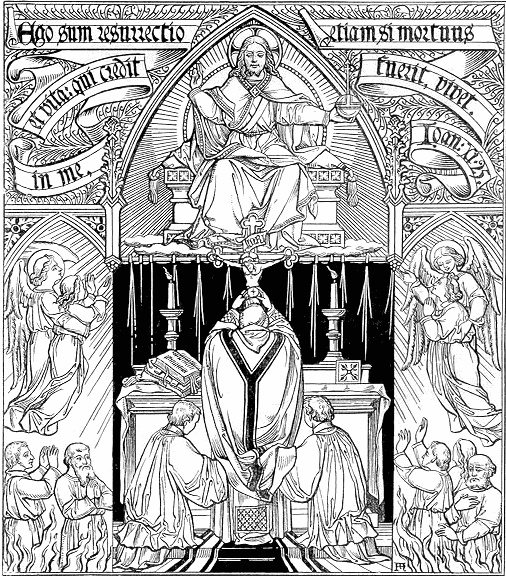
All the good works in the world are not equal to the Holy Sacrifice of the Mass because they are the works of men; but the Mass is the work of God.

Martyrdom is nothing in comparison for it is but the Sacrifice of man to God; but the Mass is the Sacrifice of God for man.

St John Vianney, Curé d'Ars