Showing posts with label Prayer. Show all posts

Saturday, 23 May 2020

Easter VII (The Sunday after Ascension) Acts 1:12-14, 1Peter 4:13-14, John 17:1-11

So that they may be one, as we are one

The ten days between Ascension and Pentecost is something of a strange time, a time of waiting, of anticipation, which speaks very powerfully to our present predicament. It is a time to wait and pray, which feels particularly apposite at this moment in time. Likewise the advice of the First Letter of Peter speaks powerfully when it says, ‘But rejoice insofar as you share Christ’s sufferings, … because the Spirit of glory and of God rests upon you’ (1Peter 4:13-14 ESV) We receive the Spirit in Baptism and Confirmation. He lives in us, and we can unite our sufferings with those of Christ, and be drawn ever closer to Him.

The Gospel this morning has taken us back to the Garden of Gethsemane, where in the seventeenth Chapter of John’s Gospel , after celebrating the Last Supper with His disciples, Jesus goes out to spend time in prayer. It can seem strange to suddenly look back to Maundy Thursday seven weeks after we have celebrated Jesus’ resurrection, but there is a very good reason to do such a thing. The prayer we have just heard is a conversation between God the Son and God the Father. It is a moment of intimacy, a private moment which shows us their relationship, something extraordinary, something wonderful, we don’t often think of prayer in these terms, but currently there is a world-wide initiative, called ‘Thy Kingdom Come’ which calls upon Christians everywhere to do something wonderful together. Between the Ascension and Pentecost we are asked to be like the Apostles in the first chapter of the Book of the Acts of the Apostles, and pray for the gift of the Holy Spirit, just like they did, and for us all to do this together, to pray for unity and the gift of the Holy Spirit. 

Prayer is a funny old thing, and most people probably think of it as asking God for things: please watch over my parents as they travel, please help me pass this examination, hopefully in our language of prayer we can also find time to say thank you for all the good things of this life, and to say sorry for when we’ve not been good enough, and also time to say, ‘I love you’ the prayer of adoration that we may be drawn closer to God. It’s a powerful thing, and a wonderful thing. It is ordinary, yet able to do amazing things:

It can be all to easy in life to think that what God wants is something big and difficult, when actually the opposite is what is required. The key to it all is humility: knowing our need of God. Those who are poor in Spirit, those who are humble can be filled with God’s Spirit, because they rely upon Him, they know their need of him. They know that God can do what we cannot, and they trust Him.

There it is plain and simple: prayer, it can change the world, and for the last two thousand years it has been changing the church and the world, one soul at a time, the wonderful revolution of God’s love at work in the world. In His prayer before his Passion, Jesus prays that we may be one, as He and the Father are one. He prays for unity, it is Jesus’ will for the church, and it is clear that the first apostles did what Jesus wanted them to do, as we can see form the Acts of the Apostles. They listened to Jesus, and did what He told them to do. We have to do the same.

‘And when they had entered, they went up to the upper room, where they were staying, Peter and John and James and Andrew, Philip and Thomas, Bartholomew and Matthew, James the son of Alphaeus and Simon the Zealot and Judas the son of James. All these with one accord were devoting themselves to prayer, together with the women and Mary the mother of Jesus, and his brothers.’ (Acts 1:13-14 ESV)

Here is unity, unity of will and purpose, and we hope to share that here and now. They are devoted to prayer, and we can be too. While the church is not as united as we would like it to be, or as God would like it to be, we can at least say that we are trying to do God’s will. It is something that we can all try and do together. So let us do it. Let us pray for unity, and the outpouring of God’s Holy Spirit, to fill the Church with love, with grace, with forgiveness, with reconciliation, that we can heal the wounds of the past, and be drawn into unity and love, by the power of the Holy Spirit, knowing our need of God, and our reliance upon Him. If we ask, God will both hear our request, and grant it (if it is His will). 

So as we stay put, and wait and pray with the Apostles for the gift of the Holy Spirit let us pray that God may be at work in us, that He will fill us with his love, and transform our lives, building us up, and giving us strength to live His life and to proclaim His truth, to offer the world that which it most earnestly desires, a peace, a joy and a freedom which pass human understanding, and the gift of eternal life in Christ. Let us pray that we are strengthened so that we can proclaim in word and deed what wonderful things God has done through his Son, Our Saviour Jesus Christ. That all that we are and do may confess that Jesus Christ is Lord to the glory of the Father, and that the world may be filled with his love so that all may come to believe and give glory to God the Father, God the Son, and God the Holy Spirit, to whom be ascribed as is most right and just, all might, majesty, glory, dominion, and power, now and forever. Amen. 

3a8ed5baf8ee2d2d1cfd265911689e5b

Sunday, 12 April 2020

Easter 2020 [John 20:1-9]

Easter is for Christians a time of celebration, a feast which we continue to celebrate for fifty days until Pentecost. We do this because it is the most important day of the year for us, because Jesus Christ not only died for us on the Cross, but rose again from the dead. For Christians Death does not have the last word, it is not the end, quite the opposite, it is the start of New Life.

We are used to hearing the proclamation of the Easter message, to the point that we can run the risk of becoming immune to the strangeness of what we are celebrating. Easter is odd: bodies don’t usually rise from tombs. In today’s Gospel, Mary of Magdala simply cannot understand what is going on. St Peter goes into the tomb and sees the cloths lying there, but only the other disciple, St John, both sees and believes, because he looks with the eyes of faith. John has listened to what Jesus has said, and understands what has happened, and how it has been foretold in the Hebrew Scriptures. He sees and understands because he LOVES.

This Easter we are not able to worship together, as we usually do. Instead, for our own safety and the safety of others, we have to worship on our own. But this does not mean that our worship ceases, not at all. This is a hard and a painful time for all of us, because as Christians we are a family, we worship TOGETHER. But while we are not able to do this together physically, we can still be united spiritually. So what can we do? We can read scripture, and we can pray: for the church, for the world, for each other, for all dealing with the current pandemic, for the sick and suffering, and for the dead and dying. We do this because God hears our prayers, and because prayer changes us. It makes us more loving, more generous, more forgiving, and more keen to seek forgiveness. 

This is how we grow in faith, and we can do it whether we are together, or we are apart. It is difficult in this current isolation, but it is by no means impossible. We are an Easter people, and ‘Alleluia’ is our song. We are called to rejoice, regardless of what is happening, regardless of what we may face in this life, because the source of our joy is God, as the prophet Nehemiah says, ‘Go on your way. Eat the fat and drink sweet wine and send portions to anyone who has nothing ready, for this day is holy to our Lord. And do not be grieved, for the joy of the Lord is your strength.’ (Nehemiah 8:10 ESV) God does not disappoint us, and Christ’s resurrection is as true today as it ever was. Christ has conquered sin and death, and risen victorious from the grave, breaking down the bars of Hell and leading souls to Heaven, so we rejoice. As St Paul writes to the Church in Rome: ‘Who shall separate us from the love of Christ? Shall tribulation, or distress, or persecution, or famine, or nakedness, or danger, or sword? As it is written, “For your sake we are being killed all the day long; we are regarded as sheep to be slaughtered.” No, in all these things we are more than conquerors through him who loved us. For I am sure that neither death nor life, nor angels nor rulers, nor things present nor things to come, nor powers, nor height nor depth, nor anything else in all creation, will be able to separate us from the love of God in Christ Jesus our Lord.’ (Romans 8:35-39 ESV) So, my brothers and sisters in Christ, ‘Pasg hapus i chi gyd!’ ‘A Happy Easter to you all!’ May the joy and peace of the Risen Lord fill your hearts and lives, both now and always. Amen. 

If you wish to, you can make a Spiritual Communion: the means of grace by which someone, prevented from sharing in a celebration of the Eucharist, nonetheless shares in the communion of Jesus Christ. Please pray the prayer below:

My Jesus, I believe that You are present in the Most Holy Sacrament. I love You above all things, and I desire to receive You into my soul. Since I cannot at this moment receive You sacramentally, come at least spiritually into my heart. I embrace You as if You were already there and unite myself wholly to You. Never permit me to be separated from You. Amen.

7a55c-anastasischora

Saturday, 19 October 2019

Trinity 18

What’s the point of it all? It’s a question people ask, and thankfully the church has an answer. Humanity exists to love God and serve him in this life, and to enjoy Him in the next. We are made for worship. Nothing else matters: work, family, friends. They’re not bad in themselves, but compared to our relationship with God, they are secondary. Worshipping God is a way of saying that God is the most important thing in our lives. We love God more than our family, our friends, even ourselves. It’s radical and counter-cultural, because it says that our immortal soul matters more than wealth, or power, or prestige. What we are doing is the most important thing we can ever do. It’s what we are made for. To worship God.

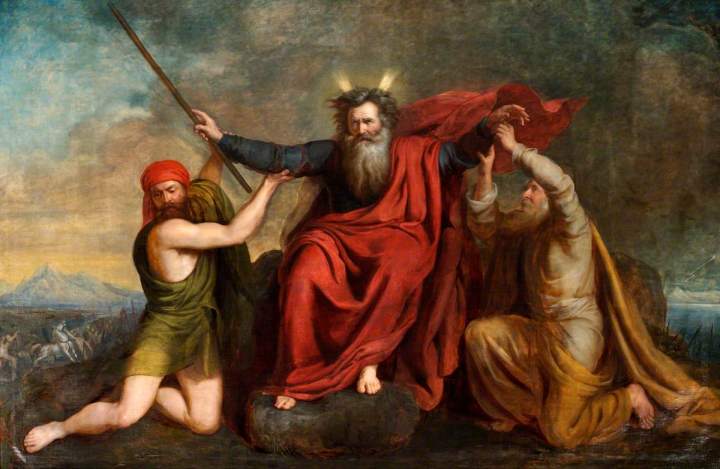
In the first reading this morning from Exodus we see what prayer can achieve. Our life is a battle, just like that fought between Israel and the Amalekites. And we can conquer in spiritual matters by keeping our arms raised in prayer, and helping others by supporting them. The church is a community where we help each other, where we bear each other’s burdens. We pray for ourselves and others, and we are prayed for, so that all around the world, every moment of every day, we are surrounded and upheld by Christians praying for us, not to change God’s mind, but to change us.

It is something which Paul’s Second Letter to Timothy shows us is something we need to learn, to believe, and to continue doing. Prayer isn’t grand, it’s a bit of a slog, it takes a lifetime. It has to be taught, it is what preaching is for. Teaching the faith, and telling people who Jesus is (the Son of God, born of the Virgin Mary) and what He does (preaches repentance, the forgiveness of sins, dies on the Cross, and rises again). It is easy to pervert this into a message which makes few demands upon us, that says, “yes, you’re all fine, you don’t need to do anything”. Christianity makes demands of us. We have to do certain things, which we might prefer not to do, and not do things we might rather like to do. We all need to reminded about this regularly, to help us stay on track. This also helps us to pray well together. 

In this morning’s Gospel Jesus teaches us ‘to pray and not lose heart’ (Lk 18:1) It is important advice. Especially when times are difficult. He teaches us with a parable. There is an unjust judge. He’s corrupt, and he’s fed up, so he gives in, for a quiet life, with the result that the widow receives what is right. God can indeed use many things The point is that the widow is persistent: she keeps on, so that he has to listen to her in the end. So likewise Christian prayer should be unceasing. The widow’s prayers turn wickedness and injustice into mercy and justice. Likewise our prayers do not change God, but instead they change us. That’s the point of prayer not to change God’s mind, but to change us, into what God wants us to be. Persistent prayer can, and will change us. It is how saints are made: through prayer. It takes WORK, but it is wonderful, and worth it. 

The parable reminds us that God hears prayer. He may not always answer it in a way we might like. Sometimes God says no, or not yet, which we might not want to hear. It teaches us patience and wisdom, and even if we suffer, we grow through it. Our growth in holiness can be painful and difficult. In the first reading from Exodus, Moses is clearly tired, he has to be held up by Aaron and Hur. In Paul’s letter to Timothy, he is not advising something popular, but something unpopular, that people will not want to hear. 

The Gospel ends with the question (v. 8): ‘Nevertheless, when the Son of Man comes, will he find faith on earth?’ It’s an important question. If we look at statistics, then people in this country are becoming less religious. Fewer people have faith. There are many reasons for this, and this is not the place to explore them. Solutions are likewise not simple, or straightforward. We can do many things, but we need to make sure that our own faith is strong and attractive, and be prepared to bear witness to it, regardless of the cost. Our faith can only be attractive when it is REAL. This is what will encourage people to follow our example, and come to know and love Jesus Christ. Only in this way can real living faith be transferred so then when Christ comes, as He surely will, He will find faith on earth. So let us trust Christ, knowing that His promises are true, that He feeds us with His Body and Blood in the Eucharist to give us life in Him. Let us love the one who loves us, who gave His life for us, to take away our sins, to heal us and restore us. And healed and restored by Him, let us bear witness to Him, so that the world may come to believe and give glory to God the Father, God the Son, and God the Holy Spirit, to whom be ascribed as is most right and just all might, majesty, glory, dominion, and power, now and forever. Amen.

NWM_AU_OP2.jpg

Trinity 18

What’s the point of it all? It’s a question people ask, and thankfully the church has an answer. Humanity exists to love God and serve him in this life, and to enjoy Him in the next. We are made for worship. Nothing else matters: work, family, friends. They’re not bad in themselves, but compared to our relationship with God, they are secondary. Worshipping God is a way of saying that God is the most important thing in our lives. We love God more than our family, our friends, even ourselves. It’s radical and counter-cultural, because it says that our immortal soul matters more than wealth, or power, or prestige. What we are doing is the most important thing we can ever do. It’s what we are made for. To worship God.

In the first reading this morning from Exodus we see what prayer can achieve. Our life is a battle, just like that fought between Israel and the Amalekites. And we can conquer in spiritual matters by keeping our arms raised in prayer, and helping others by supporting them. The church is a community where we help each other, where we bear each other’s burdens. We pray for ourselves and others, and we are prayed for, so that all around the world, every moment of every day, we are surrounded and upheld by Christians praying for us, not to change God’s mind, but to change us.

It is something which Paul’s Second Letter to Timothy shows us is something we need to learn, to believe, and to continue doing. Prayer isn’t grand, it’s a bit of a slog, it takes a lifetime. It has to be taught, it is what preaching is for. Teaching the faith, and telling people who Jesus is (the Son of God, born of the Virgin Mary) and what He does (preaches repentance, the forgiveness of sins, dies on the Cross, and rises again). It is easy to pervert this into a message which makes few demands upon us, that says, “yes, you’re all fine, you don’t need to do anything”. Christianity makes demands of us. We have to do certain things, which we might prefer not to do, and not do things we might rather like to do. We all need to reminded about this regularly, to help us stay on track. This also helps us to pray well together. 

In this morning’s Gospel Jesus teaches us ‘to pray and not lose heart’ (Lk 18:1) It is important advice. Especially when times are difficult. He teaches us with a parable. There is an unjust judge. He’s corrupt, and he’s fed up, so he gives in, for a quiet life, with the result that the widow receives what is right. God can indeed use many things The point is that the widow is persistent: she keeps on, so that he has to listen to her in the end. So likewise Christian prayer should be unceasing. The widow’s prayers turn wickedness and injustice into mercy and justice. Likewise our prayers do not change God, but instead they change us. That’s the point of prayer not to change God’s mind, but to change us, into what God wants us to be. Persistent prayer can, and will change us. It is how saints are made: through prayer. It takes WORK, but it is wonderful, and worth it. 

The parable reminds us that God hears prayer. He may not always answer it in a way we might like. Sometimes God says no, or not yet, which we might not want to hear. It teaches us patience and wisdom, and even if we suffer, we grow through it. Our growth in holiness can be painful and difficult. In the first reading from Exodus, Moses is clearly tired, he has to be held up by Aaron and Hur. In Paul’s letter to Timothy, he is not advising something popular, but something unpopular, that people will not want to hear. 

The Gospel ends with the question (v. 8): ‘Nevertheless, when the Son of Man comes, will he find faith on earth?’ It’s an important question. If we look at statistics, then people in this country are becoming less religious. Fewer people have faith. There are many reasons for this, and this is not the place to explore them. Solutions are likewise not simple, or straightforward. We can do many things, but we need to make sure that our own faith is strong and attractive, and be prepared to bear witness to it, regardless of the cost. Our faith can only be attractive when it is REAL. This is what will encourage people to follow our example, and come to know and love Jesus Christ. Only in this way can real living faith be transferred so then when Christ comes, as He surely will, He will find faith on earth. So let us trust Christ, knowing that His promises are true, that He feeds us with His Body and Blood in the Eucharist to give us life in Him. Let us love the one who loves us, who gave His life for us, to take away our sins, to heal us and restore us. And healed and restored by Him, let us bear witness to Him, so that the world may come to believe and give glory to God the Father, God the Son, and God the Holy Spirit, to whom be ascribed as is most right and just all might, majesty, glory, dominion, and power, now and forever. Amen.
NWM_AU_OP2.jpg

Sunday, 5 November 2017

Living the Life of the Kingdom: Micah 3:5-12, 1Thess 2:9-13, Matt 24:1-14

Our blessed Lord began His public life on the Mount of the Beatitudes, by preaching, ‘Blessed are the meek: for they shall possess the earth.’ He finished His public life on the hill of Calvary by practising that meekness: ‘Father, forgive them for they know not what they do.’

Fulton J. Sheen The Cross and the Beatitudes, 1937: 3

The Prophet Micah has some tough words this morning for those who lead people astray. Those who tell people what they want to hear will be the downfall of Israel. It is something which can easily be the downfall of any organisation: just tell people what they want to hear, don’t make any demands on them, just make them feel comfortable, all motherhood and apple pie. The church can and does easily fall prey to this and its fruit is apathy. People don’t want a church to make them feel comfortable, but to challenge them, and inspire them to be something better, by the grace of God. Thus we are called to holiness of life, or as St Paul puts it, ‘to lead a life worthy of God, who calls you into his own kingdom and glory.’ (1Thess 2:12) We put our faith into practice – walking the walk and talking the talk, together in an act of witness to the world, to call it to repentance, and to be formed as part of the Kingdom of God, a kingdom of love, where we are forgiven and built up in love.

It is probably a good thing that Our Lord and Saviour Jesus Christ was not an advertising executive. Fundamentally He tells it like it is – there is a simplicity and a directness to Him that is not always comfortable. He does not tell us what we want to hear, but rather he tells us what we need to hear, which is often far from pleasant or comfortable. He has been teaching in the Temple, about the Kingdom of God, and how to live out the faith in our lives and now He turns to the future.

The Temple was the single most important place on Earth for religious Jews, it was the centre of their life; it was where they came close to God. The prospect of its destruction was surely the most dreadful prospect, something not to be countenanced at all. Yet it would happen, and rather than hide behind the false hope of a pleasant image, he teaches people the plain unvarnished truth. Rather than a sugar-coated pill he gives us a bitter draught, so that we can be prepared.

False teaching is always a possibility for the Church – people want to pervert the Gospel, to twist it for their own ends and to suit their own agenda – it is happening now, and has always happened. We need, therefore to be vigilant, to know what we believe and why, so that we can discern the true from the false, the good from the bad.

In human terms, the future looks bleak – human beings have an immense capacity for doing the wrong thing, and yet in the midst of all this we know whom we can trust, whom we can look to, where we can place our hope and our confidence. The possibility of being tortured or killed for professing faith in Jesus Christ is still very real, here and now, in the world in which we live. It’s a deeply unpleasant thought, and while none of us I suspect would like to undergo such treatment, we have to be prepared for the possibility, we have to be willing to stand up and be counted, to know that we place Christ before and above all things.

At one level it is quite understandable, what Christ stands for, what we stand for: love, forgiveness, selflessness, are never going to be popular in a world obsessed by power and wealth. But we’re not here to win a popularity contest, but rather to bear witness to the truth of Christ, and to know that we are set free by it. The love of many may grow cold; indeed it has, so we need to be that love in the world to make Christ known and to call others into His loving embrace. Against a human nature which takes a perverse delight in selfishness and sin, in not living how God wants us to, we need to take a stand.

Fundamentally the calling to be a saint is there for each and every one of us. We are called to be like Christ, and through our baptism to die to the ways of the world and live for him. In our baptism we are given the grace of God and His Holy Spirit, we are given all that we need to get to Heaven, because Christ loves us, and gave Himself to die for us, to take away our sins, to show us what love and forgiveness really look like, so that we can do the same.

On our own, each one of us individually doesn’t stand much of a chance, it’s far too difficult, it’s not how it is supposed to be.Rather we need to live out our faith together, as a community of believers, helping each other, supporting each other, praying for and forgiving each other, being built up in love together, so that together we can truly be the people of God, forgiving each other, loving each other, and helping to make the Kingdom a reality here and now.

We come to be nourished by Him, to be fed by the Word of God, nourished in our faith, to be fed with His Body and Blood, to be given a foretaste of heaven, fed by Him, fed with Him, to be built up in love together, strengthened and nourished to live out our common calling to sainthood, and to encourage others to join us, as this is what God wants us to do – this is life in all its fullness, following the Truth which sets us free from the ways of the world – its selfishness, its lust for power and control, its fear and anger, all those things which separate us from God and each other.

So let us come to Him, let our lives be transformed by Him, so that we can live out our faith together, in our common calling, and encourage others so to do, so that they too may believe and give Glory to God the Father, God the Son, and God the Holy Spirit, to whom be ascribed as is most right and just all might, majesty, glory, dominion, and power, now and forever.


Sunday, 18 December 2016

A thought for the day from Fulton Sheen

Abandonment to God

We always make the fatal mistake of thinking that it is what we do that matters, when really what matters is what we let God do to us. God sent the angel to Mary, not to ask her to do something, but to let something be done. Since God is a better artisan than you, the more you abandon yourself to him, the happier he can make you.

Seven Words of Jesus and Mary

bvm-visitation-web


Monday, 23 November 2015

Thoughts for the Day from Mother Mary Clare SLG


Our life proves the reality of our prayer, and prayer which is the fruit of true conversion is an activity, an adventure - and sometimes a dangerous one - because it brings neither peace nor comfort, but always challenge, conflict and new responsibility. 

We must try to understand the meaning of the age in which we are called to bear witness. We must accept the fact that this is an age in which the cloth is being unwoven. It is therefore no good trying to patch. We must, rather, set up the loom on which coming generations may weave new cloth according to the pattern God provides.

We must learn to wait upon the Spirit of God. As he moves us, we are led into deeper purgation, drawn to greater self-sacrifice, and we come to know in the end the stillness, the awful stillness, in which we see the world from the height of Calvary. 

Saturday, 4 July 2015

A prayer of Dr Pusey

O our Saviour! of ourselves we cannot love thee, cannot follow thee, cannot cleave to thee;
but thou didst come down
that we might love thee
didst ascend
that we might follow thee,
didst bind us round thee as thy girdle
that we may be held fast unto thee;
Thou who hast loved us, make us to love thee,
Thou who hast sought us, make us to seek thee,
Tho who, when lost, didst find us,
be thou thyself the way,
that we may find thee
and be found in thee,
our only hope, and our everlasting joy.

Sunday, 28 June 2015

A thought for the day from Mother Mary Clare SLG

Today we can easily become paralysed by a sense that there is nothing we can do in the face of so much suffering, such lack of love and justice in man's relation with man, but the Cross of Christ stands at the heart of it all, and the prayer of Christ, now as always is the answer to man's need.

Tuesday, 10 March 2015

A Thought for the Day from St Benedict

If we do not venture to approach men who are in power, except with humility and reverence, when we wish to ask a favor, how much must we beseech the Lord God of all things with all humility and purity of devotion? And let us be assured that it is not in many words, but in the purity of heart and tears of compunction that we are heard. For this reason prayer ought to be short and pure, unless, perhaps it is lengthened by the inspiration of divine grace. At the community exercises, however, let the prayer always be short, and the sign having been given by the Superior, let all rise together.

Sunday, 22 February 2015

Homily for Lent I

It is all too easy to see the forty days of Lent, the season of preparation for our celebration of Our Lord’s Passion, Death and Resurrection as a time of sadness and misery. Too often it is seen in entirely negative terms: we focus on what we are giving up. Now the practice of abstaining from bodily pleasures is a good and ancient one, not in and of itself, it is not some sort of holy diet, but rather we turn away from something we enjoy so that we may focus upon something else. The other practices of Lent: prayer and almsgiving are there to focus our minds upon God and other people, so that we may enter the desert of repentance with joy, thinking of the needs of others and growing closer to the God who loves us and longs for our healing, our repentance.
       In this morning’s first reading we see a covenant between God and humanity, a sign of God’s love for us, and a promise of reconciliation between God and the world which underlies what Jesus does for us, it allows us to have hope, to see things in an entirely positive way, and to see behind what we do, that it is a means, a means to an end, namely our sanctification, rather than an end in itself. In our second reading from the first letter of Peter, he draws the link between Noah’s ark, which saves people through water, and baptism, which is prefigured in it. Lent is a season of preparation for baptism, so that we can die with Christ and be raised like him and with him to new life in him. For those of us who have been baptised it is good to have a chance to spend the time in Lent praying, drawing closer to the God who loves us, and living out our faith in our lives – we can all do better, especially when we try, and try together, supporting each other, so that we might grow in holiness as the people of God.

When St Antony was praying in his cell, a voice spoke to him, saying ‘Antony, you have not yet come to the measure of the tanner who is in Alexandria.’ When he heard this, the old man arose and took his stick and hurried to the city. When he had found the tanner .... he said to him, ‘Tell me about your work, for today I have left the desert and come here to see you.’
He replied, ‘I am not aware that I have done anything good. When I get up in the morning, before I sit down to work, I say that the whole of the city, small and great, will go into the Kingdom of God because of their good deeds while I will go into eternal punishment because of my evil deeds. Every evening I repeat the same words and believe them in my heart.’
When St Antony heard this he said, ‘My son, you sit in your own house and work well, and you have the peace of the Kingdom of God; but I spend all my time in solitude with no distractions, and I have not come near to the measure of such words.’
It is a very human failure, for far too often we make things far too complicated when all we need to do is to keep things simple. In the story from the Desert Fathers, which we have just heard, St Antony, the founder of monasticism, a great and a holy man, is put to shame by a man who spends his days treating animal skins. The key to it all is the tanner’s humility, his complete absence of pride, and his complete and utter trust in God – his reliance upon him alone.
In this morning’s Gospel we see the beginning of Our Lord’s public ministry – he is baptised by John in the River Jordan before immediately  going into the desert for forty days. He goes to be alone with God, to pray and to fast, to prepare himself for the public ministry of the Proclamation of the Good News, the Gospel.
During this he is tempted by the devil: he faces temptation just like every human being, but unlike us, he resists. The devil tempts him to turn stones into bread. It is understandable – he is hungry, but it is a temptation to be relevant, which the church seems to have given into completely: unless we what we are and what we do and say is relevant to people, they will ignore us.
There is the temptation to have power, symbolised by worshipping the devil. It leads to the misuse of power. The church stands condemned for the mistakes of the past, but in recognising this there is the possibility of a more humble church in the future – a church reliant upon God and not on the exercise of power.
There is the temptation to put God to the test – to be spectacular and self-seeking. Whenever we say ‘look at me’ we’re not saying ‘look at God’.
Jesus resists these temptations because he is humble, because he has faith, and because he trusts in God. It certainly isn’t easy, but it is possible. It’s far easier when we do this together, as a community, which is why Lent matters for all of us. It’s a chance to become more obedient, and through that obedience to discover true freedom in God. It’s an obedience which is made manifest on the Cross – in laying down his life Jesus can give new life to the whole world. He isn’t spectacular – he dies like a common criminal. He has no power, he does not try to be relevant, he is loving and obedient and that is good enough.

It was enough for him, and it should be for us. As Christians we have Scripture and the teaching of the Church, filled with his Spirit, to guide us. We can use this time of prayer and fasting to deepen our faith, our trust, our understanding, and our obedience, to become more like Jesus, fed by his word and sacraments – to become more humble, more loving, living lives of service of God and each other.  It leads to Jesus’ proclamation of the kingdom: ‘The time is fulfilled, and the kingdom of God has come near; repent, and believe in the good news.’ Words as true now as then, which the world still longs to hear, and which we need to live out in our lives, so that the world may believe and give glory to God the Father, God the Son, and God the Holy Spirit, to whom be ascribed as is most right and just, all might, majesty, glory dominion and power, now and forever

Saturday, 17 January 2015

A Thought for the Day from S. Anthony the Great


The brethren came to the Abba Anthony and said to him, 'Speak a word; how are we to be saved?' The old man said to them, 'You have heard the Scriptures. That should teach you how.' But they said, 'We want to hear it from you too, Father.' Then the old man said to them, 'The Gospel says,"if anyone strikes you on the one cheek, turn to him the other also."' (Mt 5:39) They said, 'We cannot do that.' The old man said, 'If you cannot offer the other cheek, at least allow one cheek to be struck.' 'We cannot do that either,' they said. So he said, 'If you are not able to do that, do not return evil for evil,' and they said, 'We cannot do that either.' Then the old man said to his disciple, 'Prepare a little brew of corn for these invalids. If you cannot do this, or that, what can I do for you? What you need is prayers.'

It was revealed to Abba Anthony in his desert that there was one who was his equal in the city. He was a doctor by profession and whatever he had beyond his needs he gave to the poor, and every day he sang the Sanctus with the angels.

He also said, 'Our life and our death is with our neighbour. If we gain our brother, we have gained God, but if we scandalise our brother, we have sinned against Christ.'

Sunday, 9 November 2014

Trinity XXI The Conversion and Sanctification of Man

Canon Henry Liddon was quite right when he spoke to the clergy saying ‘Our end is the conversion and sanctification of man’. It’s what the church is for, and its ministerial priesthood, sharing in the priesthood of Christ, calls the common priesthood of the baptised to be conformed more and more to the image of the Crucified Lord, Our Saviour Jesus Christ.
       This is achieved by a variety of means, but particularly by prayer: where humanity speaks to and more importantly listens to God. It is a mark of the intimacy of our relationship with the divine that it is to be a regular constant conversation so that God may be at work in us. In our prayer we praise God, not because He needs it, but because it is right and good humanity, the creature to praise its Creator. We intercede for our own needs and for those of the world, and we plead the sacrifice of His Son which alone can heal the wounds of sin which mar our fallen human nature. In our humble talking to God and in the silence of our hearts there can a space for God to speak to us, to transform us, in the power of His Holy Spirit.
       When Paul writes to Titus, in this evening’s second lesson, he is concerned with the ordering of public worship, and particularly prayer. Here in a Cathedral we are not unacquainted with decent ordered worship, as one might well expect. We have standards, which are rightly high, and can serve as an example and an encouragement, but we are first and foremost a community of prayer, which invites people to draw ever closer to the God who loves us, who saves us, and redeems us.
       We pray for the Church and the World, for the living and the departed, for the sick and those in need, which is excellent and acceptable to God. We do so in order that we may strive to live an ordered, quiet, peaceable life, and thus may be drawn ever closer to the godliness which is the path to true holiness of life in Christ. His Salvation which is for all people is both an event – His sacrifice upon the Cross of Calvary, and a process – through the outpouring of His Sanctifying Grace in the Sacraments of the Church, nourished by the Word of God in Holy Scripture, the Revealed Truth of God’s love for us, and through remaining close to God in prayer, that our human nature can be transformed and perfected in Christ. It is the will of God that all people may be saved, the invitation is offered to all, freely, it costs nothing, it may be resisted and even refused, yet God in His love and mercy offers it. We do not deserve it, we cannot earn it, it is a gift which is offered and has to be accepted.
       There is one mediator between God and humanity, Our Lord and Saviour Jesus Christ, who gave himself as a ransom for all, bearing witness to the love and mercy of God, and offering himself freely as a sacrifice upon the altar of the Cross, where as priest and victim he makes the one perfect and sufficient sacrifice for the sins of the whole world. This simple world-changing fact is at the heart of our faith: Christ died for our sins, yours and mine, and was raised to give us the hope of eternal life in Him. This is what we preach, it is what we pray, and what we live, so that we may be drawn closer to Him.
       It is wonderful, and yet it is not easy – for two thousand years the church continues to call humanity to repentance, and while our human efforts may be haltering, nonetheless the call to conversion and sanctification is a constant one, of which we need to be constantly reminded, each and every one of us, so that we can support and forgive each other, and pray for and with each other.
       I would like to end with some words of Mother Mary Clare slg:
       Today we can easily become
       paralysed by a sense that
       there is nothing we can do
       in the face of so much suffering,
       such lack of love and justice
       in man’s relationship with man,
       but the Cross of Christ
       stands at the heart of it all,
       and the prayer of Christ,
       now as always
       is the answer to man’s need.


Be Prepared - Matthew 25:1-13

The Scouting Movement has as its motto ‘Be Prepared’ which rather sums up the message of this morning’s Gospel. As people who live in the countryside we are more than used to having a supply of candles and batteries ready at hand to deal with the inevitable winter power cuts caused by bad weather. It makes sense, so that we are not caught out – having to endure the cold and dark.
      The Gospel speaks of a more serious preparedness, one which we must all face.  Our earthly lives are finite, and we have to be prepared for our end. We know that as Our Lord came among us born as a baby in Bethlehem, so he will come as Our Judge, and we have to be ready to meet Him. Rather than face this future with a feeling of uncertainty, of dread, we can as Christians have hope, we can watch and wait in hope, in the darkness, in the knowledge that Christ loves us, that he gave himself for us, he died to take away our sins, and that we can live for and through Him. It need not catch us unawares, as we have been warned, so that we can be prepared, we can be ready, with the lamp of faith and good works ready, trimmed and burning – a light burning in the darkness.
      It is a very human fear, and clearly the Christians in Thessaly around ad55 were more than a little concerned about what might happen. They can have the hope that ‘so we will be with the Lord forever.’ (1Thes 4:17) and therefore confident in that hope, they can begin to live out their faith here and now. They can live out the justice and righteousness which is pleasing to God, as it is how he wants us to live, so that we can have life in its fullness in Him.
      If what we believe in our hearts and how we live our lives are in perfect sync with each other, then we need have no fear, as the promise of sharing in Christ’s Resurrection is there for us – we do not need to be afraid, and we can get on with the business of living our lives secure in our faith. When we do this we can begin to see something of the just and gentle rule of Christ, as we will transform the world, and will be truly alive, living the life of heaven here in earth. Each day, as Christians, we pray, and we say the prayer that Jesus taught us which includes the petition ‘Thy kingdom come, Thy will be done on earth as it is in heaven’. So that our words are not empty, as well as praying for the coming of God’s kingdom, we have to do something about it – we have to show how prepared we are by listening to God and doing what he tells us.

      We pray, we are nourished by the word of God, in reading the Bible, we are nourished by the sacraments of the Church, by the Body and Blood of Christ in the Eucharist, so that we may be strengthened in our faith, strengthened to live it out in our lives, living out the sacrifice so that we may be drawn into its mystery, carrying our own Cross, and being conformed ever more and more to the example of Our Lord and Saviour, living in Him, living like Him, living the life of the Kingdom here and now, so Christ’s kingdom may come here on earth, that His will may be done. 

Tuesday, 2 September 2014

A thought for the day from St John of the Cross

Wait upon God with loving and pure attentiveness, working no violence on yourself lest you disturb the soul's peace and tranquility. God will feed your soul with heavenly food since you put no obstacle in his way. The soul in this state must remember that if it is not conscious of making progress, it is making much more than when it is walking on foot, because God himself is bearing it in his arms. Although outwardly it is doing nothing, it is in reality doing more than if it were working, since God is doing the work within it. And it is not remarkable that the soul does not see this, for our senses cannot perceive that which God works in the soul. Let the soul then leave itself in the hands of God and have confidence in him. Let it not trust itself to the hands and works of others, for if it stays in God's care it will certainly make progress. 

Sunday, 10 August 2014

Walking on Water

Fear is a very human feeling, we acquire it through learning, and yet it can be overcome, if we trust in God. Christains in Iraq, China, North Korea & Palestine – they face real danger, real persecution (we’re safe and comfortable by comparison) – and yet they trust, they pray (and so should we) and we should do all that we can to help them.
Immediately he made the disciples get into the boat and go on ahead to the other side, while he dismissed the crowds.
This morning’s Gospel carries straight on from the miraculous feeding last week, as Jesus goes to send the crowds back home, he sends disciples ahead so that they might be ready.
 And after he had dismissed the crowds, he went up the mountain by himself to pray.
Prayer is important, it is as important as the food we eat, the air we breathe, because it is about our relationship with God. Throughout the Gospels Jesus spends time alone, spends time close to the Father as this relationship is crucial. Where Jesus leads we should follow, follow his example.
When evening came, he was there alone, but by this time the boat, battered by the waves, was far from the land, for the wind was against them.
It’s getting dark, and the disciples are out in the middle of the lake, in deep water; will the boat sink, what can they do?
And early in the morning he came walking towards them on the lake. But when the disciples saw him walking on the lake, they were terrified, saying, ‘It is a ghost!’ And they cried out in fear.
But immediately Jesus spoke to them and said, ‘Take heart, it is I; do not be afraid.’
The disciples cannot believe that they are seeing Jesus, so he encourages them, his presence can give them confidence.
Peter answered him, ‘Lord, if it is you, command me to come to you on the water.’ He said, ‘Come.’
As usual, Peter is the first to react, he takes the lead – Jesus speaks a single word to him, ‘Come’ he speaks it to each and every one of us as Christians, to come, to follow him, to be close to him, to live out our faith in our lives strengthened by prayer.
 So Peter got out of the boat, started walking on the water, and came towards Jesus. But when he noticed the strong wind, he became frightened, and beginning to sink, he cried out, ‘Lord, save me!’ Jesus immediately reached out his hand and caught him, saying to him, ‘You of little faith, why did you doubt?’ When they got into the boat, the wind ceased.
 And those in the boat worshipped him, saying, ‘Truly you are the Son of God.’
Peter listens to what Jesus says, and obeys him, and does something miraculous, something extraordinary, until he is distracted by the world around him, and becomes frightened, likewise we, in our lives can in the power of God do wonderful things, if we are not distracted by the cares of the world around us, if we listen to what Jesus tells us and do it.
Peter becomes frightened; he starts to sink, as do we all when the cares of this world overwhelm us. His reaction is to cry ‘Lord, save me’ which Jesus does, indeed, through his offering of himself upon the Cross he saves each and every one of us, taking the sin of the world upon himself so that we might be freed from sin, fear and death, that same sacrifice which will be made present here, so that we the people of God, can be fed by God, with God, with his Body and Blood to be strengthened to have life in him, to be close to him.
Peter is told off for lacking faith, because it is important, we need to trust God, to have faith in Him, so that He can be at work in us and through us.

At the end, once the wind has died down the disciples worship Him, saying, ‘Truly you are the Son of God.’ The end of it all is worship, it is what we as humans and as Christians are for, to worship God, in our love and our prayer, so that all of our lives are an act of worship, drawing us ever closer to the source of life and love. So that all we say or think or do may give glory to God the Father, God the Son, and God the Holy Spirit, to who whom be ascribed as is most right and just, all might, majesty, glory, dominion and power, now and forever.