Sunday, 17 May 2015

Easter VII - Sunday after Ascension - A Radical Alternative


The prophet Ezekiel has a vision (in Chapter 36) of a messianic future, of the restoration of  Israel, which is found in his Son, Jesus Christ and the Church, we are those sprinkled with the clean water of baptism, who have been cleansed. God gives us a new heart and puts his Spirit within us, just as he did on the day of Pentecost, so we are to live as the people of God, lled with his love, and forgiveness, and proclaiming his Truth to the world.
          This Sunday in the Gospel we are in the middle of Jesus’ High Priestly Prayer, which is the summit of his teaching just before his arrest and Passion. Christ has made God’s name known to us, we know him in a different way, we pray to him as ‘Father’ and we are his, we are not our own, despite the Western Liberal infatuation with personal freedom, we are God’s, which affects who we are, and what we do.
          Christ speaks to us, and teaches us so that our joy may be complete in him, lled with his love, and the Holy Spirit. The world’s reaction to this is a negative one: because what we are, what we stand for, and how we live as Christians is to be opposed to what the world around us stands for – selshness, greed, which it makes into false gods, as though material wealth, or power, or status could save us – such things are transient and fleeting. It offers us a short-cut, an easy road, whereas if we are following Christ, then we are walking the way of his Passion, we are walking the Way of the Cross, dying daily to sin, and letting God’s grace be at work in and through us. It is not easy, it is difficult, most of us are unable to manage on our own, we need the love and support of the Christian community to help us, even the rst Christians, those who had been with Jesus, needed each 0ther’s help and support, so they can continue what Jesus started.
          We need to be together, to meet together to pray for our needs and those of the world, and to be nourished by the word of God, the Bible, and the Sacrament of Our Lord’s Body and Blood, not because they’re something nice to do on a Sunday morning: an add-on, an optional extra that we can opt into and out of as we feel like, but because as Christians they are crucial to who and what we are, if we are to remain in the love of God then we have to live this way. Only then can we offer the world an alternative to the ways of selshness and sin. It will hate us for doing this, it will despise us, it will call us hypocrites when we fail to live up to the example of Jesus, but as Christians who live in the love of God we forgive each other our trespasses, so that we can live out that same radical love and forgiveness which sees Jesus die upon the Cross for love of us and all the world. It is a message of such love, such forgiveness that the world cannot or does not want to understand it, we may not understand it, but we know that it can be experienced, and we are living testimony to its power. It turns our lives around and sets us free to live for God and to proclaim his saving truth in our words and actions, calling the world to repentance, to turn to Christ, and to be renewed in and through Him.
          So as we wait with the Apostles for the gift of the Holy Spirit let us pray that God may be at work in us, building us up, and giving us strength to live his life and to proclaim his truth, to offer the world that which it most earnestly desires, a peace, a joy and a freedom which pass human understanding, and the gift of eternal life in Christ.

Saturday, 9 May 2015

Easter VI - Love in Action


The prophet Isaiah has a vision of a Messianic future, a vision of hope, of plenty, and of love. His vision anticipates the grace and healing which God pours out on the world through His Son and the Holy Spirit. It is a vision of the future which we inhabit as Christians, through our common baptism and the grace of God. It may not always feel like we do: such is the power of human sin, and our human inability to trust in a God who loves us. Despite our failings, our inadequacy, our unworthiness, and our weakness we can trust in a God who saves us, a God who loves us, a God who makes promises and keeps them.
‘As the Father has loved me, so have I loved you’ Jesus in the Upper Room with His disciples is looking to the Cross and beyond, as the demonstration of real costly self-giving love. As St Isaac the Syrian says, ‘The sum of all is that God the Lord of all, out of fervent love for his creation, handed over his own Son to death on the cross. “For God so loved the world that he gave his only-begotten Son for its sake.” This was not because he could not have saved us in another way, but so that he might thereby the better indicate to us his surpassing love, so that, by the death of his only-begotten Son, he might bring us close to himself. Yes, if he had had anything more precious he would have given it to us so that our race might thereby have recovered. Because of his great love, he did not want to use compulsion on our freedom, although he would have been able to do so; but instead he chose that we should draw near to him freely, by our own mind’s love.’
Christ tells us to abide, to remain in His love. How do we do that? By keeping his commandments – to love God with all our heart, our soul, our mind, and our strength, and to love our neighbour as ourself. Christ speaks to us so that we may have joy, joy in all its fullness, so that we may begin to enter into that which is the life of the Divine Trinity – so that we can be caught up in the Divine Life of Love and Joy, freed from the cares of the world. We may enter into that life which is communion, of which we have a foretaste here on earth, a pledge of immortality,  the promise that God’s grace will perfect our human nature.
To reinforce the point Christ says, ‘This is my commandment, that you love one another as I have loved you. ’ Christ loves us by laying down His life for us, and this is how we are to love one another, with that same costly, self-giving love, losing our life so that we may find it in Christ – redeemed by His suffering and death, and raised to new life with Him in the power of the Holy Spirit.
Living as we do in the aftermath of a twentieth century which has seen war and death on a dreadful scale we are mindful of the fact that verses in this morning’s Gospel were use to encourage men to fight for their country. Once, this was seen as good and proper, now we are troubled by what is seen as a mis-use of Scripture, and rightly so. We cannot undo the mistakes of the past, but we can learn from them, so that the love which lies at the heart of this passage inspires us to strive for peace and freedom, to follow Christ’s example and to carry our own crosses, and live out that same love.
If it is Christ who chooses us, and not we Him, God takes the initiative, not to force us but so that we may be drawn to come with Him out of love, on our pilgrimage of faith, strengthened by the Bread of Life, the bread for the journey, walking in the footsteps of Love. In Christ we have communion, fellowship, in Him is true community born, through we are reconciled to God and each other, so that we can share in the proclamation of the Good News, walk the pilgrimage of faith and be fed and transformed by grace.
This is not some future event, but right here and right now; we thirst for this love, and only it can satisfy our deepest desires, so let us come, and draw near to the living water, who is the living bread and the true vine, the shepherd of our souls, who loves us so much that he died for us, to Christ, that we may be in Him, and remain in his love. He does not choose us because we are worthy, but that by choosing Him, we may through His grace become so. So let us love Him and one another. 

Sunday, 3 May 2015

Easter V: I am the Vine, You are the Branches

When the Apostle Philip meets an Ethiopian eunuch on the road from Jerusalem to Gaza, he comes across a man reading the prophesy of Isaiah: a financial expert, highly-trusted, and well-educated, a man of power and influence. He’s looking for something, he’s been worshipping God in Jerusalem. Philip asks him if he can understand what he is reading. He replies that he cannot, unless someone shows him the way. ‘Then Philip opened his mouth, and beginning with this Scripture he told him the good news about Jesus.’ (Acts 8:35 ESV). Isaiah’s prophesy is fulfilled in Jesus and this is the proclamation of the Church: we proclaim Jesus Christ and him crucified.
We read scripture so that we can understand it, and see in its words how it discloses the truth of the Word made flesh, who suffered and died for our sake. Isaiah prophesies Our Lord’s Passion and Death, and thus it makes sense, it can be understood, and the more we come to understand, the more we come to know just how much God loves us. The Scriptures, the entire of the Law and the Prophets point to Jesus Christ, they find their meaning and fulfilment in Him, who is the Word of God made flesh. Just like the story of the sacrifice of Isaac by Abraham points to the sacrifice of Christ on the Cross, where God gives his only Son for love of us, it is prefigured by the ram in the thicket, which points to that moment where John the Baptist can cry out ‘Behold the lamb of God who takes away the sins of the world!’

Having been nourished by the Word of God, our unnamed Ethiopian desires baptism:  so that he may be ‘in Christ’ rooted and grafted, close to him, filled with His Spirit, so that he may bear much fruit.


When we are close to Christ, washed clean by our baptism, nourished by Word and Sacrament, we can truly be Christ’s disciples, living in Him, living for Him, proclaiming Him, and bearing much fruit, so that the world may believe and give glory to God the Father, God the Son and God the Holy Spirit

Sunday, 12 April 2015

Sermon for Evensong of the First Sunday after Easter

An old man said, ‘Joseph of Arimathea took the body of Jesus and placed it in a clean garment within a new tomb, which signifies a new humanity. Therefore let each one strive attentively not to sin so that they do not mistreat the God who dwells within themselves and drive him away from their soul.’

It is a good thing that we have time at Easter to take in and make sense of what we have commemorated: Our Lord’s Passion, Death, & Resurrection. They are linked and form part of a larger whole of the history which stretches back through the Incarnation, of the Word made flesh for our sake, to the Creation of the World.
 In the 8th Chapter of the Acts of the Apostles we see the meeting of Philip and an Ethiopian eunuch, who is reading the very passage which we have just heard  as our first lesson this evening– the Suffering Servant. Philip asks him if he can understand what he is reading. He replies that he cannot, unless someone shows him the way. ‘Then Philip opened his mouth, and beginning with this Scripture he told him the good news about Jesus.’ (Acts 8:35 ESV). Isaiah’s prophesy is fulfilled in Jesus and this is the proclamation of the Church: we proclaim Jesus Christ and him crucified.
We read scripture so that we can understand it, and see in its words how it discloses the truth of the Word made flesh, who suffered and died for our sake. Isaiah prophesies Our Lord’s Passion and Death, it, like the rest of Scripture points to Christ and finds its true meaning in Him, and thus it makes sense, it can be understood, and the more we come to understand, the more we come to know just how much God loves us.
Thus for Paul in the Letter to the Romans he needs to show them how Abraham, the father of our faith is rewarded by God not through his observance of the Law, as the Pharisees would argue,  but rather by the obedience of his faith in God which can lead to his righteousness.
As Christians we believe that we are saved by grace through faith – by grace, by the unmerited free gift of God who gives his own Son to be born, to suffer and die and to rise again for us, so that we might have life in Him, through our faith, through believing in the God who does this.  We can put our trust in a God who loves us, who dies this for us, to heal us and restore us, and thus we can have new life and eternal life in Him. It is unmerited: we do not deserve it, but it is a free gift rather than a reward, something earned.
In Christ the promise made to Abraham comes true in that through the proclamation of the Gospel, the Good News of Jesus Christ to the whole world Abraham can become the father of many nations, the word for the non-Jewish peoples of the world – he becomes a spiritual parent to Christians because of Abraham’s faith in God, he trusts God, even to the point of being ready to sacrifice his only son, which itself points to Christ, who as the Lamb of God who takes  away the sins  of the world is a type of the lamb caught in the thicket at Bethel. Abraham trusts in God, puts his faith in Him, and is rewarded for that faith. We put our faith in Him, and are fed by Him, fed with Him, so that we may share in his Divine life, strengthened and nourished by God, so that his grace may perfect our nature.
Thus we are to follow Abraham’s example and put our faith in the God who loves us and saves us by His Son, who suffered and died and rose again for our sake. It’s all about faith: faith in Jesus Christ, who died and rose again for us, who was delivered up for our sins and raised for our justification, this is what we believe, we have to be like Philip and share it with others, so that they too may believe and give glory to God the Father, God the Son, and God the Holy Spirit, to whom ….


Easter II

The Cross had asked the questions; the Resurrection had answered them…. The Cross had asked ‘Why does God permit evil and sin to nail Justice to a tree?’ The Resurrection answered: ‘That sin, having done its worst, might exhaust itself and thus be overcome by Love that is stronger than either sin or death.’
        Thus there emerges the Easter lesson that the power of evil and the chaos of the moment can be defied and conquered, for the basis of our hope is not in any construct of human power but in the power of God, who has given to the evil of this earth its one mortal wound—an open tomb, a gaping sepulchre, an empty grave.
Fulton J. Sheen Cross-Ways

This morning as we rejoice in the joy of the Risen Lord, as we are filled with joy, with hope and with love, we can reflect on what the Resurrection does: when Jesus comes and stands among the disciples he says ‘Peace be with you’ Christ’s gift to the world in His Death and Resurrection is Peace, the Peace ‘which passes all understanding’. He shows the disciples his hands and side so that they can see the wounds of love, through which God’s Mercy is poured out on the world to heal it and restore it. In this peace Christ can say to them ‘As the Father sent me, so I send you’ as the baptised people of God the Church is to be a missionary community – one sent to proclaim the Good News of Jesus Christ to the world, that it may share the joy and life of the Risen Lord.
       As well as giving the Apostles the Holy Spirit, ordaining them as the first bishops of the Church, we see that the power of the Cross to bring peace to the world is also the power to absolve sins – priests and bishops can absolve the people of God in God’s name, and by God’s power – this is what the Cross achieves – reconciling us to God and each other. The Church, then, is to be a community of reconciliation, where we are forgiven and we, in turn, forgive, where we are freed from sin, its power and its effects.
       When Christ breathes on the disciples and says ‘Receive the Holy Spirit’ it is this gift of God’s Holy Spirit which transforms them from frightened people sat in a locked room in fear into the confident, joyous proclaimers of the Gospel, such as Peter in his sermon to the people of Jerusalem. In Peter’s sermon we see that all that Christ is and does is confirmed by Scripture – it is the fulfilment of prophesy, such as we find in Isaiah 25:6—9:

On this mountain the Lord of hosts will make for all peoples a feast of rich food, a feast of well-aged wine, of rich food full of marrow, of aged wine well refined. And he will swallow up on this mountain the covering that is cast over all peoples, the veil that is spread over all nations. He will swallow up death for ever; and the Lord God will wipe away tears from all faces, and the reproach of his people he will take away from all the earth, for the Lord has spoken. It will be said on that day, “Behold, this is our God; we have waited for him, that he might save us. This is the Lord; we have waited for him; let us be glad and rejoice in his salvation.”

       As the Church we know that Jesus is the Messiah, the one who gives freedom to Israel, a freedom from sin – a bringing to completion of what God started in the Exodus, in the crossing of the Red Sea – we too are free, freed by the waters of baptism, sharing in Christ’s Death and Resurrection.
       Thomas was not present with the disciples, he cannot believe in the reality of Jesus’ Resurrection unless he sees with his own eyes, and feels with his own hands – such is his grief, such is his love for Jesus. Our Lord says to him ‘Doubt no longer but believe’ which leads to his confession ‘My Lord and my God’. Blessed are we who have not seen and yet have come to believe, and through this belief we have live in Christ’s name, we have the hope of eternal life and joy with him forever.
       The disciples go from being scared and stuck in an upper room to missionaries, evangelists, spreading the Good News around the world, regardless of the cost, even of sacrificing their own lives to bear witness to the fact that Jesus Christ is the Son of God, that he died for our sins, and that he rose again, on this day for us, that God loves us and tells us to love Him and to love one another. It is a simple and effective message which people still want to hear – we need to tell it to them, in our thoughts, our words and our actions.
       The heart of our faith and the Gospel is forgiveness – no matter how many times we mess things up, we are forgiven. It is this reckless generosity of spirit which people find hard – to believe that they too can be forgiven, by a loving God, and by their fellow Christians. That we can, despite our manifold shortcomings be a people of love, and forgiveness, and reconciliation. That God’s Grace will in the end not abolish our nature, but perfect it, that being fed by Christ, with Christ: so that we too may become what He is. That faced with the sad emptiness of the world, and its selfishness, its greed, we can be filled with joy, and life, and hope. That like the first apostles we too can spread the Gospel: that the world may believe.
It’s a tall order, perhaps, but one which God promises us. That is what the reality of the Resurrection is all about, it’s either nothing, in which case we are the most pitiable of deluded fools – idiots who are more to be pitied than blamed, or it is the single most important thing in the world. It should affect all of us, every part of our life, every minute of every day, all that we do, all that we say, all that we are. This may not fit in with a reserved British mentality, we think we’re supposed to be polite and not force our views on others. But this simply will not do. We are, after all, dealing with people’s souls, their eternal salvation, it’s a serious matter. And what we offer people is entirely free, can change their lives for the better, and make life worth living.


So let us be filled with the joy of the Resurrection this Easter, let us share that joy with others, may it fill our lives and those of whom we meet with the joy and love of God, who has triumphed and who offers us all new life in Him, that all that we do, all that we are, all that we say or think may give glory to God the Father, God the Son, and God the Holy Spirit, to whom be ascribed as is most right and just, all might, majesty, dominion and power, now and forever.

Monday, 6 April 2015

A thought for the season from Dr Pusey

O
 THOU, Who didst manifest Thyself in the breaking of bread to Thy disciples at Emmaus, grant us ever through the same blessed Sacrament of Thy Presence to know Thee, and to love Thee more and more with all our hearts. Abide with us, abide in us, that we may ever abide in Thee; dwell in us that we may ever dwell in Thee, O good Jesu, Thou God of our salvation.

Sunday, 5 April 2015

Easter Homily 2015

It is early in the morning; the sun has not yet risen when Mary Magdalene, Peter and John come to the tomb. They have seen their Lord and Saviour betrayed, falsely accused, flogged, and killed. We can scarcely imagine what’s going through their minds: grief, anguish, bitterness, Peter’s regret at having denied Jesus, of not being brave enough to say that he was a follower of Jesus, Mary and John who stood by the Cross, just want to be close to him in death as in life. They can’t take in what has happened: a week ago he was hailed as the Messiah, God’s anointed, the successor of David, now he has been cast aside: all his words of God’s love have fallen on deaf ears, he has been cast aside, ignored, a failure, a madman who wanted to change the world.
        Mary sees the stone rolled away, in the darkness, she doesn’t understand but says to Simon Peter ‘they have taken away the Lord out of the sepulchre and we know not where they have laid him’ her concern is for the dead body of Jesus. She does not know, she does not believe. As Mary has run away from the tomb, John and Simon Peter run towards it. John sees the cloths but does not go in. Peter goes in first and sees everything. Then John sees and believes: he believes that God has raised Jesus from the dead. It is his love for Our Lord and Saviour which allows him to see with the eyes of faith, to make sense of the impossible, of the incomprehensible.
        As Christians we need to be like the Beloved Disciple: to love Our Lord and Saviour above all else, to see and believe like him, and through this to let God work in our lives. For what happened on that hillside nearly two thousand years ago, early in the morning, on the first day of the week is either nothing at all: just a delusion of foolish people, a non-event of no consequence or interest, something which the world can safely ignore or laugh at, mocking our credulity in the impossible, childish fools that we are; or it is something else: an event of such importance that the world will never be the same again.
        In dying and rising again, Jesus has changed history; he has changed our relationship with God, and with one another. He has broken down the gates of Hell to lead souls to Heaven, restoring humanity to the loving embrace of God, to open the way to heaven for all humanity, where we may share in the outpouring of God’s love, which is the very life of the Trinity. His death means that our death is not the end, that we have an eternal destiny, a joy and bliss beyond our experience or understanding: to share in the life and love of God forever – this is what God does for us, for love of us, who nailed him to a tree, and still do with our dismissals or half-hearted grudging acceptance, done for propriety’s sake.
        There can be no luke-warm responses to this; there is no place for a polite smile and blithely to carry on regardless as though nothing much has happened. Otherwise, we can ask ourselves: why are we here? Why do Christians come together on the first day of the week to listen to the Scriptures, to pray to God, to ask forgiveness for our manifold sins, to be fed by Christ, to be fed with Christ: with his body and his blood, for Christ: to be his mystical body, the Church in the world?
        We are called to be something different, something out of this world, living by different standards and in different ways, living lives of love not selfishness, self-satisfaction and sin. In baptism we died with Christ and were raised to new life with him, we are to live this life, and to share it with others: ours is a gift far too precious to be kept to ourselves, it is to be shared with the whole world, every last human soul, that they too may believe, perfecting creation, and bringing all of prodigal humanity into the embrace of a loving Father, filled with His Spirit, conformed to the pattern of His Son. This is our life, our calling, to have the singularity of purpose of those first disciples, who saw and believed, who let God in Christ change their lives and share this great free gift of God’s love.

So let our hearts be filled with joy, having died with Christ and raised to new life with him. Let us take that new life, and live it, in our thoughts, our words, and deeds, and share that life with others that the world may believe, that what happened outside a city two thousand years ago has changed all of human history and is still changing lives today. Christ died and is alive so that we and all the earth may have life and have it to the full, sharing in the life and love of God the Father, God the Son, and God the Holy Spirit, to whom be ascribed as is most right and just, all might, majesty, glory, dominion, and power, now and forever. 

Saturday, 4 April 2015

A Thought for Holy Saturday

Τῷ ἁγίῳ καὶ μεγάλῳ Σαββάτῳ.

Τί τοῦτο; σήμερον σιγὴ πολλὴ ἐν τῇ γῇ· σιγὴ πολλὴ καὶ ἠρεμία λοιπόν· σιγὴ πολλὴ, ὅτι ὁ Βασιλεὺς ὑπνοῖ· γῆ ἐφοβήθη καὶ ἡσύχασεν, ὅτι ὁ Θεὸς σαρκὶ ὕπνωσε, καὶ τοὺς ἀπ' αἰῶνος ὑπνοῦντας ἀνέστησεν. Ὁ Θεὸς ἐν σαρκὶ τέθνηκε, καὶ ὁ ᾅδης ἐτρόμαξεν. Ὁ Θεὸς πρὸς βραχὺ ὕπνωσε, καὶ τοὺς ἐν τῷ ᾅδῃ ἐξήγειρε.

The Lord's descent into the underworld
Something strange is happening – there is a great silence on earth today, a great silence and stillness. The whole earth keeps silence because the King is asleep. The earth trembled and is still because God has fallen asleep in the flesh and he has raised up all who have slept ever since the world began. God has died in the flesh and hell trembles with fear.


Wednesday, 1 April 2015

Good Friday 2015


Love has three and only three intimacies: speech, vision, and touch. These three intimacies God has chosen to make his love intelligible to our poor hearts. God has spoken: he told us that he loves us: that is revelation. God has been seen: that is the incarnation. God has touched us by his grace: that is redemption. Well indeed, therefore, may he say: ‘What more could I do for my vineyard than I have done? What other proof could I give my love than to exhaust myself in the intimacies of love? What else could I do to show that my own Sacred Heart is not less generous than your own?’
          If we answer these questions aright, then we will begin to repay love with love .... then we will return speech with speech which will be our prayer; vision with vision which will be our faith; touch with touch which will be our communion.
Fulton J Sheen The Eternal Galilean

The prophets of Israel spoke the word of the Lord to the people of their day – there is a lot in the prophet Isaiah which relates directly to the exile of Israel in Babylon – but this is not the only way that such scripture can be read. As well as talking to the present, they speak to the future and tell of things to come. They like all of the Hebrew Scriptures find their fullest meaning in Jesus Christ, the Word of God made flesh. He is the fulfilment of Scripture – it finds its truest and fullest meaning in Him: the Scriptures point to something beyond themselves, to our Lord and Saviour, and it is thus understandable that there have been times when Isaiah has been called the fifth Gospel, because of his prophesies especially concerning Our Lord’s Birth, Suffering and Death.
This is not a new phenomenon; in the 8th Chapter of the Acts of the Apostles we see the meeting of Philip and an Ethiopian eunuch, who is reading this very passage which we have just heard – the Suffering Servant. Philip asks him if he can understand what he is reading. He replies that he cannot, unless someone shows him the way. ‘Then Philip opened his mouth, and beginning with this Scripture he told him the good news about Jesus.’ (Acts 8:35 ESV). Isaiah’s prophesy is fulfilled in Jesus and this is the proclamation of the Church: we proclaim Jesus Christ and him crucified.
We read scripture so that we can understand it, and see in its words how it discloses the truth of the Word made flesh, who suffered and died for our sake. Isaiah prophesies Our Lord’s Passion and Death, and thus it makes sense, it can be understood, and the more we come to understand, the more we come to know just how much God loves us.
       Today Christ is both priest and victim, and upon the altar of the Cross he offers himself as a sacrifice for sin, for the salvation of humanity. A new covenant is made in his blood which restores the relationship between God and humanity, we are shown in the most graphic way possible how much God loves us, and thus how much we are to love God and to love each other, with that costly self-sacrificial love embodied by Our Lord in his Passion and Death.
After scourging him the soldiers put a purple robe around our Lord, they crown him with thorns, and give him a reed for a sceptre. They think they’re being clever and funny: they’re having a laugh, mocking a man about to be executed, but this is God showing the world what true kingship is: it is not pomp, or power, the ability to have one’s own way, but the Silent Way of suffering love. It shows us what God’s glory is really like: it turns our human values on their head and inaugurates a new age, according to new values, and restores a relationship broken by human sin.
          In being raised upon the Cross, our Lord is not dying the death of a common criminal, but rather reigning in glory – the glory of God’s free love given to restore humanity, to have new life in him. His hands and feet and side are pierced, as wounds of love, to pour out God’s healing life upon the world. In his obedience to the Father’s will, he puts to an end the disobedience of humanity's first parent. Here mankind who fell because of a tree are raised to new life in Christ through his hanging on the tree.  Christ is a willing victim, the Lamb of God who takes away the sins of the world, the Silent lamb led to his slaughter, the Good Shepherd who lays down his life for his sheep that have gone astray. At the time when the Passover lambs are slaughtered in the temple, upon the Altar of the Cross, Christ as both priest and victim offers himself as the true lamb to take away the sins of the whole world, offers his death so that we may have life, new life in Him.
          Death and hell, the reward of sin, have no power over us: for in dying, and being laid in a stranger’s tomb, Christ will go down to Hell, to break down its doors, to lead souls to heaven, to alter the nature of the afterlife, once and for all. Just when the devil thinks he’s won, then in his weakness and in his silence Christ overcomes the world, the flesh, and the devil. The burden of sin which separates humanity from God is carried on the wood of the Cross.
On the way to Calvary our Lord falls three times such is the way, such was the burden, so we too as Christians, despite being reconciled to God by the Cross, will fall on our road too. We will continue to sin, but also we will continue to ask God for his love and mercy. But those arms which were opened on the cross will always continue to embrace the world with God’s love.
We don’t deserve it and we haven’t earned it, that’s the point, but it is there to help us become the people God wants us to be: to be strengthened, fed, healed, and restored by him: to die to sin and be raised to new life, and to share that life and love with others, that the world might believe and be saved through him. Christ pays the debt which we cannot to reconcile humanity to his loving and merciful Father. He shows us the meaning of true love: that we might live it out in our lives, forgiving one another, bearing our own cross, and living lives of love for love of him who died for love of us.
          We should glory in the Cross of our Lord Jesus Christ, for he is our salvation, our life, and our resurrection, through him we are saved and made free.

Maundy Thursday 2015

Since our Divine Lord came to die, it was fitting that there be a Memorial of his death. Since he was God, as well a man, and since he never spoke of his death without speaking of his Resurrection, should he not himself institute the precise memorial of his own death? And this is exactly what he did the night of the Last Supper....His memorial was instituted, not because he would die and be buried, but because he would live again after the Resurrection. His Memorial would be the fulfillment of the Law and the prophets; it would be one in which there would be a Lamb sacrificed to commemorate spiritual freedom; above all it would be a Memorial of a New Covenant...a Testament between God and man.
Fulton J. Sheen Life of Christ

My brothers and sisters, we have come together on this most holy night to enter into the Mystery of Our Lord’s Passion: to be with him in the Upper Room and in the garden of Gethsemane, and to prepare to celebrate his suffering and death – to behold the glory of the Lord and his love for the world he created and came to save.
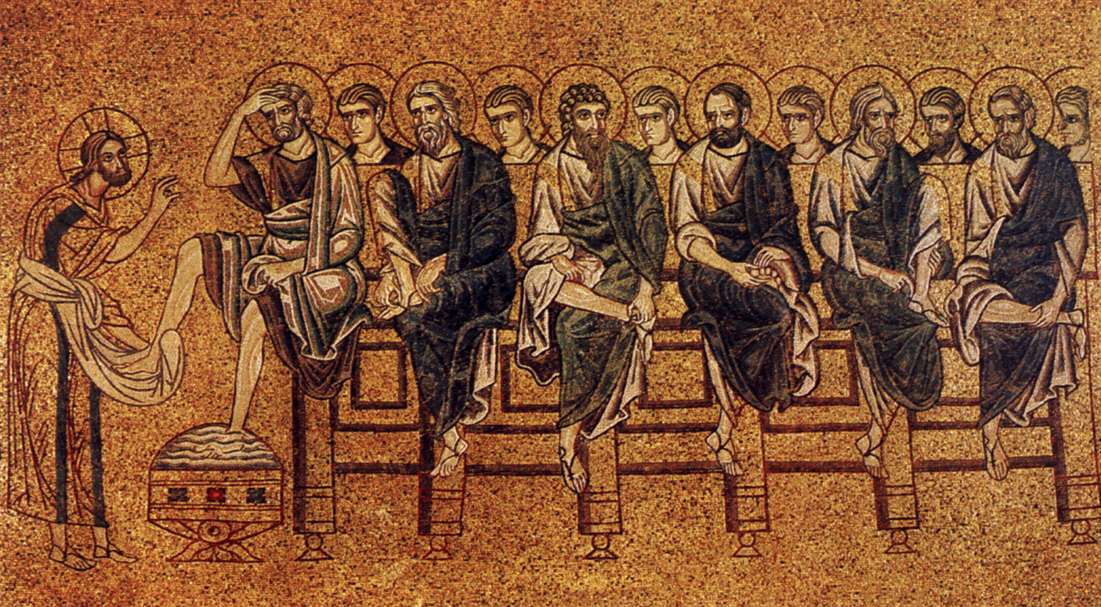
            Obedient to the Old Covenant, Our Lord and his disciples prepare to celebrate the Passover: the mystery of Israel’s deliverance from slavery in Egypt to the new life in the Promised Land. While they are at table Our Lord lays aside his outer garments and takes a basin and a towel and washes the Apostles’ feet. He says to them I have given you an example so that you may copy what I have done to you.
The new commandment given to the disciples by our Lord at the Last Supper in John's account is to love one another as he has loved us. The washing of the disciples’ feet is an act of loving service:  God who created the universe and who will redeem it kneels and washes the feet of sinful humanity. This is true love in action. . It is a gesture of humility and intimacy, which shows us how God loves us and how the events of the next few days will show us the depth of this love, a love which brings the entirety of the human race, past, present and future into a relationship with a loving God, through his sacrifice of himself upon the cross and through his bursting from the tomb
            But before this love is disclosed in our Lord’s Passion, Death and Resurrection, it is shown in loving service and humility, the Greek word for which is diakonia, which gives us our English word Deacon. All those who are ordained are set apart for the service of Almighty God and his church and we are all called to serve God and his people fashioning ourselves after the example of our Lord and Saviour Jesus Christ. All ordained Christian ministry is rooted in the diaconate, in a ministry of loving service, after the form and pattern of Our Lord and Saviour Jesus Christ, following HIS example and living it out in our lives. This is a most wonderful and humbling task which can fill us with both joy and fear and I would humbly ask that you continue to pray for me and for all of us who serve the church in this place, since we can do nothing without you.
            Christ then takes bread and wine and blesses them and gives them to his disciples. Again, this would look and feel like the Passover celebration to which they were accustomed. Except that before he broke and distributed the bread he said ‘Take, Eat. This is my body, which is given for you. Do this in remembrance of me.’ And before the Cup was distributed he said ‘Drink of it, all of you, for this is my blood of the new covenant, which is poured out for many for the forgiveness of sins. Do this, as often as you drink it, in remembrance of me.’ He feeds his disciples with his own body and blood to strengthen them, to show them what he is about to do for love of them and of the whole world. When, earlier in his public ministry, he has fed people he taught them in the synagogue at Capernaum ‘Truly, truly, I say to you, unless you eat the flesh of the Son of Man and drink his blood, you have no life in you. Whoever feeds on my flesh and drinks my blood has eternal life, and I will raise him up on the last day. For my flesh is true food, and my blood is true drink.  Whoever feeds on my flesh and drinks my blood abides in me, and I in him. As the living Father sent me, and I live because of the Father, so whoever feeds on me, he also will live because of me.’ (Jn 6:52–7 ESV). ‘Was ever another command so obeyed? For century after century, spreading slowly to every continent and country and among every race on earth, this action has been done, in every conceivable human circumstance, for every conceivable human need from infancy and before it to extreme old age and after it, ....  just to make the plebs sancta Dei—the holy common people of God’ [Dix The Shape of the Liturgy 744] Our Lord institutes the Eucharist, the Sacrament of His Body and Blood, to feed us, to nourish us, so that we may become what he is, that we may have a foretaste of heaven and the divine life of love, of the beatific vision of God, Father, Son, and Holy Spirit, the Holy, Eternal and Consubstantial Trinity. It re-presents, it makes present again, here and now, the sacrifice of Calvary, where upon the Altar of the Cross, as both priest and victim, Christ sacrifices himself for the sins of the whole world. He is the Lamb of God, foreshadowed in the ram offered by Abraham and Isaac, in the bread and wine offered by Melchisedek. In the blood and water which will flow from his side we are washed and creation is renewed. Christ gives the Church the Eucharist so that his saving work may continue, so that people may be given a pledge and token of their eternal life in him. It is loving service for our Lord to feed his disciples with his own body and blood. This the church was formed continue, offering the same sacrifice of Calvary at the altar, feeding His people with His Body and Blood, nourishing the church as a mother feeds her children, filling us with his love and grace, to transform our human nature through our sharing in the divine life of love. This is what priests and deacons are called to be, those who serve the people of God and nourish them with the word and sacrament, building up the body of Christ. We are to live exemplary lives of love, service, and prayer, which can serve as examples for the whole baptised people of God to copy and imitate in their own lives. This is a great, an awesome and wonderful task, for which we rely upon the grace of God's and the help and support of you, the people of God in this place. It is not something which we can do on our own, relying on our own abilities or strengths, but on God. For we all, as Christians, are called to love one and to serve one another in a variety of ways. In this we follow the example of Christ, who washes our feet, who institutes the Eucharist to feed us with himself, to transform our nature by his grace and bring about the full flowering of the kingdom of God. He sets his disciples apart, consecrating them to God, for a life of prayer and service and to carry on the sacrifice of Calvary through their offering of the Eucharist of the altars of his church, to feed his people. This is the glory of God: in transforming bread and wine into his very self for the life of the whole world – a sign of love and a pledge and foretaste of eternal life. This is love that we can touch and feel and taste – given for us so that we might have life in him.
            So then, let us prepare for Christ to wash our feet, as the blood and water which will flow from his side tomorrow on Calvary will wash away all the sins of humanity, let us be fed with his body and blood, which tomorrow he will offer upon the altar of the cross as both priest and victim, reconciling humanity and embracing a world with his loving arms as he is nailed to the wood. And let us follow his example, in living lives of prayer and loving service, supporting one another so that the world may believe and give praise to God the Father, God the Son, and God the Holy Spirit, to whom be ascribed as is most right and just, all might, majesty, glory dominion and power, now and forever. AMEN.

Sunday, 29 March 2015

Monday of Holy Week Reflection

Gospel
John 12:1-11

Judas really cannot understand why the myrrh is being lavished on Jesus. He doesn't care for the poor, he's looking for a chance to embezzle from the common fund. He's thinking about himself and about worldly things. Jesus enjoys the things of this world: he's having dinner with friends, he hangs around with all sorts and is accused of being a drunkard. He doesn't care a jot for social convention, for keeping up appearances. It's what on the inside that counts. He knows that Mary is acting out of love. As a costly extravagant act it points to his own death on the cross for love of us, wretches that we are. There is something wonderful and exuberant about divine generosity: it's over the top, it is lavish and excess - such is the love of God, who spared not his own son for love of us. That's how much God loves us. Can our response to that love be exuberant, or will we be like Judas: miserly, thinking of ourselves.

The Jews don't get it either. They can see an event: Jesus is news and so is Lazarus: celebrity culture is not a new thing. The Religious Authorities think it's all about power and influence: they don't get it either. They can only see a zero-sum game. They are concerned with things of this world and are unable to the Kingdom of God in their midst. It's always troubling when the church starts to look like the Pharisees: concerned with the things of this world, power, influence, courting popular opinion or popularity with politicians. Jesus has always had the ability to unsettle the powerful. They feel threatened by the freedom of the Kingdom, a freedom which sees Christ lay down his life freely. Such things can truly change the world. And they do. The Cross will show God's power in weakness, his love in rejection and humiliation. It's scandalous insofar as it turns the values of the world on their head. It announces and inaugurates the Kingdom of Christ: let us stay close to him, follow in his footsteps, and live his life by his rules, spurning the ways of the world to have life in all its fullness in Him.

Palm Sunday 2015


If anyone asks you why you are untying it [the ass the disciples were sent to find], this must be your answer, ‘The Lord has need of it’ (Lk 19:31). Perhaps no greater paradox was ever written than this – on the one hand the sovereignty of the Lord, and on the other hand his ‘need’. His combination of Divinity and dependence, of possession and poverty was a consequence of the Word becoming flesh. Truly, he who was rich became poor for our sakes, that we might become rich. Our Lord borrowed a boat from a fisherman from which to preach; he borrowed barley loaves and fishes from a boy to feed a multitude; he borrowed a grave from which he would rise; and now he borrows an ass on which to enter Jerusalem. Sometimes God pre-empts and requisitions the things of man, as if to remind him that everything is a gift from him.
Fulton J. Sheen Life of Christ

Pomp and ceremony seem to have been at the top of the agenda of late: in a week which saw the re-burial of the mortal remains of King Richard III, this is hardly surprising. As triumphant entries go, the one we see in the Gospel this morning is a bit strange: generally speaking, we are used to kings riding on horses, looking like powerful military leaders. Here we see something different, something which defies our expectations and which stops us seeing things in purely human terms.
          There are people who would ask, why all this fuss? Would Jesus have wanted it, would he want us to be carry on with it? If it were something which would not want us to do he would have said so. He did it because it was important, because it fulfilled prophesy and because liturgy is an important thing in and of itself: it marks out various things as special and helps us understand both who and what we are and what we do – it forms both habit and indeed our moral character.
          The crowd cry out “Hosanna to the Son of David! Blessed is he who comes in the name of the Lord! Hosanna in the highest!” (Mt 21:9 ESV) They cry out for God to save them, and that is exactly what he will do in a few days time, upon the Cross. This is a God who keeps his promises and defies our expectations. The crowd are expecting a king of the Davidic line, which would be seen as a challenge to the ruling elite, the status quo, but in Christ God gives Israel a King of the line of David forever. Those with power are threatened by him: he is awkward, an inconvenience. Jesus does not want their power, as he has come to be and do something completely different: what is taken as a political coup is a renewal of religion, the fulfilment of prophesy, and a new hope for Israel. 
In riding into Jerusalem Jesus is fulfilling the prophesies of Zechariah (9:9) and Isaiah (62:11).  The King of Israel comes riding on a donkey: a humble beast of burden, which carried his Mother to Bethlehem for his birth. It is an act of humble leadership which fulfils what was foreseen by the prophets. It shows us that Jesus Christ is truly the one who fulfils the hopes of Israel. The Hebrew Scriptures look forward to the deliverance of Israel, which is enacted in front of their very eyes.

Today and in the coming week we will see what God’s Love and Glory are really like: it is not what people expect, it is power shown in humility, strength in weakness. As we continue our Lenten journey in the triumph of this day and looking towards the Cross and beyond to the new life of Easter, let us trust in the Lord, let us be like him, and may he transform our hearts, our minds and our lives, so that they may have live and life in all its fullness. We are fed by the word of God and by the sacrament of His Body and Blood to be strengthened, to share in His divine life, to fit us for Heaven, and to transform all of creation that it may resound his praise and share in his life of the Resurrection, washed in His Blood and the saving waters of Baptism: forgiven and forgiving so that all that we say, or think, or do, all that we are may be for the praise of God the Father, God the Son, and God the Holy Spirit, to whom be ascribed as is most right and just, all might, majesty, glory dominion and power, now and forever…

Saturday, 21 March 2015

Homily for Lent V

During the Sermon on the Mount, Jesus reflects upon who and what he is and what he has come to do (Mt 5:17) “Do not think that I have come to abolish the Law or the Prophets; I have not come to abolish them but to fulfil them.” Christ comes to fulfil the law rather than to abolish it, and to inaugurate a new covenant in his blood which will flow from Calvary. This has been pointed to in Scripture: in the first reading this morning the prophet Jeremiah looks forward to a future covenant that will bring faithless sinful Isræl back to the Lord their God. They broke the covenant, they were unfaithful, and though they were married to the Lord their God, here we see not divorce but covenant faithfulness – it’s how God is, this is God’s love in action: self-giving, sacrificial, and costly. Christ fulfils Scripture – it finds its fullness and its true meaning in and through him, the Word of God made Flesh for our sake. God in Christ restores and heals that which was broken through human sinfulness: ‘But this is the covenant that I will make with the house of Isræl after those days, says the LORD: I will put my law within them, and I will write it on their hearts; and I will be their God, and they shall be my people’ Ours is a God who forgives our iniquities and forgives our sins through the New Covenant in Jesus’ blood.
       Jesus Christ is our great high priest: priests offer sacrifice for sin, as on Yom Kippur, the Jewish Day of Atonement where once the people were sprinkled with blood each and every year, whereas under the New Covenant, the covenant of grace rather than law, Christ the mediator of the new covenant sheds his own blood as both priest and victim to reconcile us with God. He is a priest after the order of Melchizedek, whose name means King of Righteousness, the King of Salem, better known as Jerusalem, brings out bread and wine, which point to the Eucharist, he is a priest of God Most High, before the priesthood of Aaron, the Levitical priesthood, so this is the true worship of Almighty God which points to Christ and finds its fulfilment in and through Him, who suffered for our sins.
In this morning’s Gospel some Greeks go up to Philip and say ‘Sir, we want to see Jesus’. They approach a disciple with a Greek name, and though they are not Jews themselves, they try to follow the law and to worship God. They are good people with an innate sense of the religious and they have a simple request: they want to see Jesus. Nearly 2000 years later there are people who will ask exactly the same question. What can be said to them? If they come to Mass on a Sunday morning, they will meet the Lord in Word and Sacrament. But will they also see Jesus in us Christians who are the body of Christ? We too are to be His presence in the world. Everything that we say, or think, or do, can proclaim Christ and his saving love to the world. It is our duty as Christians to try at all times and in every way to model our lives upon Christ’s, and by our sharing in his passion, death, and resurrection, to form our lives so that they may reflect his glory so that the world may believe. Each and every careless word and thoughtless action speaks to the world and says that we are hypocrites, who do not practice what we preach. We are perhaps judged more harshly nowadays than at any time before – ours is a world which does not know or understand forgiveness; but we should nonetheless try with all the strength we can muster to live Christ's life in the world.
       ‘Now the hour has come for the son of man to be glorified’ Jesus Christ is looking towards his passion and death. God shows the world the fullness of glory, the most profound expression of self-giving love in the events of his passion and death. This is why we celebrate it: week by week and year by year. We prepare ourselves during Lent to walk with Christ to Calvary and beyond. We see how much God loves us, how much God gives himself for us: totally, completely, utterly. If we serve Jesus we must follow him, and where we are he will be too. In the midst of the troubles which beset the church, Christ is with us. When we are afraid or troubled, Christ is with us, he has felt the same feelings as us, and was given the strength to carry on. When the church is written off as an irrelevance, Christ is with us.
       When secularism appears strong, we should remember our Lord’s words: ‘now sentence is being passed on this world; now the prince of this world is to be overthrown’. The World and the Devil are overcome in Christ’s self giving love, when on the cross he pays the debt which we cannot, he offers us a new way of living a life filled with love, a love so strong as to overcome death, a love which offers us eternal life.
       So then as we continue our journey through Lent our journey to the cross and beyond to the empty tomb of Easter, let us lose our lives in love and service of him who died for us, who bore our sins, who shows us how to live most fully, to be close to God, and filled with his love. Let us encourage one another, strengthen one another, and help each other to live lives which proclaim the truth of God’s saving love. All of us through our baptism share in Christ's death and resurrection and we should proclaim this truth to the world. This truth, this way, this life, overcomes the world, and turns its selfish values on their head. Together we can love and strengthen and encourage one another to do this together: to be Christ’s body in our love and service of one another, in our proclamation to the world that God loves all humanity and longs, like the father of the Prodigal Son, to embrace us, to welcome us back. And as we do this, growing in love and fellowship we will fulfil the will of God the Father, God the Son and God the Holy Spirit to whom be ascribed as is most right and just, all might, majesty, glory, dominion and power, now and forever... 

Sunday, 15 March 2015

Lent IV - Looking to the Cross

For God sent his Son into the world not to condemn the world, but that through him the world might be saved.

It is far too easy nowadays to see the church in a negative way –  it’s the fashionable thing to do – as the church we’re corrupt, we’re filling people’s heads with nonsense. We can be characterised as strange, quaint, and out of touch. It suits people to see us entirely in negative terms: as opposed to certain things. We are prescriptive: we limit people's freedom, and in failing to practice what we preach, we can be written off as hypocrites, with no right to proclaim objective truth, to offer the world a moral framework, within which to live its life; to offer the world an alternative paradigm, a new way of living and of being through which to have life, and have life in all its fullness. It’s less a valid criticism and more of an excuse for people not to bother. It’s an easy way out, which saves people from the more difficult task of living Christ-like lives of love and self-sacrifice. The church does not claim to be perfect, but rather a collection of sinners justified by the grace of God, through faith in Christ.
          The simple truth is that people like to moan and grumble – we all do, and I’m as guilty of it as anyone, but there is a fundamental difference between being dissatisfied with the way things are and longing for change, and hopefully bringing about good change, change in a god-ward direction, and the corrosive moaning rooted in selfishness, which betrays a lack of trust in God. The Israelites in the desert represent this negative moaning, they are unable or unwilling to trust God to lead them on a journey towards the Promised Land, and while they realise their mistake their poisonous moaning has disastrous consequences for them. And yet even in this they are not abandoned by God, they gaze on the bronze serpent, they look to that which prefigures the Cross, through which God heals his people, taking their sins upon himself. That’s why it appears in stained-glass windows in churches, because it points to the Cross, it’s why when talking about the Cross Jesus mentions it, so that people might understand how and why God loves them and how it might affect their lives.
St Paul in his letter to the Ephesians can state with confidence, ‘For by grace you have been saved through faith, and this is not your own doing; it is the gift of God – not the result of works, so that no one may boast(Eph 2:8-9). It’s not about what we can do, but about what God can do for us. Our relationship with God is the result of a gift, which we can receive and which can transform our lives, if we only let go, and let God…
          This morning’s gospel reminds us of the fundamental truth that God loves us – it is the heart of the Good News – the Gospel, what we preach and what we live as Christians. There are few words as comforting as ‘For God so loved the world that he gave his only Son, so that everyone who believes in him may not perish but may have eternal life. ‘Indeed, God did not send the Son into the world to condemn the world, but in order that the world might be saved through him’ (Jn 3:16-17). They may be familiar to us, they certainly should be, but we must not let our familiarity with them cloud the significance of simply stating that God loves us, does not condemn us, but saves us, in and through Jesus Christ. That’s why we are Christians, it’s why we’re here, and recognising God’s love for us will have a transforming effect upon our lives.
In the Incarnation Jesus comes among us as a poor helpless baby, laid to rest in the rough wood of an animals’ feeding trough. He is cared for through the love of his mother, the Blessed Virgin Mary, who in her love, her service, and obedience, stands as the model for all Christians to follow. She is the first Christian, the greatest, a pattern for us to imitate, of loving trust and obedience, of care and costly love, and a foreshadowing of our great mother the church, through which we are saved by grace through faith.
          Upon the rough wood of the cross, Jesus will suffer and die for us – such is the cost of human sin. His mother, Mary, stands by and watches and weeps. As the church we too should watch and weep for the wounds of human sin and division which still scar Christ's body. We feel helpless. What can we do? We should do all that we can to live God's life of sacrificial self giving love: living lives of light, which shine in the darkness. It isn’t easy, but if we try and do it together then all things are possible, through him who loves us.
          The salvation and eternal life which Christ offers freely to all, comes through the church, which we enter in baptism, where we are nourished in word and are sacrament, where we are nourished, given food for the journey, strengthened and taught, to live his risen life, to share in the joys of Easter.
          God cares so much about the world and its people that he takes flesh, and lives a life of love, amidst the messiness of humanity, to show us how to live lives filled with love, life in all its fullness. God in Christ comes among us not to condemn the world but to offer it a way of being, of being truly alive in Him. God has made us for himself, and our hearts are restless until they find their rest in him. The spiritual needs and searching which characterise people in the world around us can be satisfied in God and in God alone, through the church. We can rejoice, and relax our Lenten discipline for a little while to give thanks for the wonderful gift of God's love in our lives, in the church, and for the world.
          But we also need to trust God, to listen to what he says through Scripture, to be fed by him, and to live lives in accordance with his will and purpose, together, as a family, as a community of love, cared for and supported by our mother, the church. And in so doing we look to Our Lady as Mother of Our Lord and Mother of the Church, as a pattern for love and obedience, as a model for all mothers: loving and tender, putting the needs of others before self, self-giving, sacrificial, and open to both joy and pain, trusting in God.

This, as any mother can tell you, is not easy, it's difficult, really hard, but its rewards are likewise great. So let us, as we continue our Lenten journey towards the cross, where God shows his love for us most fully and completely, giving his body to be broken and his blood be shed for us, a sacrifice which will be made present here today under the outward forms of bread and wine, to strengthen us to live the risen life of Easter, to offer the world an alternative to selfishness, to self-centredness, to the sin which continues to separate us from God, an alternative shown to us in a self-giving love of mothers, and of our mother the church. So that we may join the Angels in our song of love and praise to the Trinity: Father, Son, and Holy Spirit, to whom..

Tuesday, 10 March 2015

A Thought for the Day from St Benedict

If we do not venture to approach men who are in power, except with humility and reverence, when we wish to ask a favor, how much must we beseech the Lord God of all things with all humility and purity of devotion? And let us be assured that it is not in many words, but in the purity of heart and tears of compunction that we are heard. For this reason prayer ought to be short and pure, unless, perhaps it is lengthened by the inspiration of divine grace. At the community exercises, however, let the prayer always be short, and the sign having been given by the Superior, let all rise together.

Sunday, 8 March 2015

Lent III Year B


Lent can feel something like a spiritual spring clean, and that’s no bad thing. We, all of us, need opportunities for repentance, to turn away from sin, and to return to the Lord Our God. In this morning’s Gospel we see Jesus in quite an uncompromising mood: this is no ‘Gentle Jesus, meek and mild’ but rather here is the righteous anger of the prophets, a sign that all is not well in the world.
            When Moses receives the Ten Commandments from God on Mt Sinai the first is ‘I am the Lord your God, who brought you out of the land of Egypt, out of the house of slavery; you shall have no other gods before me.’ Could it be that the temple traders in their desire to profit from people’s religious observance have broken this first commandment? The temptation to have power, to be concerned above all else with worldly things: money, power, success, and influence, are still a huge temptation for the Church and the world. We may not mean to, but we do, and while we think of God as loving and merciful, we forget about righteous anger, and our need to repent, to turn away from our sins – the desire to control others and to be so caught up on the ways of the world that we lose sight of who and what we are, and what we are supposed to do and be.
            The Jews demand a sign, and Christ prophesies that if they destroy this temple then he will raise it up in three days: he looks to his death and resurrection to show them where true worship lies – in the person of Jesus Christ. Christians should be concerned with a relationship, our relationship with God, and with each other. Likewise Christians can all too easily forget that Jesus said ‘I have come not to abolish the law and the prophets but to fulfill them’. The Ten Commandments are not abolished by Christ, or set aside, but rather his proclamation of the Kingdom and Repentance show us that we still need to live these out in our lives, to show that we honour God and live our lives accordingly. In his cleansing of the Temple Christ looks to the Cross and to the Resurrection, a stumbling-block to Jews, obsessed with the worship of the Temple, and foolishness to Gentiles who cannot believe that God could display such weakness, such powerlessness. Instead this supreme demonstration of God’s love for us, shocking and scandalous though it is, is a demonstration of the utter, complete, self-giving love of God, for the sake of you and me – miserable sinners who deserve condemnation, but who instead are offered love and mercy to heal us and restore us.
            When we are confronted with this we should be shocked – that God loves us enough to do this, to suffer and die for us, to save us from our sins, and from the punishment that is rightly ours. We do not deserve it, that’s the point. But we are offered it in Christ so that we might become something other than we are, putting away the ways of the world, of power and money, selfishness and sin, to have new life in and through Him.
            To live is to change and to be perfect is to have changed often. If we are changing into Jesus Christ, then we’re on the right track. If we listen to his word in Scripture; if we talk to him in prayer and let him talk to us; if we’re fed by Him and with Him in the Eucharist, by Christ who is both priest and victim, so that we might become what He is – God; if we’re forgiven by Him, through making confession of our sins, not only do we come to understand Jesus, we become like him, we come to share in his divine nature, you, me, all of humanity ideally. We, the People of God, the new humanity, enter into the divine fullness of life, we have a foretaste of the heavenly banquet – we are prepared to enter the new life of the Kingdom, and to live it.

            Lent should be something of a spiritual spring clean, asking God to drive out all that should not be there, preparing for the joy of Easter, to live the Risen Life, filled with God’s grace. In our baptism we died with Christ and were raised to new life in the Spirit. Let us prepare to live that life, holding fast to Our Lord and Saviour, clinging to the teachings of his body, the Church. Let us turn away from the folly of this world, the hot air, and focus on the true and everlasting joy of heaven, which awaits us, who are bought by his blood, washed in it, fed with it. Let us proclaim it in our lives so that others may believe so that all may praise the Father, the Son and the Holy Spirit, to whom be ascribed as is most right and just, all might, majesty, glory, dominion, and power, now and forever...