12 Put on then, as God's chosen ones, holy and beloved, compassionate hearts,kindness, humility, meekness, and patience,13 bearing with one another and, if one has a complaint against another, forgiving each other; as the Lord has forgiven you, so you also must forgive. 14 And above all these put on love, which binds everything together inperfect harmony. 15 And let the peace of Christ rule in your hearts, to which indeed you were called in one body. And be thankful. 16 Let the word of Christ dwell in you richly, teaching and admonishing one another in all wisdom, singing psalms and hymns and spiritual songs, with thankfulness in your hearts to God. 17 And whatever you do, in word or deed, do everything in the name of the Lord Jesus,giving thanks to God the Father through him.
Saturday, 28 February 2015

Sunday, 22 February 2015
Homily for Lent I
Saturday, 14 February 2015
A Thought for the Day from the Desert
Sunday, 8 February 2015
Sexagesima Year B

About 1700 years ago the passage from the Book of Proverbs which is the Old Testament Reading which we have just heard was at the centre of a theological controversy which threatened the nature and existence of Christianity as we know it. Arius, a priest of Alexandria used the passage ‘The Lord created me at the beginning of his work, the first of his acts of long ago. Ages ago I was set up, at the first, before the beginning of the earth. When there were no depths I was brought forth, when there were no springs abounding with water. Before the mountains had been shaped, before the hills, I was brought forth’ to prove that Wisdom, which was understood as the Logos, the Word of God, the Creative Intelligence was not pre-existent, that it was a creation, and that ‘there was a time when he was not’. He may have been attempting to uphold what he understood as monotheism and the supremacy of God the Father, but in so doing he threatened the very nature of Christianity itself: denying the eternal nature of the Son of God, seeing Him as a creature, something created, something less than God.
Sunday, 1 February 2015
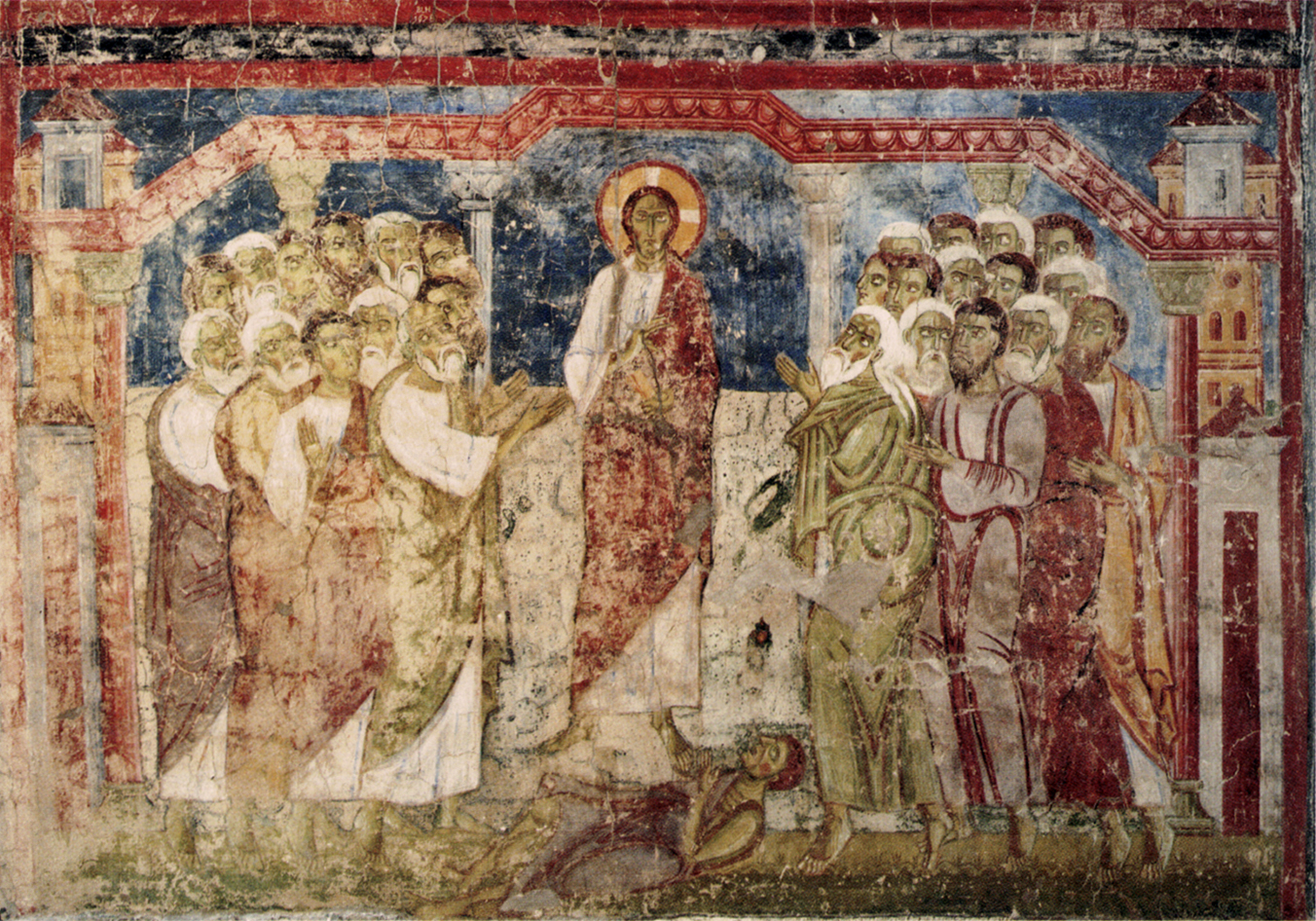
Jesus at the Synagogue in Capernaum
Sunday, 18 January 2015
Sermon for Evensong (2nd Sunday after Epiphany)
Epiphany II: John 1:43-51
Saturday, 17 January 2015
A Thought for the Day from S. Anthony the Great

The brethren came to the Abba Anthony and said to him, 'Speak a word; how are we to be saved?' The old man said to them, 'You have heard the Scriptures. That should teach you how.' But they said, 'We want to hear it from you too, Father.' Then the old man said to them, 'The Gospel says,"if anyone strikes you on the one cheek, turn to him the other also."' (Mt 5:39) They said, 'We cannot do that.' The old man said, 'If you cannot offer the other cheek, at least allow one cheek to be struck.' 'We cannot do that either,' they said. So he said, 'If you are not able to do that, do not return evil for evil,' and they said, 'We cannot do that either.' Then the old man said to his disciple, 'Prepare a little brew of corn for these invalids. If you cannot do this, or that, what can I do for you? What you need is prayers.'
It was revealed to Abba Anthony in his desert that there was one who was his equal in the city. He was a doctor by profession and whatever he had beyond his needs he gave to the poor, and every day he sang the Sanctus with the angels.
He also said, 'Our life and our death is with our neighbour. If we gain our brother, we have gained God, but if we scandalise our brother, we have sinned against Christ.'
Monday, 12 January 2015
A thought for the day from St Athanasius
Like many people I have found the images in CharlieHebdo which mock religion, and in particular Christianity, somewhat difficult and troubling. The following words of St Athanasius are, however, both a help and a comfort:
Come now, blessed one and true lover of Christ, let us, with the faith of our religion relate things concerning the Incarnation of the Word and expound his divine manifestation to us which the Jews slander and the Greeks mock, but which we ourselves venerate, so that all the more from his apparent degradation, you may have even greater and fuller piety towards him, for the more he is mocked by unbelievers by so much he provides a greater witness of his divinity, because what human beings cannot understand as impossible, these he shows to be possible (cf. Mt 19:26), and what human beings mock as unseemly, these he renders fitting by his own goodness, and what human beings through sophistry laugh at as merely human, these by his power he shows to be divine, overturning the illusion of idols by his own apparent degradation through the cross, invisibly persuading those who mock and disbelieve to recognise his divinity and his power.
Athanasius de Incarnatione Dei Verbi 1
tr. J. Behr (St Vladimir's Seminary Press : 2011)
Sunday, 4 January 2015
Christmas II
Wednesday, 24 December 2014
Homily for Christmas 'And the Word became flesh and dwelt among us'

|
I
|
Sunday, 21 December 2014
Advent IV Year B - Veni Emmanuel
Monday, 15 December 2014
A thought for the day from William of St Thierry
Sunday, 14 December 2014
Advent III - Rejoice
Sunday, 7 December 2014
Advent II Year B 'Repent the Kingdom is close at hand'
Saturday, 29 November 2014
Advent I Year B 'Be on your guard, stay awake, because you never know when the time will come'
|
T
|